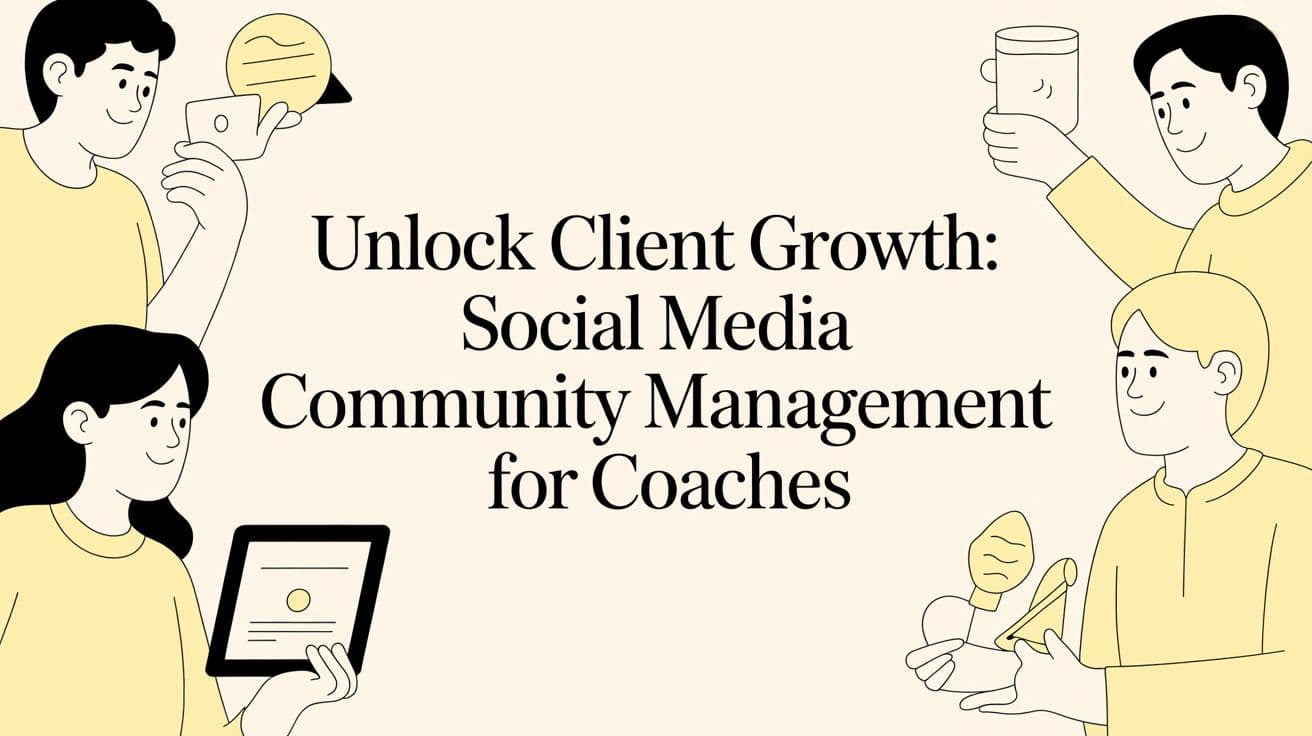
Unlock Client Growth: Social Media Community Management for Coaches

Coachful
Social media community management isn't just another box to check. It’s the art of building, engaging, and nurturing an online space centered around your coaching brand. You might be thinking, "But isn't that just posting on Instagram?" No, this isn't about just broadcasting your content; it's about fostering a genuine ecosystem where your clients feel seen, supported, and connected to one another. That connection is what truly deepens the value of your coaching, turning passive followers into life-long clients.
Move Beyond an Audience and Build a Thriving Community
Ever look at your follower count and wonder why it isn't translating into real connection or business growth? It’s a common frustration. You pour your energy into creating valuable content, sharing insights, and responding to comments, but it still feels like you're shouting into the void. The gap between having an audience and building a true community is where so many coaches get stuck.
You're probably asking yourself, "I'm already swamped. Is this really worth my time?" It's a fair question. The idea of adding another major task to your plate can feel overwhelming. But this is more than a task—it's a mindset shift. It's about moving from being a 'content creator' to a 'community leader,' and that shift is the key to unlocking sustainable growth for your practice. It's the difference between chasing clients and attracting them effortlessly.
From Silent Followers to Raving Fans
Here's the fundamental difference you need to grasp: an audience consumes your content, but a community co-creates value right alongside you. It's the difference between people passively watching your videos and people actively jumping into discussions, supporting each other's goals, and becoming true advocates for what you do.
Imagine this: a client posts in your group about struggling to stay motivated. Before you even have a chance to reply, three other members jump in with encouragement and what worked for them. That’s the magic. When this happens, you’ll see some incredible results:
- Deeper Accountability: Members start holding each other accountable, extending the impact of your coaching sessions well beyond your one-on-one time. A member of a fitness coach's community might post, "I'm committing to my 3 workouts this week!" and get immediate cheerleading from others.
- Increased Retention: Clients who feel like they belong to a supportive group are far more likely to stick with your programs long-term. They're not just paying for your expertise; they're invested in the relationships they've built.
- Powerful Referrals: A vibrant community naturally becomes a referral engine as members share their positive experiences with their own networks. Think about it: when a member says, "You have to join this group, it changed everything for me," that's the most powerful marketing you could ever ask for.
The numbers absolutely back this up. In 2026, building a community has become a proven loyalty driver, with a staggering 76% of consumers reporting they are more loyal to brands that actively nurture these spaces. And while there are over 5.17 billion social media users globally, the real power isn't in reaching all of them. It's about quality engagement. Having 1,000 deeply engaged fans is infinitely more valuable than having 10,000 silent followers.
A community transforms your coaching practice from a one-to-many broadcast into a many-to-many network of support. It turns your brand from a service you provide into a space where clients belong.
The True Return on Your Time
You're probably thinking, "This sounds great, but I don't have more time." Building a community isn't about spending more hours online; it's about investing your time more strategically. Instead of just pushing out content, you're facilitating connections that start to do the heavy lifting for you. Suddenly, you're no longer the sole source of value—the community itself becomes a primary benefit of working with you. This shift is what turns passive lurkers into your most active participants. For a deeper dive into this, check out this great resource on Mastering Social Media Community Engagement for Your Brand.
This approach creates an environment where clients feel deeply connected to your brand and, just as importantly, to each other. Imagine a new client joining your program and being instantly welcomed into a vibrant, supportive group. Their experience is elevated from day one. If you're ready to start laying the groundwork, take a look at our complete guide on building an online community. This is how you stop chasing follower numbers and start building a brand that attracts and keeps clients effortlessly.
2. Where Will Your Community Actually Live? Picking Your Platform
I’ve seen it countless times: a coach gets excited about building a community, tries to be on Facebook, Instagram, and LinkedIn, and ends up spread so thin that none of them take off. The indecision is real. You're thinking, "Should I be on Facebook? Is Discord the new thing? Am I missing out if I'm not on LinkedIn?" Stop. The answer isn’t to be everywhere. It’s to be exactly where your ideal clients already are.
Choosing your platform is one of the most critical decisions you'll make. It sets the entire tone for your community. Think about it—a business coach building a network of C-suite executives is going to have a much better time on a LinkedIn Group than a casual Facebook Group. On the flip side, a wellness coach who uses visual storytelling will find a much more receptive audience on Instagram.
Go Where Your People Are, Not Where It’s Popular
You need to put on your client's hat for a minute. Seriously, ask yourself the tough questions and be brutally honest.
"Will my executive clients really hang out in a Facebook group?" Let's be honest, probably not. Their online time is likely focused on professional development and industry news, making LinkedIn their natural habitat. They check it between meetings; they're not scrolling through vacation photos.
Or, "Is a Discord server just too complicated for my audience of retirees learning a new hobby?" If you're forcing a non-tech-savvy group onto a platform built for gamers, you’re creating barriers. The whole point is to make it easy for them to connect, not make them feel incompetent before they even start.
This is the fundamental choice you're making. Are you building a space that will buzz with activity, or one that will end up with silent followers?
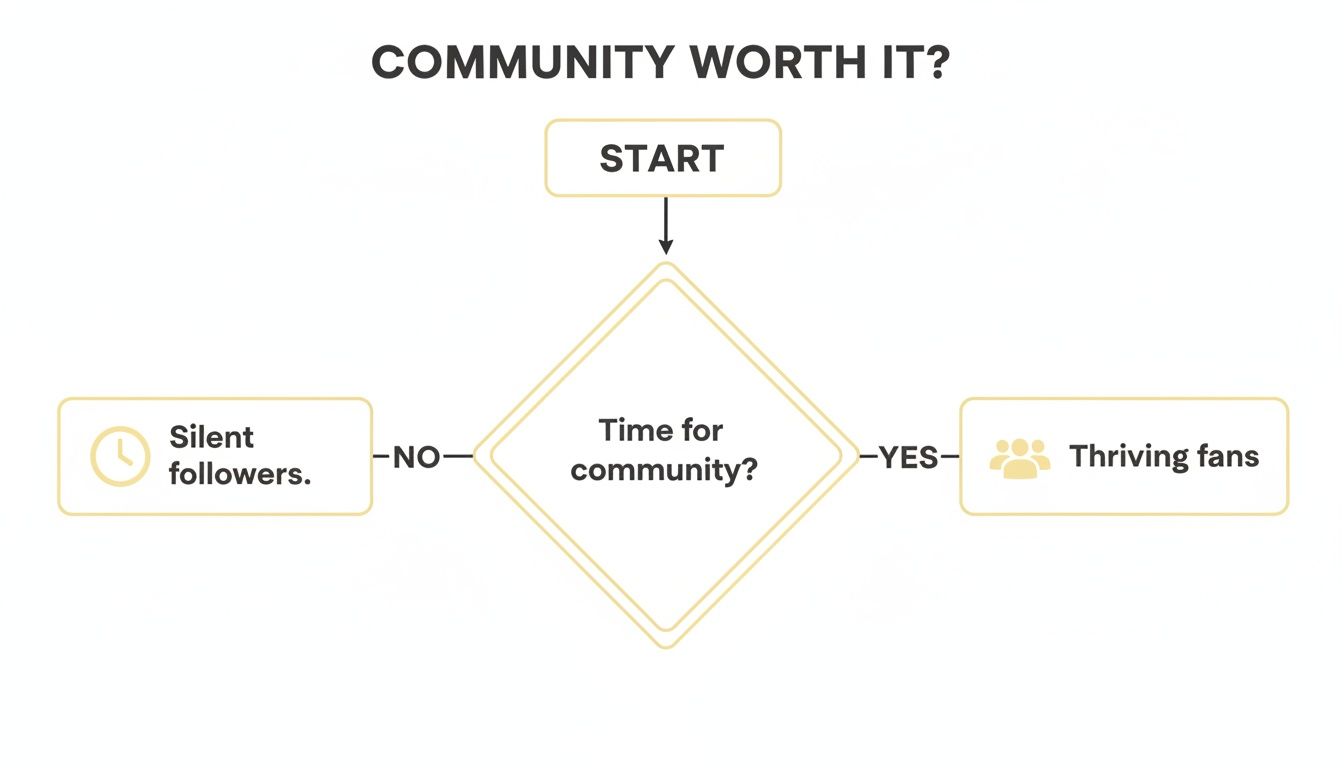
Creating a community of thriving fans doesn’t happen by accident. It's a direct result of investing your time and energy in the right place.
The Platform Selection Matrix for Coaches
To help you decide, let's break down the most popular options. I've put together this quick-reference table to match platforms with different coaching styles and client types. This isn't about finding a single "best" platform, but the best one for you.
| Platform | Best For (Coaching Niche) | Typical Client Profile | Key Engagement Features | Potential Pitfalls |
|---|---|---|---|---|
| Facebook Groups | Life, Wellness, Hobby, Parent Coaching | Broad; B2C focused; values peer support | Live video, events, polls, topic tags, dedicated posts | Can feel crowded; organic reach is declining |
| LinkedIn Groups | Career, Business, Executive, B2B Coaching | Professionals, entrepreneurs, industry leaders | Articles, professional networking, shared documents | Slower-paced engagement; less casual interaction |
| Wellness, Fitness, Creative, Brand Coaching | Visual learners; younger demographics (18-34); lifestyle-focused | Reels, Stories w/ Q&A stickers, Live, collaborative posts | Less suited for deep, threaded conversations | |
| Discord | Tech, Gaming, Creator, Financial Coaching (for younger clients) | Tech-savvy; community-oriented; Gen Z/Millennials | Voice/video channels, text chat, highly customizable roles | Steeper learning curve; can feel chaotic if not well-managed |
| Slack | High-ticket Masterminds, Corporate Coaching, Tech | Teams, professionals in tech/startups | Threaded conversations, app integrations, dedicated channels | Can feel like "work"; less discoverability; often paid |
Each of these has its own unique culture and set of tools. The goal is to find the environment where your specific clients will feel most comfortable and engaged.
What Kind of Vibe Are You Going For?
Beyond just demographics, consider the type of interaction you want to encourage.
Deep Dives & Discussion: If you imagine members sharing long-form posts, asking detailed questions, and sharing resources, a Facebook Group or LinkedIn Group is your best bet. Their structure is built for threaded, text-heavy conversations. A career coach, for instance, would benefit from members sharing their resume drafts for feedback in a LinkedIn Group.
Quick Hits & Inspiration: For more visual, in-the-moment engagement, Instagram is king. Use Stories for quick Q&As ("What's your biggest block this week?") and Reels for bite-sized, motivational content. A fitness coach could use Stories to post a quick 5-minute warm-up that members can do together.
Real-Time & Niche: If your clients are digital natives and you want a space for instant chat, voice calls, and a highly organized, almost clubhouse-like feel, Discord is a fantastic option. A financial coach for Gen Z could have channels for #stock-talk, #crypto-news, and #saving-wins.
The right platform isn’t the trendiest one. It’s the one that feels like a natural home for your clients and a seamless extension of your coaching.
Thinking this through also helps you plan how your community fits into your business model. For many coaches, the community is a key benefit of a paid program. If that's your plan, it's worth learning more about building a membership website to see how all the pieces connect.
Ultimately, pick one platform (two at the absolute most) and go all in. When you focus your energy, you can build a community with real depth and connection—one that delivers massive value for your clients and becomes a cornerstone of your coaching business.
Design Your Community Onboarding Experience
Alright, you've picked your platform. But what happens next? We’ve all been there: staring at a brand-new, empty group, the digital silence almost deafening. The big question is, how do you transform this blank slate into a vibrant, buzzing space where people feel instantly welcome? That inner voice might be saying, "What if I invite everyone and no one says anything?"
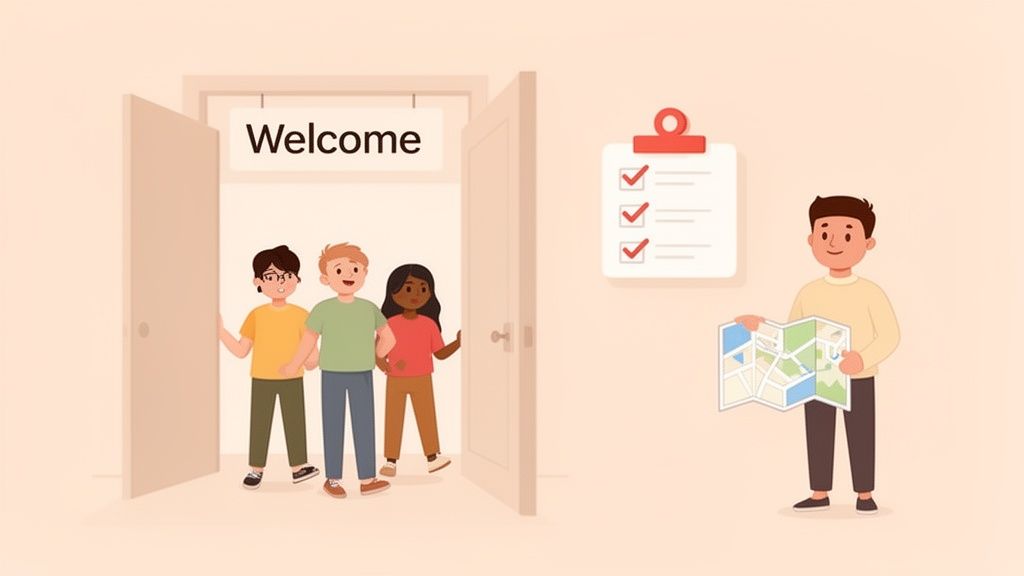
That transformation starts with a thoughtfully designed onboarding experience. A new member’s first few moments are critical. This is your chance to make them feel seen, guide them toward their first interaction, and set the cultural tone for everything that follows. It's how you prevent your community from becoming a ghost town.
First, Establish Your Community Guidelines
Before you even think about inviting your first member, you need to set the rules of the road. This isn't about being overly strict; it's about proactively creating a safe, respectful, and productive space where everyone can thrive. Think of these guidelines as the constitution of your new digital nation. You might be worried about sounding like a principal, but clear rules make good people feel safe, not restricted.
Keep them simple, frame them positively, and make them impossible to miss. Pin them right at the top of your group or feature them prominently in all your welcome materials.
Example of Positive Framing:
- Instead of "Don't post spam," try "Keep it Value-Focused: No Unsolicited Promotions."
- Instead of "Don't be a jerk," try "Lead with Kindness and Respect."
From my experience, a few guidelines are non-negotiable for a healthy community:
- Be Kind and Courteous: This is the baseline for all interactions. It sounds simple, but it sets a powerful precedent.
- No Hate Speech or Bullying: Make it crystal clear that your community is a zero-tolerance zone for harassment.
- No Promotions or Spam: Protect your members' feeds (and your sanity) from unsolicited sales pitches.
- Respect Everyone's Privacy: This is absolutely essential for building trust, especially when coaching on sensitive topics.
Having these rules in place from day one empowers you to moderate with confidence and shows members that you’re serious about protecting the integrity of the space.
Craft a Compelling Welcome Sequence
That first welcome message is your digital handshake. It needs to be warm, enthusiastic, and genuinely helpful. This isn't just a simple "hello"—it's a strategic move to kickstart engagement.
Don't just post a generic "Welcome to the group!" Instead, design a sequence that pulls new members into the conversation. Many of the same ideas for crafting a great welcome message for a website apply here, so it’s worth a read for inspiration.
A strong welcome post should do three things right away: make members feel seen, tell them what to do next, and point them to key resources.
Example Welcome Post for a Business Coach's Group:
"🎉 So excited to have you here, [New Member Name]! Welcome to The Accelerator Hub. We're a community of founders dedicated to growing without burning out.
To get started, drop a comment below and tell us the #1 goal you're hoping to crush in the next 90 days. Let's get some accountability from day one!
And don't forget to check out our pinned 'Start Here' post—it has links to our resource library and weekly call schedule. Welcome to the crew!"
This simple prompt works wonders because it gives them a clear, low-effort way to engage. In 2026, engagement is the only metric that truly matters. With 5.66 billion active social media users, the old model of chasing vanity metrics is dead. Having 1,000 highly engaged superfans is infinitely more valuable than 10,000 silent followers. This shift is redefining how coaches build thriving online tribes. You can see more on this trend and how micro-communities are taking over by checking out these insights about social media trends on mmmake.com.
Your onboarding isn't just about sharing information; it’s about creating momentum. The goal is to guide every new member from "I'm new here" to "I belong here" as quickly and smoothly as possible.
Get this part right, and you're not just building a group—you're laying the foundation for a true community hub that delivers real value and keeps members coming back.
Finding Your Content and Engagement Rhythm
Let’s talk about the single biggest fear that stops most coaches from even starting a community: "What on earth am I going to post every single day? I'll run out of ideas in a week!"
It's a valid concern. The thought of constantly being "on" and churning out new content is exhausting. But here’s the secret: a great community isn't built on a firehose of brand-new, mind-blowing posts from you. It’s built on a sustainable, predictable rhythm of connection and conversation.
Your job isn't to be a content machine. It's to be the host of a great party, making sure everyone has a drink and feels included in the conversation.
Establish Your Content Pillars
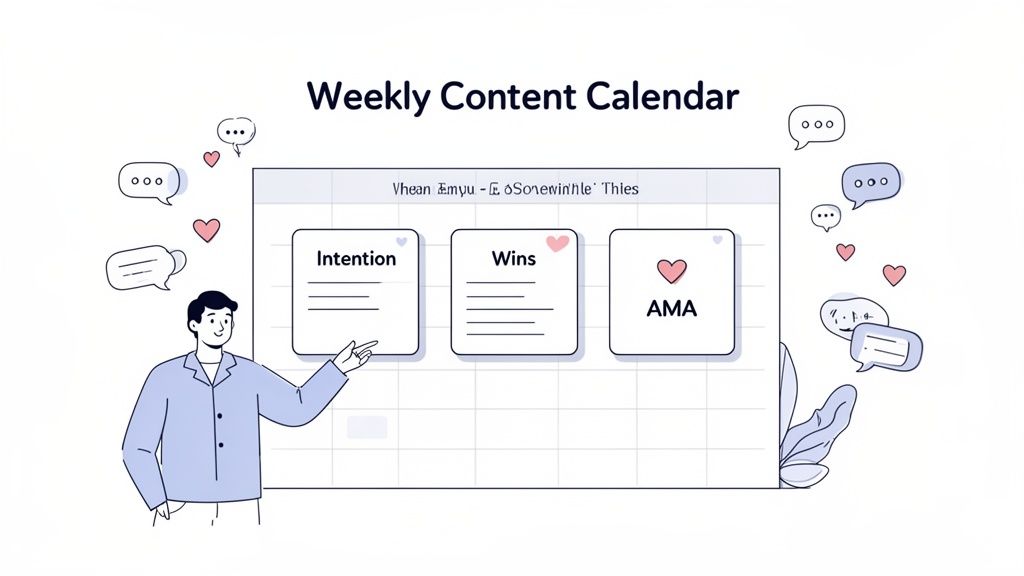
Instead of facing a blank page every morning, you need content pillars. These are simply 3-5 recurring themes that anchor your weekly schedule. They provide structure, make content creation almost effortless, and give your members specific reasons to check in on certain days.
Think of them as the steady heartbeat of your community. They should be simple, engaging, and tied directly to the transformation your clients are working toward.
Here are a few powerful pillars I’ve seen work wonders in coaching communities:
- Intention-Setting Mondays: Kick off the week with focus. Ask members to share one small, achievable goal they’re committing to. Example: "Happy Monday! What's the ONE thing you'll do this week to move the needle? No goal is too small!"
- Tool-Share Tuesdays: Share a single resource that's helped you—a book, a podcast, an app, or a simple productivity hack. Then, open the floor for members to share their own discoveries.
- Wins Wednesdays: This is non-negotiable. Create a dedicated space for members to celebrate progress, no matter how small. Acknowledge and cheer on every single win. Example: "It's Wins Wednesday! Share a win from your week—professional or personal. Did you land a client? Did you finally clean your desk? Let's celebrate it all!"
- Thought-Provoking Thursdays: Post a powerful, open-ended question related to your coaching niche. The goal isn’t for you to provide the answer, but to spark a genuine discussion among members.
- AMA Fridays: Host a weekly "Ask Me Anything." This can be a live video or just a simple text-based thread where members can get your direct input. It’s an amazing way to reinforce your expertise and build trust.
This kind of structured approach to social media community management eliminates the daily guesswork. It turns content from a dreaded chore into a simple, repeatable system.
The Art of the Powerful Question
The biggest mistake I see coaches make is feeling like they have to be the sole expert, the sage on the stage. Your real power as a community leader is in being the best facilitator. The easiest way to step into that role is by mastering the art of the powerful question.
A great question sparks curiosity and, more importantly, invites member-to-member interaction. It gracefully shifts the spotlight from you to them.
Let’s look at the difference.
- A weak question: "What are your goals?" (Too broad, feels like homework, and gets crickets).
- A powerful question: "What's one thing you're procrastinating on this week that, if you did it, would change everything?" (Specific, emotional, and instantly relatable).
Here's another one for a wellness coach:
- A weak question: "Do you exercise?" (A yes/no answer that goes nowhere).
- A powerful question: "What's a form of movement that feels less like a 'workout' and more like 'play' to you right now?" (Invites personal stories, discovery, and new ideas).
The quality of your community is directly proportional to the quality of the questions you ask. Your goal isn't to have all the answers; it's to spark the conversations that help members find their own.
Repurpose with Purpose
You're thinking, "This is great, but where do the ideas for these powerful questions come from?" Believe it or not, you are already sitting on a goldmine of content: your coaching sessions. The themes, struggles, and breakthroughs that surface in your one-on-one or group calls are the exact topics your community is hungry to discuss.
Ethically repurposing these insights is a cornerstone of sustainable social media community management.
Here’s how you do it without ever breaking client confidentiality:
- Isolate the Universal Theme: In a coaching call, a client has a major breakthrough about overcoming self-doubt. The theme here is "imposter syndrome," not the client's specific, personal story.
- Generalize the Problem: Take that specific situation and frame it as a universal question for the group. Instead of mentioning your client, you post: "Let's talk about that little voice that says 'you're not qualified.' When does it get loudest for you, and what's one thing you've learned to do to quiet it?"
- Share a Framework: You can then follow up by sharing the general framework or tool you used to help that client, presenting it as a helpful tip for everyone in the community.
This simple method allows you to create deeply relevant, potent content that resonates because it’s grounded in the real-world problems your clients are facing—all without ever compromising their privacy.
Moderate Your Community and Measure What Matters
Every coach I know who starts a community has two big worries that keep them up at night. First: "What if this whole thing turns negative, spammy, or just plain weird?" And second: "How will I even know if this is working?"
If that sounds familiar, you're in good company. You've poured your energy into creating a valuable, positive space, and the idea of it going sideways is genuinely scary. On top of that, your time is your most valuable asset, and you need to know this investment is paying off. Let's walk through how to handle both.
Protecting Your Positive Culture
Here's a secret: great moderation isn't about being a heavy-handed enforcer. It’s about being a consistent guardian of the culture you want to build. Your inaction is also a form of action.
When you let things slide—a little spam here, an off-topic promotion there—you’re silently telling your members that the rules don't really matter. That’s how trust dies and your best, most engaged members start to fade away.
Here’s a simple, firm-but-fair way to handle those tricky moments:
When someone posts off-topic self-promo: You see a member drop a link to their own program in the main feed. Your instinct might be to just delete it. Don't. First, send them a quick, private message. Something like: "Hey [Name], thanks for being an active part of the group! Just a quick heads-up, we try to keep the main feed clear of promotions so it stays focused on our conversations here. We have a thread for that on Fridays if you'd like to share there! Appreciate you understanding!" Then, you can delete the post. It’s respectful, it educates, and it reinforces the rules without public shaming.
When a comment is negative or unhelpful: Someone leaves a cynical or dismissive reply on another member’s vulnerable share. This is your moment to protect your people. Delete the comment immediately. Then, follow up with a firm, private DM: "Hi [Name], I've removed your recent comment. We're committed to keeping this a supportive and encouraging space, and your comment didn't align with our community guidelines."
You don't need to get into a drawn-out debate. You're simply upholding the standards you've set for the group. For some platforms, getting good at role management and Discord security can also give you powerful tools to automate some of this and keep things running smoothly.
Measuring What Truly Matters
Now, for that second nagging question: "Is this actually working?" It is so easy to fall into the trap of tracking vanity metrics. Member count and post 'likes' feel good, but they don't tell you if your community is truly healthy or helping your business.
We need to look at the numbers that signal genuine connection and tie directly back to your business goals. This is how you prove that your social media community management is an essential part of your coaching practice, not just a time-consuming hobby.
The goal isn't just to be active; it's to be accountable. Stop tracking vanity metrics and start measuring the numbers that prove your community is creating real business value.
So, what should you track instead?
- Comment-to-Post Ratio: This is a huge one. Lots of comments on a post mean you're sparking real dialogue, not just shouting into the void. Example: If your post gets 10 likes but 15 comments, that's a huge win. It shows people are talking to each other.
- Member-Initiated Discussions: Are members starting their own threads without you prompting them? That's the holy grail—a sign your community is becoming a self-sustaining ecosystem. Keep a weekly tally of how many discussions are started by members versus you.
- Direct Mentions: This is qualitative data, and it's pure gold. When a client says on a call, "I got so much out of that discussion in the group this week," write it down. Keep a simple log of these wins. This is your "proof of impact" file.
The final piece of the puzzle is connecting this activity to real business outcomes. For example, you can start tracking how many of your most active community members eventually upgrade to a higher-tier package or buy a new offer.
When a new client signs up for your mastermind, make it a habit to ask what role the free community played in their decision. This is how you move from "running a group" to nurturing a powerful asset that drives client success and grows your bottom line.
Your Top Community Questions, Answered
Once the strategy is set and your community is live, the real work begins. It’s here, in the day-to-day interactions, that the most pressing questions pop up. Let's get into the nitty-gritty questions I hear from coaches all the time—the ones you’re probably thinking about right now.
How Much Time Does This Really Take Each Week?
"I'm already working 50-hour weeks. How can I possibly add this without burning out?"
This is, without a doubt, the number one fear I see. And it's completely valid. The answer isn't about working harder; it's about working smarter. Great community management is about consistency, not constant presence.
Believe it or not, you can run a vibrant and engaged community in just 2-4 hours per week. The key is to have a system.
Here's a simple, sustainable approach:
- Batch Your Content: Spend an hour on Sunday or Monday to plan and schedule the week's core posts. Line them up with your content pillars so you're not just staring at a blank screen. This is a non-negotiable.
- Use Engagement Pockets: Instead of letting notifications run your day, schedule two 15-minute blocks to check in. I do one in the morning with my coffee and one in the afternoon. That's it. You reply to comments, welcome new folks, and then you're out. Resist the urge to check constantly.
- Host 'Office Hours': Train your members by being predictably available. Announce that you'll be live for a Q&A every Thursday at noon. This concentrates engagement and respects your own boundaries.
This isn’t about being online 24/7. It's about being present and impactful when you are.
What Do I Do With a Difficult Member?
"What if someone starts arguments, posts spam, or just brings a negative vibe? I don't want to be the bad guy."
Protecting the culture of your group is one of your most critical jobs. A safe, positive space is a non-negotiable, and your members are trusting you to keep it that way. Don't worry about being the "bad guy"—worry about failing the members who follow the rules.
I've always relied on a straightforward "Warn, Delete, Remove" framework. It’s fair, firm, and takes the emotion out of it.
- Private Warning: The first time someone breaks a rule (like posting unauthorized self-promo), shoot them a polite but direct private message. Reference the specific guideline they missed. Always assume it was an honest mistake first. Example DM: "Hey Mark, quick heads up - I had to remove your post with the link to your site. As per our community guidelines, we keep the main feed free of promotions. Appreciate you understanding!"
- Delete the Post: Immediately after sending the DM, remove the post or comment in question. This keeps the community feed clean and high-quality for everyone else.
- Firm Removal: If they ignore your warning and do it again, remove them. No drama, no long back-and-forth. You gave them a chance, and now your priority has to be the health of the community as a whole.
Strong leadership isn't about being liked by everyone. It's about earning the trust of the members who are there for the right reasons. Acting decisively shows you’re serious about building a quality space.
How Do I Get Quiet Members to Participate?
"I have a bunch of members who never post or comment. How do I get them involved without being pushy?"
First off, it's totally normal for a large chunk of your community to be "lurkers." Many people join just to listen and learn, and that's okay! Your job isn't to force them to talk but to create easy, low-stakes opportunities for them to join in when they're ready.
- Polls are your best friend. Seriously. A simple "This or That?" poll or a multiple-choice question is the easiest way for someone to participate with a single click. Example: "Quick poll: What's harder for you? A) Starting a new project B) Finishing the last 10%."
- Tag new members personally. In a weekly welcome thread, tag a few new faces and ask a fun, non-intimidating question. "What's one thing you're excited about this month?" works way better than "Introduce yourself!"
- Celebrate the small things. When a quiet member finally chimes in with a comment, acknowledge it. A simple, "That's a great point, Jane! So glad you shared that." can be all the encouragement they need to speak up again.
Should I Offer Exclusive Content in the Community?
"Is it enough just to have conversations, or do I need to give them something extra to justify them being there?"
Yes, 100%. To make your community a must-visit destination, it needs to offer something people can't get from your public Instagram or newsletter. This is what creates real value and gives people a powerful reason to not only join but to stick around.
"Exclusive" doesn't have to mean "time-consuming."
- Quick behind-the-scenes videos: A raw, unpolished phone video sharing a quick thought or a weekly win. Example: "Just got off a great client call and had a thought I needed to share with you all..."
- Simple downloadable resources: Think checklists, templates, or a single-page worksheet that complements your coaching. Example: "I mentioned my 'Weekly Reset' process on our call, here's the exact checklist I use. Hope it helps!"
- Early bird access: Give community members the first shot at enrolling in new workshops or grabbing a spot on your calendar. This is a simple, powerful way to reward them.
This simple act of generosity rewards your most engaged followers and makes them feel like true insiders.
Ready to bring all your coaching workflows—from client onboarding to community touchpoints—into one seamless platform? Coachful is designed to help you organize your programs, deepen client accountability, and free up more time for the work that matters most. See how you can deliver consistent results and grow your practice by visiting the Coachful website.