Your Guide to Transformation Life Coaching in 2026

Coachful
When you first get into coaching, it’s easy to think it's all about setting goals and creating action plans. You help a client get from Point A to Point B. Simple, right? But what if you're feeling that nagging sense that something is missing? What if the real work isn't about the destination, but about transforming the person making the journey?
That’s the heart of transformation life coaching. It's a fundamental shift in perspective that moves beyond surface-level achievements and into the realm of profound, identity-level change.
What Is Transformation Life Coaching Really
So, is "transformation life coaching" just another buzzword? You're right to be skeptical. The short answer is no. This isn't just a new label; it represents a completely different way of thinking about change, moving from transactional to transformational.
Think of it this way: traditional coaching can feel like a GPS. It gives your client the most efficient, turn-by-turn route to a specific goal, like launching a business or getting a promotion. It’s strategic, effective, and focused on doing.
Transformation coaching, on the other hand, is less like a GPS and more like teaching your client how to read a map, understand the terrain, and use a compass. You’re empowering them with the skills to navigate any journey, long after their sessions with you are over.
The core idea is that lasting external change only happens after a profound internal shift. You're not just helping a client achieve something; you're guiding them to upgrade their entire inner operating system.
From External Goals to Internal Identity
Let’s get practical. Imagine a new client wants to lose weight—a classic coaching goal.
A purely goal-based approach would probably involve meal plans, workout schedules, and weekly check-ins. A transformation coach, however, starts by digging into the identity that drives the client's behavior. You might be thinking, "But how do I even start that conversation?"
Instead of asking, "What's your target weight?" you might ask:
- "Who do you want to become in this process?"
- "What would it feel like to be someone who feels powerful and energized in their body?"
See the difference? The focus shifts from a number on a scale to a powerful change in self-perception. You work with your client to dismantle limiting beliefs like "I'm just not a healthy person" and help them build a new identity rooted in self-worth and vitality. The weight loss becomes a natural outcome of who they are becoming, not just a difficult task they have to complete.
If you're interested in exploring this further, our article on what is transformational coaching dives even deeper into these core distinctions.
A Growing Demand for Deeper Change
This deeper approach isn’t just a coaching philosophy; it’s meeting a very real need in the market. The life coaching industry is booming, with the U.S. market alone valued at an estimated $2.06 billion in 2025.
What does this growth tell us? People are looking for more than just quick fixes. They’re hungry for meaningful personal development that creates lasting change, and they’re willing to invest in it. This means your instinct to go deeper isn't just a personal preference—it's a massive business opportunity.
Ultimately, transformation life coaching is about facilitating a change in being, not just doing. It’s about guiding a client to rewrite the fundamental stories they tell themselves, which creates a ripple effect across every area of their life. You’re not just helping them cross a river; you’re teaching them how to build their own bridges.
The Core Principles Driving Deep Client Change
If you're a coach, a little voice might be piping up right now: "This all sounds great, but what do I actually do differently in a session? Isn't this just a fancier way of setting goals?"
It’s a fair question, and the answer gets to the very heart of what makes this work so powerful. Transformation life coaching isn't about simply chasing the 'what' and 'how' of a client's goals. It’s about digging down to the foundational 'why' that fuels their every desire.
You shift from being just an accountability partner to something more profound. Think of yourself as a guide helping your client see the invisible scripts that have been running their life on autopilot, and then handing them the pen to write a new story.
Moving Beyond S.M.A.R.T. Goals to Core Motivations
Most of us were trained on S.M.A.R.T. goals (Specific, Measurable, Achievable, Relevant, Time-bound). They’re fantastic for managing tasks and projects, but when it comes to deep personal change, they can fall short by only scratching the surface.
Transformation life coaching dares to go deeper.
Imagine a client comes to you and says, “I want a promotion.”
- A traditional approach: You'd likely jump into action mode—polishing their resume, running mock interviews, and mapping out a networking strategy. These are the actions.
- A transformational approach: You’d start with a simple, powerful question: “What will that promotion give you that you feel you’re missing now?” The client might think for a moment and say, “Respect.” You gently probe again: “And what would having that respect mean to you? How would it feel?” Maybe they reply, “It would finally mean that I’m valued and competent.”
And there it is. The goal was never the new job title. The real, underlying need is to feel valued and competent. This is the 'why'—a breakthrough insight that reframes everything. Now, your work together can focus on building that sense of internal worth, a change that will not only supercharge their career goals but also ripple positively into every other part of their life.
Creating a Safe Harbor for Vulnerability
You can't ask someone to explore their deepest beliefs without first building a space of absolute psychological safety. A client's inner world is sacred ground. Your most important job is to create an environment where they feel safe enough to be completely vulnerable, perhaps for the very first time.
This goes way beyond just being a good listener. It’s about actively practicing non-judgment, holding space for messy emotions without an agenda to "fix" them, and reflecting your client's own wisdom back to them with genuine compassion. You may feel an urge to jump in with advice, but this is where your restraint becomes your superpower.
As a coach, your silence is often more powerful than your questions. It communicates that you trust your client to find their own answers and that you are a steady anchor while they navigate the uncertain waters of their inner world.
This unconditional safety is what allows them to finally give voice to the fears and "unacceptable" thoughts they've held down for years. Acknowledging them is the first step toward releasing their power.
Fostering a New Growth Identity
Ultimately, transformation life coaching isn't about fixing a single problem. It's about guiding a client to embody an entirely new identity. It’s the profound shift from "I'm someone who struggles with confidence" to "I am a person who embraces challenges and grows from them."
You facilitate this evolution by helping clients:
- Identify Limiting Beliefs: Gently uncovering those core stories we all tell ourselves, like "I'm not good enough" or "I'm destined to fail."
- Re-script Narratives: Working together to consciously create new, empowering truths to live by. For instance, shifting from "I failed" to "This experience is teaching me how to succeed."
- Celebrate Evidence: Training the client to actively notice and celebrate real-world proof that supports their new identity, no matter how small the win seems.
Think of this process like planting a new seed. At first, it's fragile and needs your full attention and care. But with consistent nurturing, it develops strong roots and eventually becomes their new, natural way of being—a permanent, positive change that radiates outward into everything they do.
How To Design a Signature Transformational Program
So, you’re seeing the power of this work and wondering, "How do I actually package this into a structured, high-value program that people will invest in?" That’s the million-dollar question for any serious coach. You can't just offer one-off sessions and hope for the best; a premium program needs a premium, well-defined experience that delivers real, lasting change.
A true transformational program is so much more than a collection of appointments. It’s a journey you meticulously craft to guide a client through the distinct phases of inner evolution. While every person's path is unique, a 3- to 6-month container is usually the sweet spot, giving deep shifts the time they need to take root and truly blossom.
This timeline gives you a bird's-eye view of what that journey can look like, moving a client from identifying what's holding them back to fully embodying a new version of themselves.

You can see the clear progression here—breaking down the old, building up the new, and finally, stepping into a completely different way of being.
Phase 1: The Awareness Phase (Months 1-2)
The first leg of the journey is all about deep discovery. Your job is to be a mirror, helping your client finally see the invisible forces running their life. The whole point is to gently unearth the core beliefs, ingrained patterns, and unmet needs that have created their current reality.
Think of it as peeling back the layers of an onion. For example, a client who constantly procrastinates on their business goals isn't just "lazy." In this phase, you might help them see a crippling fear of failure, or maybe even a surprising fear of the visibility that comes with success.
This is where the magic begins. By bringing unconscious patterns into conscious awareness, you give your client the power to choose a different path for the first time. They stop being a passenger in their own life and start taking the wheel.
Sample Session Themes & Questions:
- Theme: Mapping Your Inner World. Question: "If your 'inner critic' had a voice, what would it say? What is its biggest fear for you?"
- Theme: Uncovering Limiting Beliefs. Question: "What's a story you've been telling yourself for years about what you can or cannot do?"
- Theme: Defining Your Core Values. Question: "When in your life have you felt most alive and authentic? What were you doing, and what values were you honoring?"
Phase 2: The Integration Phase (Months 2-4)
Once awareness clicks into place, the client is ready for integration. This is where insights turn into action—but not the "hustle harder" kind. This is about real-world experimentation and practice.
During this phase, clients start consciously trying on new beliefs and behaviors in low-stakes situations. It’s all about gathering evidence that their new, desired reality is actually possible. For a client who believed they were "unworthy of love," this might be as simple as learning to receive a compliment without deflecting it.
As you map this part of your program, looking at how others structure progress can be incredibly helpful. You might get some great ideas from this data coaching playbook for scaling which has a fantastic approach to tracking client development.
Sample Session Themes & Reflective Homework:
- Theme: Re-scripting the Narrative. Homework: "Write a new story about your relationship with money, starting with 'I am someone who...'"
- Theme: Building New Habits of Being. Homework: "This week, your practice is to make one small decision that honors your new value of 'courage.' Report back on what you did and how it felt."
- Theme: Navigating Resistance. Homework: "When you feel resistance pop up, get curious. Ask it, 'What are you trying to protect me from?' and journal what comes up."
Phase 3: The Embodiment Phase (Months 4-6)
The final phase is all about embodiment. This is the point where the client's new way of thinking and being becomes their default state. All those conscious, sometimes difficult, practices from the integration phase start to feel natural and automatic.
The new identity isn't something they have to "try on" anymore; it's simply who they are. Your role as a coach shifts to helping them solidify this new self, plan for their future from this empowered place, and celebrate just how far they’ve come. This is how you cement the transformation life coaching experience, making it a permanent part of who they are now. If you need a solid framework for structuring this kind of learning journey, our guide on how to write a curriculum is a great resource.
This three-phase structure gives your signature program a clear, logical flow. It creates a container that feels both safe and expansive—justifying a higher investment because you're not just selling a goal, you're guiding them to a new self.
Measuring Progress in Transformation Coaching
As a coach, you've probably had that nagging thought in the back of your mind: “How do I actually prove this works?” It’s a fair question. When the work is so deep and the changes are so internal, how can you show a client the tangible return on their investment?
This is a common sticking point for many coaches. It's easy to fall into the trap of thinking that profound inner shifts are somehow beyond measurement. But that’s a myth. Tracking progress in transformation life coaching isn’t just possible—it’s absolutely critical for showing your value and keeping your client motivated for the journey ahead.
A Blend of The 'What' and The 'Why'
The secret is to combine quantitative (the numbers) with qualitative (the stories). Numbers give you a clean, clear snapshot of progress over time. But the stories? That's where you find the context that makes those numbers meaningful.
Think of the quantitative side as simple, powerful check-ins. You can ask clients to rate key areas of their life on a 1-10 scale, both at the start of your program and at regular points along the way.
Simple Quantitative Metrics to Track:
- Confidence Level: "On a scale of 1-10, how confident do you feel in making decisions that align with your values?"
- Clarity of Purpose: "How clear do you feel about your life's direction right now (1 = completely lost, 10 = crystal clear)?"
- Anxiety or Overwhelm: "Rate your typical level of daily anxiety on a scale of 1-10."
When a client sees their "Clarity" score jump from a 3 to an 8 in just three months, that’s undeniable proof that something is working. This isn't just for show; it validates their hard work and cements the value of what you’re doing together.
Capturing The Story of The Shift
While numbers are solid evidence, the real magic happens when you capture the qualitative changes—the shifts in a client's perspective, their language, and how they see themselves. This is where you document the story of their transformation.
The most compelling evidence of transformation is hearing a client describe their own growth in their own words. Your role is to create the systems that capture those words.
Here are a few ways to gather this crucial evidence:
Guided Journaling Prompts: Don't just assign open-ended journaling. Give them specific prompts that relate directly to your work. For example, after a session on boundaries, you could ask: "Describe a moment this week where you honored your own needs. How did that feel compared to how you might have reacted three months ago?"
'Before-and-After' Language Analysis: Listen closely to the words your client uses. In early sessions, you might hear phrases like, "I have to do this" or "I feel so stuck." As you progress, that language might evolve to, "I choose to do this" or "I'm exploring my options." Documenting this shift is powerful proof of a change at the identity level.
Testimonial Frameworks: Instead of asking for a generic review at the end, guide them. Ask specific questions like: "What was the single biggest challenge you faced when we started? What was the turning point for you in our work together? Who have you become now?"
This focus on measurable outcomes is backed by hard data. For executive coaching, companies frequently report an incredible 221% return on investment. But it’s not all about the money. A massive 80% of all coaching clients report improved self-confidence—a core metric for personal transformation. These aren't just feel-good numbers; they show that the industry sees coaching as a data-driven path to real growth. You can dive deeper into these powerful life coaching statistics.
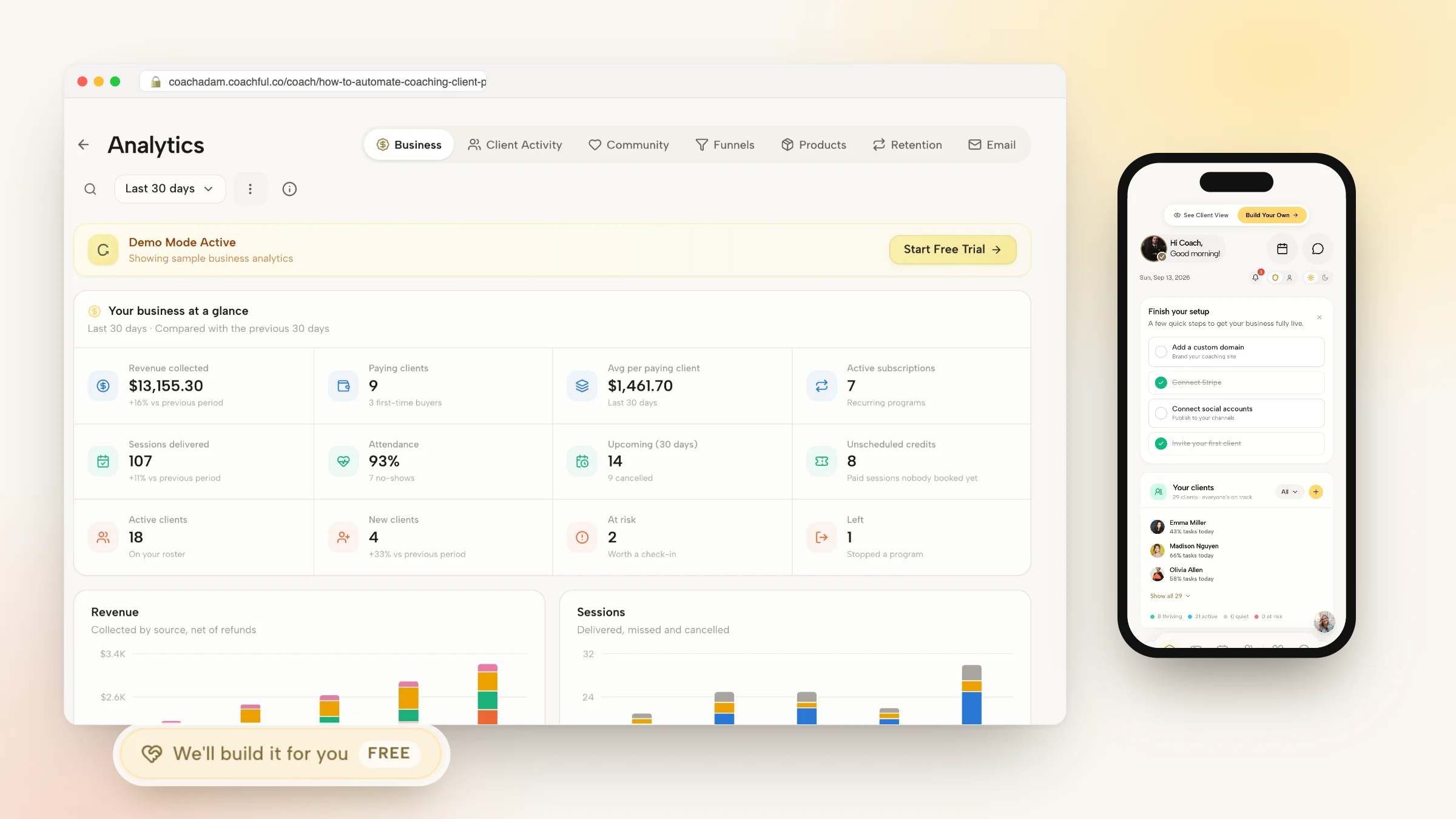
This is where a tool like Coachful can make your life so much easier. You can set up automated weekly check-ins with your custom questions, gathering both the ratings and the written reflections without any extra effort. It builds a living record of your client’s journey, giving you both a clear, undeniable picture of the incredible internal shifts taking place.
Using Technology to Scale Your Impact

The deep, personal nature of transformation coaching often leads to a very practical question: "I'm just one person. How can I possibly guide more people through this kind of work without completely burning out?"
It’s a real concern. The energy it takes to hold space for someone's profound personal shifts feels incredibly personal and tough to duplicate. But what if technology could actually amplify your unique impact instead of diluting it? By building systems to handle the administrative side of your business, you free up your mental and emotional bandwidth for the deep work that only you can do.
This isn’t about replacing the human connection; it’s about supporting it. The right tools let you scale your high-touch, personal approach, making your transformation life coaching available to more people who need it.
Streamline Onboarding to Go Deeper, Faster
A client’s transformation doesn’t start in your first session—it begins the moment they commit. A professional, organized, and thoughtful onboarding process sets the stage for the depth you'll explore together. This is where the right tech becomes your secret weapon.
Instead of a messy back-and-forth of emails and Word docs, picture an automated workflow that immediately immerses your new client in the process. A platform like Coachful helps you build a seamless onboarding experience from day one.
- Automated Intake Forms: Design forms with insightful questions that go way beyond logistics. Ask about their biggest dreams, their deepest fears, and the stories they've been telling themselves. All this rich information lands in an organized client file before you even have your first call, giving you a massive head start.
- Program Agreements and Payments: Handle contracts and payments securely upfront. This gets the administrative details out of the way smoothly, so your first session is 100% focused on your client, not on paperwork.
A structured start like this signals to your client that they’ve entered a professional, well-thought-out space designed for their success.
Automate the Journey to Deepen Engagement
The real work happens between your sessions. This is when clients start to integrate new awareness into their everyday lives. Technology can build a supportive structure around them during this time, keeping them engaged and accountable without you having to manually send every single reminder.
This is where a client dashboard becomes invaluable, giving clients a central hub for all their resources and a clear view of their progress.

Having a single source of truth like this reinforces the program's structure and their own journey. It automates the small touchpoints that are so critical for consistency and reflection.
When you automate reminders for weekly reflections or milestone check-ins, you're not just saving time. You're building a consistent rhythm of introspection for your client, a critical component of lasting change.
By setting up program milestones, you create a clear roadmap for the journey ahead. Automated prompts for journaling ensure the inner work continues, which makes your live sessions that much more powerful. For more ideas on finding the right tools, check out our guide to the best online coaching platforms.
Scaling Intimacy with Group Programs
One of the best ways to scale your impact is through group coaching. I know what you might be thinking: "How can I possibly do deep transformation work in a group? Won't it lose that personal touch?"
It’s a common fear, but with the right structure and technology, a group program can actually accelerate transformation. Clients quickly realize they aren't alone in their struggles, which creates a powerful sense of community and shared momentum. A dedicated coaching platform is what makes this manageable.
Here’s how you can use a platform’s features to run an effective group program:
- Manage Curriculum: Drip-feed your content, assignments, and videos on a set schedule to guide the entire cohort through the journey together.
- Foster Community: Use a dedicated group space or forum where clients can share their wins, ask questions, and support each other.
- Track Group and Individual Progress: You can monitor engagement for the cohort as a whole while still having a private space to track each individual's journey.
When you let technology handle the logistics, you can guide multiple transformations at once. You shift from being the sole source of support to becoming the facilitator of a powerful, collective experience.
Your First Steps To Becoming a Transformational Coach
Alright, you’ve been reading along, and I bet the gears are turning. You're starting to see how this deeper approach could completely re-energize your practice. But that initial excitement is often followed by a nagging little voice asking, "This is great, but what do I actually do right now to get started?"
That's the most important question. Let's get you moving from inspiration to action. We're not talking about tearing down your business and starting over. The key is to take small, intentional steps that build your confidence and create real momentum toward transformation life coaching.
Here’s a simple, no-risk plan to get you started today.
Redefine Your Ideal Client Avatar
First things first, let's adjust your focus. You need to stop thinking about clients who are just looking for a quick strategy or a simple to-do list. Instead, start picturing the person who is genuinely ready for a profound, lasting shift.
Who is this person? They aren't just asking "what should I do?" but are wrestling with the much bigger question of "who am I becoming?" They might look successful on paper but feel a deep sense of emptiness inside. They're craving a fundamental change in how they experience life, not just another goal to tick off their list.
Audit and Elevate an Existing Program
You don’t have to invent something new. Pick one of your current coaching packages—it could be a 3-month career program or a 12-session wellness plan—and look at it through this new transformational lens.
Your only goal here is to find three small opportunities to go deeper. For instance, you could:
- Add a guided journal prompt about personal identity to your onboarding materials.
- Swap out one standard goal-setting session for a conversation dedicated to uncovering their core values.
- Create a simple "wins" tracker that celebrates internal shifts (like more self-compassion) instead of just external results.
This simple exercise shows you that transformation isn't some separate, complicated service. It's a layer of depth you can weave into the work you're already doing, instantly elevating its value.
Practice the Power of 'Why'
Here’s a powerful experiment for your next discovery call. When a potential client tells you their goal—let's say, "I want to start my own business"—commit to asking "Why is that important to you?" at least five times.
With each "why," you'll peel back another layer. The initial goal might seem to be about money, but the deeper 'whys' will almost always reveal a core human need for freedom, purpose, or creative expression. This simple practice trains you to listen past the surface-level goal and hear the true transformation they're longing for.
Finally, begin sketching out what your first signature program might look like. You can use a free tool or a trial of a platform like Coachful to outline the three core phases: Awareness, Integration, and Embodiment. Just the act of mapping it out makes the vision feel real and is the first concrete step toward building your most valuable offering. For a more detailed roadmap, a practical guide can be a huge help in figuring out how to successfully start a life coaching business. Our list of mistakes new life coaches make shows what to avoid in your first year.
Frequently Asked Questions About Transformation Life Coaching
If you're exploring this path, you probably have a few questions swirling around. Is this the right fit for you and your clients? How does it really differ from other practices? What does it take to get started? Let’s get you some clear answers.
How Is Transformation Life Coaching Different From Therapy?
This is the big one. Many coaches wonder, "Wait, this sounds like it's digging into emotional stuff. Isn't that what therapists do?" It’s a great question, and the distinction is crucial. While both fields create a safe space for clients, they operate from different starting points and aim for different outcomes.
Therapy often looks backward to heal past wounds, treat clinical conditions like anxiety or depression, and help someone become functional again. A transformation life coach, however, partners with clients who are already functional and helps them leap from good to truly exceptional. The focus is squarely on the future. That line matters most in niches like sobriety coaching, which works alongside treatment rather than replacing it.
- Therapy is primarily about healing what's broken and managing diagnosed conditions.
- Coaching is about self-discovery, unlocking potential, and consciously creating a new reality.
As a coach, you're not a diagnostician or a clinician. You are a guide, helping your client expand their own awareness and build a new identity from the inside out.
How Long Does a Typical Transformation Program Last?
I get it, you're wondering if this is a quick-win process or a lifelong commitment. The truth is, genuine transformation takes time. We're talking about rewiring beliefs and behaviors that have been in place for years, sometimes decades. Quick fixes just don't stick.
A solid program typically runs for three to six months. That length of time gives you and your client enough runway to move through the essential stages: uncovering the deep patterns, practicing and integrating new ways of being, and finally, embodying that new identity so it feels natural. Anything shorter rarely gets past the surface level.
Can I Apply These Principles to a Specific Niche?
Absolutely! In fact, that's when the magic really happens. Transformation isn't a separate niche; it's a powerful framework you can apply within your existing niche, whether that’s careers, health, relationships, or anything else.
Think of it this way:
- Career Coach: You don’t just polish a resume. You help a client shift their core belief from "I'm not good enough for that role" to fully embodying the identity of a confident industry leader.
- Health Coach: You go way beyond meal plans. You help your client dismantle the "I have no self-control" story and build the identity of someone who instinctively makes choices that nourish their body.
Transformation is the operating system. Your niche is the specific app you’re running.
What Kind of Training or Certification Is Necessary?
The coaching world is still a bit like the Wild West—it's largely unregulated. That means you don't legally need a specific credential to call yourself a coach. But let's be real: credibility, confidence, and competence are everything in this work. If you're serious about this path, getting a handle on how to successfully start a life coaching business is a non-negotiable first step.
While not legally required, I strongly recommend pursuing training from a well-respected organization. It will give you the proven tools, ethical grounding, and the skill to confidently navigate the profound work your clients will bring to you. For the ethics side, our guide to the coaching code of ethics walks through the ICF standards.
Ready to build, manage, and scale a truly impactful coaching practice? Coachful is the all-in-one platform built for this. It handles your onboarding, scheduling, program content, and client tracking, freeing you up to do what you do best: facilitate deep, lasting change. Start your free trial today.