8 Types of Welcome Message for a Website: A Coach's Guide for 2026

Coachful
Your website homepage is your digital handshake, your first chance to connect with a potential client. But what are you actually saying? For most coaches, this moment is filled with paralyzing self-doubt. 'Am I coming across as authentic? Does this sound too salesy? Will they understand the transformation I offer?'
This guide is designed to silence that inner critic. We will dissect eight powerful strategies for crafting a welcome message for a website that not only captures attention but also builds immediate trust and rapport. It's about getting inside your visitor's head, analyzing the psychology behind why certain messages compel action while others cause them to click away.
Forget generic templates; this is a deep dive into creating a welcome that feels like the start of a genuine coaching relationship. A strong first impression can turn casual browsers into your next success story. For a prominent and engaging 'first hello,' you might consider using an Elementor modal popup widget to effectively capture your visitor's attention right away.
This article moves beyond basic theory to give you specific, replicable methods. We will explore how to:
- Communicate your core value instantly.
- Leverage client success stories for immediate credibility.
- Use visuals and metaphors to connect with a client's core problem.
- Segment your audience to make every visitor feel understood.
By the end, you will have a clear playbook for writing welcome messages that not only greet but also convert, setting the stage for meaningful client relationships from the very first click.
1. Value Proposition Welcome Message
A value proposition welcome message gets straight to the point. It's the first thing a visitor sees, and it must immediately answer their unspoken question: "What's in this for me, and why should I care?" This direct, benefit-focused approach is powerful because it respects the visitor's time and cuts through the noise. For coaches, this means articulating the precise outcome or solution you provide, connecting instantly with the problem they are trying to solve.
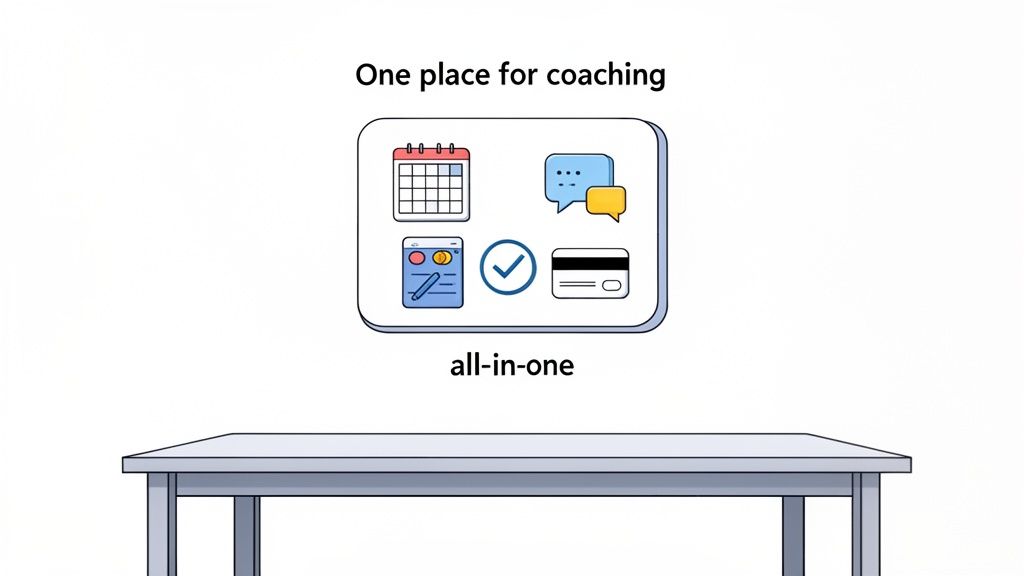
Think of it as your website's elevator pitch. It’s not about listing features; it’s about communicating the end result. A life coach might say, "Find Your Focus. Build Your Future." An executive coach might use, "Lead with Confidence. Achieve Exponential Growth." This type of welcome message for a website acts as a powerful filter, attracting your ideal clients and telling others they might be in the wrong place.
Strategic Breakdown
- Clarity Over Cleverness: Your primary goal is immediate comprehension. A new visitor, likely a busy coach juggling multiple tasks, doesn't have time to decipher a poetic but vague headline.
- Problem-Solution Framing: The best value propositions hint at a common pain point. "The All-In-One Platform for Modern Coaches" implicitly answers the coach's inner thought, "I'm tired of cobbling together five different tools just to run my business."
- Audience-Centric Language: Speak your client's language. A business coach targeting startup founders would use different terminology than a wellness coach focused on new mothers.
Key Insight: A strong value proposition isn't just a welcome message; it's the foundation of your entire marketing communication. It sets the tone and promises a specific result, which every other piece of content on your site should support.
How to Apply This
- Identify the Core Pain Point: What is the single biggest frustration your ideal client faces? Is it disorganization, lack of confidence, or stagnant business growth?
- State the Desired Outcome: What is the ultimate result they get from working with you? More clients, less stress, a promotion?
- Draft and Test: Write several versions. For instance: "Stop Juggling Tools. Start Coaching." vs. "Your Complete Coaching Business in One Place." See which one feels more direct and impactful. Testing different headlines is a critical component of effective marketing for coaches, allowing you to find what truly connects with your audience.
- Quantify When Possible: If you can, add a number. "Save 10+ hours a week on admin" is far more compelling than "Save time." For a coach thinking, "I barely have time to sleep," that specific number feels like a lifeline.
2. Client Success Story/Social Proof Welcome Message
While a value proposition tells a visitor what you do, a social proof welcome message shows them it works. This approach immediately answers the skeptical coach's question: "Okay, you say you can help, but can you prove it?" It anchors your welcome message in tangible outcomes, using real client success stories, glowing testimonials, or hard-hitting case studies to build credibility from the first click. For a new visitor, seeing a peer's success is often more convincing than any claim you can make yourself.
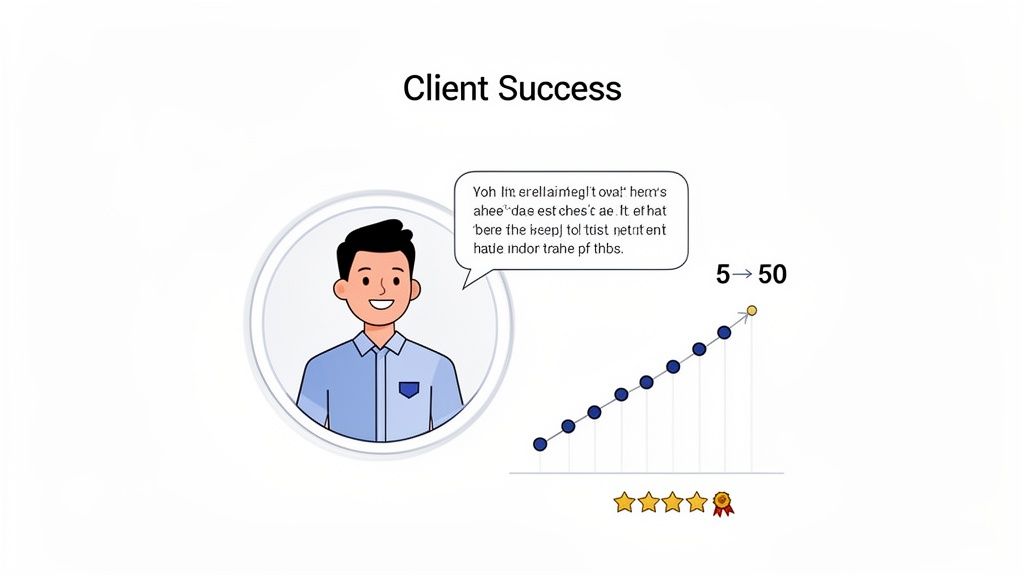
Instead of saying, "We help coaches grow," you lead with, "See how Sarah, a life coach, doubled her client base in 90 days." This type of welcome message for a website shifts the focus from your promise to your proof. It's a powerful way to demonstrate the real-world impact of your services, making the potential for success feel attainable and real for the visiting coach. This method is particularly effective for coaching platforms and services where results can be clearly demonstrated.
Strategic Breakdown
- Relatability is Key: The featured success story should reflect your ideal client. A business coach visiting your site will be more moved by the story of another business coach's revenue growth than a wellness coach's client-life-balance achievements.
- Outcome Over Process: While the "how" is important for a full case study, the welcome message should focus on the "what." Highlight the most compelling result, such as "Landed 5 High-Ticket Corporate Clients" or "Saved 10 Hours a Week on Admin."
- Authenticity Builds Trust: Use real names, photos, and specific details. A generic "A client increased their income" is forgettable. "Mark Chen, Executive Coach, boosted his revenue by 40% in Q1" is credible and memorable.
Key Insight: Social proof works by bypassing skepticism. When a visitor sees someone just like them who has already succeeded with your help, their internal dialogue shifts from "Is this for me?" to "How can I get those results too?"
How to Apply This
- Gather Your Best Stories: Identify your most successful clients. Reach out and ask for a testimonial, permission to feature them, or to collaborate on a brief case study.
- Craft a Compelling Headline: Pull the single most impressive result into your headline. Frame it as an accomplishment: "How [Coach's Name] Achieved [Specific Outcome]."
- Use a Quote Snippet: Below the headline, include a powerful, direct quote from the coach that expresses their satisfaction or the impact on their business. A quote like, "Before this, I was overwhelmed. Now, I feel in control for the first time," speaks directly to a visitor's emotional state.
- Provide a Path to More Information: Always link to a more detailed case study or testimonial page. A visitor who is hooked by the headline will want to learn more about the process. Adding a variety of social proof examples can further strengthen your case.
3. Problem-Focused Welcome Message with Visual Metaphor
This approach hooks visitors by immediately validating their frustrations. Instead of leading with a solution, it opens with the known pain points: scattered client notes, payment tracking nightmares, and the administrative quicksand that steals time from actual coaching. This method creates an instant connection by showing you understand the coach's reality. It acknowledges their struggle before offering the antidote.
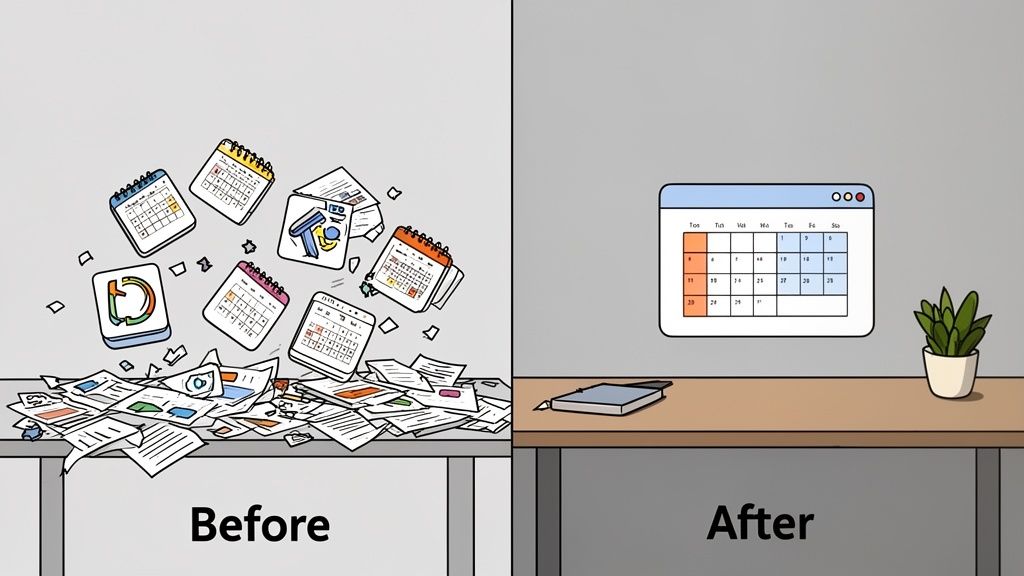
Think of it as starting a conversation with, "I know exactly what you're going through." For a coach landing on a website, seeing a headline like "Tired of Juggling 5 Apps to Run Your Business?" is deeply affirming. This welcome message for a website uses empathy as its foundation, making the subsequent solution feel like a perfectly timed rescue. It answers the coach's internal sigh, "Ugh, another Monday spent on admin instead of coaching," before they even have to think it.
Strategic Breakdown
- Acknowledge and Validate: Your message should say, "We see you." It acknowledges the real, often unspoken, operational headaches that prevent coaches from doing their best work.
- Create Emotional Resonance: By using visual metaphors, such as a cluttered desk transforming into a clean workspace, you tap into the feeling of being overwhelmed and the desire for control and calm. The problem feels personal, making the solution more appealing.
- Position the Solution as Relief: After establishing the pain, your product or service is not just another tool; it’s the aspirin for their business headache. This framing is inherently persuasive because it solves an immediate and irritating issue.
Key Insight: People are more motivated to move away from pain than toward pleasure. A problem-focused welcome message taps into this powerful psychological driver, making the need for a solution feel urgent and necessary.
How to Apply This
- Identify the "Before" State: What does a day in the life of your ideal client look like without your solution? List the frustrations: "I can't find my notes from last week's session," or "I forgot to invoice a client again."
- Use Empathetic Language: Frame your headline around that pain. For example: "Is Admin Work Stealing Your Coaching Time?" or "Your Client Data: Everywhere and Nowhere."
- Create a Visual Contrast: Use a "before and after" image or a short animation. Show scattered papers, multiple browser tabs, and a stressed-looking person. Contrast this with a unified dashboard, a clear calendar, and a relaxed, focused individual.
- Promise a Clear "After" State: Your sub-headline should present the solution as the direct cure. If the problem is "Scattered Tools," the solution is "Your Entire Coaching Business in One Place." This makes the value proposition simple to grasp.
4. Interactive Feature Demo or Product Tour Welcome Message
An interactive feature demo welcome message is a "show, don't tell" approach that invites visitors to experience your platform's core functions firsthand. Instead of just reading about how your coaching software works, they can click, drag, and explore key workflows like client onboarding or session scheduling in a controlled, guided environment. This dynamic welcome message for a website moves beyond static images and text, turning passive browsers into active participants.
For a busy coach wondering, "Will this tool actually make my life easier or just add another thing to learn?" this method is profoundly effective. It answers their question by letting them feel the simplicity and power of the tool immediately. By engaging with a mini-version of the product, they can self-educate in minutes, building confidence and seeing the direct benefit to their practice without any commitment.
Strategic Breakdown
- Reduce Friction and Build Confidence: Coaches are often time-poor and skeptical of new tech. An interactive demo removes the barrier of signing up for a trial just to see if the interface is intuitive. It proves the product's ease of use on the spot.
- Focus on Key Workflows: This isn't about showing every single feature. It's about highlighting the 2-3 most critical actions that solve a primary pain point, such as automating client intake or tracking session notes. A great product tour demonstrates a clear 'before and after' feeling.
- Product-Led Engagement: This strategy puts the product at the forefront of the marketing effort. It’s built on the idea that experiencing the product is the most persuasive form of marketing, leading to higher-quality sign-ups from users who already understand its value. To truly make your welcome message engaging and effective, especially for interactive demos, consider the 10 essential features of interactive product demos that boost conversions outlined in this guide.
Key Insight: An interactive welcome message shifts the user's mindset from "What does this do?" to "What can I do with this?" It transforms a hypothetical benefit into a tangible experience, making the value proposition feel real and achievable.
How to Apply This
- Isolate the "Aha!" Moment: Identify the single moment a new user understands your product's core value. Is it when they see how a client can book a session in three clicks? Build your demo around that.
- Keep It Short and Sweet: Limit the tour to a maximum of 2-3 core features. The goal is a quick win, not a comprehensive training manual. Your headline should promise this, like "See How to Onboard a Client in 90 Seconds."
- Use Action-Oriented Language: Frame the call-to-action around an activity. Instead of "See Our Features," use "Try Our Scheduler" or "Build a Sample Client Profile."
- Connect to a Real-World Outcome: Ensure the demo ends by reinforcing the primary benefit. For example, after showing an automated onboarding sequence, the final message could be, "You just saved 20 minutes. Imagine doing that for every new client." This is a key part of effective client onboarding best practices.
5. Role-Based Segmented Welcome Message
A role-based segmented welcome message recognizes that not all visitors are the same. Instead of a one-size-fits-all greeting, this approach directs different users to custom-tailored experiences based on who they are. For a coaching platform or school, this means acknowledging that a solo life coach has very different needs from a corporate L&D leader evaluating your services for their entire team. This personalization makes visitors feel understood from the first click.
This method works by presenting choices upfront, often with clear buttons like "I'm a Solo Coach," "I Lead a Team," or "I'm in HR." Each path leads to a version of your website where the headlines, case studies, and feature highlights are specifically relevant to that role. A solo coach sees messaging about saving time and easy client onboarding, while the HR leader sees content about ROI, compliance, and scalability.
This type of welcome message for a website directly answers the visitor's inner question: "Is this actually for someone like me?" By offering a specific path, you tell them, "Yes, it is. And we've designed this just for you." This shows you understand the unique challenges of each audience segment, building instant rapport and trust.
Strategic Breakdown
- Recognition Before Persuasion: This strategy works because it first says, "I see you and understand your specific world." Only after establishing that recognition does it attempt to persuade.
- Reduces Cognitive Load: By showing visitors only what's relevant, you eliminate the mental work of sifting through features or benefits that don't apply to them. This creates a smoother, more direct path to conversion.
- Creates High-Intent Pathways: Segmenting visitors funnels them into specific marketing sequences. A user who clicks "Coaching School" can be shown testimonials from other schools and offered a demo tailored to academic program management.
Key Insight: A segmented welcome message isn't just a friendly greeting; it's a powerful qualification and routing tool. It assumes your audience is diverse and intelligently guides each member to the solution that best fits their unique context, dramatically increasing the chances they'll find what they're looking for.
How to Apply This
- Define Your Core Segments: Identify 3-5 distinct visitor profiles. Examples for a coaching business might be: Independent Coaches, Boutique Coaching Firms, and Corporate HR Managers.
- Map Needs to Messages: For each segment, list their top 2-3 pain points and desired outcomes. An independent coach wants simplicity and affordability. A corporate manager needs security, reporting, and team management features.
- Craft Role-Specific Headlines: Write a powerful value proposition for each path. For example: "The #1 Platform for Independent Coaches to Grow Their Business" vs. "Scale Your Company's Coaching Program with Confidence."
- Allow for Easy Switching: Always include a small link like, "Not you? See other options." This prevents users who mis-click from getting stuck on the wrong path and abandoning your site.
6. Urgency and Scarcity-Based Welcome Message
An urgency-based welcome message for a website is designed to spur immediate action. By introducing time-sensitive offers, limited availability, or exclusive bonuses, it taps into the psychological principle that people place a higher value on things that are less available. As a coach, your prospective clients are often stuck in indecision; this type of message can provide the final nudge they need to commit to a solution for their problems.
Instead of a generic greeting, a visitor might see, "Limited Time: Get a free 1-on-1 onboarding session when you sign up this week," or "Only 3 spots left in our next group coaching cohort!" This approach shifts the visitor's mindset from "I'll think about it later" to "I need to decide now or I'll miss out." It works because it frames the decision not just as a choice to gain something, but as a choice to avoid losing a valuable opportunity.
Strategic Breakdown
- Authentic Scarcity: This is crucial. Faking scarcity ("Only 2 spots left!" for an evergreen digital product) destroys trust instantly. Your offer must be genuinely limited by time, quantity, or bonus availability.
- Benefit-Driven Urgency: The offer shouldn't be the only reason to act. The urgency must be paired with a strong benefit. The message should be, "Get this amazing outcome, and get it with a special bonus if you act now," not just, "Buy now to get a discount."
- Strategic Placement: While effective, constant urgency on a homepage can feel aggressive. This welcome message is best used for specific campaigns, new feature launches, or during seasonal pushes (like New Year's resolutions for life coaches).
Key Insight: Urgency doesn't create desire; it accelerates a decision for a desire that already exists. A coach visiting your site who is already frustrated with their disorganized practice is the perfect candidate for a message like, "Lock in your founding member rate before it expires Friday."
How to Apply This
- Define a Genuine Limitation: What can you realistically limit? It could be your time for 1:1 onboarding, a limited number of seats in a group program, or a special price that will truly expire.
- Craft a Clear, Concise Headline: State the offer and the limitation upfront. For example: "Join by Sunday and get our Client Acquisition Toolkit ($297 value) for free."
- Use a Visual Countdown: A simple countdown timer or a bolded date can visually reinforce the deadline, making the urgency more tangible for the website visitor.
- Set a Realistic Timeline: For a B2B decision like choosing coaching software, a 24-hour deadline is often too short. A 3-7 day window gives coaches time to consider the offer without losing the sense of urgency.
7. Values-Aligned and Mission-Driven Welcome Message
A values-aligned welcome message goes beyond features and benefits to connect on a deeper, more human level. It speaks directly to the coach who sees their work not just as a business, but as a calling. This type of message articulates a shared mission, assuring visitors that you understand and support the principles that guide their practice, such as client empowerment, ethical standards, and building a sustainable, meaningful career.
For the coach asking, "Do these people get what I'm about? Are they just another tech company, or do they share my commitment to making a real difference?" this approach provides a resounding "Yes." It shifts the conversation from a transactional tool to a partnership in purpose. A platform might state, "Built for Coaches Who Prioritize Purpose Over Profit." This kind of welcome message for a website creates a powerful sense of belonging and trust, making the visitor feel they've found their tribe.
Strategic Breakdown
- Authenticity is Non-Negotiable: This approach fails spectacularly if the values are just marketing fluff. Your company's actions, product design, and policies must genuinely reflect the mission you're promoting.
- Target a Specific Mindset: This message appeals to a particular segment of coaches, often those focused on wellness, life purpose, or conscious leadership. It may not resonate as strongly with coaches who are purely growth-and-revenue driven.
- Show, Don't Just Tell: Instead of simply saying you value "sustainability," explain how your platform helps coaches build a practice that prevents burnout. If you value "ethics," highlight product features that support client privacy and data security.
Key Insight: A mission-driven message turns your brand into a movement. It attracts coaches who are not just looking for a tool, but for a community and a partner that mirrors their own professional integrity and worldview.
How to Apply This
- Define Your Core Principles: Conduct an internal audit. What does your company truly stand for beyond making money? Is it coach well-being, client-centric practices, or data privacy?
- Research Your Audience's Values: What principles matter most to your ideal coach? A life coach may prioritize community and sustainability, while an executive coach might be focused on integrity and measurable impact.
- Craft a Mission-Oriented Headline: Draft headlines that speak to a shared purpose. Examples include: "The Platform for Conscious Coaching" or "Empowering Coaches. Transforming Lives. Together."
- Tell Stories of Alignment: Use case studies or testimonials that focus not just on business results, but on how a coach was able to build a practice that felt more aligned with their personal mission by using your platform. This makes your abstract values tangible.
8. Comparison-Based Welcome Message ('From X to Coachful')
A comparison-based welcome message directly confronts a coach's biggest frustration: the chaotic mess of juggling multiple apps. This approach frames your platform as the clean, unified solution to a complex problem they experience daily. It works by creating a clear "before and after" picture, contrasting their current state (Calendly for booking, Stripe for payments, email for communication, Asana for tasks) with the simplicity of an all-in-one system.
This type of welcome message for a website is particularly effective for coaches who are actively researching solutions. They are already aware of the problem and are looking for a hero to save them from "tool fatigue." Messaging like Notion's "Replace 30+ tools" or Slack's classic "Slack vs. Email" campaign demonstrates the power of this strategy. For a coaching platform, a headline like "From Five Apps to One Focus" instantly connects with a coach's desire for efficiency.
Strategic Breakdown
- Acknowledge the Status Quo: Explicitly name the tools your target coaches are likely using. This shows you understand their world and the specific pains associated with it.
- Highlight the Cost of Inefficiency: The comparison isn't just about features; it's about the hidden costs of a fragmented system—wasted time, missed opportunities, and the mental load of managing it all.
- Focus on the 'Gain' Not Just the 'Pain': While you start with the pain of the old way, the message must quickly pivot to the tangible benefits of the new way. It's about what they gain: more time for coaching, better client experiences, and a more professional operation.
Key Insight: A comparison message validates the visitor's frustration. It tells them, "You're not disorganized; your tools are." This shifts the blame from the user to their current system, positioning your platform as the empowering alternative.
How to Apply This
- Identify the 'Franken-stack': Research and list the top 3-5 tools your ideal coaching clients use to run their business. Think Calendly, Stripe, a project manager, and email.
- Create a 'Before & After' Headline: Draft messages that create a strong contrast. For example: "Tired of Juggling Calendly, Stripe, and Email? Meet Your All-in-One Coaching Hub."
- Quantify the Difference: Go beyond just listing tools. Calculate the real savings. "Save $50/month and 10+ hours a week by replacing five separate subscriptions." Numbers make the benefit concrete.
- Address Switching Concerns: Directly tackle the fear of migration. For a coach thinking, "I can't face the nightmare of moving all my client data," offer a "White-Glove Onboarding" service or a "3-Step Migration Guide" to show that moving to your platform is painless. This builds trust and lowers the barrier to entry.
8 Welcome Message Types Compared
| Welcome Message Type | Complexity (🔄) | Resource Requirements (💡) | Expected Outcomes (⭐ 📊) | Ideal Use Cases (⚡) | Key Advantages |
|---|---|---|---|---|---|
| Value Proposition Welcome Message | Low 🔄 — simple headline + subhead | Low 💡 — copywriter, basic design, trust assets | Clear understanding; faster conversions ⭐📊 | Homepage hero; quick evaluators; first-time visitors ⚡ | Immediate clarity; SEO-friendly; reduces decision paralysis |
| Client Success Story / Social Proof | Medium 🔄 — collect and present stories | Medium–High 💡 — interviews, photos, video production | Strong credibility and trust; higher persuasion ⭐📊 | Validation-seeking coaches; mid-funnel; retargeting ⚡ | Builds social proof; helps prospects envision outcomes |
| Problem-Focused + Visual Metaphor | Medium 🔄 — crafted pain → solution flow | Medium 💡 — research, creative copy, illustrative design | Emotional resonance; increased engagement and problem awareness ⭐📊 | Coaches unaware of better workflows; acquisition campaigns ⚡ | Memorable message; highlights pain then relief |
| Interactive Feature Demo / Product Tour | High 🔄 — guided flows and interactivity | High 💡 — development, design, analytics, maintenance | Deep product understanding; higher qualification & engagement ⭐📊 | Product-led growth; visual learners; trial signups ⚡ | Shows functionality live; differentiator; usage insights |
| Role-Based Segmented Welcome Message | High 🔄 — branching content per persona | High 💡 — multiple copy variants, UX, analytics | Higher relevance and segment-specific conversions ⭐📊 | Diverse audiences (solo coaches → enterprise L&D) ⚡ | Personalization at scale; improved conversion by persona |
| Urgency & Scarcity-Based Welcome Message | Low–Medium 🔄 — timers and offer logic | Medium 💡 — promo setup, legal, tracking | Short-term conversion lift; may lower average LTV ⭐📊 | Seasonal campaigns; closing deals; last-step motivators ⚡ | Drives immediate action; reduces procrastination |
| Values-Aligned / Mission-Driven Welcome Message | Medium 🔄 — authentic brand positioning | Medium–High 💡 — values audit, storytelling, policy evidence | Strong retention and loyalty among aligned users ⭐📊 | Values-conscious coaches; premium/mission markets ⚡ | Deep emotional fit; brand differentiation; better retention |
| Comparison-Based Welcome Message ("From X to Coachful") | Medium 🔄 — side-by-side research & claims | Medium 💡 — competitor analysis, comparison assets | Helps switchers decide; clarifies ROI of switching ⭐📊 | Users actively evaluating alternatives; retargeting ⚡ | Clear differentiation; quantifies cost/time savings |
Crafting Your Welcome: From Insight to Impact
We've explored a spectrum of welcome messages, from value-driven propositions to urgent calls to action. Yet, the central theme connecting them all isn't a particular turn of phrase or a clever headline. It's strategic empathy. The most effective welcome message for a website is born from a deep understanding of your visitor's inner world the moment they land on your page. It’s about meeting them exactly where they are.
You might be thinking, "This is a lot to consider for just a few lines of text." But this initial greeting sets the entire tone for your relationship. It’s the first promise you make. As we’ve seen, this promise can take many forms: a promise to solve a specific pain point, a promise of belonging to a mission-driven community, or a promise backed by the undeniable success of others. Your task is not to guess which one is "best," but to determine which one is most true for you and most needed by your ideal client.
Bridging the Gap: From Template to Transformation
The examples provided are not meant to be copied and pasted. Think of them as conversational blueprints. They demonstrate how to translate a strategic goal into a human connection. A coach wrestling with imposter syndrome might feel paralyzed, thinking, "My welcome message has to be perfect, or they'll think I'm not a real expert." This is a common fear.
The solution is to shift your focus from perfection to intention. Before writing a single word, ask yourself these focusing questions:
- What is the single biggest "aha!" moment I want a new visitor to have? Is it that they're not alone? That a solution is simpler than they imagined? That they've finally found a coach who gets it?
- What feeling do I want to create? Is it relief, curiosity, excitement, or a sense of validation and being understood?
- Which of my core coaching pillars does this welcome need to reflect? If you're a no-nonsense business coach, your message should feel direct and results-oriented. If you're a wellness coach focused on mindfulness, it should feel calm and reassuring.
Your welcome message is the front door to your digital practice. It must align with the experience a client will have once they step inside. A disjointed message creates distrust, while an authentic one builds an immediate foundation of credibility.
Your Actionable Next Steps: Choosing Your Path
Now, the theory becomes practice. Your immediate next step is to choose one strategic approach from this article and draft your own version. Don't aim for a final draft. Aim for a "version one."
- Select Your Strategy: Review the eight types we covered. Which one resonates most with your coaching style and your clients' primary needs right now? Are they seeking concrete proof (Social Proof), a clear solution (Problem-Focused), or a sense of shared purpose (Values-Aligned)?
- Draft Your Message: Write a short welcome message based on your chosen strategy. Get the core idea down without overthinking it.
- Test It Against Your "Why": Read your draft aloud. Does it sound like you? More importantly, does it speak directly to the person you are meant to serve? Does it answer that silent question in their mind: "Am I in the right place?"
Remember, a powerful welcome message isn't just about attracting clients. It's about attracting the right clients. It acts as a filter, drawing in those who are a perfect fit for your unique approach and gently guiding away those who are not. This clarity saves everyone time and energy, allowing you to dedicate your focus to creating the transformations you promise. The right welcome message for a website is your first, and most important, step in building a practice defined by impact and authenticity.
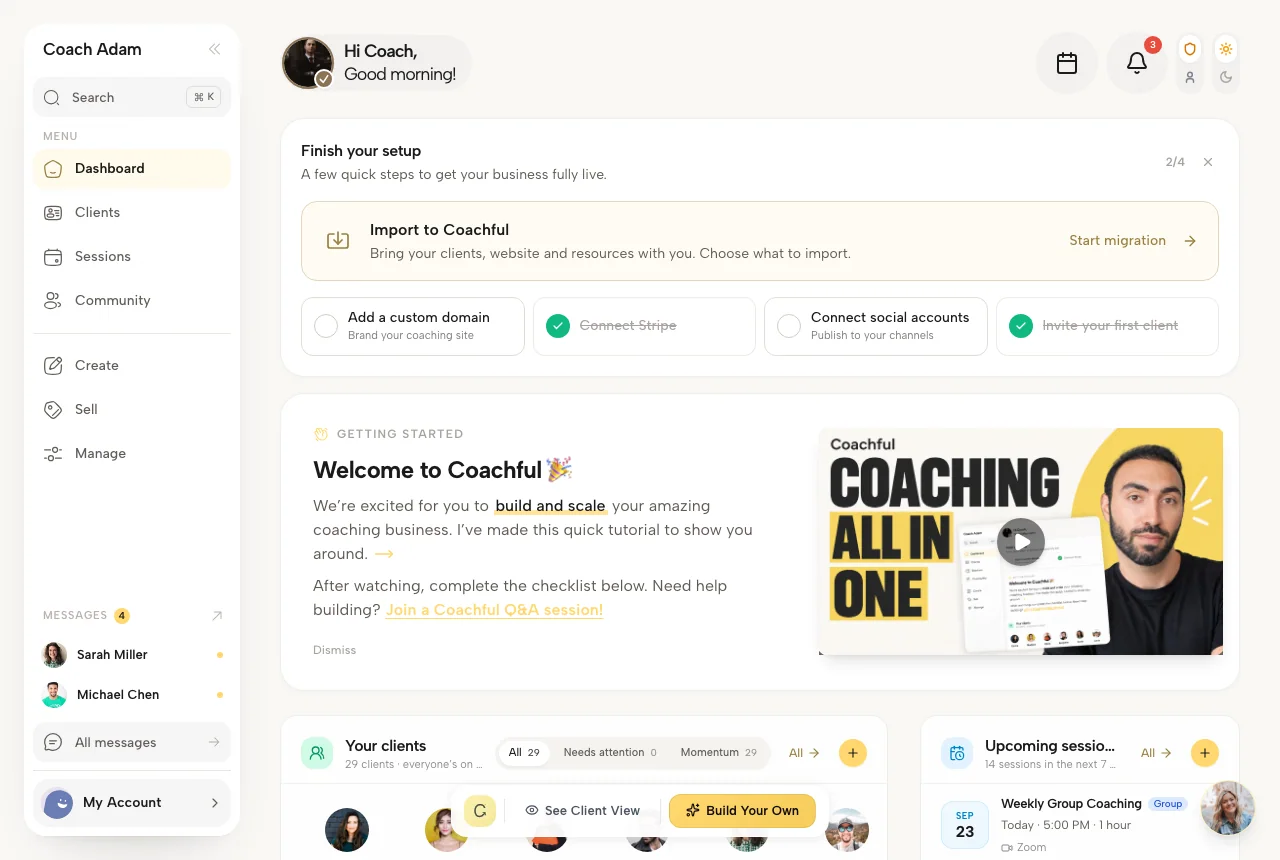
Now that you have the strategy to craft a welcome message that connects and converts, ensure the rest of your client experience is just as seamless. Coachful handles the administrative backend of your coaching business, from scheduling and payments to client management, so you can focus on delivering the powerful transformation your welcome message promises. Discover how Coachful can support your practice by visiting Coachful today.