80/20 Rule in Coaching: Clients, Offers and Talk Time
The 80/20 rule in coaching applies the Pareto principle: a small share of causes produces most of the results. For coaches, that usually means about 20 percent of clients bring most of the revenue and referrals, a few offers and channels bring most sales, and a few actions drive most of a client's progress. It also names a talk-time ratio: the client talks 80 percent.
Coaches use "80/20" in at least four ways, and each is useful for a different decision. Below we explain where the rule comes from, why the real ratio is rarely exactly 80/20, and how to apply it to your clients, your offers, your marketing, your sessions and your clients' own goals, with a spreadsheet method you can run in an afternoon.
Where the 80/20 rule comes from
The Pareto principle is named after the Italian economist Vilfredo Pareto, who observed that about 80 percent of the land in Italy was owned by about 20 percent of the population. In the 1940s the management consultant Joseph Juran applied the pattern to quality problems and called it "the vital few and the trivial many", later softening it to "the vital few and the useful many" so the 80 percent would not be dismissed.
Two things are worth knowing before you build a strategy on it.
- The numbers are shorthand. The split can be 90:10 or 70:30 in a given case, and the two numbers do not have to add up to 100 because they measure different things.
- In real businesses it is often closer to 70/20. A study of 339 publicly traded companies by McCarthy and Winer found the top 20 percent of customers accounted for about two-thirds of sales on average, and less for subscription businesses. An earlier study of 22 packaged-goods categories found about 73 percent.
So the rule is real as a pattern, and unreliable as a precise number. That is exactly how to use it: as a prompt to look for the vital few, not as a quota.
The four ways coaches use the 80/20 rule
| Version | The claim | Who uses it | What to do with it |
|---|---|---|---|
| Clients and revenue | A few clients bring most revenue, referrals and joy; a few others take most of your time | Coaches running their own practice, business coaches | Find both groups and treat them differently |
| Offers and channels | One or two offers and lead sources bring most sales | Anyone selling coaching | Double down on the few, cut or fix the rest |
| Talk time | The client talks 80 percent, the coach 20 | Coach trainers, sales trainers | A stricter cousin of the 70/30 rule in coaching |
| Client goals | A few actions produce most of a client's progress; health coaches also use "eat well 80 percent of the time" | Life, productivity and health coaches | Help clients find their vital few actions |
How to run an 80/20 analysis on your coaching clients
You need a spreadsheet, your payment history for the last 12 months and an honest hour. The goal is two lists: the clients who make the business, and the clients who quietly drain it.
- List every client from the last 12 months, one row each.
- Add four columns: revenue, referrals they sent, roughly how many hours they took (sessions plus messages and admin), and a gut score from 1 to 5 for how much you enjoy the work.
- Sort by revenue, add a running total and mark where you cross 70 to 80 percent of the total. Those clients are your revenue few.
- Sort by hours per dollar. The top of that list is where your time goes for the least return.
- Look for overlaps. What do the revenue few have in common: a niche, an offer, a lead source, a stage of life or business?
An illustrative result for a solo coach with ten clients might look like this:
| Group | Clients | Share of revenue | Share of your hours | What you notice |
|---|---|---|---|---|
| Vital few | 2 | About 60% | About 25% | Both on the six-month package, both referred by past clients |
| Steady middle | 5 | About 30% | About 40% | Monthly clients, mostly from Instagram |
| Time drain | 3 | About 10% | About 35% | Single sessions, frequent rescheduling, long message threads |
Illustrative numbers, not data. Your split will differ, and as the research above shows, it is often softer than 80/20.
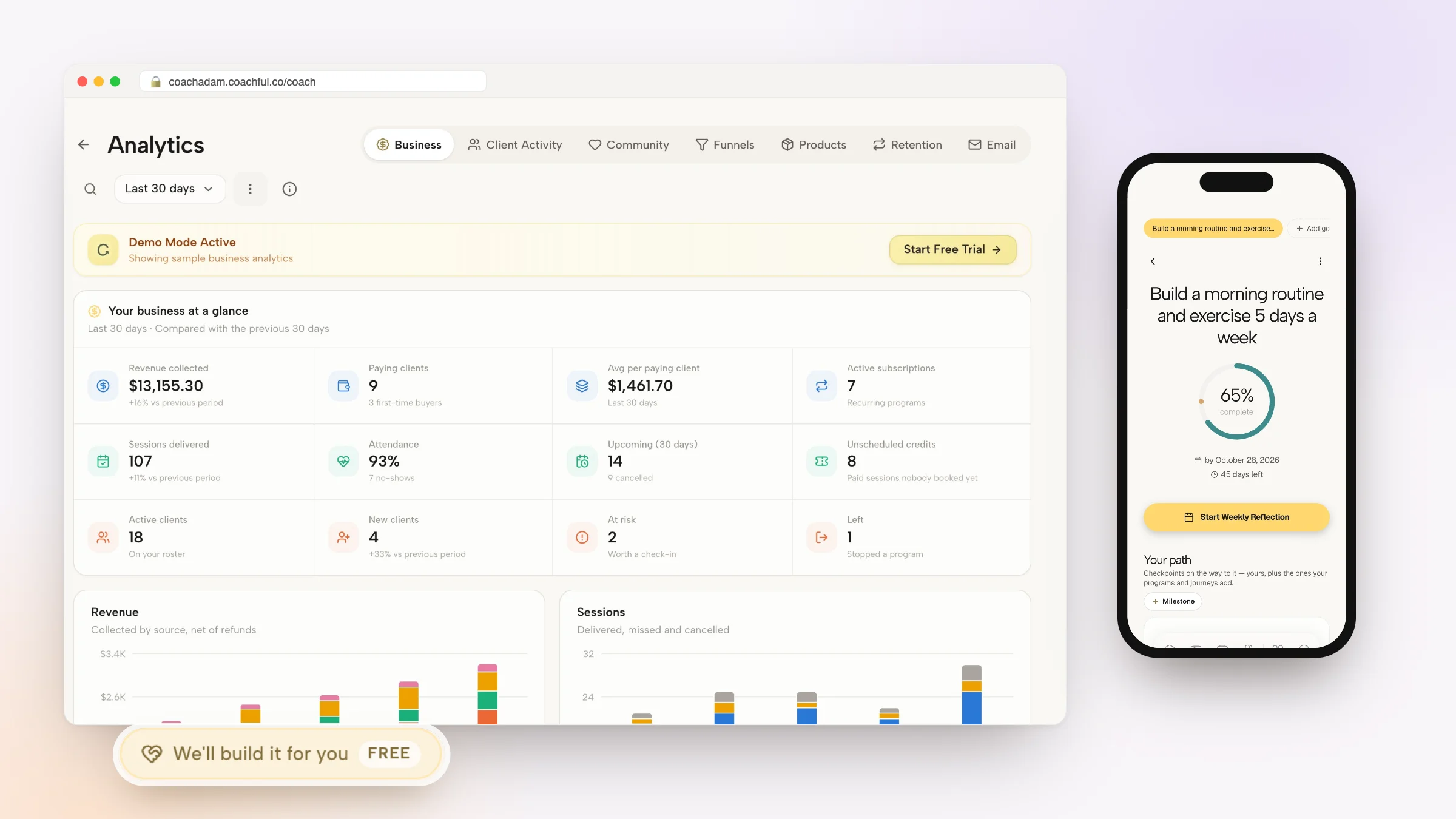
Coachful does the first few steps for you. Analytics breaks revenue down by source (programs, sessions, content) and shows paying clients and average revenue per client, and the Clients view shows who is thriving, quiet or at risk.


What to do with each group
The vital few
- Ask them for referrals and testimonials, specifically and soon. People like them know people like them.
- Write your marketing to them. Your website, your offer page and your posts should describe their situation in their words.
- Design your next offer around what they bought. If both bought six months, your core offer is probably six months.
- Protect their experience. These clients should never feel the effects of you being stretched by the rest.
The steady middle
- Systematize. Onboarding, reminders, check-ins and follow-up emails can run on automation so you spend your time in sessions.
- Offer a next step. Some of the middle would become vital few with a longer or deeper package.
The time drain
- Reset the agreement. Many drains are boundary problems. Our guide to resetting a coaching agreement when boundaries slip has scripts.
- Change the format. A single-session client who reschedules often may fit a group program or a course better.
- Raise the price or end kindly. If neither works, see how to end a coaching engagement that is not a fit.

The 80/20 rule for coaching offers and marketing
The same analysis works on what you sell and where buyers come from.
- Offers. List every offer and its revenue for the year. Most coaches find one offer carries the business and two or three exist mostly because they once seemed like a good idea. Retire or merge the extras, and make the winner easier to buy.
- Lead sources. Tag where each paying client first came from: referral, Instagram, LinkedIn, podcast, a free guide. Then compare where you spend your marketing hours. The mismatch is usually stark.
- Conversion points. Track how many discovery calls turn into clients by source. A channel that sends fewer leads but converts twice as often deserves more of your time.

In Coachful, each lead carries its source (funnel, quiz, newsletter, link in bio, referral, intake form) and the Intakes view shows your discovery call conversion rate, so the comparison is a filter rather than a spreadsheet. For more on picking channels, see choosing a growth strategy your results can support.


The 80/20 rule for your own week
Run the same lens over your calendar. Most solo coaches split their time between sessions, marketing, admin and building things, and a handful of activities produce nearly all the new clients and nearly all the results. Track a normal week in 30-minute blocks, then ask three questions of every block: did it move a client forward, did it bring in a lead, or could someone or something else have done it?
- Keep and protect: sessions, follow-up on warm leads, the one content channel that actually books calls.
- Automate: reminders, invoices, onboarding emails, check-in prompts. Our guide to client onboarding automation lists what is safe to hand to software.
- Cut or batch: the second and third social platforms, tool-switching, rewriting the same welcome message by hand.
Then put a few numbers on the wall and review them monthly. A short list of coaching business KPIs, such as revenue by offer, discovery call conversion and client retention, keeps the 80/20 view current instead of a one-off exercise.
A quarterly 80/20 review in six questions
- Which clients brought the most revenue and the most referrals this quarter, and what do they share?
- Which client relationships took the most time for the least progress, and what will change?
- Which offer sold best, and which could you retire?
- Which lead source produced paying clients, not just followers?
- Which two activities in your week did the most for clients, and are they protected in your calendar?
- What is one thing you will stop doing next quarter?
Write the answers somewhere you will see them again, ideally next to your business numbers rather than in a notebook you never reopen.
The 80/20 rule inside coaching sessions
Talk time
Some trainers teach an 80/20 split in the client's favor, stricter than the common 70/30. Neither ratio has been tested as an optimum; both express the ICF's emphasis on listening actively and evoking awareness. If you want a number, measure your own talk share on a recorded session and work it down.
Helping clients find their vital few
This is the most valuable version for clients. People arrive with a list of twenty things they "should" do. Coaching helps them find the two that would make the other eighteen easier or unnecessary. Questions that work:
- "If you could only do three things this month, which three would make the biggest difference?"
- "Which one of these, if it went well, would make others easier?"
- "What are you doing out of habit that is not moving anything?"
- "Looking back at a good week, what did you do that you skipped in a bad week?"
Then cut the list. Three focus tasks a day is plenty, which is why Coachful's client app limits the daily focus list to three by default and puts the rest in a backlog. For more questions in this vein, see 25 coaching techniques that work in real sessions.

The health coaching 80/20
Nutrition and health coaches often use "eat well 80 percent of the time" as a flexibility rule, so clients stop treating one dessert as failure. It is a behavior strategy rather than a nutritional finding, and it works best when the 80 percent is defined concretely, such as "a protein and a vegetable at lunch and dinner on weekdays."
Where the 80/20 rule goes wrong
- Cutting the wrong 80 percent. A client who brings little revenue may be your best source of referrals or your clearest case study. Look at more than money.
- Treating it as a law. If your analysis shows 55/20, that is your answer. Do not force the data to match the slogan.
- Ignoring the useful many. Juran himself renamed them. The middle of your client list pays the bills in most months.
- Using it as an excuse to stop caring. The point is to design your business so every client gets good work, not to rank people by value to you.
If the analysis shows your best clients all came through one funnel or one sales page, and you would like a second one built in the same mold, Coachful's team will build it inside your account through the free white-glove service, included on every plan.

Frequently asked questions
What is the 80/20 rule in coaching?
It applies the Pareto principle to coaching: a small share of causes drives most results. In a coaching business, roughly 20 percent of clients often bring most revenue and referrals, and a few offers and channels bring most sales. In sessions, it can mean the client talks 80 percent of the time, or helping clients find the few actions that matter most.
Is the 80/20 rule accurate?
As a pattern, yes; as a number, rarely. A study of 339 companies found the top 20 percent of customers drove about two-thirds of sales on average, and less for subscription businesses. The two numbers do not have to add to 100. Run your own analysis and use your real split.
How do I apply the 80/20 rule to my coaching clients?
List last year's clients with revenue, referrals, hours taken and how much you enjoy the work. Sort by revenue to find the few who carry the business, then by hours per dollar to find the drains. Market to the first group, systematize the middle, and reset boundaries or change format for the drains.
What is the 80/20 rule for talking in coaching?
Some trainers teach that the client should talk about 80 percent of a session and the coach 20 percent. It is stricter than the more common 70/30 guide, and neither has been tested as the ideal ratio. Both reflect the ICF competencies on active listening and evoking awareness.
How do health coaches use the 80/20 rule?
Many use it as a flexibility rule: eat in line with your plan about 80 percent of the time and relax about the rest. It is a behavior strategy that helps clients avoid all-or-nothing thinking, not a measured nutritional ratio, so define the 80 percent concretely for each client.
Should I fire my bottom 20 percent of coaching clients?
Not automatically. Some low-revenue clients send referrals or are your best stories. Start by resetting the agreement, changing the format or adjusting the price. End the engagement only when a client is consistently a poor fit, and do it kindly with a clear handover.
What is the difference between the 80/20 rule and the 70/30 rule in coaching?
Both are used for talk time, with 80/20 the stricter version. Beyond that they diverge: 80/20 is the Pareto principle about a vital few causes, while 70/30 is also used for the 70:20:10 learning model, where most development comes from experience between sessions.