How to Start Becoming an Ambassador for a Brand

Coachful
You've spent months building a trusted coaching practice. People ask what software you use, which books you recommend, and what really helps your clients follow through. Then a brand approaches you, or you consider pitching one yourself, and the question appears: Am I influential enough to become an ambassador for a brand?
That's the wrong first question. The better question is whether you can create a credible, measurable recommendation for a relevant audience, while protecting your reputation and understanding the deal you're signing. A serious ambassador partnership isn't a badge, a discount code, or an occasional promise to “post sometimes.” It's a defined endorsement service with obligations on both sides.
Why Your Audience Trusts You More Than Ads
A business coach I know once hesitated before pitching a planning software company. Her audience wasn't enormous, and she assumed the brand would prefer a famous creator with a much larger following. Yet her clients regularly asked her about the tools behind her weekly planning system. She had used the software in her own practice, demonstrated it during workshops, and answered detailed questions about its limits.
A larger account might have produced more views. She could produce a more credible recommendation.
That distinction matters because recommendations work through a different psychological channel from conventional advertising. Your audience has watched you make decisions, explain trade-offs, and help people solve specific problems. When you recommend a product that fits those patterns, followers don't receive the message as a random interruption. They evaluate it through an existing relationship.

Nielsen's Global Trust in Advertising research found that 83% of global respondents trusted recommendations from people they knew, making word-of-mouth the most trusted form of advertising measured in the study. You can review the finding in Nielsen's Global Trust in Advertising reference. The practical lesson is simple: trust is the asset, not reach by itself.
Influence starts with relevance
Ask yourself what your audience expects from you. A leadership coach might have credibility recommending a note-taking platform, executive education provider, or meeting tool. That same coach may struggle to persuade followers about a skincare product, even with strong engagement, because the recommendation doesn't connect to the relationship already established.
Use this relevance test:
- Problem fit: Does the product solve a problem your audience already brings to you?
- Experience fit: Have you used it enough to describe the experience candidly?
- Professional fit: Would recommending it strengthen or weaken your positioning?
- Conversation fit: Can you discuss it naturally without forcing every piece of content toward a sale?
Your personal brand should make those answers visible. If you're refining how you present your expertise on LinkedIn, this personal branding guide from WaveGen.ai offers useful context on building a recognizable professional presence.
A coach with a focused community can outperform a broad creator when the product solves a problem that audience members already care about. That isn't a promise of conversion. It's a stronger foundation for persuasive communication.
Credibility is built through useful detail
Weak ambassadors repeat taglines. Strong ambassadors explain how they made a choice, where the product helped, and where it didn't. They show the workflow rather than making inflated promises.
Suppose you use a client-management platform. You could say, “This tool will transform your coaching business.” That's vague and potentially unsupported. A credible alternative would be, “I use this workspace to schedule sessions, share resources, and keep client notes organized. It doesn't replace a coaching method, but it reduces the number of places I need to manage.”
That kind of specificity gives your audience room to decide. It also gives a brand a safer, more durable form of promotion.
Before worrying about follower volume, review your own social proof examples. Look for repeated questions, genuine conversations, and evidence that people act on your recommendations. Those signals tell you whether you have a community that trusts your judgment, not merely an audience that scrolls past your content.
Understanding Eligibility and FTC Disclosure Rules
The moment a brand gives you money, free access, a discount, commissions, employment benefits, or another material benefit, the relationship needs operational discipline. You're not doing a casual favor for a company. You're making an endorsement in a regulated marketing relationship.
The U.S. Federal Trade Commission first issued its Endorsement Guides in 1980 and materially revised them in 2009, when blogs, online reviews, and social promotion needed clearer treatment. On June 29, 2023, the FTC issued another major update to its Endorsement Guides, covering influencers, brand ambassadors, reviews, testimonials, virtual influencers, and platform disclosure tools, as described in this overview of the FTC update.
The FTC's standard is practical. A disclosure should be clear, conspicuous, understandable, and difficult to miss. It should appear in the same medium as the endorsement. A visual recommendation needs a visible disclosure. An audio recommendation needs an audible disclosure. A video should generally make the relationship clear early, rather than hiding it after the viewer has already formed an impression.
What counts as a material connection
You don't need to be paid in cash for disclosure obligations to arise. Consider these situations:
- Free access: A software company gives you a complimentary subscription, and you recommend it during a webinar.
- Affiliate commission: You earn money when someone joins through your referral link.
- Employment: You work for the brand while discussing its product publicly.
- Discounts or perks: The brand gives you benefits your audience wouldn't reasonably expect.
- Product gifting: The company sends you a product that you then feature.
If an ordinary audience member might evaluate your recommendation differently after learning about the relationship, disclose it. A platform's built-in disclosure tool may help, but don't assume it does all the work for you.
A vague phrase buried in a profile bio isn't enough for a specific endorsement. Neither is an unexplained tag. Say what the relationship is in language your audience understands: “This is a sponsored partnership,” “I'm a brand ambassador for this company,” or “I earn a commission if you join through this link.”
Separate experience from promises
The FTC states that endorsements must reflect the endorser's honest opinion and experience, and an endorser can't describe personal experience with a product they haven't tried. The guidance also matters when a brand supplies suggested language. You remain responsible for what you publish.
A coach who has used a scheduling platform can explain her own workflow. She can't claim that every coach will gain a particular business result unless the brand can substantiate that claim and the wording is approved. “This helped me keep client appointments in one place” is personal experience. “This guarantees better client retention” is a performance claim that requires evidence.
Practical rule: Disclose the relationship and describe your experience. Don't turn your personal result into a guarantee for everyone else.
Make compliance part of your operating system. Keep the agreement, approved claims, disclosure language, product notes, and approval history together. If you manage sensitive client information while demonstrating a coaching workflow, review your approach to data protection and compliance before publishing examples.
Transparency doesn't weaken authority. It shows that you can evaluate a product while acknowledging your commercial relationship. That combination is far more persuasive than pretending a paid recommendation appeared spontaneously.
Building a Standout Pitch and Verified Portfolio
Brands don't need another email saying, “I love your company and would be a great ambassador.” They need to understand who you reach, what you can deliver, and how they'll know whether the partnership worked.
Build your pitch around three decisions:
- Audience: Who specifically do you reach?
- Behavior: What do you want those people to do?
- Conversion event: What counts as success?
For a business coach pitching a project-management platform, the audience might be independent consultants who struggle with client follow-up. The desired behavior could be starting a trial or booking a demonstration. The conversion event might be a qualified registration captured through a tracked link.
That structure immediately separates you from applicants who lead with follower counts.
Build evidence before making the pitch
Your portfolio should show product familiarity, communication skill, and professional reliability. Include examples that answer the brand's unspoken concerns:
- What does your audience ask you about?
- Can you explain a product without sounding scripted?
- Have you used the product yourself?
- Can you meet deadlines and follow approval requirements?
- Can you discuss results without exposing private client information?
The FTC's guidance is unambiguous about product use. You cannot claim personal experience with something you haven't tried. If you want to pitch a coaching platform, use it first. Document the workflows you tested, what worked, and what required adjustment.
A strong portfolio for an executive coach might contain a short introduction, audience themes, representative posts, workshop clips, anonymized client-work examples, and a page explaining how she handles disclosures. She doesn't need to manufacture a dramatic case study. She needs to show that she understands coaching practice and can communicate responsibly.
If your work includes user-generated content, this guide to how to become a UGC creator can help you think about production quality and portfolio presentation without confusing polished content with genuine influence.
Offer a controlled pilot
Don't ask a brand to commit to an undefined long-term relationship. Offer a 30-day pilot with a fixed scope, weekly review of content and traffic quality, and a written evaluation at the end.
Your proposal could include:
- A defined number of posts or demonstrations.
- Named channels and content formats.
- One unique tracking link or referral code.
- Approved claims and disclosure wording.
- A review process with response times.
- A report covering qualified clicks, leads, conversions, and audience feedback.
A pilot reduces risk for both parties. You learn whether the brand communicates clearly and pays reliably. The brand learns whether your audience is relevant and whether you can represent the product without excessive supervision.
Your content creator workflow should support that discipline. Keep drafts, approvals, publication dates, links, and performance notes in one place. A brand sees a professional partner when you arrive with evidence and a measurement plan, not just enthusiasm.
Comparing Compensation Models and Negotiation Tactics
Free access can feel flattering, especially when you already like the product. It can also become expensive if the partnership demands research, filming, writing, revisions, community replies, and ongoing promotion.
Treat compensation as a question of time, risk, rights, and measurable value. A standard ambassador-agreement template describes a base amount paid at a stated frequency plus performance-based incentives tied to predetermined metrics, as shown in this brand ambassador agreement template.
| Model | Best fit | Main risk | What to negotiate |
|---|---|---|---|
| Flat fee | Defined content with predictable scope | Extra revisions or usage can expand the work | Deliverables, revision limits, payment dates |
| Commission | Strong audience-product fit and trackable sales | You carry more performance risk | Attribution window, refunds, chargebacks, reporting |
| Product or free access | Genuine trial or early portfolio building | Your labor may exceed the benefit | Exact deliverables, product value, future payment path |
| Hybrid | Ongoing promotion with both guaranteed work and performance upside | Ambiguous commission rules | Base fee, metric definition, payment schedule, reporting |
Consider a business coach negotiating a partnership with a planning tool. She agrees to a $500 monthly fee plus an 8% commission on attributable sales, using a unique referral code. She also defines whether discounts, refunds, taxes, and chargebacks reduce “net sales.” Those terms matter more than the headline percentage.
Ask the questions that protect your business
Before accepting, ask:
- How many pieces of content are required, and on which platforms?
- Does the brand need approval before publication?
- How many revision rounds are included?
- Can the brand reuse your content in paid advertising?
- For how long, and in which territories?
- Does exclusivity prevent you from working with adjacent products?
- When will fixed fees and commissions be paid?
- What happens if the brand cancels halfway through the term?
- Can either party terminate the agreement, and with what notice?
- Does gifted software supplement cash compensation or replace it?
A fee doesn't cover unlimited usage. A commission doesn't compensate you for undefined production work. A free subscription isn't automatically fair payment because you may already have paid with your expertise, audience access, and credibility.
Negotiate calmly and in writing. Your aim isn't to extract every possible benefit. It's to make the exchange precise enough that neither party has to guess what “ambassador” means.
Evaluating Programs with Verification and Tracking
A polished ambassador program can still be a poor business opportunity. Before you sign, inspect the audience and the measurement system, not just the brand's visual identity.
Audit audience geography, follower growth patterns, engagement distribution, comment quality, and previous sponsored content. Unusually high engagement paired with generic comments, repeated phrases, or concentrated low-value locations deserves manual review. One current benchmark report identifies fake or bot followers as 56.5% of reported influencer-fraud or quality issues, making audience validation a requirement rather than an optional refinement, according to this influencer fraud benchmark report.
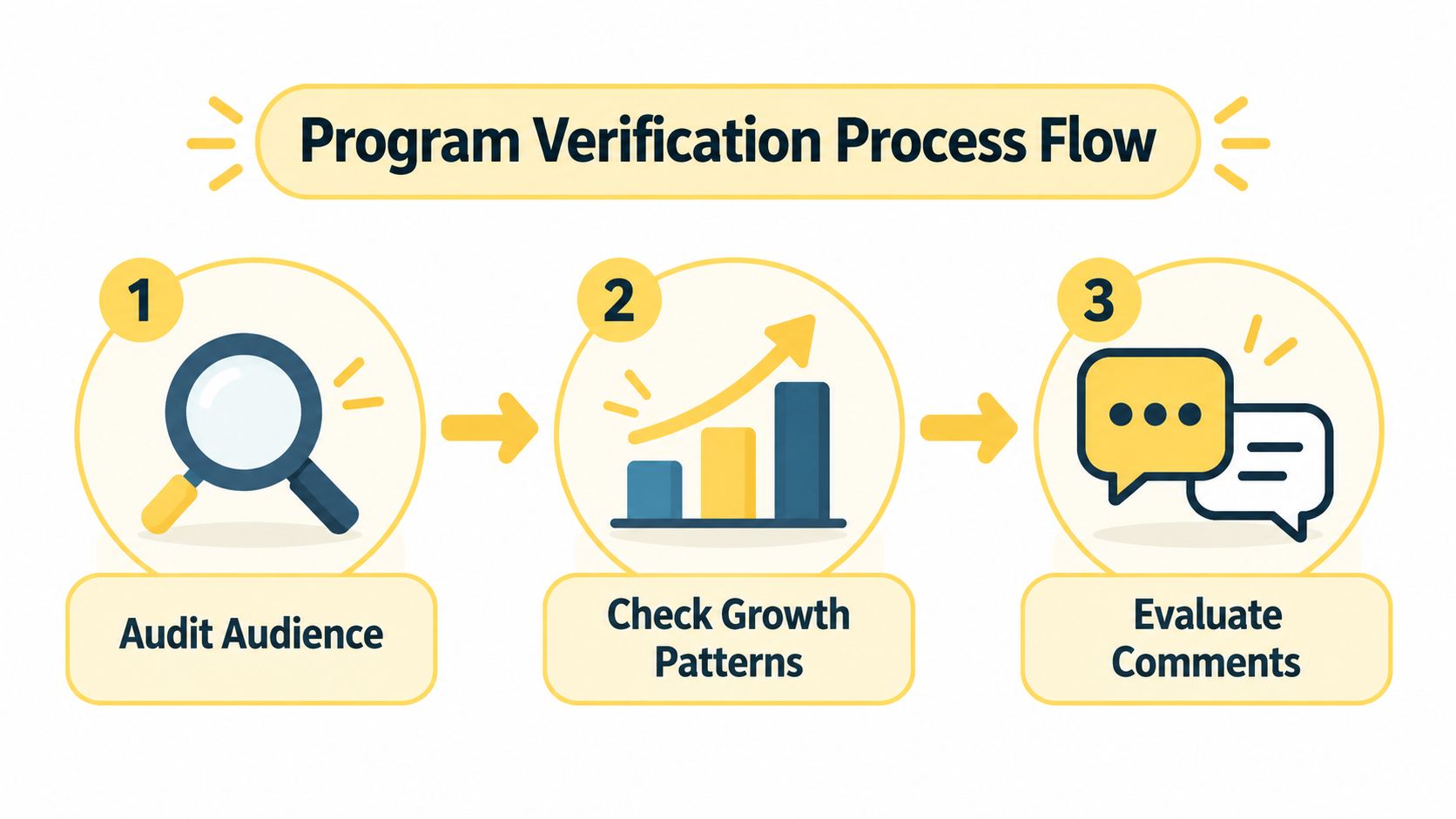
A coach once showed me a partnership offer with impressive engagement on recent posts. The comments were almost entirely generic praise, the audience locations didn't match the coach's market, and the brand couldn't explain how it calculated previous conversions. She declined. The opportunity looked attractive until she asked for evidence.
Demand attributable reporting
Every serious program needs a way to connect your work with outcomes. Request:
- A unique URL or coupon code.
- UTM parameters tied to your campaign.
- A CRM field identifying ambassador-sourced leads.
- A definition of qualified lead and conversion.
- Reporting that separates assisted conversions from last-click sales.
- Treatment of duplicates, refunds, and cancellations.
- A regular reporting cadence.
Likes alone don't tell you whether your recommendation reached the right people. For a coaching product, the scorecard might include qualified coach sign-ups, activated accounts, trial-to-paid conversion, retention after 60 to 90 days, and acquisition cost. Those measures should sit alongside compliance and audience authenticity as eligibility gates.
A program that refuses transparent attribution isn't offering partnership. It's asking you to fund its uncertainty with your reputation.
Set minimum data requirements before judging performance. One or two conversions don't provide a reliable basis for renewal, and self-reported impressions shouldn't replace tracked activity. Where practical, compare results with a pre-campaign baseline or a holdout audience. Staggering ambassador activation can also help distinguish genuine incremental demand from sales that would have happened anyway.
Review performance by audience segment and content format. A webinar may create qualified leads, while a short social post creates awareness. Treating both as identical hides useful information and encourages the brand to overvalue cheap reach.
Your contract should also specify who owns the tracking data and when you'll receive it. You can't improve your contribution if the brand keeps every meaningful result behind a vague monthly update.
Maintaining Long-Term Brand Relationships
A lasting ambassador relationship grows from dependable execution, not constant enthusiasm. Deliver what you agreed to, disclose every material connection, preserve client confidentiality, and send the brand a clear account of what happened.
A publicly filed ambassador agreement requires promotion across named social platforms and at least two content items every calendar month, as shown in the filed ambassador agreement. The specific requirement may differ in your contract, but the principle is useful: define frequency, channel, format, deadline, and approval process.
An executive coach could agree to publish one LinkedIn insight and one short video each month demonstrating how a sponsor's planning tool supports client accountability. She should explain her actual workflow, avoid exposing client details, disclose the partnership where the recommendation appears, and record the link, reach, qualified responses, and conversions.
Make renewal evidence-based
Use a simple operating rhythm:
- After publication: Save the live link, disclosure, creative, and approval record.
- During the campaign: Monitor traffic quality, audience questions, and compliance issues.
- At review time: Share attributable activity, qualified leads, conversions, retention signals, and costs.
- Before renewal: Decide whether the partnership created incremental value for both parties.
Renewal should follow results, not habit. A brand that changes its claims, misses payment dates, or refuses reporting isn't entitled to automatic loyalty. You can remain professional while ending the arrangement.
If you're researching how companies identify suitable partners, this guide to finding authentic ambassadors is useful because it reinforces the same standard you should apply to yourself: relevance, reliability, and genuine connection.
The strongest ambassador relationships feel natural because the operations are precise underneath. You know what you owe the brand, the brand knows what it owes you, and your audience knows when a recommendation is commercial. That combination protects your authority while creating room for a partnership to become a meaningful business asset.
Coachful helps coaches manage the practical work behind credible partnerships, from client delivery and scheduling to secure payments, progress tracking, resources, and organized workflows. If you want to demonstrate a professional coaching operation while keeping client information controlled, visit Coachful and build the system your next brand partnership can trust.