10 Best Accountability Software for Coaches in 2026

Coachful
A promising coaching program can lose momentum between sessions. Clients leave a call motivated, agree to complete a task, and then miss the check-in, forget the habit, or fall behind. You end up sending follow-up messages, reconstructing progress from scattered notes, and wondering whether a silent client is progressing or just reporting less.
The best accountability software for coaches does more than send reminders. It makes commitments visible, gives clients a simple way to act, reduces administrative chasing, and shows you where support is needed without turning the relationship into surveillance. The right choice depends on the problem you're solving: full coaching operations, structured programs, health tracking, lightweight practice management, behavioral nudges, commitment stakes, or team outcomes.
I ranked these tools by accountability depth, program fit, workflow coverage, pricing clarity, scalability, client experience, and practical limitations. If you're still defining the human role around your software, start with this guide to finding the right accountability partner. Then choose the platform that fits the way your clients work between sessions.
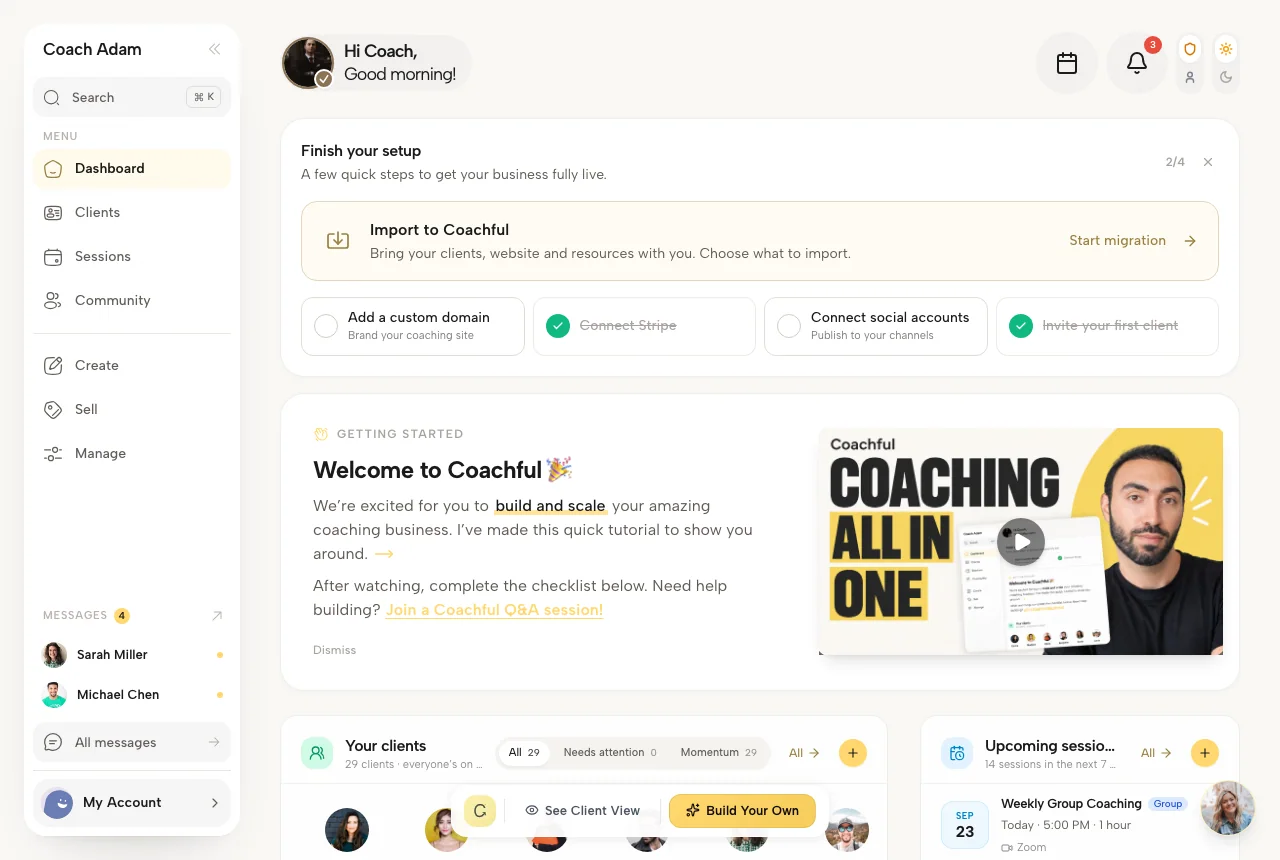
1. Coachful
When a coaching business runs on separate calendars, payment tools, course platforms, message threads, and spreadsheets, accountability breaks at the handoffs. Coachful is the strongest fit when you need to run those operations and manage follow-through in the same workspace.
It covers client onboarding, scheduling, payments, messaging, program delivery, tasks, habits, analytics, and follow-up automation. A client can join a program, book through Google or Outlook calendar sync, receive lessons and assignments, track habits, message you, and review progress without switching between unrelated tools. You can see goals, session notes, tasks, check-ins, and client details together.
That broader setup also supports group programs, cohorts, community feeds, gated content, and automated lesson delivery. The same workflow can serve a private client, a growing cohort, or an academy without forcing your team to rebuild its process for each format.
Where Coachful earns its place
The practical gain is continuity after a missed check-in. A missed task can trigger a nudge, appear in engagement reporting, and give you a concrete topic for the next call. An AI assistant can summarize calls, draft content, generate action items, and help nudge clients. Coaches can train an AI Coach on their own materials, with voice-cloning capabilities available for a consistent branded experience.
Practical rule: If the commitment lives in one app, the reminder in another, and the review in a spreadsheet, your accountability system is leaking.
Coachful offers a Solo plan from $49 per month, a Studio plan at $199 per month with three coach seats and unlimited clients, and custom Agency plans for larger teams. It also offers a 7-day free trial. Coachful says its all-in-one approach can replace an app stack costing $350 or more per month, though actual savings depend on the tools you already use. Coachful's accountability workflows and client portal also cover permissions, encrypted messaging options, flexible branding, custom domains, funnels, renewals, and WhatsApp integrations.
The trade-off is administration at scale. Higher-tier team features and added seats can raise the budget. Moving away later may take work if you build custom programs, content, payment histories, or AI configurations inside the system. Larger organizations should confirm enterprise integrations and custom requirements with the sales team.

2. CoachAccountable
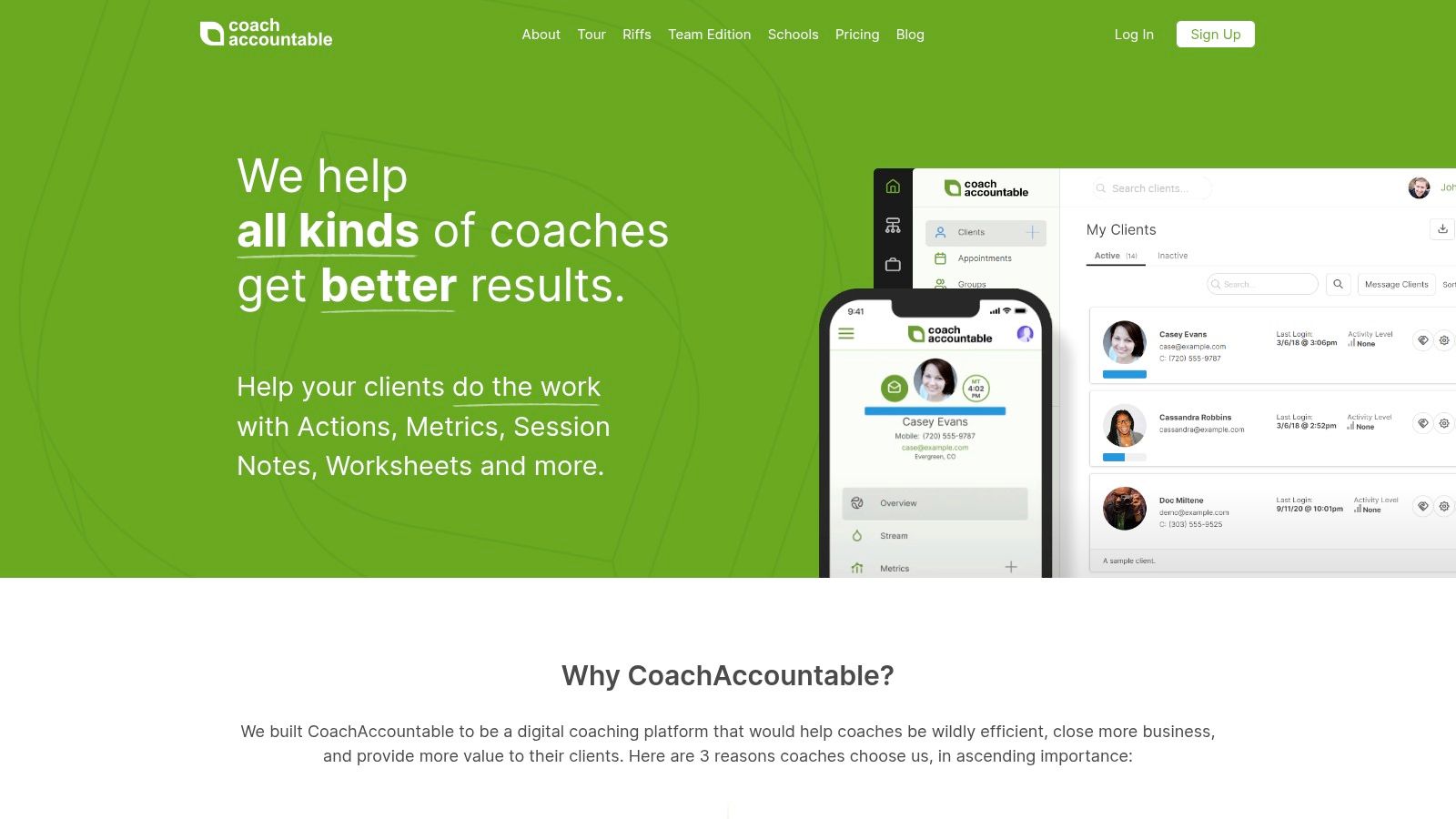
CoachAccountable is the best fit when your central question is simple: Did the client do what they agreed to do? The platform is built around action items, check-ins, metrics, projects, forms, reminders, and progress visibility. It treats accountability as a record of commitments and follow-through, not just a collection of motivational messages.
That makes it especially useful for coaches who run structured engagements. You can assign a client an action after a session, set a due date, collect a check-in, and review the activity trail before the next conversation. Group metrics and cohort features help you see whether a program is moving together or whether several participants are stalling at the same point.
Best for accountability-first coaching
The client portal gives participants a clear place to see what's expected. Time-stamped tasks and automated reminders create useful evidence when a client says, “I thought I'd done that,” or when you need to separate a motivation issue from a confusing assignment. The Team Edition also helps multi-coach practices standardize delivery and give supervisors visibility across coaches.
If your practice already has reliable systems for payments, marketing, and scheduling, CoachAccountable's accountability depth may be exactly what you need. If you're tired of assembling those systems yourself, its narrower operational scope may push you toward a broader platform such as client management software from Coachful.
CoachAccountable prices around active clients rather than charging separately for each coach or administrator. That can work well for a team with several coaches and a controlled client roster, but the cost can feel heavier as the active roster grows. It offers a 30-day full-featured free trial, giving you enough time to test a real client workflow rather than judging the platform from a quick demo. The interface is available in English only, which may matter if your clients or coaching team need broader language support.
The limitation isn't accountability. It's breadth. CoachAccountable is a strong commitment-tracking environment, but you may still need adjacent tools for a fully branded website, advanced funnels, richer course commerce, or a unified marketing engine.
3. Delenta
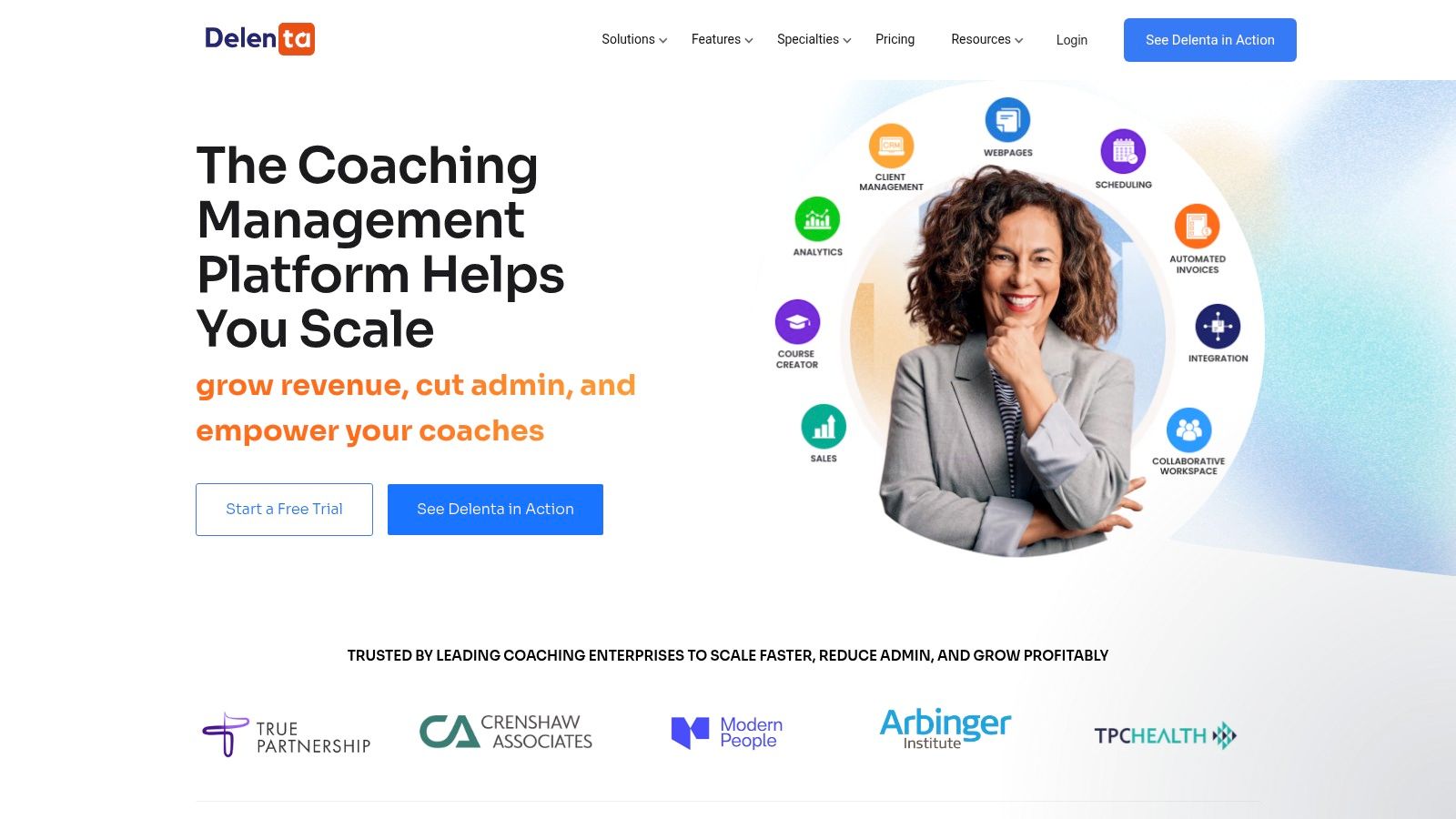
Delenta suits coaches who need client accountability alongside day-to-day practice operations. Delenta combines client goals, tasks, progress reports, group coaching, course delivery, invoicing, forms, calendar synchronization, and role-based permissions, giving a solo coach a workable alternative to managing a separate CRM stack.
It fits a solo practice that has outgrown disconnected tools and a multi-coach business that needs administrative controls. Stripe and PayPal payments, multi-calendar support, mobile access, and white-label branding reduce the number of systems clients and coaches must use.
Where it fits best
Delenta works best when recurring goals and deliverables matter more than elaborate learning architecture. An executive coach can assign preparation before each session, request a progress update, review goals, and handle invoicing in one system. A coaching school can add group programs and course materials without rebuilding its practice around a dedicated learning platform.
The practical result is fewer missed handoffs. A client can review a task between meetings, while the coach can see progress before a check-in instead of chasing updates across email, documents, and messaging apps. Mobile access matters when commitments arise during a commute or between meetings, because the client can respond without waiting to return to a laptop.
Delenta's main buying concern is pricing clarity. Plan details and limits can vary across comparison pages, and features may change as the site is updated. Ask for current limits on clients, coaches, storage, course delivery, branding, permissions, and reporting before migrating.
Privacy requires disciplined setup. Separate session notes, billing information, and marketing contacts, restrict access by role, monitor who can view sensitive material, and define what happens when a client leaves. Solutions Academy's coach data protection guidance recommends practices such as unique passwords, multi-factor authentication, protected storage, password managers, locked screens, and secured email and scheduling accounts.
Choose Delenta when you want broad practice administration with built-in accountability and can confirm that its current plan limits match your operation. If you need one workflow spanning scheduling, payments, messaging, CRM, automation, branding, and ongoing client management, Coachful may justify the move to an all-in-one platform.
4. Practice Better
Practice Better is the clear specialist choice for health and wellness coaches who need accountability tied to behavior, routines, journals, metrics, and client records. It supports tasks, reminders, client journals, habits, programs, courses, portals, and integrations with tools such as Zoom, calendars, Fitbit, and Apple Health.
A wellness coach may ask a client to record meals, complete a reflection, follow a routine, and report a health-related metric before the next appointment. Practice Better gives the client a dedicated place to complete those actions and gives the coach a richer picture than a simple “done” checkbox.
Health workflows need more than streaks
The platform supports self-paced and fixed-date programs, which helps when your clients need either flexibility or a defined cohort schedule. Mobile apps make logging more practical, while compliance features address the concern behind many health-coaching purchases: “Can I manage sensitive information without creating unnecessary exposure?”
Practice Better is described as HIPAA-ready and supports HIPAA, PIPEDA, and GDPR-related compliance features. Compliance isn't a substitute for sound operating practices, though. You still need to configure permissions, secure accounts, control access, and establish a retention policy. Delenta's guidance on data protection for coaches recommends setting retention periods and using calendar reminders to review, delete, or anonymize former-client data, including a quarterly review rhythm.
The platform offers a free tier and team plans, with documentation and plan comparisons that are frequently updated. That makes it easier to start small and assess fit. Some users report that costs rise as needs become more advanced, and reviews have raised invoicing complexity. Test the billing workflow with your real offers, payment structure, and client records before committing.
Practice Better is stronger than general coaching software for health data and behavior tracking. Coachful becomes more compelling when your practice needs those workflows plus broader funnels, branding, AI-assisted content, community, and general-purpose program delivery.
5. upcoach
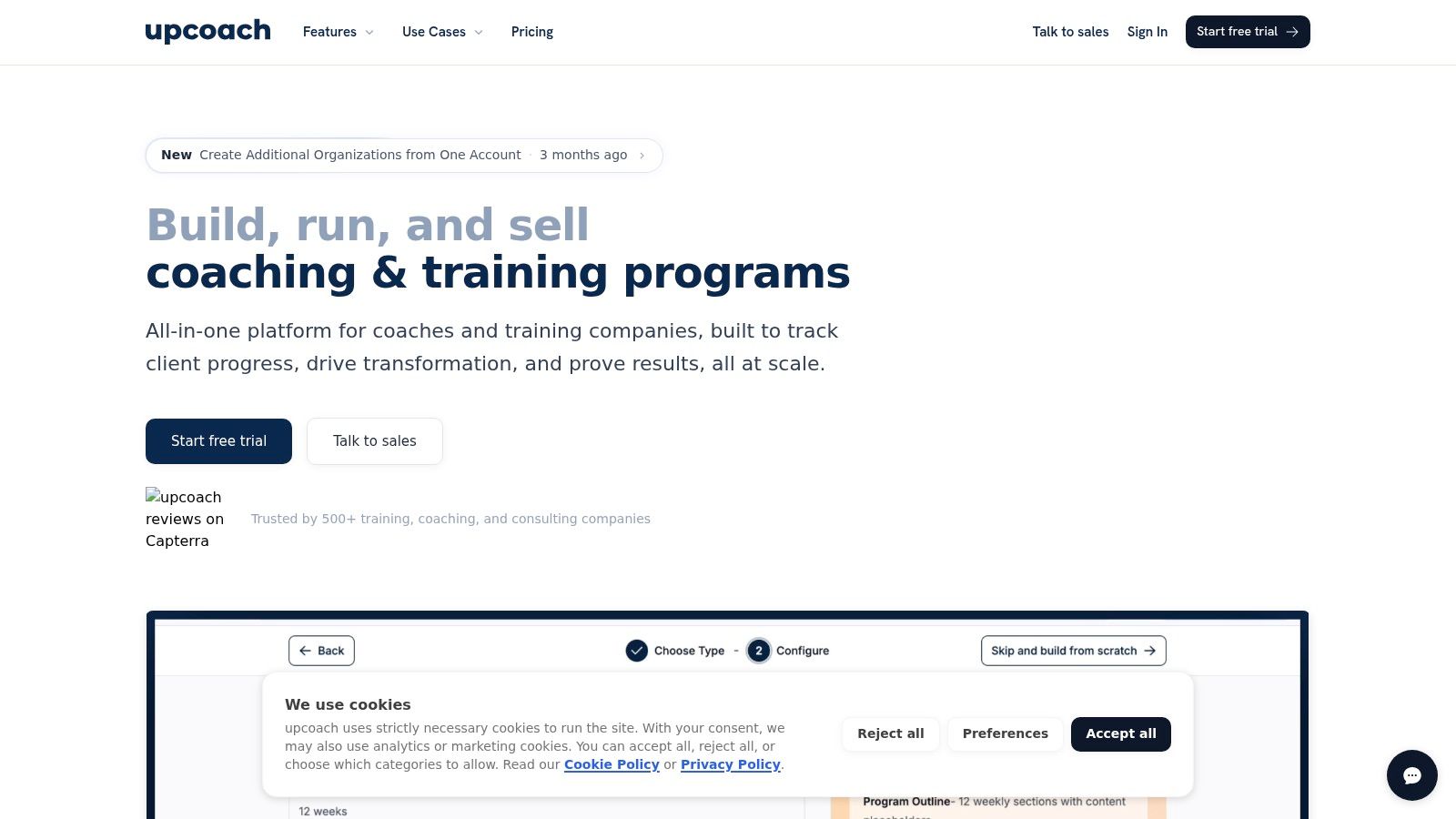
upcoach solves a different problem from CoachAccountable. It's designed for coaches who sell a repeatable program, cohort, mastermind, bootcamp, or corporate learning experience and need participants to keep moving through a defined path.
You can build reusable curricula with worksheets, activities, tasks, check-ins, events, and progress views. A participant who misses a worksheet or falls behind in a module becomes visible before the next live call. Peer visibility and community features add social pressure without requiring you to personally chase every participant.
When the program is the product
Say you're running a six-week leadership cohort. Week one includes a reflection worksheet, a group event, and a personal action. Week two asks participants to report progress and respond to a prompt. upcoach gives you a structured environment for delivering those steps, while dashboards help identify who hasn't engaged.
That structure answers a common coach concern: “How do I deliver the same standard without making every client experience feel automated?” You can reuse the program architecture while keeping coaching conversations and participant interaction personal. AI integrations, including connections with tools such as Claude and ChatGPT, can support reporting and operational insight.
upcoach is also a good choice for branded delivery, with custom domain options and a participant experience built around the program rather than a general task list. It fits corporate training and group education better than a platform designed mainly for one-to-one client records.
The compromise is CRM depth. If your work depends on detailed sales pipelines, extensive client records, complex billing, and broad practice administration, you may need another system. Participant-count pricing can also require a plan change as enrollment expands, so test the numbers against your largest expected cohort rather than your smallest pilot.
Choose upcoach when program progression is the accountability mechanism. Choose Coachful when the program must sit alongside scheduling, payments, messaging, CRM, automation, branding, and ongoing client management.
6. CoachVantage
CoachVantage is the sensible choice for a solo coach who wants to leave point tools behind without taking on an enterprise-style platform. It combines client goals, assignments, progress tracking, scheduling, contracts, e-signatures, invoicing, group programs, and simple course delivery inside a branded client portal.
The experience is straightforward. After a session, you can assign a goal, attach an activity, schedule the next appointment, and keep the client's work connected to the engagement. Two-way calendar synchronization and Zoom or Meet integrations remove friction from scheduling, while Stripe and PayPal support billing.
A clean entry point for growing practices
CoachVantage's published plan limits and feature descriptions make budgeting easier. That's useful when you're asking, “Can I afford to move from spreadsheets now, and will this still work as my practice grows?” An entry tier gives new coaches a lower-friction starting point, while larger plans expand capacity.
It also supports group programs and basic course delivery, so you aren't limited to one-to-one coaching. A coach launching a small workshop can create a program page, collect agreements, share materials, and assign follow-up tasks without purchasing a separate course platform.
The trade-off is depth. Storage and course limits may become restrictive for content-heavy programs, and the feature set is lighter than broad enterprise suites. You'll want to check how your current library, contracts, payment history, and client records would fit before moving everything.
CoachVantage works best when accountability means clear goals, visible assignments, and a professional portal. It won't replace every specialist system. If your practice needs deeper analytics, advanced automation, AI support, marketing funnels, and extensive community workflows, Coachful's broader coverage justifies the move to an all-in-one platform.
7. Focusmate
Focusmate solves the moment when a client knows what to do but can't start. It's a virtual body-doubling service that pairs people for live, scheduled work sessions. Participants state their intention at the beginning, work with focus, and report back at the end.
That simple rhythm can help a client complete a writing block, prepare a presentation, process a backlog, or finally begin the habit they've been postponing. For an ADHD-friendly coaching practice, Focusmate can serve as an execution layer between deeper coaching conversations.
Strong nudge, narrow system
Focusmate offers a free plan with three sessions per week, while Plus provides unlimited sessions. A Business option is available for teams and communities. Those are product-plan details from Focusmate's stated offering, not a promise that every client will experience the same outcome.
The advantage is low friction. You don't need to design a curriculum or maintain a client database. You can recommend a session when a client says, “I keep planning the task, but I never sit down to do it.” The partner's presence creates a social commitment at the exact point of execution.
The weakness is equally clear. Focusmate has no CRM, billing, course delivery, or coaching record. Matching depends on availability and time zone, so the partner experience can vary. It also doesn't tell you whether the client's weekly goal is strategically sound or whether repeated no-shows signal a deeper barrier.
Use Focusmate as a complement, not your practice backbone. It's excellent for a stalled habit that requires a start time. It isn't the right choice for managing onboarding, program milestones, client notes, payments, or cohort analytics.
8. Beeminder
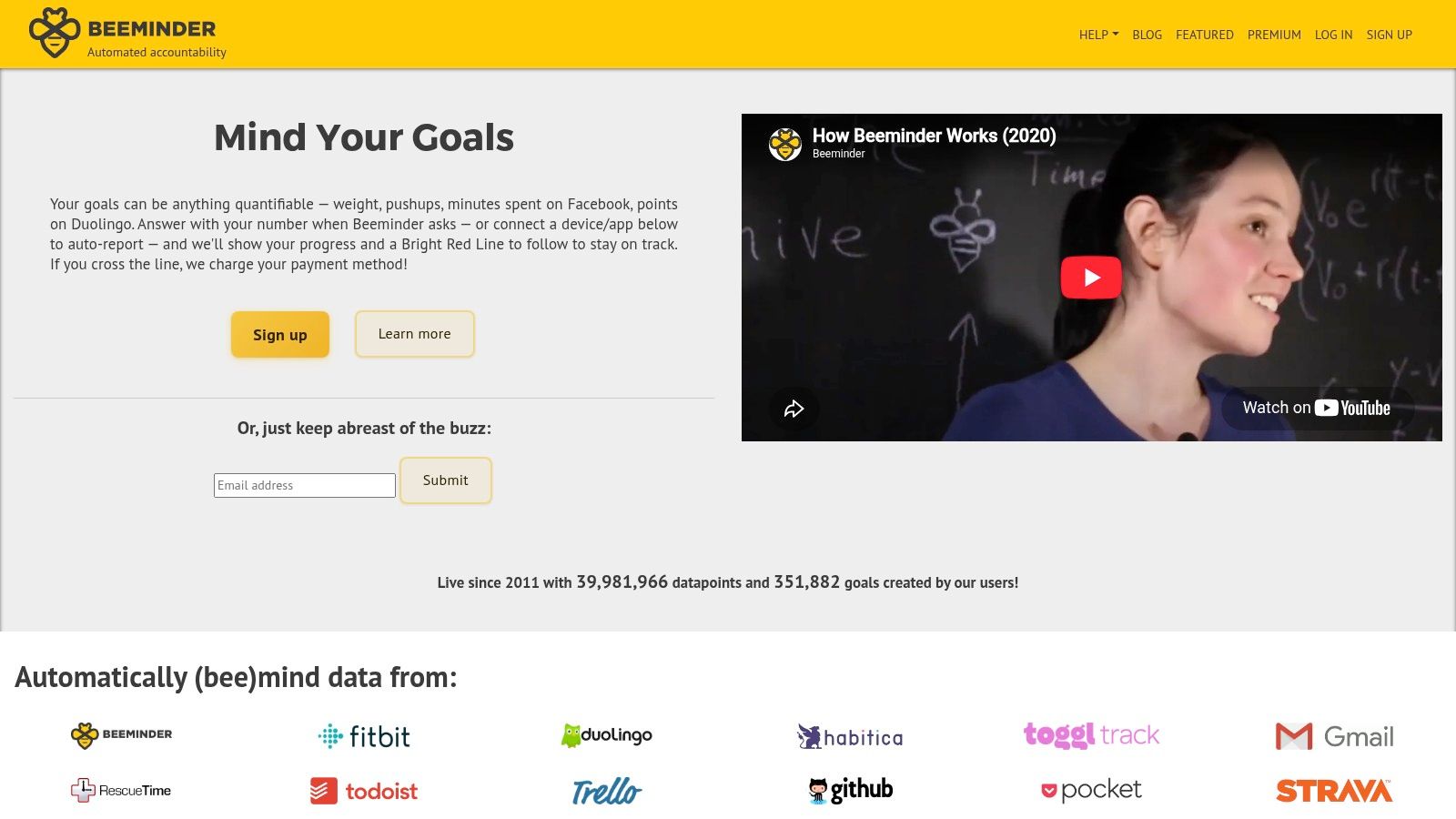
Beeminder suits clients who respond to quantified targets and financial consequences. It combines graphs, hard commitment lines, pledge escalations, and integrations with apps and wearables. When behavior leaves the agreed path, the financial stake adds pressure to act.
That approach works for a specific, measurable commitment. A client can connect a tracking source, set a target, and check whether daily behavior remains on course. Integrations with services, wearables, IFTTT, Zapier, and Beeminder's API can provide automated evidence, reducing manual follow-up work. Coaches who want a clearer reminder process can also review these follow-up reminder practices.
Choose consequences carefully
Financial stakes require a deliberate fit. Some clients find loss aversion motivating. Others experience it as punitive, particularly when the goal involves shame, health anxiety, or an already stressful situation.
The question isn't whether a client can pay for failure. It's whether the consequence supports the behavior you're trying to build.
Use Beeminder when the commitment is specific, measurable, and within the client's control. It is a poor fit for exploratory coaching, complex emotional goals, or outcomes that depend heavily on other people. The coach still has to define the goal, interpret the graph, and reset the plan when the target proves unrealistic.
Beeminder does not cover client onboarding, billing, session management, coaching records, or program delivery. It is a focused commitment layer, not a practice platform. If you already use Coachful or another coaching system, it can add consequences for selected clients. If you need one system for intake, follow-up, delivery, and administration, choose Coachful instead.
Use Beeminder when the problem is commitment without consequence, and only after confirming that the client wants this mechanism.
9. stickK
stickK turns a goal into a commitment contract. Clients can create one-shot or ongoing commitments, set reporting expectations, add referees and supporters, and direct financial stakes to a charity or another recipient when the contract fails.
That structure is useful when a client needs a clear deadline and an accountability partner outside the regular coaching relationship. For example, a client working toward a certification could ask a trusted colleague to verify weekly progress while you focus on planning, obstacles, and reflection during coaching sessions.
Useful structure without practice overhead
stickK is free to create commitments. Charges apply when monetary stakes are used and failure is reported. That lets clients choose a light-touch commitment or add a consequence when they believe it will help.
The social layer is the differentiator. A referee can verify progress, while supporters can provide encouragement. This can make a promise more visible than a private tracker, particularly for clients who already have a trusted friend, colleague, or family member willing to participate.
The limitations are important. stickK isn't a CRM, scheduler, billing system, client portal, or program-delivery platform. Its interface can feel dated compared with newer tools, and some features vary by goal type. You'll still need somewhere to document the coaching relationship and review patterns over time.
Use stickK when you want to add social accountability and consequences to an existing coaching method. Don't make it the core of a growing practice. If your clients need contracts, programs, messaging, payments, notes, and progress tracking in one place, Coachful offers the broader workflow, while stickK remains a targeted add-on.
10. Tability
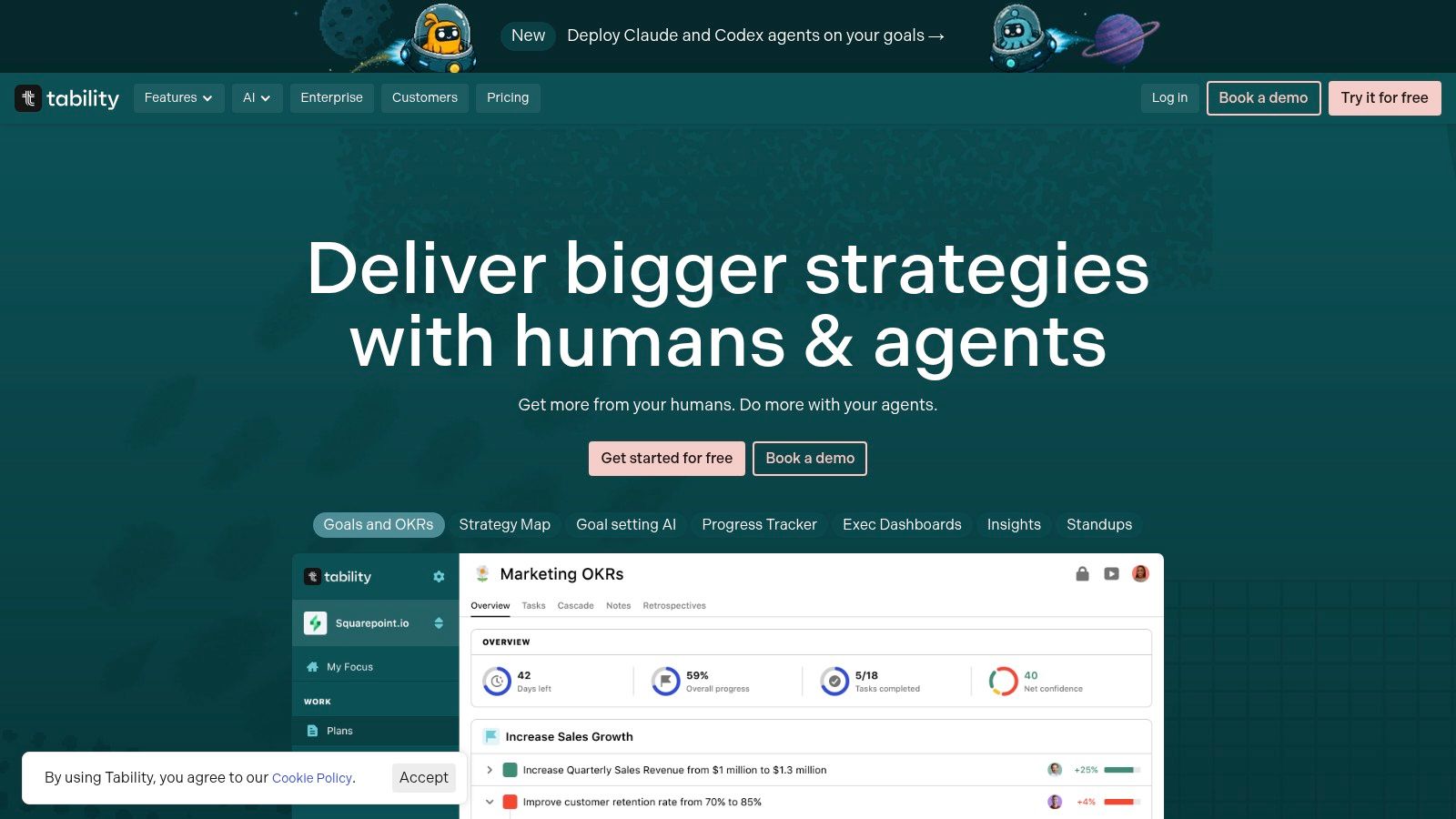
Tability fits teams that need accountability around shared outcomes rather than individual client commitments. It combines recurring weekly check-ins, initiative tracking, strategy maps, reporting, integrations with Slack, Teams, Jira, and Linear, and an AI assistant for goal formulation and insights.
A leadership coach supporting a department can turn a broad objective into visible outcomes and weekly updates. The coach reviews progress signals, spots blocked initiatives, and uses the next session for decisions instead of collecting separate status messages. That makes Tability particularly useful when team reporting is inconsistent or a growing cohort needs one shared view.
A lighter cadence for team outcomes
Tability suits teams that want a weekly rhythm without adopting a heavyweight OKR process. Its low per-seat positioning makes it approachable for teams new to outcome tracking, while integrations connect goals with the tools where work already happens.
The trade-off is scope. Tability does not handle client records, health information, EHR workflows, detailed coaching notes, or full program administration. Advanced access controls and data connectors require higher-tier plans, so corporate buyers should test permissions and integration requirements before rollout.
Choose Tability when the accountability question is, “Are we moving toward the outcome, and what is blocking us this week?” Choose another system when you need to know what an individual client committed to, what they received, what they paid, and what should happen next.
For practical guidance, how coaches can track client progress inside Coachful shows why completed tasks are only one signal. A team or client can report activity while remaining misaligned with the outcome. Tability provides outcome visibility. Coachful connects outcomes with sessions, programs, habits, communication, and client administration, so its broader workflow coverage justifies choosing an all-in-one platform when missed check-ins and overloaded administration are the larger problem.
Top 10 Accountability Software Comparison
| Product | Core focus / Key features | Unique selling points (✨) | Target audience (👥) | Value / Pricing (💰) | Quality / UX (★) |
|---|---|---|---|---|---|
| Coachful 🏆 | All‑in‑one ops: onboarding, scheduling (Google/Outlook/Zoom), payments, programs, analytics, AI assistant | ✨ Trainable AI Coach & voice clone, built‑in site/funnels, program automation | 👥 Solo coaches, multi‑coach teams, schools, corporate programs | 💰 Solo $49/mo, Studio $199/mo (3 seats), Agency custom; 7‑day trial; replaces multi‑app stacks | ★★★★★ |
| CoachAccountable | Accountability-first: action items, automated check‑ins, metrics, client portal, Team Edition | ✨ Time‑stamped tasks, cohort metrics, auditability | 👥 Solo & multi‑coach programs | 💰 Pricing by active clients; 30‑day trial | ★★★★☆ |
| Delenta | Ops + payments: tasks/goals, reporting, course delivery, invoicing, mobile app | ✨ Flat‑fee approach, white‑label branding, role permissions | 👥 Solo coaches → multi‑coach enterprises | 💰 Predictable flat fees; Stripe/PayPal built‑in | ★★★★ |
| Practice Better | HIPAA‑ready practice management: tasks, journals, habit/metric tracking, integrations | ✨ Compliance (HIPAA/PIPEDA/GDPR), health app integrations | 👥 Health & wellness coaches, clinics, corporate wellness | 💰 Free tier → team plans; some report rising costs | ★★★★ |
| upcoach | Program-centric: reusable curricula, worksheets, tasks, participant dashboards | ✨ AI flags at‑risk participants, peer/community features | 👥 Cohorts, masterminds, corporate training | 💰 Participant‑count pricing; branded participant experience | ★★★★ |
| CoachVantage | Lightweight ops: goals, assignments, scheduling, contracts, invoicing, simple courses | ✨ Clear published limits, budget‑friendly entry tier | 👥 New/solo coaches moving from point tools | 💰 Affordable entry tiers; scalable plans | ★★★☆ |
| Focusmate | Virtual body‑doubling: scheduled 50‑min partner sessions with check‑ins | ✨ Live accountability sessions, simple behavioral nudge | 👥 Individuals needing focus (ADHD‑friendly), teams | 💰 Free (3/wk) or Plus unlimited; business plans available | ★★★★ |
| Beeminder | Commitment device: graphs, hard commitments, pledge escalations, many integrations | ✨ “Bright red line” + optional monetary stakes for failure | 👥 Habit‑driven clients motivated by financial consequences | 💰 Low base fees; pay‑on‑failure model optional | ★★★★ |
| stickK | Commitment contracts: referees, supporters, weekly reporting, directed stakes | ✨ Referees/supporters + charity or recipient stakes | 👥 Anyone wanting formal commitment + social accountability | 💰 Free to set goals; charges only if monetary stakes used and failure reported | ★★★ |
| Tability | Lightweight OKRs: weekly check‑ins, initiative tracking, reporting, AI assist | ✨ OKR cadence + Slack/Teams integrations, AI goal help | 👥 Small teams or cohorts adopting outcome roll‑ups | 💰 Low per‑seat cost; paid tiers for advanced controls | ★★★★ |
Choose the Accountability Layer Your Practice Can Sustain
The market around accountability software is expanding because organizations increasingly want measurable goals, progress tracking, and evidence of follow-through. Industry summaries place employee monitoring adoption at about 78% of employers by 2026, compared with roughly 60% in 2021 and about 30% in 2019, while the employee monitoring software market is projected at USD 3.89 billion in 2025 and USD 8.29 billion by 2030. These figures describe a broader workforce-monitoring category, not coaching software specifically, but they show why buyers are separating useful visibility from invasive surveillance. The employee-monitoring adoption analysis provides that market context.
The OKR ecosystem points in the same direction. One market summary projects the OKR software market at USD 1.51 billion in 2025 and USD 5.15 billion by 2034, with a 14.60% CAGR, while another coaching-platform analysis estimates the global coaching platform market at $4.2 billion in 2025 and $11.8 billion by 2034, with software representing 67.9% of 2025 market share. Those projections reinforce a practical point: coaches and organizations are investing in systems that connect goals, actions, evidence, and review rhythms. See the OKR statistics overview and the coaching platform market analysis for those estimates.
Choose Coachful when onboarding, scheduling, payments, messaging, program delivery, habits, automation, branding, and analytics need to live together. It's the strongest all-in-one option for a solo practice, multi-coach team, coaching school, corporate program, or course business that wants accountability connected to the entire client journey.
Choose CoachAccountable when your practice already has its operational basics covered and you want the deepest commitment, action, metrics, and check-in workflow. Choose upcoach when the program itself is the product and cohort progression matters more than CRM breadth. Choose Practice Better for health and wellness coaching where journals, metrics, integrations, mobile access, and privacy controls carry more weight.
Use Delenta or CoachVantage when you want broader practice management with a lighter operational footprint. Add Focusmate when clients struggle to start, Beeminder or stickK when a client deliberately wants financial stakes, and Tability when team outcomes and weekly OKR check-ins are the priority. These tools solve different accountability problems, so don't judge a body-doubling service by whether it can process invoices or judge a practice platform by whether it can enforce a financial pledge.
Roll out the system in a controlled way:
- Define one measurable commitment: Make the first action clear enough for a client to complete and report without interpretation.
- Configure the cadence: Set the reminder, check-in, deadline, and review point before assigning the commitment.
- Explain the review: Tell clients what you'll look at, when you'll look at it, and how missed actions will shape the next conversation.
- Pilot with a small group: Test the workflow with real clients before moving an entire cohort or practice.
- Audit missed actions: Look for confusing instructions, unrealistic deadlines, weak reminders, or a mismatch between the accountability mechanism and the client's motivation.
Research-linked material on accountability partnerships warns that check-ins can increase visible logging while reducing actual study time or encouraging performative compliance. Clear personal goals and richer partner communication can reduce those negative effects, which is why dashboards alone shouldn't define success. The Capterra research discussion on accountability and software is useful for making that distinction.
Your privacy process also needs an endpoint. Protect records with access controls, multi-factor authentication, encrypted storage, screen locks, and role-based permissions. Set a retention period, review inactive records, and delete or anonymize information you no longer need, as recommended in coach-focused data protection guidance. A platform can support good governance, but it can't replace the decisions your practice makes about access, retention, and client offboarding.
The best system is the one you'll maintain and your clients will use between sessions. Start with one behavior, make the evidence visible, and choose the smallest accountability layer that can reliably support it. Expand only after the workflow survives missed check-ins, busy weeks, stalled habits, and the administrative reality of your practice.
Coachful brings onboarding, scheduling, secure payments, messaging, programs, habits, tasks, automation, branding, and progress analytics into one coaching workspace. Visit Coachful to see how a broader accountability workflow can keep client commitments visible while reducing the follow-up work that steals time from coaching.