Coaching Client Complaint Response: 5 Email Templates

Nour
Founder, Coachful
How do you reply when a coaching client complains without making the situation worse? Acknowledge the specific concern, separate what you know from what you need to check, and give a realistic time for your next response. Do not turn the first email into a defense of your coaching, a renewal pitch, or an instant promise you cannot keep.
A complaint can arrive after a genuinely useful session. It can also expose something you missed: an unanswered message, a resource you promised, a confusing program description. Your job is to investigate the experience, not persuade the client that they should have enjoyed it.
These five coaching client complaint response email templates cover the first acknowledgment, a delivery mistake, disappointment with progress, a support-scope mismatch, and a serious conduct or confidentiality concern. They are original examples to adapt, not legal wording or evidence of client outcomes.

Before replying, decide which kind of complaint this is
Read the message once for the facts and again for the request. “I felt rushed” and “you ended three sessions early” are different claims. Both deserve attention, but the second also gives you something concrete to verify.
- Delivery: something agreed did not happen, such as a session, resource or response.
- Experience or progress: the client says the work is not useful, relevant or moving in the direction they expected.
- Scope: you and the client understood access, support or responsibilities differently.
- Conduct, confidentiality or safety: the concern may require a formal process, specialist advice or immediate protective action.
A refund request or a payment dispute may sit alongside any of these. Do not substitute this article for the coaching refund guide when money is the main decision. This guide focuses on what to say and how to follow through on a complaint, whether or not the client wants to continue.
Choose a response time you can actually meet. A same-working-day acknowledgment is a sensible service target when feasible, not a universal legal deadline. If your agreement or an applicable process sets a different requirement, follow it. Serious concerns can require faster action.

1. First acknowledgment: when you need to check the facts
Use this when the complaint is clear enough to acknowledge but you have not yet reviewed what happened. The first reply should stop the client wondering whether you read their message. It does not need to settle the entire case.
Subject: Your concern about [specific issue]
Hi [Name],
Thank you for telling me about [brief, neutral description]. I understand that [the impact they described] has been frustrating.
I want to review this properly rather than give you an answer based on memory. I will check [relevant agreement, session detail or message thread] and write back by [day, time and timezone].
If you would prefer to explain anything by email, that is absolutely fine. A call is available if it would be easier for you.
[Coach name]
Why it works: it names the issue, explains the limited review, and makes a specific commitment. “I am looking into it” with no next update leaves the client managing your investigation for you.
Do not ask them to repeat a detailed complaint in a form before acknowledging it. If one fact is genuinely missing, ask one useful question: “Which session date are you referring to?” Avoid sending an interrogatory list that reads like a challenge.
Before using the template, replace every bracket. If you cannot finish the review by the time promised, update the client before that time, explain what is outstanding, and give a new realistic checkpoint.

2. Delivery mistake: when you did not do what you agreed
Use this only after confirming the mistake. Suppose you promised written feedback by Tuesday and did not send it. You do not need a paragraph explaining how busy Tuesday became. You need to own the missed commitment and state the repair.
Subject: Putting [missed deliverable] right
Hi [Name],
You are right that I said I would send [deliverable] by [date], and I did not. I am sorry you had to chase it.
I can provide [specific correction] by [date and time]. If that timing no longer helps, please tell me so we can discuss an appropriate alternative.
I have also [specific change already made] to prevent the same gap. I will confirm when [correction] is complete.
[Coach name]
Only include the prevention sentence if you have actually made that change. A reminder you intend to create is not a completed improvement. If the correction is still under review, say what you are checking instead.
Match the repair to the loss. Resending an inaccessible worksheet may solve an access problem. It does not automatically solve a coaching session you missed. Where the failure affects payment, contractual rights or a guarantee, review those obligations rather than inventing a credit on the spot.
Do not make the remedy conditional on a positive review, deleting criticism, or agreeing to renew. A service correction is not a marketing exchange.

3. Disappointment with progress: when the client says coaching is not helping
This complaint can feel like a judgment on your competence. Resist answering with a list of completed exercises or sessions attended. Attendance documents delivery; it does not prove the work met the client's needs.
Subject: Reviewing what is and is not working
Hi [Name],
Thank you for saying that the coaching has not felt useful in the way you expected. I would like to understand the gap rather than assume that completing the planned sessions has answered it.
Could you tell me which part feels least useful, and what you expected to be different by this point? We can discuss this in writing or arrange [a specific review option].
I will review the goal and approach we agreed, then suggest a concrete next step by [date]. That may mean changing the work, discussing whether I am the right fit, or considering how to end the engagement fairly.
[Coach name]
Ask about the experience without implying that the client must defend their feelings. “What did you expect to be different?” is useful. “Did you actually do all the homework?” as an opening response sounds like you have already decided who is responsible.
In the review, distinguish a guaranteed deliverable from a hoped-for outcome. You can be responsible for providing the promised sessions and resources without guaranteeing a promotion, a relationship outcome or a particular business result. Equally, do not use that distinction to excuse a misleading promise you made when selling.
If continuing makes sense, agree on a specific change and a review point. Do not promise that a new exercise will definitely produce the desired result. If fit has broken down, a respectful ending may be better than a retention attempt.

4. Support-scope mismatch: when you understood access differently
Use this when a client expected something such as daily responses, weekend availability or detailed document review, while your service was structured differently. First check the actual sales messages and onboarding material. The signed agreement is important, but it may not be the only expectation you created.
Subject: Clarifying support between our sessions
Hi [Name],
I understand you expected [specific support], and that the current arrangement has felt different. I will review how I described that support before we decide what needs to change.
The arrangement I have been working to is [plain-language scope and response window]. If my earlier explanation suggested something else, I want to address that directly.
By [date], I will send you a written summary of what I found and the available options. We can then agree how to proceed without leaving either of us guessing.
[Coach name]
Do not start with “as clearly stated in the contract.” Even when your terms are clear, that line turns clarification into a contest. Quote the relevant wording later if needed, explain what it means, and address any contradictory sales statement.
If the client now wants more support than they originally purchased, you can decline or discuss a different arrangement. But do not introduce a paid upgrade as the first answer to an unresolved delivery failure. Resolve what they were already owed first.
For a recurring mismatch, revise the plain-language support description at onboarding. Include where to send messages, typical reply windows, what happens outside those windows, and which requests fall outside coaching.

5. Serious concern: when confidentiality, conduct or safety is involved
This is not a routine unhappy-customer email. An allegation about sharing client information, harassment, discrimination, safeguarding or professional conduct may require a formal complaints process, insurer notification or qualified legal or professional advice. Do not use a template to postpone an urgent obligation.
Subject: Your concern about [neutral description]
Hi [Name],
I have received your concern about [brief description], and I am treating it seriously.
I will review [the relevant facts or process] and provide an update by [realistic date and time]. [Name or role] will be your contact for this review.
You can continue in writing if you prefer. I will explain the next steps and any applicable complaint or escalation route without asking you to withdraw your concern.
[Coach name]
Only name a reviewer who exists and is authorized. If the complaint is about you in a team practice, consider whether another appropriate person should manage the review. Do not promise independent investigation if you are investigating yourself.
Preserve relevant records, limit unnecessary access, and obtain advice about any immediate protective or notification steps. Do not delete messages, silently rewrite session notes, or circulate the complaint to colleagues who do not need it. Any later factual correction should be identifiable as a correction.
If someone is in immediate danger, follow the relevant emergency or safeguarding route. An email response deadline is not an emergency plan. For confidentiality decisions, also consult the coach's confidentiality guide and the rules that apply to your practice.
Close the loop with a factual written outcome
A friendly acknowledgment followed by silence is not complaint handling. Once you have reviewed the issue, explain what you checked, what you found, what will happen, and when. Where facts are disputed, state the uncertainty rather than presenting your interpretation as an established fact.
A useful outcome note includes:
- The issue reviewed: a short description in neutral language.
- The finding: what the available records do and do not establish.
- The action: the correction, revised arrangement or other decision, with an owner.
- The timing: a specific date or next checkpoint.
- The next route: how the client can ask a remaining question or use an applicable escalation process.

For a hypothetical missed-feedback complaint, the record might say: “Feedback promised Tuesday; client followed up Thursday; reviewed Friday; feedback sent Friday; client asked whether the timing affected their preparation.” That is more useful than “difficult client, resolved.” Keep observation separate from your opinion.
Do not mark the matter resolved just because you sent a reply. Record the action you completed and any disagreement that remains. A client does not have to endorse your conclusion for you to document it accurately.
Then make one justified process improvement. If two people misunderstood reply times, rewrite the support explanation. If a resource link was broken, test the actual client route. If you repeatedly miss a promised follow-up, change the delivery process rather than polishing the apology.

How Coachful can help you prepare, and what it does not decide
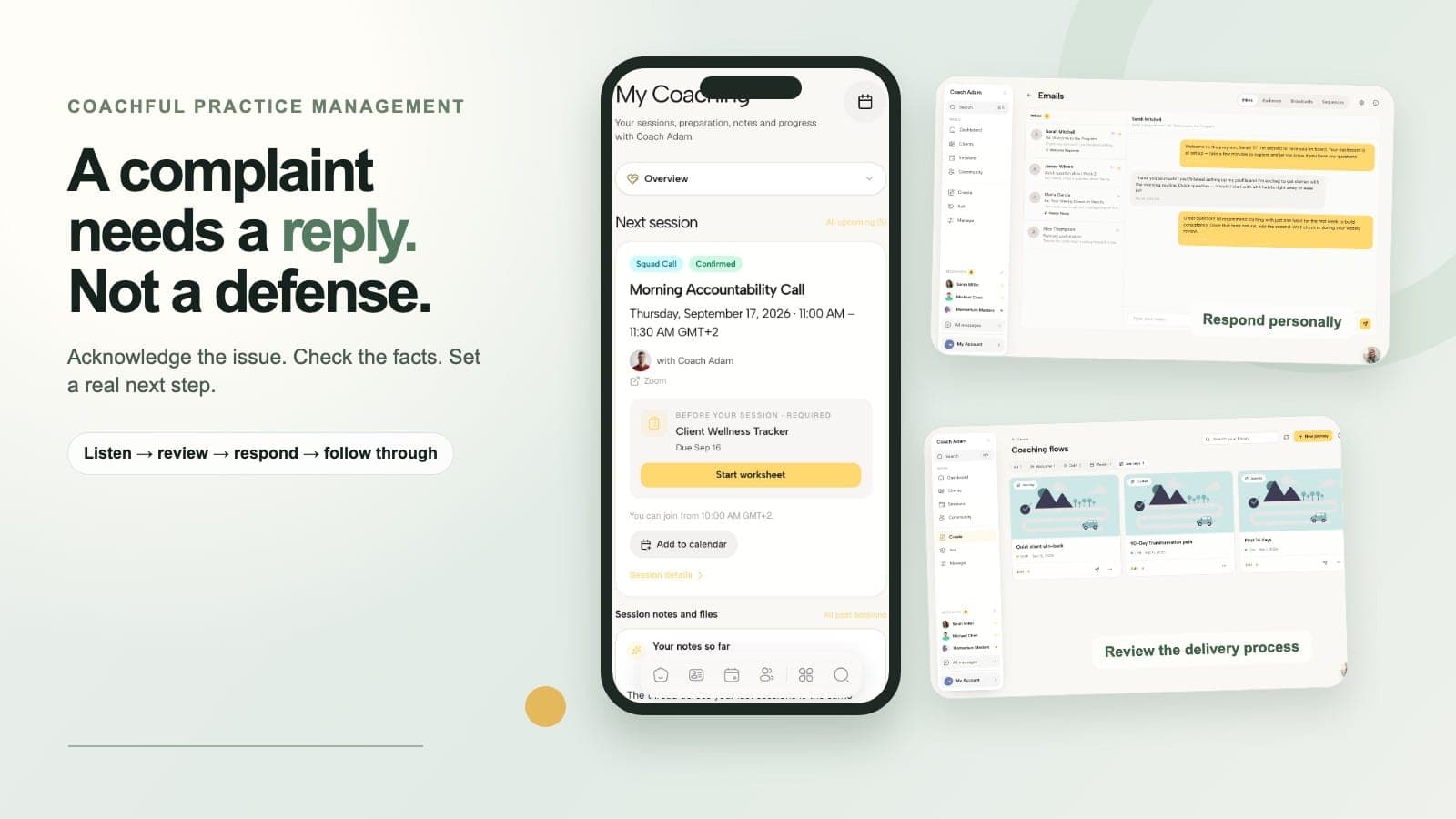
The demo screenshots show actual Coachful client, email, program, progress and coaching-flow surfaces. They illustrate the practical preparation: identify the client, review what you were delivering, inspect the client-facing experience, and respond personally.
They do not prove that every message was sent, that every promise was fulfilled, or that a complaint is justified or unjustified. Coachful is not presented here as a legal case-management system, an independent investigator, or software that decides remedies for you.
If you are assessing how your practice keeps delivery records, try the interactive Coachful demo. Follow a client-facing program and an individual email conversation, then ask whether your own records would let you answer a complaint accurately. That is a better test than counting software features.
Questions coaches ask about complaint responses
Should I apologize before I have investigated?
You can acknowledge the experience and express concern without inventing a finding. Once you confirm a mistake, own it plainly. For a serious allegation with legal or insurance implications, get appropriate advice promptly rather than relying on a general template.
Should every complaint move to a call?
No. Offer a call if it would help, but respect a preference for writing. Written communication can make specifics easier to review and gives both people a clear record. Summarize any decisions made on a call afterward.
What if the complaint arrives as a public review?
Do not reveal private coaching details to defend yourself. Keep any public acknowledgment brief and direct the person to a private contact route. Avoid confirming sensitive facts about the relationship. Follow platform rules and seek advice if the situation involves threats or serious allegations.
What if the client is insulting me?
You can investigate a complaint while setting a reasonable communication boundary. Separate the substance from abusive behavior, document both factually, and use your agreement and applicable duties when deciding whether work can continue. A complaint is not permission for harassment.
Can I automate the response?
A receipt acknowledgment can explain when a human will respond, if that is your genuine process. Do not let a routine campaign answer the substance of a complaint or continue a sales sequence as if nothing happened. Review any relevant scheduled communication deliberately.
The rule worth keeping
A good complaint response makes your next action clear, not your innocence louder. Name the issue, review the right facts, make a fair decision, and do what you said you would do.
These templates and suggested response targets are editorial guidance for coaching-practice operations. They are not legal, insurance or clinical advice. Serious complaints, data incidents, consumer rights and professional procedures need jurisdiction-specific review.