Coaching Workshop Pre-Work: 5 Activities and an Email Template

Nour
Founder, Coachful
What should you ask participants to do before a coaching workshop, and how much preparation is reasonable? Assign one small task that you will actually use during the session, explain what to bring or submit, and provide a route for people who arrive without it. Do not send a reading pack simply because the workshop feels more substantial with homework.
Useful coaching workshop pre-work produces an input: a situation to practise, a few observations, a response to an example or a question to investigate. It is not a test of commitment. Someone can be interested in the workshop and still have caring responsibilities, limited access, a difficult week or no appetite for sharing personal material online.
Below are five preparation activities, a copyable email and a practical delivery method. Choose the activity that supports your workshop's promised output, not all five. The examples are fictional design suggestions, not client results or a prebuilt Coachful workshop.
When does a coaching workshop need pre-work?
Use pre-work when arriving with a small input will materially improve a specific exercise. A career experiment workshop may benefit from each participant bringing two possible directions. A communication workshop may benefit from an ordinary situation to rehearse. A public introductory talk may need no preparation beyond joining instructions.
Mural's guide to pre-work describes readings, videos and short activities as preparation formats, and recommends stating the purpose, instructions, links and deadline. Those are useful design checks. They do not mean every workshop needs every format, or that assigning more work guarantees participation.
Before sending anything, finish this sentence: “We will use your preparation during [named activity] to [specific action].” If you cannot finish it honestly, remove the task or redesign the workshop. Preparation should earn its place in the participant's week.

Keep essential access information separate from learning preparation. Knowing the venue, joining route or required equipment is not optional homework. A person should not need to complete a reflection exercise to discover where the workshop is happening.
5 coaching workshop pre-work activities to choose from
1. Bring one ordinary situation to work on
Best for: workshops built around applying a method to a participant's own situation. Ask for something bounded enough to use in a short exercise. “Bring a problem from your life” invites a much wider disclosure than most workshops can safely accommodate.
For a career experiment workshop, ask participants to privately note two possible directions and one question they would need to answer before testing either. They do not need to send you their CV, explain a redundancy or identify an employer. A few lines are enough to begin comparing possible experiments.
Spend five minutes noting two career directions you are considering and one uncertainty about each. Keep the notes for yourself and bring them to the workshop. We will use them to draft a small information-gathering experiment. If you prefer, use the fictional case we provide.
Collect the case beforehand only if reviewing it changes how you will facilitate. Otherwise, let participants retain their notes. If you do need a submission, ask for a short anonymized version and say who can see it. “Submit your story” is not a sufficient privacy explanation.

Use it live: give people a moment to select their case, then apply the workshop method. Keep the fictional option equally legitimate. A participant should not have to explain why they chose not to work on something personal.
2. Gather three observations, not a full personal audit
Best for: workshops where people need concrete evidence rather than a general impression. A leadership coach discussing delegation could ask participants to note three occasions when they took a task back instead of clarifying ownership. A business coach could ask for three recurring customer questions.
Specify the observation window and the boundary. Ask for a recent, accessible example rather than requiring someone to reconstruct months of history. Do not request a full calendar export, internal customer list or confidential performance record when a private note will do.
Before our delegation workshop, note three recent occasions when a task came back to you. For each, write what happened and what responsibility was unclear. Omit names and confidential details. We will compare the patterns, not evaluate your team members.
Use it live: ask participants to separate what they observed from what they inferred. “I completed the task after the handoff” is an observation. “They do not care” is an interpretation. The preparation provides material for that distinction without requiring a formal assessment.
Do not make access to workplace data a condition of participation unless it is genuinely necessary and disclosed before purchase. Someone between jobs or working under confidentiality restrictions needs an alternative dataset or case, not a public explanation of their circumstances.
3. Review one short worked example
Best for: a workshop where participants need to recognize a method before attempting it. Send one example with a narrow question, rather than an entire library of background material. A short text can be easier to revisit than a video with the useful moment buried in the middle.
A communication coach might provide two versions of an ordinary request and ask which information the second version makes explicit. Explain that participants are noticing a distinction, not memorizing your preferred personality or speaking style.
Read the two short requests in the preparation lesson. Note one fact or next step that is clearer in the second version. We will use your observation before drafting our own requests. You can read the text version instead of watching the demonstration.

Use it live: begin by revisiting the example and inviting observations, then move into practice. Do not spend the opening testing who remembers the terminology. Keep the essential example available in the session for people who need to read it again.
If you assign video, provide the meaningful information in an accessible text format as well. Check captions and the actual reading route rather than assuming a transcript exists. Required materials should be available through the access participants were promised, not behind an unexpected purchase or separate subscription.

4. Make a bounded self-rating and explain the number
Best for: helping participants choose a focus when the workshop supports more than one starting point. Ask about a specific task, not a global judgment of wellbeing, competence or potential. A single rating is a conversation prompt, not a diagnostic instrument.
For a career decision workshop, ask, “How clear are you about the next piece of information you need?” Define the endpoints in plain language. Follow the number with one sentence about what is already clear and one question that remains. The explanation is usually more useful than a room average.
Privately rate your clarity about your next information-gathering step from 0 to 10. Zero means you cannot yet name one; ten means you can describe a specific step. Write what makes your number accurate today and one thing you want to clarify. You do not need to submit the number.
Use it live: let participants use their explanation to choose a relevant exercise or question. If you revisit the rating at the end, ask what changed in their reasoning. Do not market a change in this informal score as validated evidence that the workshop improved mental health or professional performance.
Where an employer is paying, agree reporting boundaries before collecting named responses. A participant's private starting point should not quietly become a manager's performance assessment. Use an appropriately designed evaluation process if you need to assess learning, rather than repurposing a reflective prompt.
5. Write one question the workshop should help investigate
Best for: mixed-experience groups where you need to understand expectations without conducting a full intake. Ask for a question related to the workshop's stated scope. This can help you choose examples and identify requests the event cannot reasonably satisfy.
What is one question about testing a career direction you would like to investigate? Keep it to one sentence and leave out identifying details. We will use submitted themes to choose examples, but cannot promise individual advice on every situation.
Use it live: name the relevant themes, explain which ones the session covers and distinguish those outside scope. If the submitted questions are all about job interviews but your workshop concerns career experiments, correct the expectation before the event rather than hoping the mismatch disappears.
Keep access requests on a separate, private route. “What would help you participate?” should not become a compulsory public introduction or a demand for a diagnosis. Explain whom to contact and what practical arrangements can be discussed. Do not promise an adjustment before checking you can deliver it.

How much pre-work should you assign?
Start with the smallest task that makes the live activity possible. For a short introductory workshop, a five-minute private note may be enough. A specialist paid program may justify more preparation, but disclose substantial prerequisites before someone commits. These are planning judgments, not a universal time allowance.
Test the task yourself, then ask someone unfamiliar with it to try the instructions. Include opening the link, locating the material and understanding what to produce. “Three-minute video” does not mean three minutes of total effort if access requires a new account and a lengthy download.
- Must do: reserve this label for preparation genuinely necessary to participate safely or meaningfully, disclosed in advance.
- Recommended: useful preparation with an announced in-session fallback.
- Optional reference: background reading that is not needed to complete the workshop.
Do not label everything essential. If you assign five tasks but plan to use only one, you have created administrative work for participants and a predictable opening apology for yourself.
A copyable coaching workshop pre-work email
Send the request after registration, early enough for the actual task and any access arrangements. Choose a date based on what you need to review, not a supposed universal best day. If nothing is being submitted, the useful deadline may simply be before the workshop starts.
Subject: Before [workshop]: bring one [specific input]
Hi [first name],
Before [workshop title] on [date, time and timezone], please spend about [tested estimate] on one preparation task.
[Exact task in one or two sentences.]
Bring [output] to the session. [Keep it private / submit the short version through this verified link by this actual deadline.] We will use it during [activity] to [purpose].
Leave out names, sensitive personal information and confidential workplace material. If you prefer not to use your own situation, [specific fictional alternative].
You can find the material at [exact destination]. If it will not open, or you want to discuss an access requirement, contact [private help route].
If you cannot complete the preparation, [accurate fallback and any genuine participation limit]. Joining details: [verified event information].
See you then,
[coach name]
Replace every bracket and test every destination. The template deliberately separates what to do from where to join. Do not hide a sales invitation in an essential preparation message or assume a registered participant consented to an unrelated newsletter.

Test the delivery route on a participant's device
A preparation task that works only in your editor is not ready. Open the actual destination with participant-level access. Check that the expected person can find the correct event, open the material and tell whether their response is private, saved or submitted.

Keep the instruction in live text. Do not make an image the only place a participant can find the question or deadline. Offer a workable alternative when a worksheet cannot be edited on a phone. If printing is necessary, say so early and provide a realistic route for someone without a printer.
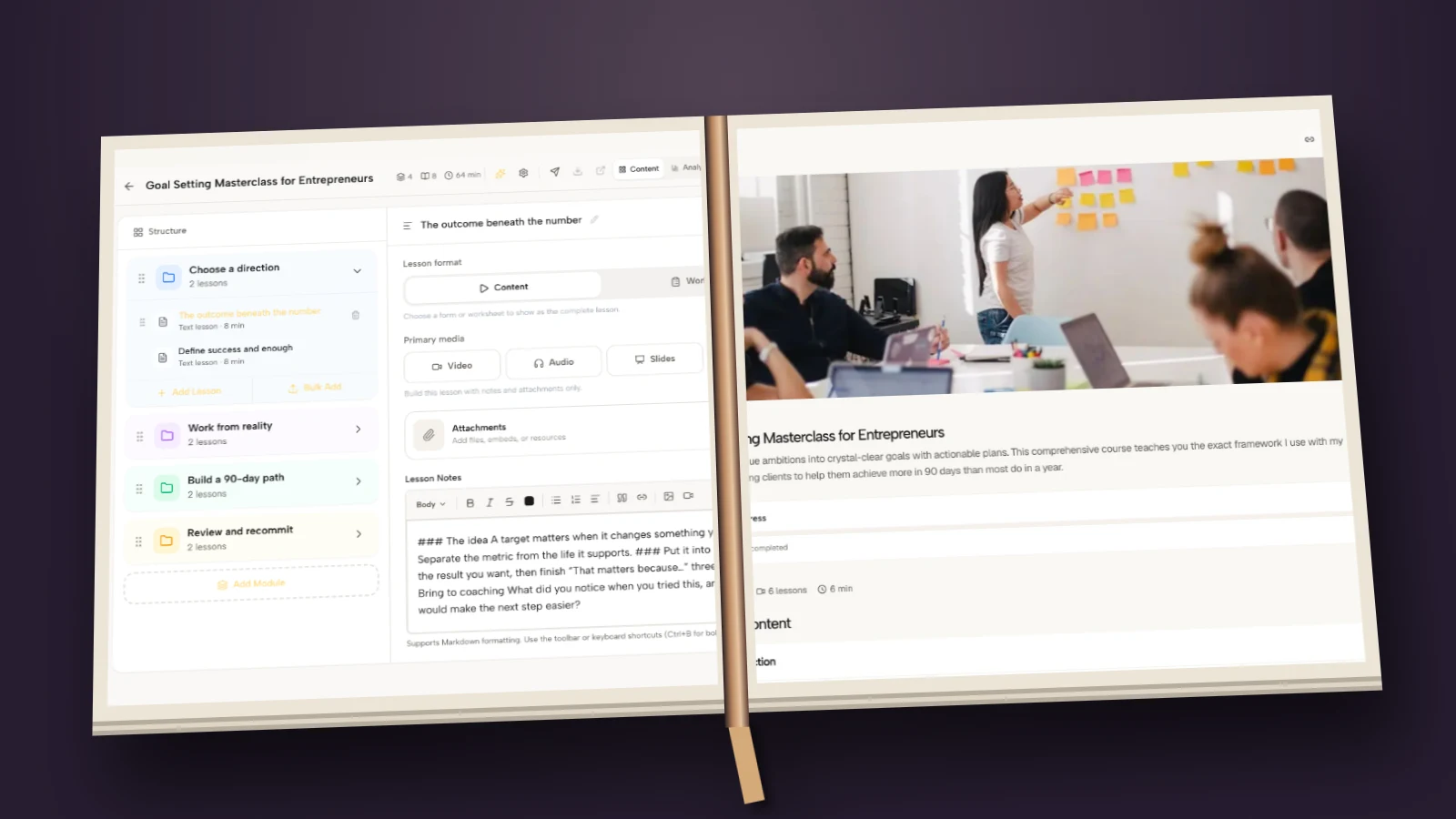
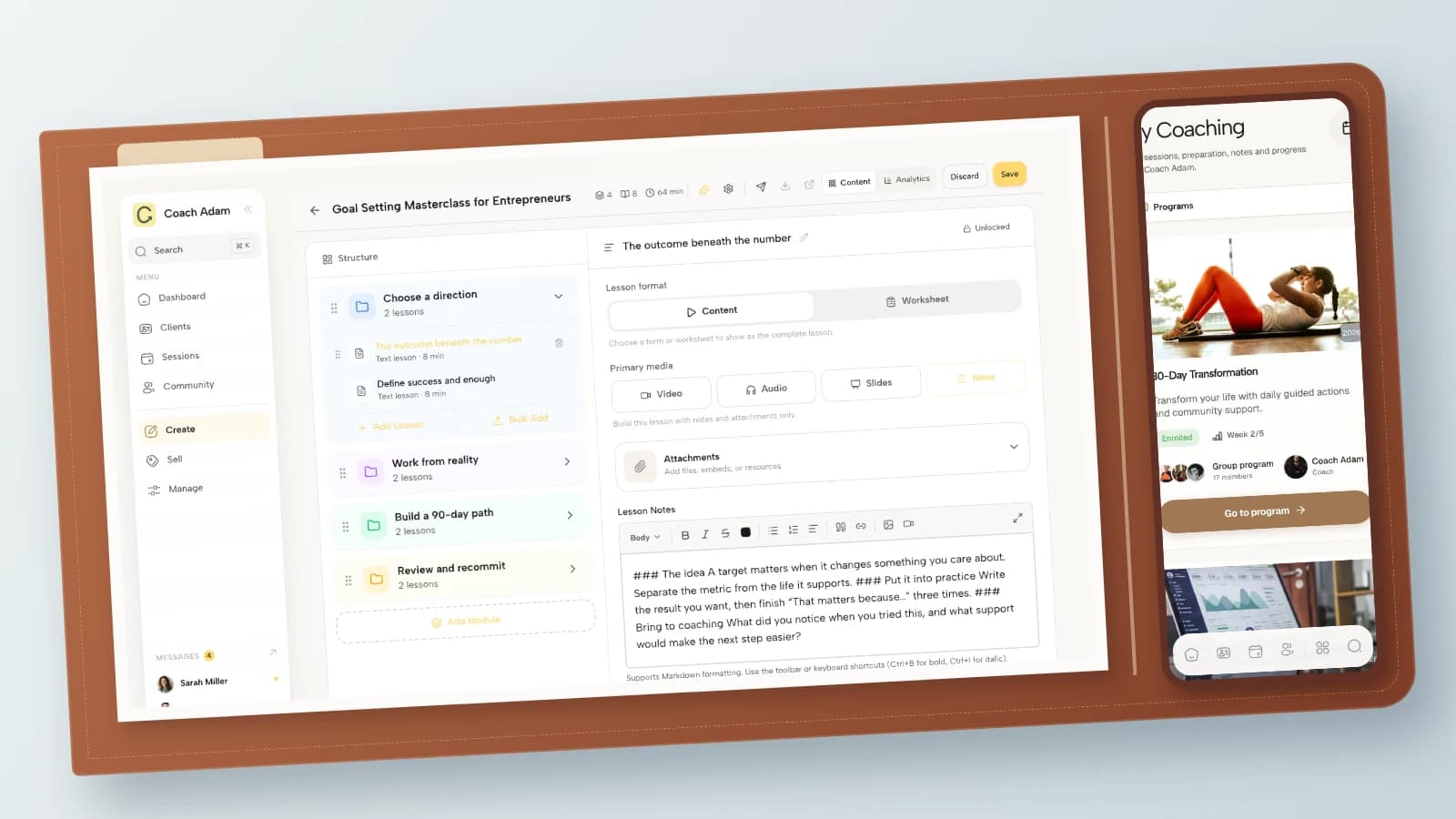
The Coachful screenshots illustrate real lesson, form, program and participant-workspace surfaces. They do not establish that this sample preparation is installed, that an email automatically enrolls participants, or that every attachment and visibility setting works as you intend. Verify your own configuration before promising the route.
What if participants arrive without doing the preparation?
Use the fallback you announced. For a short reflective task, allow a brief private start or supply the fictional case. Continue without a show of hands about who completed the homework. Public comparison rarely tells you whether the problem was time, access, unclear instructions or a deliberate privacy choice.
Where a genuine prerequisite is essential, explain the consequence before enrollment and follow a fair, accessible process. Do not improvise a penalty on the day. A safety briefing or licensed assessment has different requirements from a suggested personal reflection.

After the workshop, review whether the input was actually used and what needed clarification. If you ignored the preparation, acknowledge that design mistake and remove it next time. Do not respond to low completion by adding more reminders before checking whether the task deserves to exist.
Frequently asked questions
Should coaching workshop pre-work be mandatory?
Only when it is a genuine, disclosed prerequisite. For many short workshops, recommended preparation with a fictional or in-session alternative is more proportionate. Make the distinction explicit before participants register.
Should I collect everyone's answers?
Not automatically. Collect only what you need for a defined facilitation purpose, explain visibility and handling, and leave private reflection private where possible. Sponsored attendance does not by itself justify giving an employer individual answers.
Is pre-work the same as a workshop workbook?
No. Pre-work is the activity before the event; a workbook is a possible container for activities before, during or after it. Our workshop workbook template covers participant pages, while the workshop run-of-show guide covers the facilitator's live delivery sheet.
Choose one task before building the preparation area
Write the task, its live use, its privacy boundary and its fallback first. Then choose the simplest delivery route that supports those decisions. A preparation area with six resources is not inherently better than one useful instruction.
If you are choosing where participants will find the lesson, task and help route, try the interactive Coachful demo. Compare the coach and participant surfaces with your actual preparation task in mind, then test the access and visibility you need before inviting your next group.
Visuals show real Coachful demo screens, an original product-story cover and two original educational specimens. Examples are illustrative, not client records or claims of measured workshop results.