Cohort Based Learning Platform: The Coach's Complete Guide

Coachful
You've built the curriculum, recorded the lessons, and opened enrollment. A few clients start enthusiastically, then deadlines slip, discussion disappears, and your dashboard becomes a collection of unfinished profiles. You're left asking whether the problem is the content, the audience, or the delivery model.
Usually, it's the structure. A cohort based learning platform turns learning from an isolated activity into a scheduled experience with shared milestones, peer visibility, and deliberate intervention. That can improve completion, but it also introduces operational demands that many platform reviews ignore. The right system doesn't merely host lessons. It helps you run the people, timing, communication, and measurement behind the program.
Why Coaches Are Rethinking Self-Paced Courses
A business coach launches a self-paced leadership program for newly promoted managers. The course includes excellent videos, worksheets, and reflection prompts. During the first week, members log in, download resources, and promise themselves they'll return on Friday. By the following month, the coach is sending personal reminders to people who never opened the next module.
The coach hasn't failed at teaching. The program has failed to create a reason to continue today.
Self-paced courses ask learners to supply their own deadlines, social accountability, feedback, and recovery plan when work becomes busy. That model works well for reference material and independent exploration. It struggles when the desired outcome requires practice, behavior change, or completion by a meaningful date.
The accountability gap
Cohort learning changes the psychological contract. Instead of saying, “Access this whenever you want,” the coach says, “We begin together, complete this milestone by a shared date, and discuss the application with peers.” The learner gains a visible path, while the coach gains natural points for encouragement and intervention.
That same structure appears outside education. A carefully designed startup peer group for founders can create momentum through shared commitments, candid feedback, and regular participation. Your coaching cohort uses the same basic human mechanism, but applies it to a defined curriculum and transformation.
The strongest evidence supports the shift. A vocational technical certificate study reported completion of 76.8% for a 22-week cohort program, compared with 47.7% for a traditionally taught non-cohort program. The same source reported 96.7% completion for a non-credit cohort program. These figures come from the study's specific programs, so you shouldn't treat them as a guaranteed benchmark for your coaching business. They do show why synchronized delivery deserves serious consideration. (Northeastern University repository study)
Why the market is moving
Cohort models have been used in formal higher education for years. A peer-reviewed public health paper described a two-year cohort model supported by a digital learning platform, showing that synchronized group learning predates the current creator economy. (Frontiers in Education article)
Commercial adoption has accelerated. One 2025 market report estimated the global course cohort platforms market at $1.1 billion, projecting $5.8 billion by 2034 at a 17.2% CAGR. The same report also identified a broader course cohort platforms market estimate of $1.8 billion, with a forecast of $7.2 billion by 2034, also at 17.2% CAGR. These are market projections, not proof that every coach needs new software, but they confirm that cohort delivery has become a substantial category for training, coaching, and professional development. (Marketintelo cohort platforms report)
The practical lesson is simple. If you sell transformation, don't assume a content library will create movement. Give clients a shared starting point, a rhythm they can follow, and a group that notices when they disappear.
The Pedagogy and Workflows Behind Cohort Learning
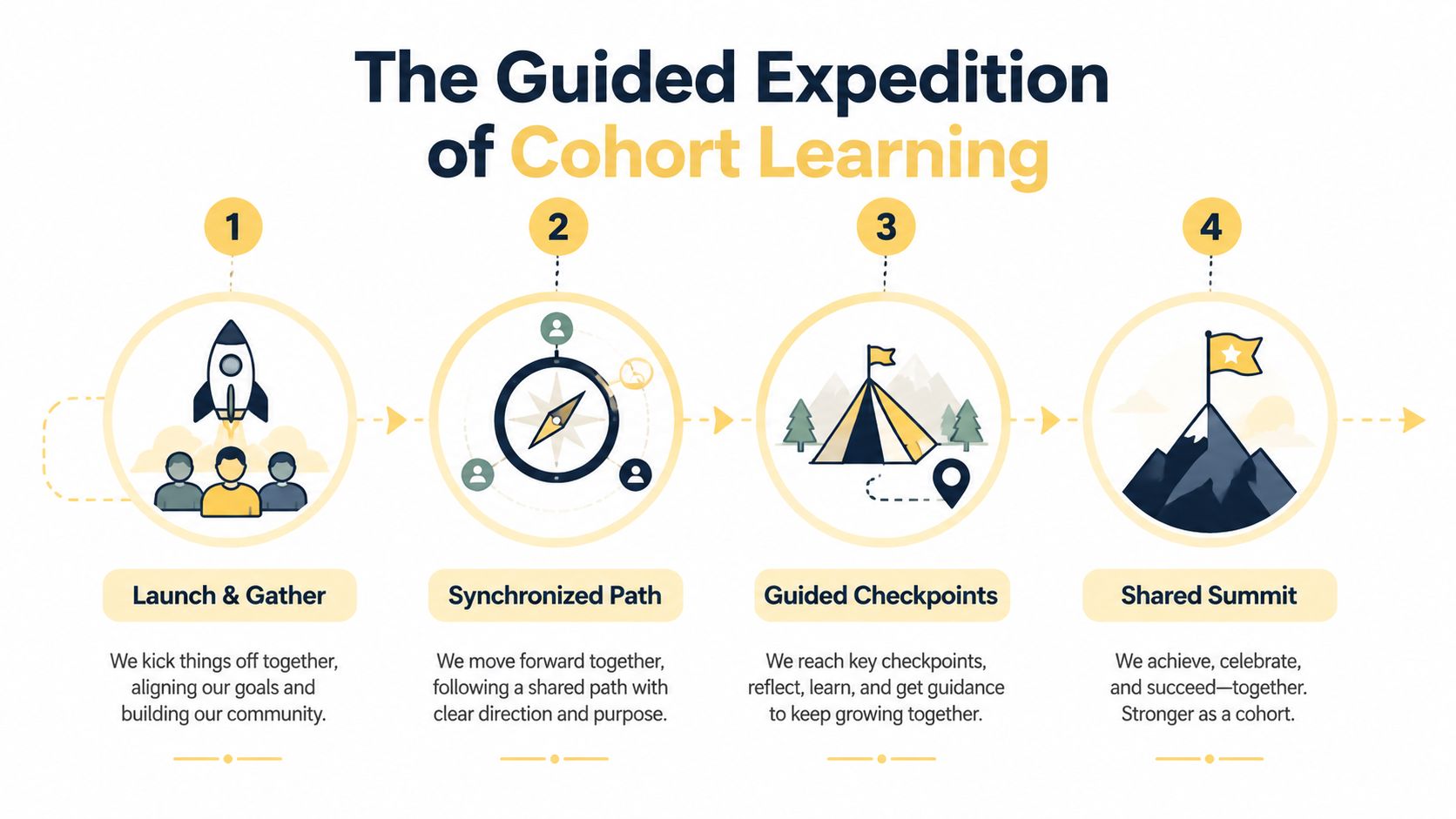
A self-paced course is a solo hike. The learner chooses the trail, pace, rest stops, and finish date. A cohort is a guided expedition. Everyone follows a route, meets at checkpoints, and receives support when conditions change.
That distinction matters because content access isn't the same as learning design. A platform can place videos, chat, and calendars beside each other without connecting them. Your job is to build a workflow where each element causes the next action.
Start with one shared launch
Onboarding should make the cohort feel like a group from the first interaction. Enroll members into the same program instance, show the calendar immediately, explain participation norms, and give them a low-risk opening task.
For example, an executive coach might ask every participant to post a leadership challenge before the first session. That task does three jobs at once. It confirms access, gives the facilitator context, and creates the first opportunity for peer recognition.
The workflow should then follow a stable sequence:
- Orient the group. Explain the purpose, schedule, communication channels, and support process.
- Release the first learning block. Keep the initial action concrete enough to complete without extensive preparation.
- Connect learning to practice. Pair a lesson with a worksheet, role-play, reflection, or workplace experiment.
- Meet at a checkpoint. Use a live session or structured discussion to review application.
- Advance together. Open the next block when the group is ready, while preserving a recovery path for people who need more time.
You can find a useful complementary explanation of the model in this guide to what group coaching involves. The key point is that the group isn't decorative. It's part of the instructional mechanism.
Engineer peer interaction
“Use the community” is not a workflow. Learners need a prompt, a reason to respond, and enough structure to make participation feel safe.
Ask members to compare approaches, review a practical exercise, or answer a specific question. Rotate small-group activities when the cohort is large enough to make a single discussion unwieldy. Give feedback guidelines before the first peer review, especially when the subject involves identity, performance, or sensitive professional decisions.
Research on graduate public health programs links cohort structure with collaboration, support, engagement, retention, and content retention. (Frontiers in Education cohort-learning research) The platform should therefore make community activity visible beside the relevant curriculum, not bury it in a separate social feed.
Practical rule: Every lesson should lead to a visible action, and every action should have a clear place for feedback.
Core Technical and UX Features You Cannot Compromise On
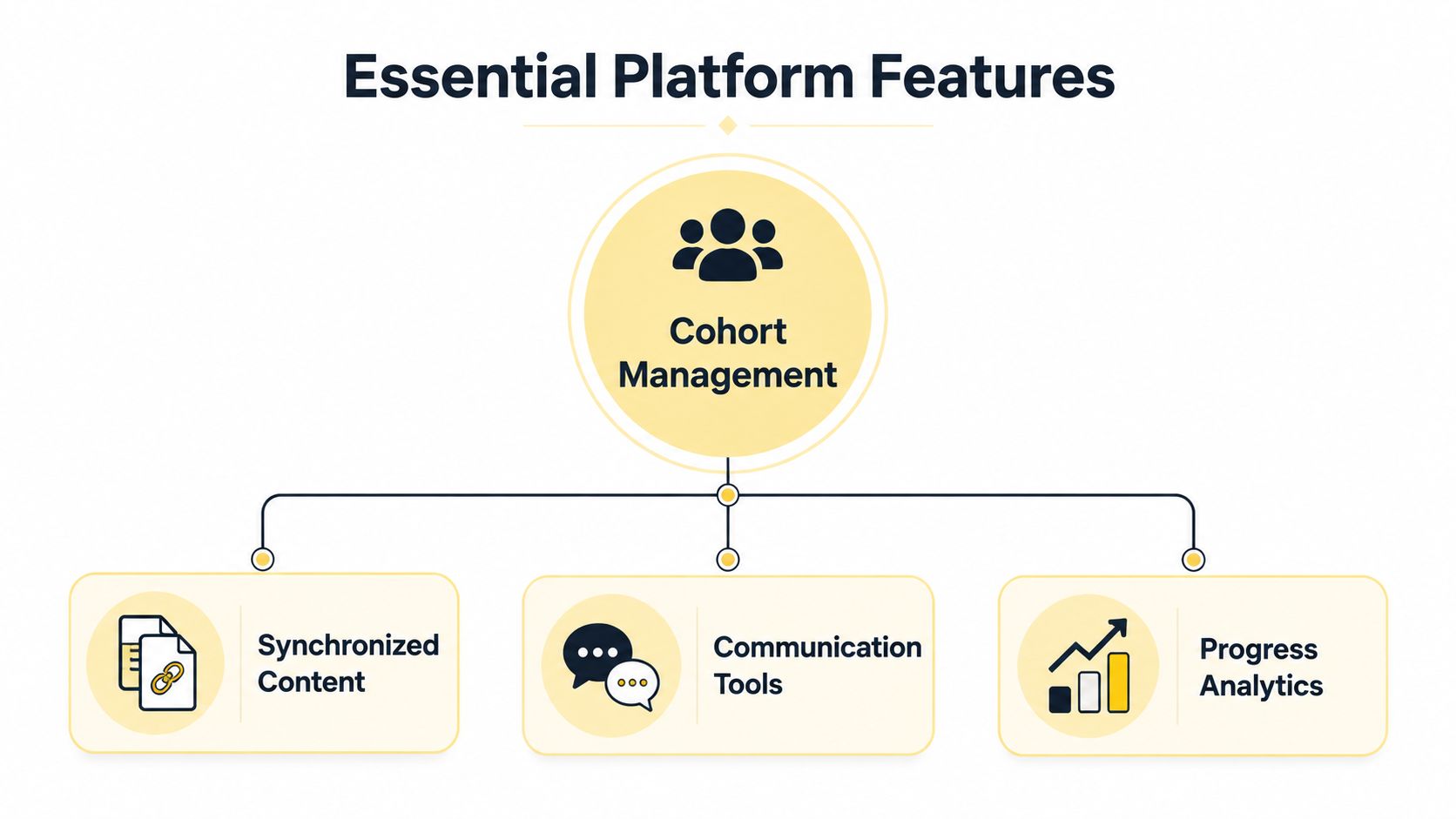
A genuine cohort platform manages time, membership, interaction, and intervention as connected systems. If the software only provides course pages plus a general discussion forum, you're still doing the operational work manually.
Synchronized delivery
Your platform should let you define a cohort start date, release content against a shared calendar, schedule milestones, and handle late entry without corrupting the learning sequence. Ask a vendor to demonstrate what happens when one learner misses a task, when you duplicate a cohort, and when you need to pause a module for everyone.
A useful cohort experience might release a negotiation lesson on Monday, open a practice assignment on Wednesday, and schedule peer discussion before a live coaching call. The learner sees one connected path. You see whether the group is moving through the intended sequence.
Cohort-level analytics
Individual progress is useful for support. It isn't enough for program management.
New Zealand's tertiary education methodology defines cohort-based qualification completion as the share of students in a starting cohort who complete a qualification by a later reporting year. It defines first-year retention as the share of that same starting cohort still enrolled the following year. (New Zealand cohort methodology)
Apply that logic to coaching. Lock an entry date, preserve cohort membership, and calculate outcomes against the original baseline. Don't change the denominator every time someone joins, pauses, or re-enrolls. Also consider pathway completion. The New Zealand methodology doesn't require completion of the originally enrolled qualification, only a qualification at the same level. A coaching marketplace could use a similar approach by crediting an equivalent pathway instead of forcing every client through one rigid route.
Look for dashboards that surface:
- Milestone movement: Which lessons, assignments, or checkpoints are stalling?
- Participation patterns: Who attends, posts, submits, or responds?
- Intervention signals: Which learners need a personal message?
- Cohort comparisons: How do different launches perform against the same baseline?
Integrated communication and intervention
The community should sit close to the curriculum. A learner shouldn't have to search through a general chat to find the discussion connected to today's assignment.
You also need automated reminders that support, rather than shame, the learner. A message can say, “You haven't submitted this week's reflection. Do you need help choosing a smaller next step?” The platform should alert you when a person falls behind, but you still decide whether the right response is a reminder, a private conversation, a deadline adjustment, or a referral.
Use the Coachful group coaching software overview as one reference point while comparing tools. During demos, insist on seeing the actual facilitator workflow, not just the learner-facing screens.
Here's a practical test. Ask the vendor to create a cohort, assign a milestone, trigger a reminder, record participation, and export a report. If the representative can't complete that sequence smoothly, the platform may become another administrative burden.
Comparing Cohort Platforms to Self-Paced and Live Workshops
The right delivery model depends on the promise you're making. If clients only need a searchable reference library, a cohort may add unnecessary coordination. If they need to change how they lead, sell, communicate, or make decisions, structured group practice usually deserves consideration.
| Feature | Self-Paced | Live Workshops | Cohort-Based |
|---|---|---|---|
| Scalability | High, with little scheduling friction | Limited by live capacity and facilitator availability | Strong when you can repeat templates and workflows |
| Completion support | Learner must create their own accountability | Event attendance creates urgency, but follow-through may fade | Shared pacing, milestones, and peer visibility support persistence |
| Revenue pattern | Often evergreen and continuous | Concentrated around scheduled events | Tied to launches or recurring group starts |
| Coach time | Low after production, higher when learners need individual help | High during delivery, lower afterward | Higher during the active program, with automation reducing administration |
| Best use | Reference material, foundations, refreshers | Intensive introductions, demonstrations, and decisions | Skill development, transformation, certification, and applied practice |
| Main risk | Quiet abandonment | Strong event, weak ongoing implementation | Pacing conflict, coordination load, and uneven participation |
A self-paced course can be the right first layer. Put foundational concepts, templates, and optional reference material there. Then use the cohort for the work that requires feedback and accountability. For example, a sales coach might provide a self-paced product knowledge library while running a cohort for live objection handling and call review.
A live workshop is more concentrated. It can create energy quickly, but the coach needs a follow-up mechanism if the desired behavior must survive beyond the event. A cohort spreads the learning journey across scheduled checkpoints, which makes it better suited to practice and adjustment.
What the evidence actually supports
A larger dataset covering more than 32,000 courses found completion of 48.2% for non-cohort courses, 64.2% for scheduled cohort courses, and 65.5% when active discussion was present. (Forasoft cohort platform analysis)
Those numbers don't mean every cohort will outperform every workshop or self-paced course. They do support a clear design conclusion: scheduling helps, and discussion adds value. The platform must make both easy to operate.
Choose self-paced when flexibility is the product. Choose a workshop when concentrated exposure is enough. Choose a cohort when the result depends on repeated application with other people.
Solving the Hidden Friction of Cohort Management
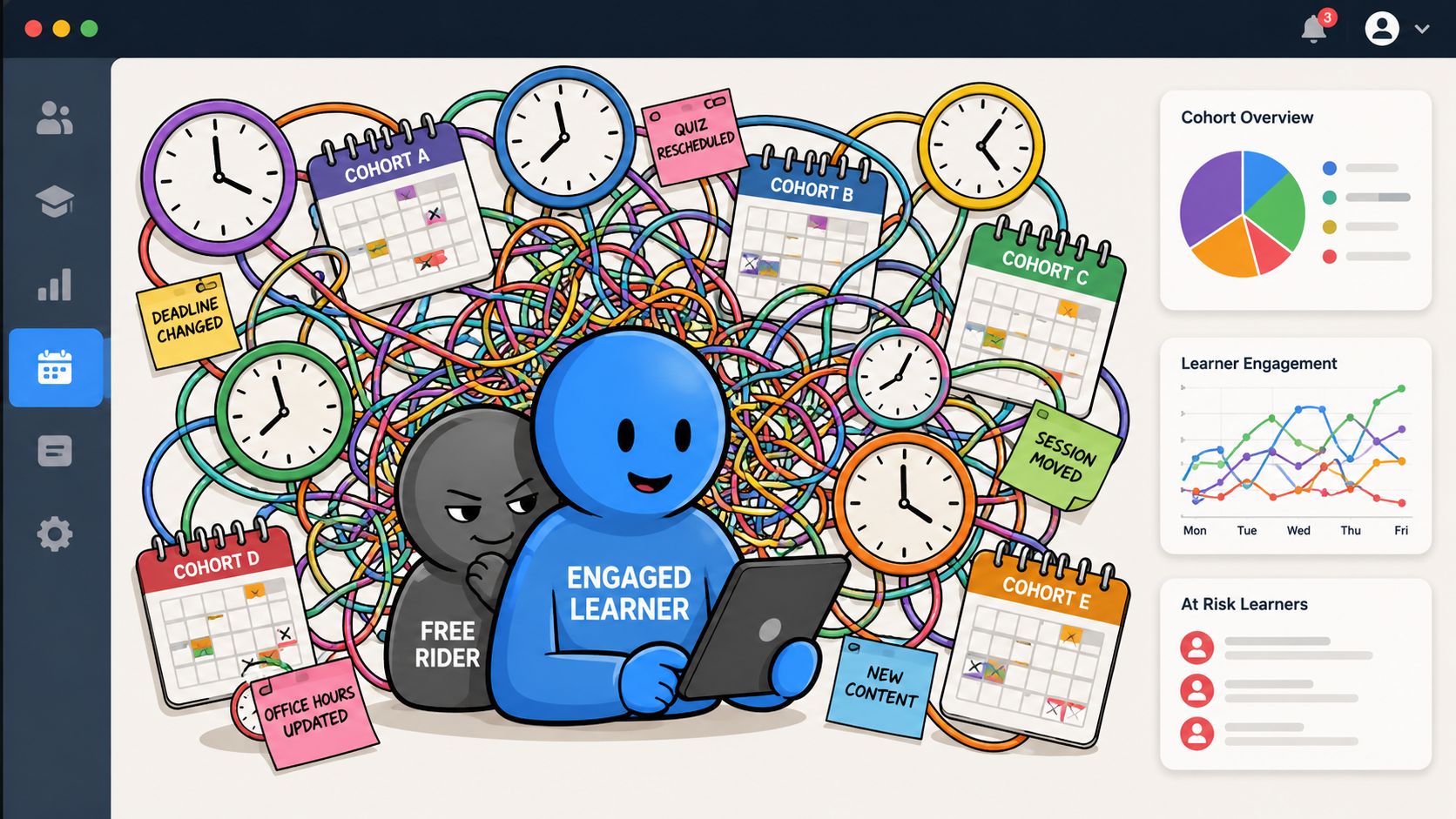
Completion rates are the attractive part of cohort marketing. The difficult part begins when learners don't move at the same pace, live in different time zones, or arrive with very different foundations.
Independent coverage identifies uneven learning pace, low active participation, limited individual adaptation, progress-visibility gaps, and scaling strain as key cohort-management failure modes. (Forasoft cohort management reference architecture) A cohort creates structure, but structure can become exclusionary when the coach treats everyone's schedule, confidence, and prior knowledge as identical.
Design for different starting points
Run a short orientation or diagnostic before the first milestone. Give advanced learners extension work, and give less experienced members a supported path to the same core outcome. Don't make the fastest learner the informal teaching assistant unless they've agreed to that role.
Time zones require similar care. Record essential live sessions, provide asynchronous alternatives, and rotate meeting times when the program repeats. A learner shouldn't lose access to the central experience because your calendar only works for one region.
The “free rider” problem needs explicit design. Group assignments should include individual evidence of contribution, such as a reflection, peer response, or separate application task. Otherwise the most vocal participants carry the work while quieter members receive the benefit without practicing.
Protect trust and value
Buyers are also questioning whether every cohort justifies a premium. Recent commentary describes a movement from longer 6 to 8 week programs toward 1 to 3 week micro-cohorts, while a preprint raises concerns about transparency, surveillance risk, inadequate financial support, and overreliance on social-media signals when judging instructor quality. (Stratistics cohort-based learning platforms commentary)
Answer those concerns before enrollment. State what live access includes, how feedback works, what happens after a missed session, which data you collect, and who the program isn't for. A short cohort can be valuable, but only when the promise matches the actual contact, practice, and support available.
A community manager's responsibilities, such as welcoming members, moderating participation, and spotting disengagement, offer a useful operational comparison. The coliving community manager role shows why community work is active labor, not an automatic result of placing people in a chat room.
Use a clear client onboarding workflow to collect access needs, preferred communication methods, baseline context, and scheduling constraints before the program starts. Equity isn't a warm add-on. It's part of the delivery system.
Selecting and Implementing Your Platform with Coachful
Choose software based on the program you intend to run, not the feature list you admire in a sales demo. A platform can have attractive course pages and still leave you manually reconciling attendance, reminders, payments, and progress.
Start with vendor questions that expose operational reality:
- Data privacy: What information does the platform store, who can access it, and how are permissions managed?
- Brand control: Can you use your own visual identity, domain, and client-facing language?
- Integrations: Can scheduling, payments, video, email, and reporting connect to the tools you already use?
- Cohort separation: Can each group have its own dates, discussions, assignments, and roster?
- Recovery paths: Can a learner catch up without forcing you to rebuild the program manually?
- Export and ownership: Can you retrieve learner records and outcome data if your business changes platforms?
Coachful is one option for coaches who want client onboarding, session scheduling, secure payments, messaging, progress tracking, programs, goals, milestones, and group delivery in one workspace. It supports structured curricula, assignments, group messaging, live group sessions, and progress tracking for learners moving through a program together. Treat it as a candidate to test against your workflow, not as a substitute for defining that workflow first.
Build the first cohort deliberately
Begin with one transformation and one audience. A business coach might create a leadership operating system for first-time managers rather than combining leadership, productivity, communication, and career planning into one launch.
Then map the experience on a calendar:
- Enrollment and orientation: Confirm payment, access, expectations, accessibility needs, and the first task.
- Weekly learning blocks: Pair concise teaching with an applied assignment.
- Peer interaction: Place discussion prompts and feedback beside the relevant lesson.
- Facilitator checkpoints: Schedule live sessions around decisions, practice, and troubleshooting.
- Intervention rules: Define when the system sends a reminder and when you personally reach out.
- Completion and continuation: Provide a clear final outcome, reflection, and appropriate next step.
Test the journey with a colleague acting as a learner. Ask them to join late, miss a task, reply to a discussion, and find the next live session. Those edge cases reveal more than a polished demonstration.
Automate repetition, keep judgment human
Automate confirmations, calendar reminders, assignment nudges, session links, and renewal notices. Keep sensitive feedback, accommodation decisions, and re-engagement conversations personal.
Before launch, prepare message templates for welcome, missed milestone, catch-up support, peer feedback, and completion. Review your dashboard at a fixed cadence so you're responding to patterns rather than waiting for a client to complain.
The platform should reduce coordination, not eliminate coaching judgment. If automation sends every learner the same pressure message, it can damage trust. Use data to decide who needs attention, then respond like a coach.
The Future of Group Coaching and Learning Communities
Cohort learning is moving from a teaching format into an operating model for coaching businesses. Micro-cohorts and niche programs give practitioners a way to serve a specific audience with a defined outcome, while repeated launches create a more structured alternative to rebuilding bespoke support for every client.
The opportunity isn't to put more people into the same program. It's to design a better relationship between curriculum, community, and intervention. Coaches who build that relationship can preserve personal attention while creating a repeatable experience.
The risk is treating completion as the only success measure. Retention and completion matter, but so do equitable access, meaningful practice, privacy, client confidence, and the quality of the result after the cohort ends. A strong cohort based learning platform helps you observe those signals without turning learners into surveillance subjects.
Start small. Define the transformation, set the cadence, test the recovery path, and measure the cohort against a fixed baseline. Then choose software that supports the way you coach, including the inconvenient moments when people fall behind, need flexibility, or ask for help.
Coachful brings client onboarding, scheduling, payments, messaging, progress tracking, structured programs, and group cohort workflows into one coaching workspace. Visit Coachful to evaluate whether its cohort tools fit the program you're ready to launch.