Client Onboarding Workflow: A Coach's Guide

Coachful
A new client signs your agreement on Monday. You send a welcome email, a payment receipt, and an intake form. On Tuesday, the client says they'll complete it “later.” The scheduling link gets buried, the kickoff call never lands on the calendar, and by the time you notice the silence, the client is already questioning whether they made the right decision.
That isn't a motivation problem. It's usually a client onboarding workflow problem. When email, forms, scheduling, messaging, notes, and payments operate as separate islands, no one owns the spaces between them. The client experiences those gaps as uncertainty, while the coach experiences them as surprise cancellations and awkward follow-ups.
Why Your First Two Weeks Determine Client Retention
A coach can deliver excellent sessions and still lose a client before the coaching relationship has properly begun. The warning signs are often quiet: a partially completed questionnaire, a delayed reply, an unanswered scheduling message, or a client who arrives at the first session without knowing what to bring.
The first two weeks create the client's working theory of your service. They're asking themselves:
- Did I make the right decision?
- Does this coach understand what I need?
- Will this process fit into my life?
- What am I supposed to do next?
If the answer to any of those questions feels unclear, the client has to spend effort interpreting your process instead of preparing for change.
A widely cited onboarding benchmark puts the average onboarding process for a new corporate client at up to 100 days, while 74% of enterprise organizations have a dedicated customer onboarding team. The same benchmark reports that only 13% of SMBs use customer success software, while 54% are most likely to charge for onboarding. Together, those figures show that onboarding has become a structured business function in larger organizations, even though smaller businesses often still run it through scattered email and manual coordination. The benchmark data on customer onboarding supports a useful conclusion for coaches: onboarding isn't paperwork around the work. It's part of the work.
The silence after the sale
Consider a business coach working with a new leadership client. The client signs enthusiastically, but the coach sends four separate requests:
- Complete the intake form.
- Choose a kickoff time.
- Sign the coaching agreement.
- Send background materials before the first session.
Each request makes sense alone. Together, they create a small project the client has to manage. The coach thinks, “They haven't completed the basics.” The client thinks, “This already feels harder than I expected.”
A 2026 customer onboarding roundup reports that 63% of customers consider onboarding a key factor when deciding whether to subscribe to a service or purchase a product. The same industry benchmark identifies the first 90 days as the highest churn-risk period, with bottom-performing teams taking 2 to 3 weeks to onboard clients and top performers completing onboarding in a median of 4.8 days. Top performers also reach a 78% completion metric, according to the customer onboarding statistics roundup.
For a coach, speed doesn't mean rushing intimacy or squeezing a complex relationship into a template. It means removing avoidable uncertainty. The client should know what happens next, why it matters, and how much effort you're asking from them.
Practical rule: If a client has to ask, “What happens now?”, your workflow has already made them do too much work.
That's why a thoughtful client retention approach starts before the first coaching breakthrough. Your welcome, intake, kickoff, and first useful action should form one continuous experience. Trust grows when your promises, process, and follow-through line up.
The Core Onboarding Sequence Every Coach Needs
A reliable workflow has five connected stages: welcome, intake, kickoff, first session, and follow-up. Each stage should have one clear objective, one trigger, and one owner. Templates create consistency, but the client should still feel that a person is paying attention.
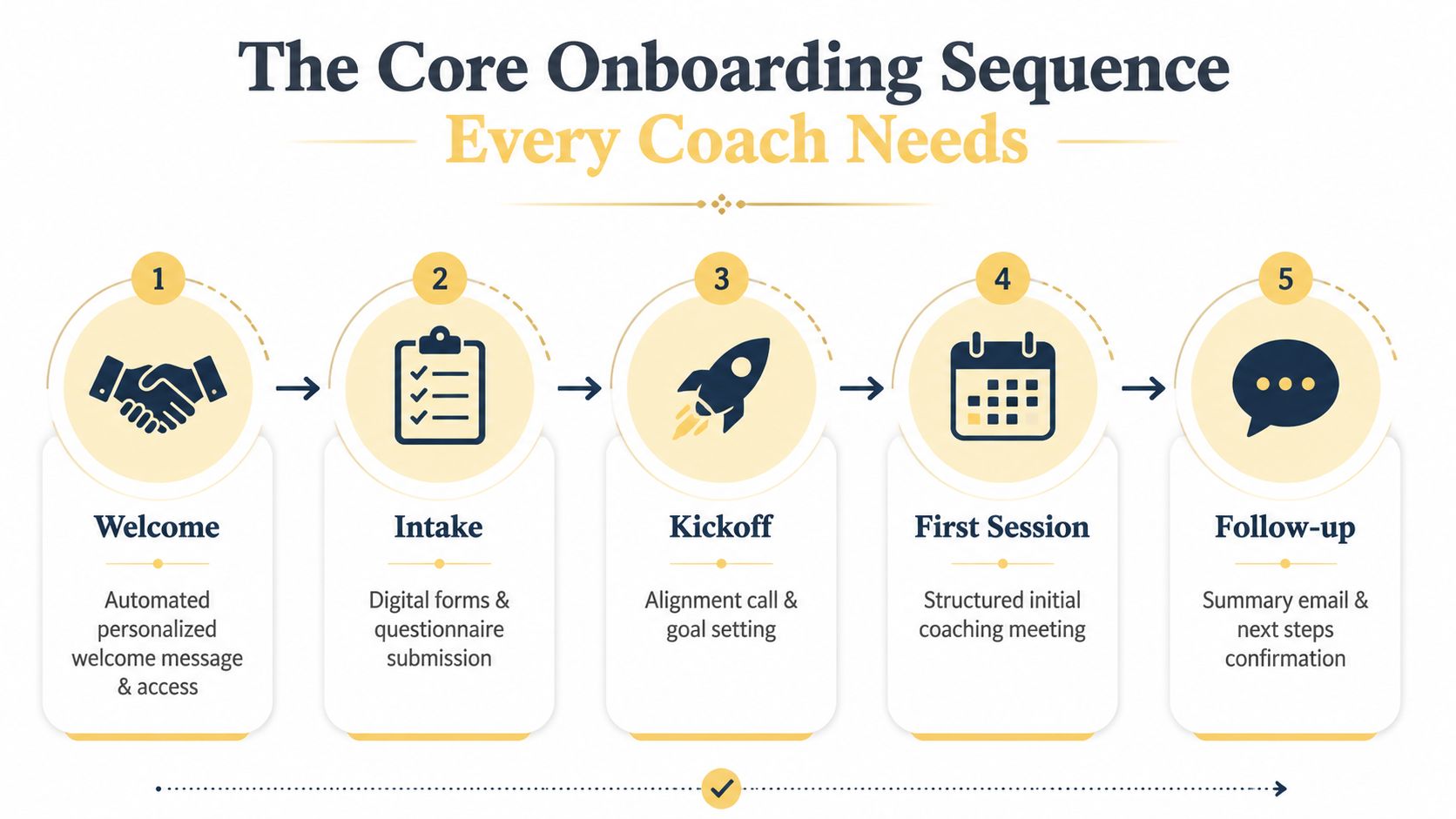
1. Welcome
Objective: Confirm the decision, establish expectations, and make the next action obvious.
Trigger: Agreement signed or payment received.
Example message:
Hi Maya, I'm glad we're working together. Your first step is to complete the intake form below so I can tailor our kickoff conversation. After you submit it, you'll receive the scheduling link for our kickoff call. You don't need to prepare anything else yet.
The mistake here is sending a generic “welcome aboard” email with five attachments and several unrelated links. A strong welcome message lowers buyer's remorse by showing the client that the process is organized. It also prevents the common failure where a coach assumes the client knows whether the next step is payment, scheduling, paperwork, or preparation.
2. Intake
Objective: Gather enough context to make the kickoff useful without turning the form into an interrogation.
Trigger: Welcome message delivered.
Ask about the client's desired outcome, current situation, constraints, relevant history, preferred communication style, and practical availability. Keep sensitive or unnecessary questions out of the first request. The client should feel understood, not processed.
Example prompt: “What would make this coaching engagement feel worthwhile by the end of our initial phase?” That question invites an outcome instead of collecting a vague list of complaints.
A well-designed coaching intake form should also capture logistics that affect delivery, such as time zone, accessibility needs, and who else may be involved. For more guidance on intake structure and client communication, review these effective onboarding strategies.
3. Kickoff
Objective: Turn information into a shared working agreement.
Trigger: Intake submitted and kickoff scheduled.
Use the call to clarify the client's goal, define what success will look like, agree on communication norms, and identify the first action. Don't spend the entire meeting reading answers the client has already given you. Reflect the pattern you see, test your assumptions, and ask what feels most important now.
Example opening: “I noticed that your goal is important, but the lack of protected time keeps getting in the way. Would it be useful to begin by designing a realistic weekly commitment rather than adding another ambitious plan?”
The common mistake is treating kickoff as a warm introduction with no decision at the end. The client should leave knowing the first milestone, the next appointment, and what they'll do before then.
4. First session
Objective: Deliver an immediate, relevant experience of progress.
Trigger: Kickoff completed.
The first session shouldn't be a second kickoff. Give the client a meaningful outcome, such as a decision framework, a prioritized challenge, a conversation plan, or a clearly defined experiment. The result doesn't have to be dramatic. It has to make the coaching feel concrete.
5. Follow-up
Objective: Preserve momentum and close the loop.
Trigger: First session ends.
Example message: “Today we agreed that your next step is to prepare the conversation with your team and write down the outcome you want. I've added that action to your workspace. Reply if anything changes before our next session.”
The weak version says, “Great session today, see you next time.” The stronger version confirms the client's interpretation, records the commitment, and gives them a safe way to raise a blocker. Your platform should trigger this summary from the completed session, not rely on your memory at the end of a busy day.
Adapting Your Workflow by Client Type and Value
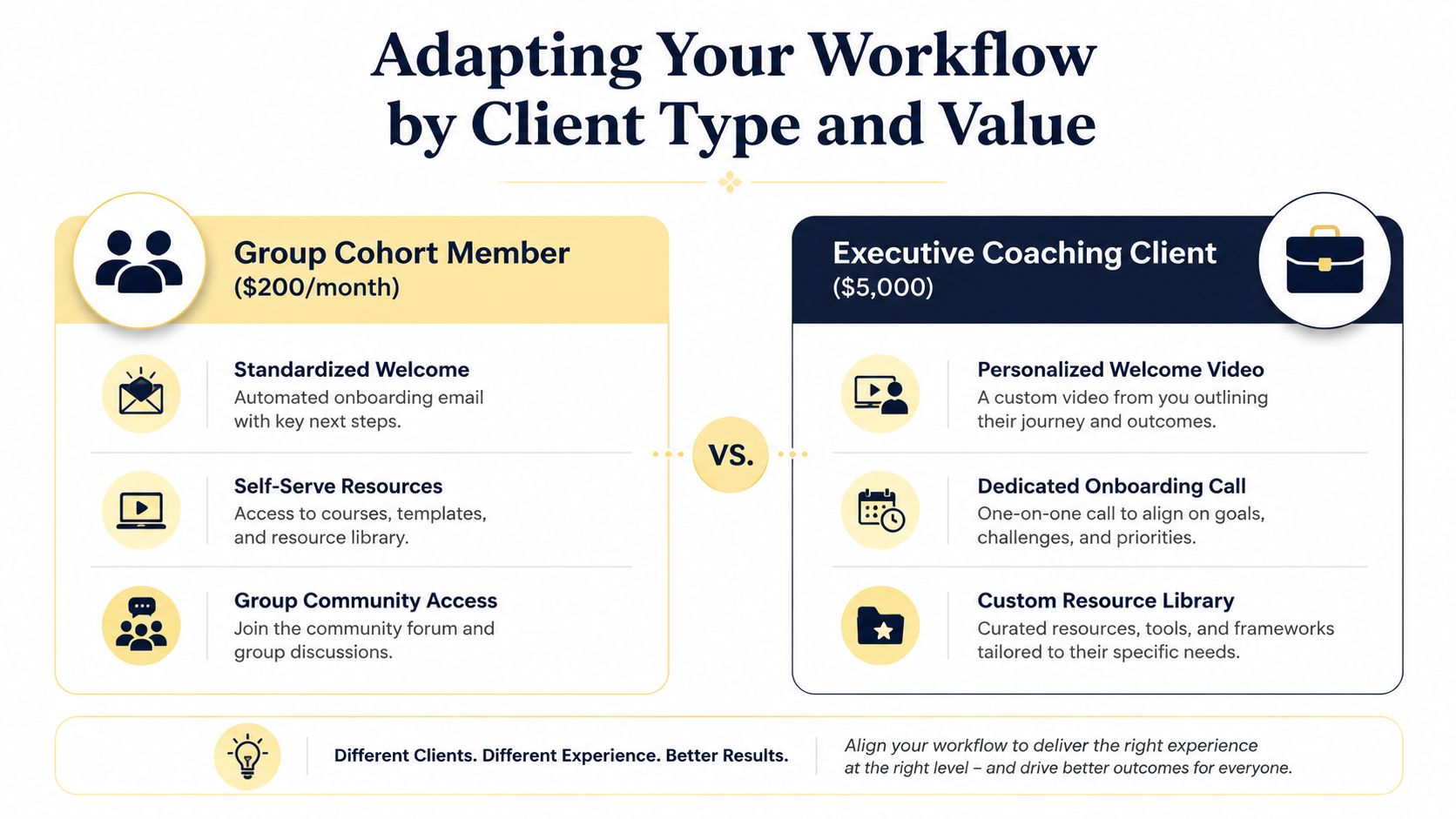
A single onboarding path feels fair because every client receives the same thing. It often produces the opposite result. Lower-touch clients get more human attention than the economics support, while premium clients receive a sequence that feels generic and impersonal.
The better question is not, “How do I automate onboarding?” It's, “Where does human judgment create the most value?”
Group and lower-touch clients
A group cohort member needs clarity, access, and belonging. The workflow can be largely self-serve:
- Standardized welcome: Explain the cohort rhythm, community location, participation expectations, and first assignment.
- Self-serve preparation: Provide a short orientation, intake questionnaire, and resource hub.
- Community access: Make the first interaction easy, such as introducing themselves or responding to a guided prompt.
- Escalation path: Flag missing forms, inactivity, or unanswered questions for personal outreach.
The goal isn't to make the experience impersonal. It's to reserve personal intervention for moments when a client is confused, stalled, or asking for a level of support outside the cohort design.
Premium and executive clients
A high-value executive engagement needs more context and more continuity. A personalized welcome video, a dedicated onboarding call, and a custom resource library can communicate that the relationship has been designed around the client's role and constraints.
A premium path might begin with a brief internal handoff between the person who sold the engagement and the coach delivering it. Capture the executive's stated priorities, stakeholders, sensitivities, and promised outcomes before the first call. Then ask the client to confirm what has changed since the sales conversation. That step protects both sides from working from outdated assumptions.
Benchmark data shows meaningful variation in time-to-value by ARR band, from a median of 11 minutes for engagements below $5K ARR to 23 days for $100K-plus engagements. The same source reports a 3.2x median lift for AI-native onboarding over tour-based onboarding, while top performers use conversational intake and branching experiences rather than static sequences. These findings are detailed in the 2026 customer onboarding benchmark.
Branching without operational chaos
Branch based on complexity, value, client readiness, and delivery format. A life-coaching package may need a different intake emphasis from an executive program, as the distinctions between types of life coaching can affect goals, risks, and communication needs.
Use simple rules:
- If the client joins a cohort, send the cohort path.
- If the engagement includes multiple stakeholders, add a stakeholder and alignment step.
- If the client buys a premium package, assign a human onboarding owner.
- If intake reveals urgency or confusion, create an immediate personal follow-up.
You don't need a maze of automation. You need a small number of deliberate paths that reflect how you serve people.
Building a 30-60-90 Day Onboarding Arc
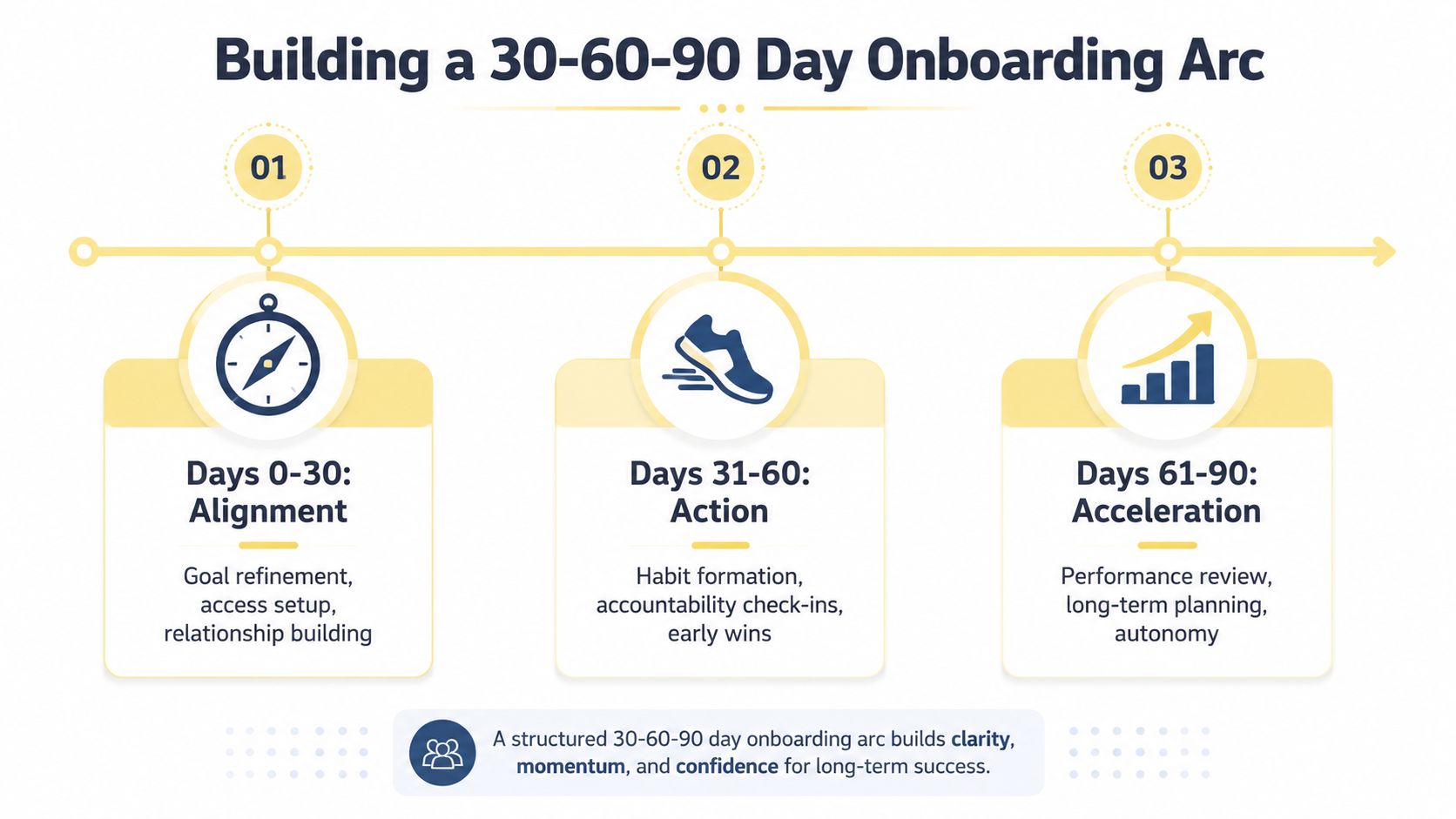
The first session is a milestone, not a finish line. Clients often need several weeks to turn an intention into a routine, test new behavior, and recognize evidence of progress. A 30-60-90 day arc gives you a structure for staying involved without making every interaction feel like a chase.
A guidance source describes the arc as days 0 to 30 for alignment and access, days 31 to 60 for adoption and steady operations, and days 61 to 90 for proof, optimization, and renewal preparation. It also recommends a milestone check-in by day 14 and at least one meaningful workflow completed by day 30, as outlined in this 30-60-90 day onboarding plan.
Days 0 to 30, alignment
Your job is to remove ambiguity and help the client experience an early, meaningful action.
By the end of this phase, check:
- Goal clarity: Can the client state the outcome in practical language?
- Access: Do they have the portal, schedule, resources, and communication channel?
- First action: Have they completed something that connects directly to the coaching objective?
- Relationship fit: Do you understand how they prefer to work and where they may need accountability?
The day-14 check-in shouldn't be a status interrogation. Ask, “What has felt easy, what has felt harder than expected, and what should we adjust before this becomes a pattern?” That wording makes it safer for the client to disclose friction.
Days 31 to 60, action
This phase shifts from setup to repeatable participation. The client should understand the cadence, complete agreed actions, and bring real examples into sessions.
A useful checkpoint reviews what the client tried, what happened, and what they learned. If a business client committed to a difficult delegation conversation, discuss the actual response rather than marking the task complete. If a health coach's client struggled to follow a routine, examine the environment and timing before assuming a motivation issue.
A staged client onboarding plan template describes this middle phase as steady-state operations and first results. That distinction matters. You're not trying to prove the entire coaching promise yet. You're looking for evidence that the client can participate in the process and use it in real life.
Days 61 to 90, acceleration
Now review progress against the original outcome, identify what still blocks independence, and decide what the next phase should look like. Renewal preparation shouldn't appear as a surprise sales conversation. It should emerge from a clear discussion of progress, remaining opportunity, and the support required next.
Track practical signals, not vanity activity. Note whether the client attends, responds, completes agreed actions, brings useful reflection, and can describe a change in behavior or decision-making. For group programs, track participation and assignment momentum. For executive coaching, include stakeholder feedback or observable workplace outcomes when the client has permission to share them.
Solving the Visibility Gap That Silently Loses Clients
A checklist tells you what should happen. It doesn't tell you what is happening right now.
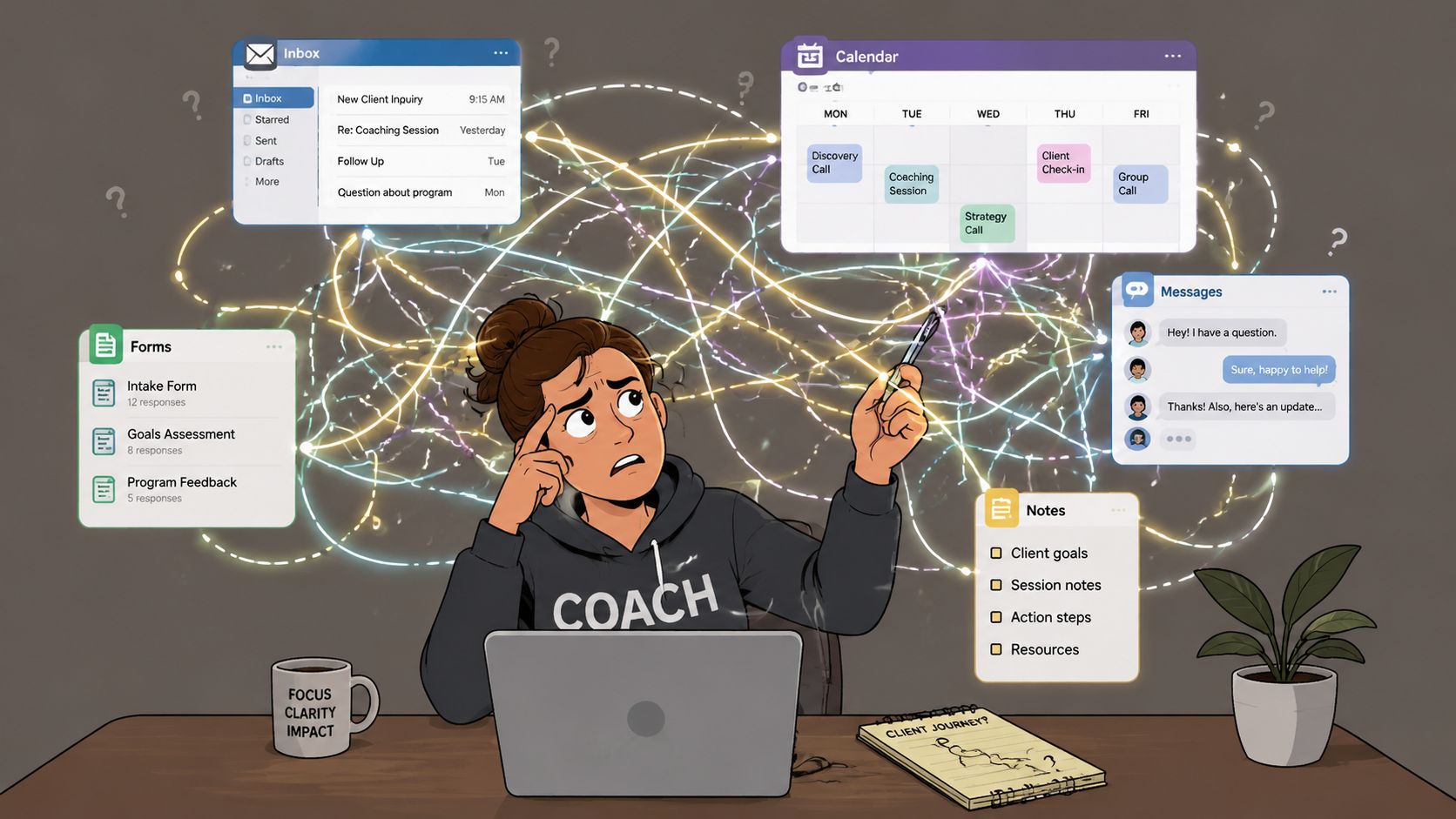
Most companies still use four to six tools for onboarding, and 62% of customer-success leaders lack real-time visibility into onboarding progress. Another 2026 survey reports that only 9% report real-time visibility, according to the state of onboarding report. The exact percentages differ by survey, but the operational problem is consistent: teams struggle to see the client's current position across disconnected systems.
A solo coach feels this gap in smaller, more personal ways. The form lives in one application, the appointment in another, the agreement in a document folder, the session note somewhere else, and the follow-up reminder in your head. Each tool may work perfectly. The workflow still fails because no system connects the events.
What silent drop-off looks like
A client who hasn't booked the kickoff may not be disengaged. They may be traveling, confused by the scheduling page, or waiting for you to clarify whether the kickoff counts as a coaching session. A client who hasn't completed intake may be concerned about privacy. A client who stops replying after the first session may not understand the next action.
Without visibility, coaches often respond too late or with the wrong message. They send a generic reminder when the core issue is missing context.
Create a dashboard with a small set of statuses:
- Payment and agreement complete
- Intake requested
- Intake submitted
- Kickoff scheduled
- First session complete
- Follow-up sent
- At risk or needs personal outreach
Each status should have an owner and a next action. “Intake requested” isn't useful unless the system can show how long the client has remained there and alert you when intervention is appropriate.
Connect the handoffs
The strongest workflow connects an event to a meaningful next step. Agreement completion should create the client workspace, send the welcome message, and present the intake task. Intake submission should make the scheduling step visible. A completed session should create a summary prompt and update the progress record.
An all-in-one platform can reduce the number of seams you have to manage. Coachful combines client onboarding, scheduling, payments, messaging, and progress tracking in one workspace, with client portals, program organization, goals, milestones, session notes, resources, reminders, and renewal support. It can serve as one option for coaches who want to replace a fragmented setup with connected workflows, rather than adding another isolated tool.
Operational test: Open your client list and ask, “Can I tell who is waiting, why they're waiting, and what I need to do next?” If not, your workflow needs visibility before it needs more automation.
Implementation Priorities and Common Mistakes to Avoid
Start with the points where clients wait or lose context. Map the path from signed agreement to first follow-up on one page, then mark every handoff that requires copying information, switching tools, remembering a task, or interpreting an instruction. These points reveal where a checklist becomes a disconnected system.
Build the first automations around those handoffs:
- Agreement or payment trigger: Create the client record and send the welcome.
- Intake completion trigger: Deliver the scheduling step and notify the onboarding owner.
- Kickoff completion trigger: Create the first-session preparation task.
- Session completion trigger: Prompt the summary and next-action message.
- Stall alert: Flag incomplete intake, an unscheduled kickoff, or a missing response for review.
Test the workflow as a client. Use a separate email address, submit incomplete information, reschedule an appointment, and skip a task. Watch for points where the system stops showing progress or sends contradictory instructions. A workflow that looks orderly in the builder can still leave a real client waiting without an owner.
The mistakes that keep returning
- Over-automating the welcome: A polished sequence can feel cold when premium clients never hear from a person. Keep the automation for speed, then add a human check where trust matters.
- Collecting too much intake data: Each unnecessary question adds friction and can prevent form completion. Ask only for information needed to start the work.
- Skipping the day-14 check-in: Early confusion rarely resolves without a deliberate invitation to discuss it.
- Ending onboarding after the first session: Clients still need reinforcement, action tracking, and a visible path forward.
- Measuring activity instead of progress: A completed form matters less than whether the client can take the first meaningful action.
Start with one offer, one client type, and one connected workflow. After the first month, review every stalled client and revise the trigger, message, or ownership rule that failed. The goal is not to eliminate every exception. It is to make exceptions visible early enough to handle them well.
Coachful brings intake, contracts, scheduling, messaging, payments, client workspaces, and progress tracking into one coaching platform, so your client onboarding workflow does not depend on scattered tools and memory. Visit Coachful to see how you can turn the next signed client into a clear, connected experience from welcome through follow-up.