Discovery Call No-Show Email: 5 Templates for Coaches

Coachful
Editorial Team
What should you email a prospect who booked a discovery call and never joined? Send a short, factual message that names the missed appointment, offers one straightforward rebooking route if you want to offer one, and makes it easy to decline. Check the time, invitation and access details first. A missed call is an event to resolve, not evidence that someone is lazy, unserious or afraid of success.
The useful boundary is equally simple: give the enquiry a next step and an end point. You do not need to keep an empty video room open indefinitely, send five increasingly wounded reminders, or turn a prospective client into an unpaid investigation.
Below are five original discovery call no-show email templates for coaches: a first missed call, an access problem, a second missed call, a final follow-up and a coach-side mistake. They are adaptable examples, not emails Coachful has sent or proof of any automatic notification feature. Replace every bracketed field before sending.
Before writing: make sure this was actually a no-show
Start with the booking record. Confirm the date, start time, named time zone, meeting location and email address. Look for a cancellation, a reschedule request, an updated invitation or a message saying the link is broken. If someone arrived in a different meeting room because your confirmation contained two links, the problem is not their commitment.
For a short introductory appointment, choose a waiting window you can apply consistently. For example, you might wait ten minutes, send a brief access check while still available, and then leave. That is an operational choice, not a universal rule or a research-backed optimum. Do not send “I'm still here” if you have already closed the room.
Separate free discovery calls from paid coaching sessions. A prospect has not necessarily accepted your client agreement. Do not import a paying client's session-forfeiture rule, issue a surprise invoice, or claim that a free call used a package credit. If the introductory appointment was paid, refer to the actual terms agreed for that booking and get appropriate advice about disputed charges.

A simple follow-up timeline for a missed discovery call
Choose a small sequence before you are annoyed. One reasonable starting point is a same-day rebooking invitation, then one final follow-up a few business days later if there is no response. After that, close the active enquiry. This is a suggested boundary, not a claim about the best conversion cadence.
Stop sooner if the person declines, asks not to be contacted, replies with a question or books another appointment. A reply requires judgment; it should not be followed by an obsolete “still waiting to hear from you” message. If you are following up manually, write the next review date beside the enquiry instead of relying on memory.
Do not stack an email, a personal text, a LinkedIn message and a phone call because one appointment was missed. Use the contact channel the person reasonably expects for booking communication. A calendar booking is not permission for newsletter enrollment or an indefinite sales sequence.


1. First discovery call no-show: offer a clean restart
Use this when: You checked the appointment, the prospect missed their first call, and you are willing to offer another time. Keep the message neutral. “We didn't connect” leaves room for an explanation without pretending you know one.
Subject: Another time for our introductory call?
Hi [first name],
We didn't connect for our introductory call today, [full date], at [time and time zone].
If you would still like to explore whether my [type of coaching] is a fit, you can choose another [duration]-minute call here: [working HTTPS discovery-booking link].
If timing has changed or you no longer need the call, that's fine too. Let me know and I'll close the enquiry.
Best,
[coach name]
Adapt before sending: Link to the correct introductory appointment, not the checkout for a coaching package or a paid session. If your calendar is not open for rebooking, replace the link with two genuine options and ask which works. Do not offer both a calendar link and a long list of competing instructions.
Avoid adding a miniature sales page beneath the invitation. The immediate decision is whether to have the conversation, not whether to buy twelve sessions. One sentence about the purpose of the call is enough to help someone recognize the booking.
2. Suspected access or time-zone problem: check before blaming
Use this when: The prospect says they could not join, an invitation may have been confusing, or you have a specific reason to suspect an access issue. Do not state that there was a technical problem unless you have established it.
Subject: Checking the details for our missed call
Hi [first name],
We didn't connect for the call booked for [full date] at [time and time zone]. I wanted to check whether the invitation or joining link caused a problem.
If it did, could you tell me which step was unclear? Please don't send passwords or private account information.
If you would like another time, book here: [working HTTPS discovery-booking link]. I'll check the new invitation before we meet.
Best,
[coach name]
Adapt before sending: If you already found the error, own it directly instead of asking the prospect to diagnose it. If you have not found one, inspect the actual invitation and test the recipient's route. Your already-signed-in coach account can hide problems a new visitor encounters.
Check what happens on a phone, whether sign-in is required, which email address should be used, and whether the displayed time zone is clear. For guidance on event and display time zones, consult Google Calendar's time-zone documentation or the equivalent instructions for your calendar. Do not assume two locations change their clocks on the same date.

3. Second missed discovery call: decline another booking politely
Use this when: A prospect missed a replacement appointment and you have decided not to offer another introductory slot. This is a capacity boundary, not a diagnosis of whether they are ready to change their life.
Subject: Closing our introductory-call enquiry
Hi [first name],
We didn't connect for the replacement introductory call on [full date].
I'm not offering another introductory appointment for this enquiry, so I'll close it here. You don't need to take any further action.
If there is an access issue with information I've already sent, you can contact me at [monitored contact].
Wishing you well,
[coach name]
Adapt before sending: Only describe a replacement appointment if it actually was one. If you prefer to permit another booking in exceptional circumstances, explain the route without asking for medical evidence or a detailed personal account. A simple “Something unexpected happened” can be sufficient for your business decision.
You can be compassionate and still decline. Conversely, a second absence does not automatically require rejection. Access barriers, caring responsibilities and unpredictable work patterns may change what is reasonable. Consider whether a different format or time would solve the problem before applying a rule mechanically.
4. Final no-response follow-up: give the enquiry an end point
Use this when: You sent a first rebooking invitation, received no reply, and want to close the active follow-up. Send this once, not as the opening message of another five-email sequence.
Subject: Shall I close the enquiry?
Hi [first name],
I'm following up once on the introductory call we missed on [full date].
If you would still like to speak, choose a time here: [working HTTPS discovery-booking link]. If not, no action is needed.
If I haven't heard from you by [real review date], I'll close this enquiry and stop following up about the call.
Best,
[coach name]
Adapt before sending: The review date is an administrative stopping point, not an invented deadline to buy coaching. Do not write “last chance” unless a real, accurately described availability restriction exists. If there is no reason for a specific date, say you are closing the enquiry now and leave out the countdown.
“Close” should mean what you say it means. Do not keep sending personal booking chases afterward. Retain or delete enquiry information according to your documented policy and applicable obligations; closing a sales task is not the same as promising immediate deletion of every record.

5. When the coach missed the call: take responsibility
Use this when: You were late, absent, double-booked, or supplied incorrect joining instructions. Do not use the prospect's no-show template to describe your own mistake.
Subject: My apology for missing our call
Hi [first name],
I missed our introductory call on [full date]. That was my mistake, and I'm sorry for wasting your time.
If you are still open to speaking, I can offer [genuine option one, including time zone] or [genuine option two]. You can also choose another time here: [working HTTPS discovery-booking link].
If you'd rather leave it here, I understand. There is no obligation to rebook.
Best,
[coach name]
Adapt before sending: State the error briefly without a long defense. Choose either specific options or a booking link if including both makes the message cumbersome. If payment or another obligation was involved, address that separately and accurately under the terms that actually apply.
Fix the cause before offering another slot. Check the right calendar, buffers, availability and invitation. An elegant apology followed by the same broken process is not a repair.
Make the rebooking link do exactly one job
Open the destination as a new visitor. Can the prospect recognize the call, understand its length and price, see suitable availability, and complete the booking without accidentally buying a different service? A familiar link can point to an old appointment type after you change an offer.
Use descriptive link text in the real email, such as “Book another 20-minute introductory call,” with the correct HTTPS address behind it. Keep the link visible and usable without an image. In the templates above, bracketed URLs are placeholders, not links a reader should send unchanged.
If you are restricting repeat bookings, verify how that restriction is actually applied. Do not promise that software blocks a second no-show, waives a fee or stops a sequence unless you have tested those exact conditions. A manual review is better than an imaginary automation.

Record facts, not a story about the prospect
A useful enquiry note might say: “Introductory call missed. Invitation checked. Rebooking email sent. Review on [date].” If they explain that the link failed, update the note rather than preserving your original assumption as fact.
Keep personal disclosures minimal. You do not need to copy a detailed family emergency into a lead record, share it with a referral partner, or speculate about motivation. Someone who referred the prospect is not automatically entitled to know whether the person attended.
If you use a pipeline, distinguish “rebooking offered,” “rebooked,” “declined” and “closed without response” in whatever notes or stages your system actually supports. These are suggested working labels, not a claim about Coachful's built-in field names. Assign one person to the next action so two team members do not send the same chase.


What to change if discovery call no-shows keep happening
Review the pattern before rewriting the email again. Look at bookings that were genuinely due, actual attendance, confirmed access failures and successful rebookings. Separate a free pre-sale call from a paid client session. Reschedules and coach cancellations should not quietly become prospect no-shows in your notes.
With small numbers, read individual cases instead of treating a percentage as a verdict on your niche. Ask whether the booking page explained the purpose, whether the invitation gave a usable time zone and joining route, and whether a long delay between booking and the call made the appointment easy to forget.
Fix one identifiable problem, then observe the next bookings. More qualification questions are not automatically better; they can create unnecessary work or collect sensitive information before you need it. For the separate prevention task, see our guide to preventing coaching no-shows. For messages before an existing appointment, use these coaching session reminder templates.
Frequently asked questions
How soon should I email after a missed discovery call?
After checking the booking and waiting your chosen window, a same-day message is a practical starting point. If you write while the room is still open, state how long you remain available. If the slot has ended, offer a new appointment rather than implying the original one is still running.
Should I ask why the prospect did not attend?
You can ask whether access was difficult without demanding a justification. You need enough information to decide the next step, not a detailed account of their circumstances. Avoid questions that turn a free introductory call into a test of how much personal information someone will disclose.
Should I charge a no-show fee for a free discovery call?
Do not introduce a fee after the missed appointment. A call described as free should not generate a surprise charge. If you want a paid introductory appointment in future, communicate its price and terms before booking and check the legal and payment requirements that apply to your practice.
How many follow-ups should I send?
A first rebooking invitation plus one final unanswered follow-up is a reasonable editorial starting point. It is not a proven maximum or minimum. Stop when the person declines or requests no further contact, and do not continue old messages after a reply or rebooking.
Can I put the prospect into my newsletter instead?
Not merely because they booked a call. Keep appointment communication separate from promotional subscriptions and follow the consent and marketing rules that apply. An existing, valid newsletter subscription is a separate relationship; do not invent one to keep a missed-call enquiry alive.
Make the next step easy, not compulsory
A useful discovery call no-show email does three things: describes what happened without blame, makes the available next step specific, and tells you when to stop. It does not need to rescue every enquiry to be good practice.
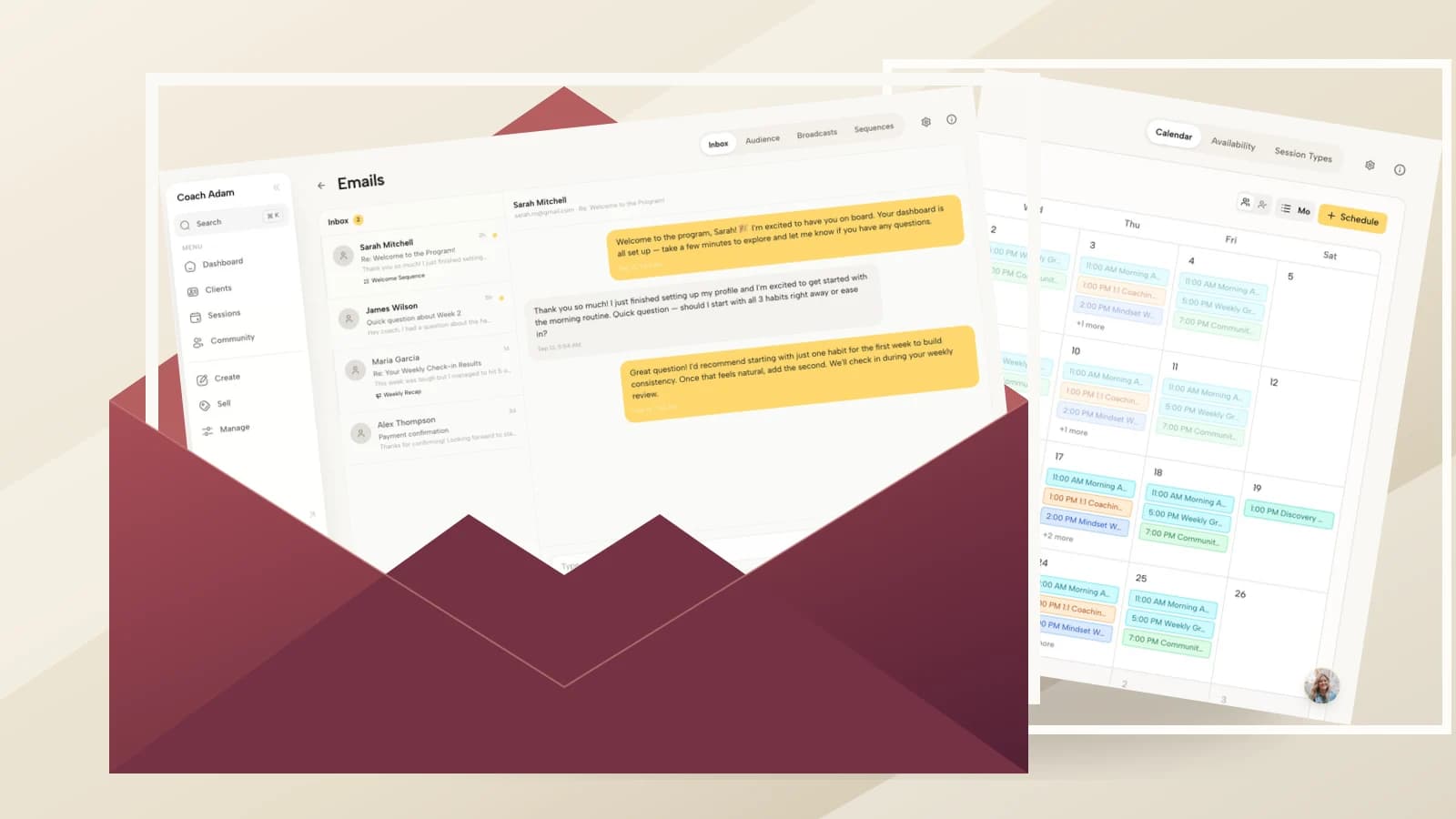
The Coachful demo screens above show the real scheduling, intake, email, links and prospect surfaces behind that handoff. Before building a recovery process, inspect whether the booking destination and enquiry record support the action your email promises. Try the interactive demo to explore those surfaces; then test your own message and recipient journey before using them with prospects.