Etsy for Coaches: 5 Checks Before Selling Worksheets

Nour
Founder, Coachful
Can you sell coaching on Etsy, or should you sell the worksheets instead? Etsy’s current services policy prohibits coaching services, while its creativity standards allow qualifying original digital downloads. For a coach, that makes Etsy a possible marketplace for a genuinely self-contained workbook, not a checkout workaround for private sessions.
That distinction matters before you spend a weekend designing listing images. A PDF that helps someone compare career options is a product. A PDF that merely tells them how to book the coaching call they just bought is not a sensible way to get around a services restriction.
This guide covers five checks before selling coaching worksheets on Etsy: eligibility, originality, buyer fit, economics and delivery. It is for coaches deciding whether a small download business belongs beside their practice. The examples are fictional, the calculations are illustrative, and no sales or client-conversion result is promised.
1. Check that you are selling an eligible product, not a disguised service
Start with Etsy’s services policy. It explicitly lists personal therapy, tutoring, training, coaching and similar professional services among prohibited services. Seeing another seller advertise a coaching session does not establish that the listing complies with policy.
Then read Etsy’s creativity standards. Its “designed by a seller” category includes original content created by the seller and sold as a digital download. That can provide a route for your own text-based workbook or original planning resource, subject to the rest of Etsy’s rules.
Use this practical boundary: could the buyer receive the promised value from the delivered file without you providing personal coaching? If the answer is no, do not solve that problem by renaming your session a digital product. Choose a channel that actually supports the service you intend to sell.
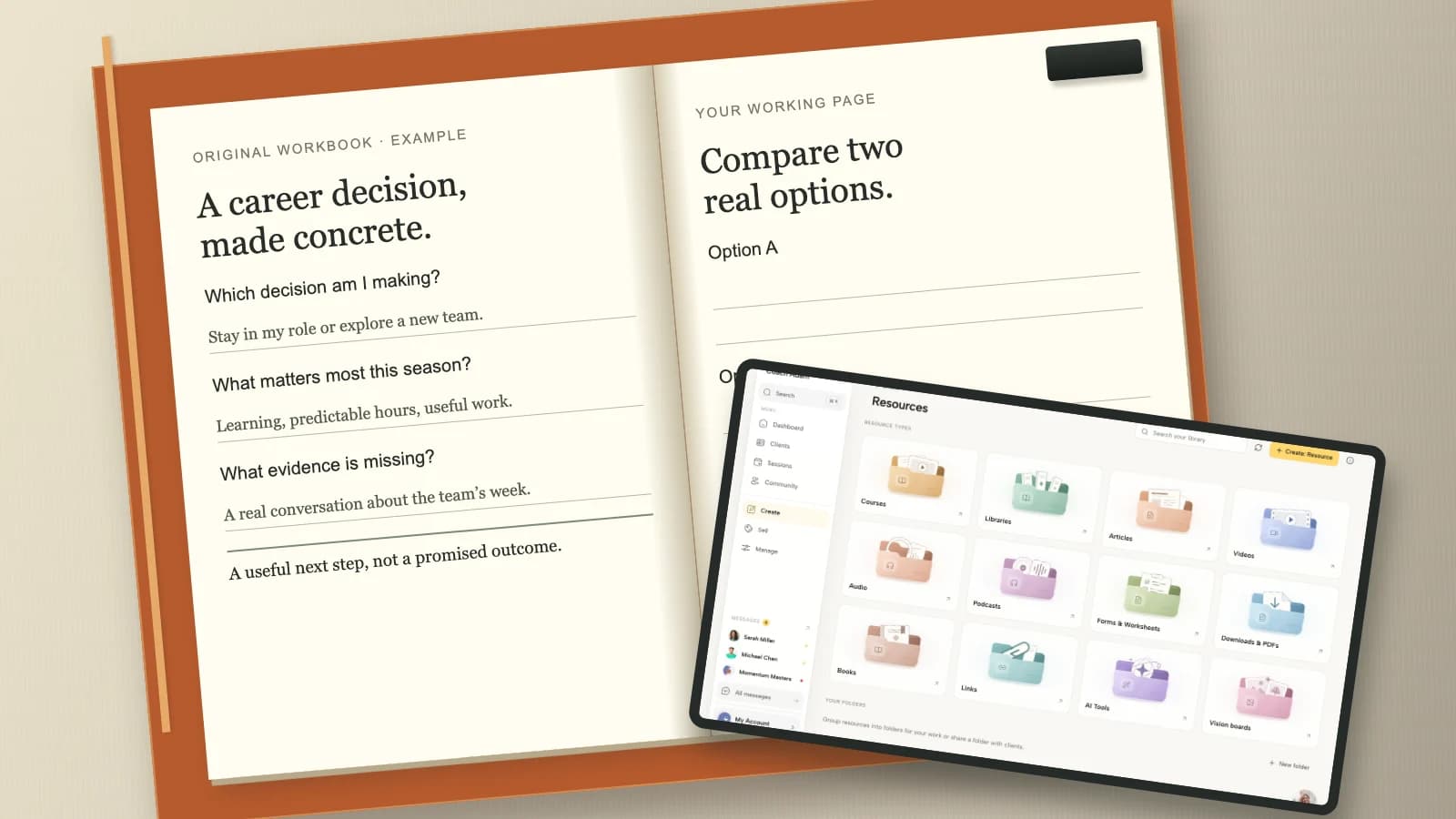
- A potential download: your original printable career-decision exercise, with instructions, a worked example and blank pages.
- A different proposition: a package whose essential value is a live coaching conversation, personal feedback or ongoing accountability.
- A reason to pause: a custom assessment, interpretation or advice offer that sits ambiguously between a file and a professional service. Ask Etsy about the specific item rather than assuming a downloadable deliverable makes it eligible.
This is also a positioning decision. A shopper buying a printable does not necessarily want a coach. Treat the download as a complete purchase with its own purpose, not an intentionally incomplete teaser that pressures the buyer into paying for help.

If your main goal is selling sessions, work on your own coaching package sales process instead. If your goal is selling a useful standalone resource to marketplace shoppers, continue with the checks below.
2. Verify that the worksheet is your original work
A commercial-use license and marketplace eligibility answer different questions. You may have permission to use a purchased template with clients without having permission to resell it. Even a broad resale license does not automatically make the finished item your original design under Etsy’s standards.
Etsy specifically excludes a bundle, collection, scan or PDF of someone else’s work from its “designed by a seller” category. Do not build your launch around buying a large coaching bundle, changing the cover color and assuming the rights question has disappeared.
Before preparing a listing, make a small rights record for the product. Identify who wrote the exercises, who made the illustrations, what fonts or photos are included, and what the relevant licenses actually permit. Retain your source files and permission records privately.
- Write your own explanations, examples and instructions.
- Check the license for every third-party asset, including editable-template use where relevant.
- Do not reproduce proprietary assessment questions or scoring systems without permission.
- Remove real client responses, names and identifying scenarios.
- Do not imply endorsement by a credentialing organization or rights holder.
A familiar coaching idea does not give you the right to copy someone else’s worksheet wording or visual design. Equally, calling an exercise “evidence based” is not a substitute for knowing what evidence applies to the specific exercise and its intended use.

For a fictional career workbook, use an invented example such as someone comparing an internal move with staying in their current role. Say that the example is fictional. You can demonstrate the exercise clearly without turning a client’s confidential decision into sales material.
For health, relationship or mindset resources, stay within your competence and describe the limits plainly. A reflection worksheet should not be marketed as diagnosing a condition, treating distress or guaranteeing a life outcome. A disclaimer cannot rescue a misleading promise.
3. Choose one buyer and describe the actual download
There are two substantially different buyers in this market: a person using an exercise themselves, and a coach buying a resource to use professionally. Decide which buyer you serve before writing the title or license. A personal-use workbook and a practitioner toolkit are not interchangeable.
For the self-guided buyer, explain the decision the resource supports, what they will complete, and the format they receive. For the professional buyer, explain permitted client use, whether editing is allowed and whether redistribution is prohibited. Do not offer permissions you do not own.
A useful product sentence is specific enough to test: “An original printable workbook for comparing two career options, including a filled example and a next-step exercise.” That tells a buyer more than “a transformational toolkit for unlocking your potential.” It also leaves room for honest limitations.

A copyable listing-description structure
[Product name] is a [file format] for [specific audience] working on [specific decision or task].
You receive [actual files, page count and sizes], including [instructions, example and exercise]. You need [actual software, printing requirements or account requirements, if any].
This is a digital product. No physical item, coaching session or individual feedback is included. [State the actual usage license and relevant limits.]
For file-access or usability questions, contact [your real support route]. [Explain applicable shop policies without overriding statutory rights.]
Replace every bracket and remove anything you cannot verify. If the product is not fillable, do not call it interactive. If it requires paid software, say so before purchase. If a buyer receives an instruction file containing a template link, explain that accurately rather than suggesting they receive a finished printable PDF.
Show the real finished product in the listing images, with previews that match the supplied files. A glamorous mockup cannot compensate for tiny writing spaces or unreadable instructions. Do not use Coachful demo screenshots as if they were pages included in your Etsy download.
For deeper product-development guidance, see how to turn a coaching worksheet into a paid product. The Etsy-specific question here is whether a marketplace shopper can judge exactly what they are buying without knowing your coaching practice first.
4. Calculate the return after fees and support
“It can sell repeatedly” is not the same as “it is profitable.” Use Etsy’s current fees policy and the charges shown for your shop country. At the time of checking, the policy lists a US$0.20 listing fee and a 6.5% transaction fee. Those are not the entire cost of selling.
Payment-processing fees vary by country. Other costs can include a setup fee where applicable, listing renewals, advertising, currency conversion, taxes on fees and location-specific charges. Check your own setup rather than copying a creator’s screenshot from a different country or year.

For that hypothetical $12 sale, the 6.5% transaction fee is $0.78. Subtracting that and one $0.20 listing or renewal charge leaves $11.02 before the remaining costs. It is not net profit, a complete fee quote or a forecast for your shop.
Support time is easy to omit because it does not appear in Etsy’s fee statement. Record time spent answering download questions, fixing confusing instructions, maintaining links and processing customer issues. A product that repeatedly requires personal explanation may need redesigning before it needs more promotion.
Also inspect Offsite Ads participation and the fee that would apply to an attributed order. Etsy’s policy distinguishes the standard 15% rate from a 12% rate linked to its stated shop-sales threshold and participation rules. Do not assume every order carries the same advertising cost or that every seller can opt out.
Use a small product test, not a passive-income forecast
Choose one finished product and a review date. Record listing views, paid orders, actual fees, refunds where applicable, support minutes and the most frequent buyer questions. Set your own time and spending limit before adding more listings or paid advertising.
Interpret the stages separately. Views without orders can indicate unclear fit, weak previews or an uncompetitive offer, but they do not prove which explanation is correct. Orders with repeated support requests point toward a delivery or usability problem. A useful review changes one identifiable issue rather than multiplying nearly identical products.
If the economics do not work without a future coaching sale, the download is not yet a sound standalone offer. Do not assign an imaginary lifetime value to an Etsy buyer to make the spreadsheet look better. A marketplace customer is not a booked coaching client.
5. Test the files, delivery and customer boundaries
Etsy’s digital-listing guidance distinguishes instant downloads from made-to-order downloads. It says instant-download listings can contain up to five files, with a maximum size of 20MB per file. Confirm the current supported formats and limits when preparing your actual listing.
Name the files clearly before uploading them. Give the buyer instructions that match the real contents. If you supply multiple formats, identify which one to print and which one to open digitally. A ZIP archive should not become a surprise technical obstacle for someone expecting a straightforward workbook.

Print a sample in grayscale, check the margins and write actual answers into the spaces. Open the digital version on a phone and an ordinary computer. Test fields only if you sell it as fillable, and follow every link. Ask a reviewer unfamiliar with the exercise to explain what they think they should do first.
Explain your support scope without becoming hostile. You can help someone access a file or understand an instruction without quietly adding unlimited coaching to a low-priced purchase. If a question requires individualized professional support, explain that it falls outside the resource rather than pretending a generic worksheet can resolve it.
Do not write an absolute “no refunds under any circumstances” rule as if it overrides consumer law or Etsy’s policies. Digital-content rights and exceptions vary by jurisdiction. Use accurate shop policies and get qualified advice where necessary.

Keep marketplace delivery and your separate practice systems distinct. Before copying customer data anywhere, check Etsy’s seller policy, your privacy obligations and the buyer’s permissions. An order email address is not blanket consent to receive your coaching newsletter.
Likewise, do not divert an Etsy transaction to another payment page to avoid fees. A resource should deliver the value advertised in the Etsy purchase. Any separate marketing, external links or later service offer needs its own policy and consent check; it is not the financial premise of this test.
When your own coaching platform is the better route
Use Etsy when the marketplace product itself makes sense. Use a suitable coach-owned selling and delivery path when the real offer is a course, a program or a personal coaching relationship. These are different business models, not competing buttons for the same restricted listing.
For example, a self-contained PDF exercise may stand alone as a download. A sequence of lessons with demonstrations and practice activities is a different learning experience. A coaching package adds personal attention and an agreement about how you work together. Name and sell the actual offer.

For traffic you acquire independently of Etsy, also choose a destination that matches the promise. A page for a workbook should explain the workbook. A page for coaching should explain the service and its next step. Do not make a visitor infer which offer you meant from a crowded menu.

If you want to compare those practice-side options, try the interactive Coachful demo and inspect the resource library, offers and course builder. It is a practical way to decide whether you need a simple standalone file or a broader coaching experience before building the wrong thing.
Frequently asked questions
Can life coaches sell on Etsy?
A life coach can potentially sell qualifying original digital products, subject to Etsy’s policies. That does not mean they can sell life-coaching sessions there. Check the item itself against the services policy and creativity standards before listing.
Can I sell coaching worksheets I bought with resale rights?
Do not assume so. Your license and Etsy’s originality requirements both matter. Etsy excludes PDFs or collections of someone else’s work from its “designed by a seller” category. Review the specific rights and marketplace rules rather than treating a changed cover as proof of originality.
Will worksheet buyers become coaching clients?
Some people may later seek separate support, but that is not a result you can forecast from a download purchase alone. Judge the product on its own usefulness and economics. Respect marketplace rules and obtain appropriate permission before any separate marketing.
What should a first Etsy product include?
One specific, self-contained task; clear instructions; a fictional worked example; usable blank pages; accurate format details; and an honest usage license. Exclude personal coaching from the promise, and make the files useful without a sales conversation.
The decision is not whether you can make a pretty PDF. It is whether you can offer an original, eligible product that works without you and still earns its place after costs. If the value requires your coaching, sell coaching through an appropriate service channel instead.