Eventbrite for Coaches: 5 Checks Before Selling Workshop Tickets

Nour
Founder, Coachful
Should you use Eventbrite to sell a coaching workshop, or sell places through your own coaching business? Use Eventbrite when you want to test a clearly defined public event and its ticketing costs fit your numbers. Do not treat a listing as a promise of new clients, or confuse a ticket purchase with consent to an ongoing coaching relationship.
The useful question is not whether you can put a workshop online. It is whether this route can attract suitable participants, leave enough money to justify delivery, and give every buyer an accurate next step. A sold-out workshop can still be a poor business decision if you priced only the hour on camera.
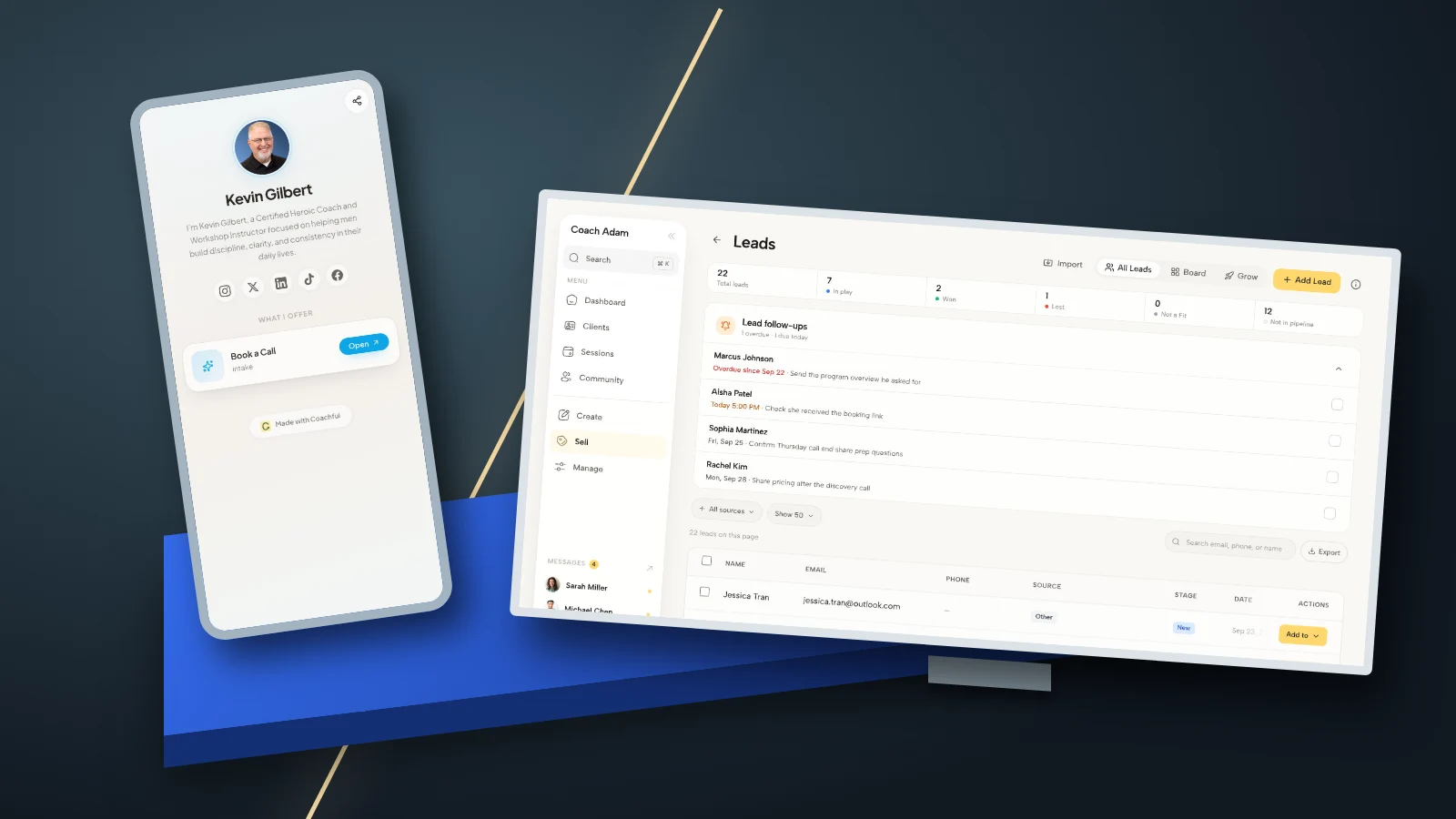
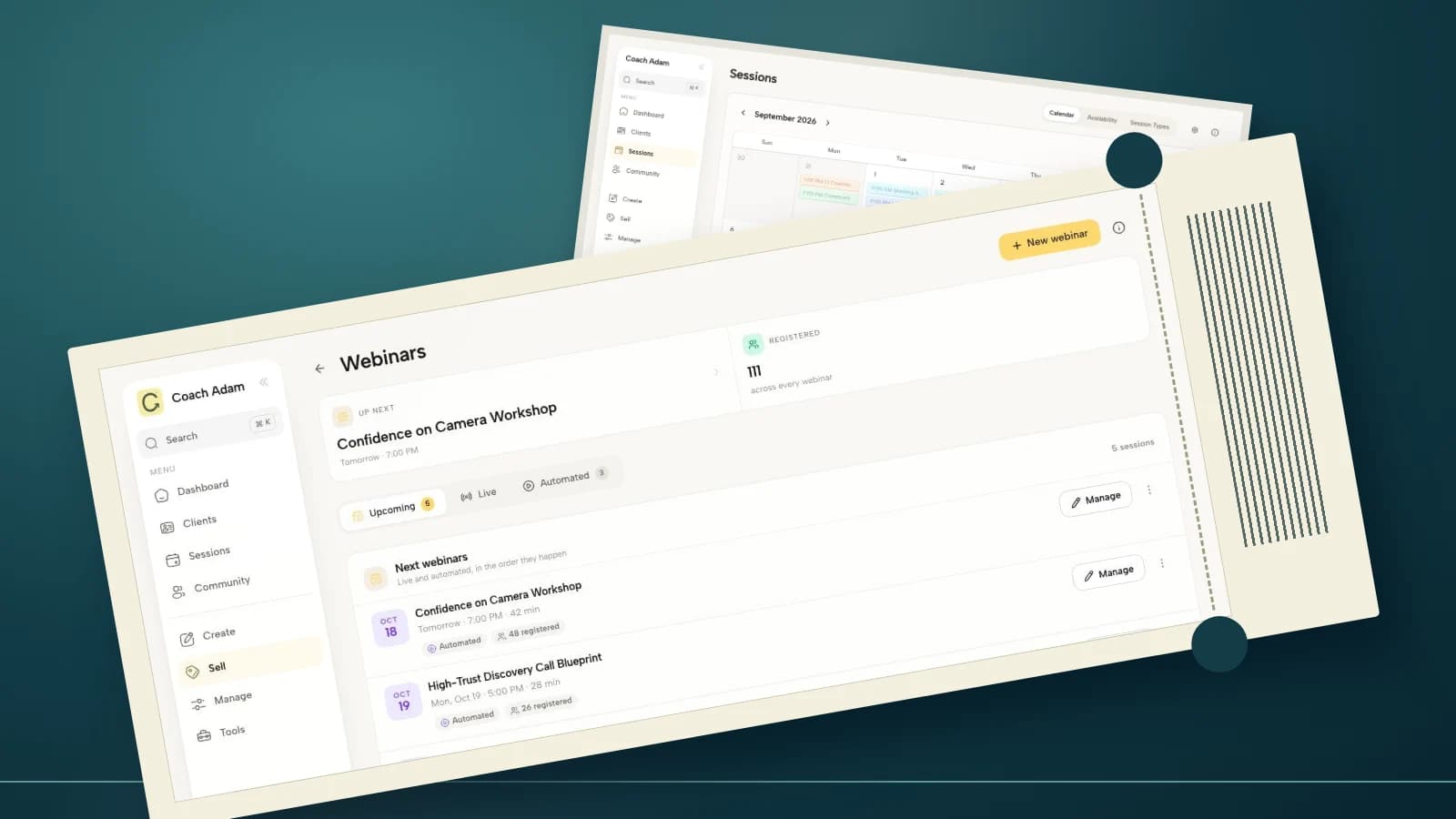
Here are five checks to make before using Eventbrite for coaching workshops. They cover the platform decision, not a minute-by-minute teaching agenda. All examples are hypothetical; the product screenshots show Coachful demos, not Eventbrite or an integration between the two.
1. Sell a specific workshop, not a vague invitation to coaching
A public event needs a bounded promise. Someone browsing workshops should be able to understand who it serves, what happens during the session and what they can reasonably leave with. “Unlock your potential” does not tell a buyer whether to reserve Tuesday evening.
A career coach could offer “Draft your first career experiment: a live workshop for mid-career professionals.” Participants compare possible directions and write one small test they can carry out. That is different from promising a new job or selling a disguised consultation.

Before opening your event editor, write down these facts:
- Participant: a recognizable group with a relevant problem, rather than everyone who wants to improve their life.
- Task: the decision, draft, practice or plan they will work on during the event.
- Format: teaching, individual reflection, paired practice or optional group discussion, including any participation expectations.
- Boundaries: what admission does not include, such as private coaching, personalized clinical advice or unlimited follow-up.
- Logistics: date, time zone, duration, location, access arrangements, recording policy and cancellation terms.
Decide whether the experience is genuinely useful without a later purchase. If the ticket mainly buys a lengthy pitch for your coaching package, the listing should not pretend it is a complete practical workshop. A paid event should deliver the value it advertises.
Choose a format you can facilitate responsibly. A large audience may suit teaching and private writing; a small group may allow live feedback. Do not promise personal attention to every participant unless your capacity and agenda support it. For the teaching plan itself, use the separate online coaching workshop run sheet.

2. Check the actual fees, then calculate your minimum viable attendance
Eventbrite's official pricing says free tickets have no ticketing fees. Paid tickets incur fees, and buyers pay them by default unless the organizer chooses to absorb them. Free admission does not make your workshop free to produce, and passing fees to buyers does not make those charges irrelevant to conversion.
As checked for this article, the official ticketing-fee guide lists a US service fee of 3.7% plus $1.79 per sold ticket, with payment processing of 2.9% of the total order. Countries and currencies differ. The guide says processing uses the order total, including service fees and tax, so simply adding percentages against the ticket's face value can give the wrong answer.
Use the fee breakdown in your own Eventbrite account, not an unofficial calculator as your final quote. The official route is Events, select your event, Tickets, select or create a paid ticket type, then “How fees work.” Check the buyer's full checkout price and your actual ticket revenue.
Make a planning model with three separate inputs: fixed event costs, contribution per paid place and delivery capacity. Fixed costs should include preparation and administration time at a rate you choose, as well as venue, assistance or other committed expenses. Contribution is the amount left from one ticket after its variable costs.
Minimum paid places = fixed costs divided by contribution per place, rounded up. If contribution is zero or negative, selling more seats does not fix the underlying model. Raise the price, reduce costs, change the experience or decide consciously that you are funding a marketing experiment.

For example, suppose a $40 workshop leaves $34 per paid attendee after a hypothetical $6 allowance for variable costs. With $300 of fixed costs, nine paid places cover those costs. At twelve paid places, the model leaves $108 before anything you excluded. These figures illustrate the method, not Eventbrite's actual charges for a $40 ticket.
Now compare that minimum with your practical capacity. If you can responsibly facilitate eight people but need nine to break even, the design does not work as stated. Do not quietly increase the group to rescue the spreadsheet while keeping a promise of individual feedback.
Also check payout timing, identity and banking requirements, refund handling and the terms that apply to your event. Revenue earned is not necessarily cash available for a venue deposit today. Keep enough cash to handle the obligations you accept, and seek appropriate tax or legal advice for your jurisdiction.

3. Decide what Eventbrite must contribute that your existing audience cannot
There are two different reasons to use an event platform: it helps administer a purchase, or it helps people discover your event. Do not pay for both in your mental justification when you have only tested one. A convenient checkout is useful, but it is not proof of additional demand.
If every buyer arrives from your own newsletter, you may be choosing Eventbrite mainly for ticketing convenience. That can be reasonable. Compare its total costs and administrative work with a direct sales route that you can actually operate, rather than assuming either option is automatically cheaper or better.
If your reason is discovery, look at current relevant listings in your location or niche. Do the descriptions match the language your participants use? Are similar events genuinely comparable in audience, topic and format? A full-looking marketplace is evidence of supply, not a guarantee that your own workshop will sell.
Write a small test hypothesis before promoting: “This public workshop will attract suitable people beyond my existing contacts, at an acquisition and delivery cost I am willing to bear.” Choose the maximum cash and time you will risk, a decision date and the attendance minimum from your model.
- Track source: distinguish your own email, social links, partner introductions and any identifiable platform discovery. Use available reporting and an optional source question, acknowledging imperfect attribution.
- Track paid attendance: separate ticket orders, actual attendees and people who completed the workshop task.
- Track suitability: note whether the audience matched the experience you designed, without collecting unnecessary private details.
- Track effort: include setup, buyer questions, delivery, refunds and follow-up, not just advertising spend.
Keep advertising optional and separate from the first decision. Paying to promote an event before you have a credible offer and workable economics makes it harder to diagnose a weak result. Choose a limit you can afford to lose; do not describe hypothetical future coaching sales as money already earned.
Continue only for a clear reason: useful additional demand, acceptable workshop economics or a deliberately funded learning goal. “I already spent time making the page” is not a reason to keep buying traffic.
4. Give every paid attendee one reliable route into the workshop
The most expensive ticketing mistake may happen after checkout: a person has paid, but your event records, joining instructions and access list disagree. Decide which record establishes admission and who checks it. A name in a separate form is not necessarily a paid ticket.
For an Eventbrite sale, verify the order in Eventbrite before treating it as paid. If you deliver elsewhere, make the handoff explicit. This article does not assume a native Eventbrite integration with Coachful, automatic enrollment, live capacity synchronization or imported payment records.

Give the process a named owner, even if that person is you. Before the event, reconcile the confirmed roster against the people who have received the correct joining instructions. Account for transfers, cancellations, duplicate names and one purchaser buying for someone else.
A practical confirmation tells the buyer what they booked, when it happens, the relevant time zone, how to join, what to prepare and where to ask for help. Explain any separate account or access step before purchase if it is material. Do not surprise a ticket holder with a second paid checkout for the event they already bought.
Test from a participant's perspective in a fresh browser session. Use a supported test or preview process and test information you control. Check mobile readability, the correct session, the link destination, access permissions and the support route. Do not create real charges or message an existing audience merely to test a workflow.

If an exercise depends on breakout rooms, captions, recording or participant controls, test that feature in the actual meeting tool and configuration. A logo on an integrations page does not prove a feature is enabled for your event. For in-person workshops, apply the same care to the venue address, entry instructions and access needs.
Agree on what happens when a link fails or a participant cannot get in. Keep a monitored support contact and a usable fallback message. Do not make public attendee lists or group chats the default place to troubleshoot someone's payment or personal situation.
5. Separate workshop fulfillment from your next coaching sale
A workshop buyer has agreed to attend an event, not to become a private coaching client. Deliver the promised materials and necessary event updates first. Keep ongoing marketing permission and any later coaching agreement separate, following the rules that apply to your situation.
That distinction matters even when someone shares a meaningful question during the workshop. Vulnerability is not buying intent. Do not use another participant's disclosure as a sales example, a testimonial or an excuse for a private pitch.
If you include a community, state whether it is optional or part of the purchased experience, what participants can see about one another and when access ends. Do not call it lifelong access unless you can define and support that commitment. A short workshop does not require a permanent group space.

Set the communication boundary too. Decide whether follow-up means one resource email, a limited question window or an ongoing service. If a participant needs private help, provide an appropriate route without implying that you owe unlimited coaching because they bought admission.

Your later invitation can be simple and specific: “If you want individual support turning this experiment into a decision, here is what my career-coaching engagement includes.” Explain who it suits and let people choose. Do not create an artificial deadline or imply the workshop only works if they upgrade.
A sensible first test
For a first Eventbrite experiment, choose one audience, one date and one bounded outcome. Build the cost model, decide your minimum attendance and publish accurate terms. Then run the actual access test before you promote. Review the result against the hypothesis you wrote, not against someone else's launch story.
Keep the decision reversible where possible. Avoid booking a large nonrefundable venue or buying extensive promotion before you know what financial commitments you can carry. If you set a minimum attendance condition, make it clear to buyers beforehand and explain what happens if you cancel.
When you already have a direct audience and want to explore the delivery side, try the interactive Coachful demo. Inspect the event, calendar, payment-record and communication surfaces against your checklist. The useful next step is to choose a reliable admission-to-delivery process, not add a second system without a job.
Frequently asked questions
Is Eventbrite free for coaching workshops?
Eventbrite states that free tickets have no ticketing fees. Paid tickets have country- and currency-dependent charges, with buyers paying by default unless you absorb fees. Your preparation, venue, delivery and optional promotional costs remain separate. Check the current breakdown for your account and event.
Will listing a workshop on Eventbrite bring coaching clients?
It may create another route to discover your event, but a listing is not a client guarantee. Measure where suitable attendees came from, whether the workshop delivered its promise and whether later enquiries were appropriate. Evaluate the workshop on its own economics before relying on speculative future sales.
Should I pass ticketing fees to attendees or absorb them?
Compare the full buyer price and your contribution per place under both choices. Absorbing fees reduces what you retain; passing them on increases what buyers pay. Choose deliberately, disclose the total appropriately and verify the actual checkout rather than relying on the headline ticket price.
Can I automatically move Eventbrite buyers into Coachful?
No automatic Eventbrite-to-Coachful workflow is established by this guide. Verify any proposed connection against current documentation and test its exact behavior before relying on it. Without one, use a documented manual reconciliation process and avoid unnecessary copying of personal data.
Sources and related reading
- Eventbrite pricing, for the distinction between free and paid ticketing and who pays fees.
- Eventbrite's Ticketing Fees, for country-specific charges, calculation bases and the account fee-checking route. Pricing can change.
- Workshop registration form template for coaches, for the separate question of what to collect and when a place is confirmed.