
How to Become a Grief Coach: Training, Limits and Clients
Many people who look up how to become a grief coach have been through a loss themselves, and that experience is a real asset when it's paired with training. The path: coach training, a grief-specific program such as the Grief Recovery Method certification, David Kessler's Grief Educator certification or ADEC's thanatology credential, practice with people after loss, and firm rules for referring anyone whose grief has become a clinical problem. Grief coaching isn't licensed. It serves people living with loss who need help rebuilding daily life, decisions and identity, while grief counselors and therapists treat grief that has become stuck or dangerous.
What follows is the line between coaching and grief therapy, an honest check on whether the work suits you, the trainings and what they cost, how to pace sessions, how to price without exploiting anyone, and how grieving people find a coach they trust. When you're ready to launch, Coachful's team will build your grief coaching website for free on every plan.
Most grief isn't a disorder, and that's where a coach fits
Grief after a death is normal, and for most people it slowly becomes something they can carry. A minority develop prolonged grief disorder, now a recognized diagnosis in the American Psychiatric Association's DSM-5-TR and in ICD-11. A 2017 meta-analysis in the Journal of Affective Disorders estimated a pooled prevalence of 9.8 percent among adults bereaved by non-violent deaths, roughly one in ten, with higher rates at older ages.
That leaves a large group of people who aren't ill but are struggling: the widow who has never paid the bills, the son who has to clear the house, the manager going back to work three weeks after a funeral. Grief coaching serves them. It also covers losses that aren't deaths, such as divorce, a diagnosis, a miscarriage, retirement or estrangement.
| Role | What they do | Licensed? |
|---|---|---|
| Grief coach | Daily structure, decisions, return to work, identity and meaning after loss | No |
| Grief counselor or therapist | Assessment and treatment of complicated or prolonged grief, depression, trauma | Yes, as a counselor, social worker, psychologist or therapist |
| Hospice bereavement staff | Support for families before and after a death in hospice care | Often clinicians or trained volunteers |
| Support group facilitator | Peer groups for people with a shared loss | Usually not |
When a grieving client needs a licensed professional
Put this list in your intake and your agreement, and refer when you see it:
- Thoughts of suicide or of joining the person who died. Act the same day. In the US, the 988 Suicide & Crisis Lifeline takes calls and texts.
- Grief that hasn't eased many months on and is stopping the person from working, eating, sleeping or caring for others.
- Traumatic loss: suicide, overdose, violence or a sudden death the client witnessed.
- Heavy drinking or drug use to get through the days.
- A child or teenager as the grieving client, who needs a specialist.
Our guides to trauma-informed coaching and an emergency escalation protocol are worth reading before your first client, not after.

Is grief coaching the right work for you?
Coming to this work through your own loss gives you a kind of credibility no course can. It also carries a risk. Before you take clients, be honest about three things:
- Your own grief. If your loss is recent, other people's stories will reopen it in sessions. Plenty of coaches wait until their own grief has settled before they start.
- Your caseload. Four grief sessions in a day is heavier than four career sessions. Cap how many you book, and leave time after each one.
- Your support. A supervisor or peer group to talk your cases through keeps you steady; our guide to coaching supervision explains how it works.
If those three are in place, the work is some of the most meaningful in coaching.
Grief coach training and certification
There's no single grief coaching board. Most grief coaches combine general coach training with one grief-specific program. The options below were checked on each organization's own site in October 2026.
| Program | Format and length | What you get |
|---|---|---|
| Grief Recovery Method Certification Training (The Grief Recovery Institute) | Four days, 32 hours of live training, online on Zoom or in person; listed at $2,495 online and $4,995 for the in-person premium format in October 2026 | The title Certified Grief Recovery Specialist; the institute says no degree or license is needed |
| Grief Educator Certification (David Kessler) | A 12-week program in spring and fall cohorts | Certified Grief Educator status and eligibility for a listing on Kessler's site |
| Certified in Thanatology (CT) (ADEC, the Association for Death Education and Counseling) | An exam held once a year in October, with applications in the summer | A knowledge credential in death, dying and bereavement; eligibility through a bachelor's in a related field, a related professional license, or an associate degree in a related field |
| ICF-accredited coach training | Several months part time; ICF credentials from 60 hours of education and 100 coaching hours | The coaching skill itself, which grief programs don't fully teach |
One practical route the certificates can't replace: volunteer with a hospice bereavement program or a grief support organization if one near you trains volunteers. You'll sit with grief in its real forms, which is the only way to learn whether you can do this work week after week. Our guide to whether a certification is worth it has seven checks to run on any program before you pay.
What it costs and how long it takes
| Step | Time | Cost |
|---|---|---|
| A grief-specific program | Four days to twelve weeks | From $2,495 for the Grief Recovery Method online format (as listed in October 2026); check others on their sites |
| General coach training | Several months | Varies widely by school |
| Volunteer or practice hours | Three to six months alongside training | Time |
| Practice setup | A few weekends, or less with the free build | Insurance, a website, booking and payments |
How to pace grief coaching
Grief doesn't move in twelve tidy weeks, and an offer that promises a finish line will feel wrong to the people you most want to help. Design around the calendar of loss instead: the first months, the first holidays, the anniversary, the house sale, the first day back at work.
A first session shape that works:
- Their person. Ask who died, or what was lost, and let them tell it. This isn't wasted time.
- What's hardest right now. Usually something concrete: mornings, paperwork, the empty side of the bed, a colleague who won't mention it.
- What is already helping. Name it, so they leave with something that works.
- One small next step, for this week only.
- A check on safety and support, including who else they can call.
Then plan touch points between sessions: a gentle weekly check-in, a reminder before a hard date, a prompt they can answer when they want to. Silence in sessions matters too; our piece on when to wait and when to speak applies more to grief work than to any other niche.

Pricing grief coaching fairly
Coachful's rates data has no grief-specific figure. The nearest band, life coaching, is $75 to $200 an hour in the 2026 report (PayScale and practitioner reports), with practitioner estimates of $50 to $100 for coaches in their first years. Grief work has an extra rule: never pressure someone in fresh loss into a large package. Offers that respect that:
| Offer | Shape |
|---|---|
| Single sessions | Bookable one at a time for the first months, with no commitment |
| A first-year companion | A monthly session plus check-ins before holidays and the anniversary |
| Back to work after loss | Four to six sessions around a return to work, sometimes paid by the employer |
| A small grief circle | Six to eight people meeting weekly for a set number of weeks |
Many grief coaches keep a few reduced-fee places each month; sliding-scale coaching rates shows how to set them without undercutting yourself. For the broader picture, see the life coaching rates page.

The tools a grief coaching practice runs on
Grief clients need things to be simple and private. In Coachful, the pieces are included in your membership:
- Booking for single sessions or packages, with reminders by email, SMS or WhatsApp.
- Gentle check-ins and prompts you design, on the schedule you choose, answered in the client app.
- Journeys that pace steps over weeks, so a first-year plan can follow the calendar.
- Groups and live sessions for a grief circle or a remembrance workshop, with a private feed and chat.
- Privacy controls: Coachful is GDPR-ready with full data export, and an owner-only Sensitive Data Mode blocks AI processing of client records, notes and check-ins. It is not HIPAA-certified.


See the Coachful page for life coaches for the wider feature set, and our sibling guide to grief coaching for how clients choose a grief coach.
A quiet website for your grief coaching practice, built for free
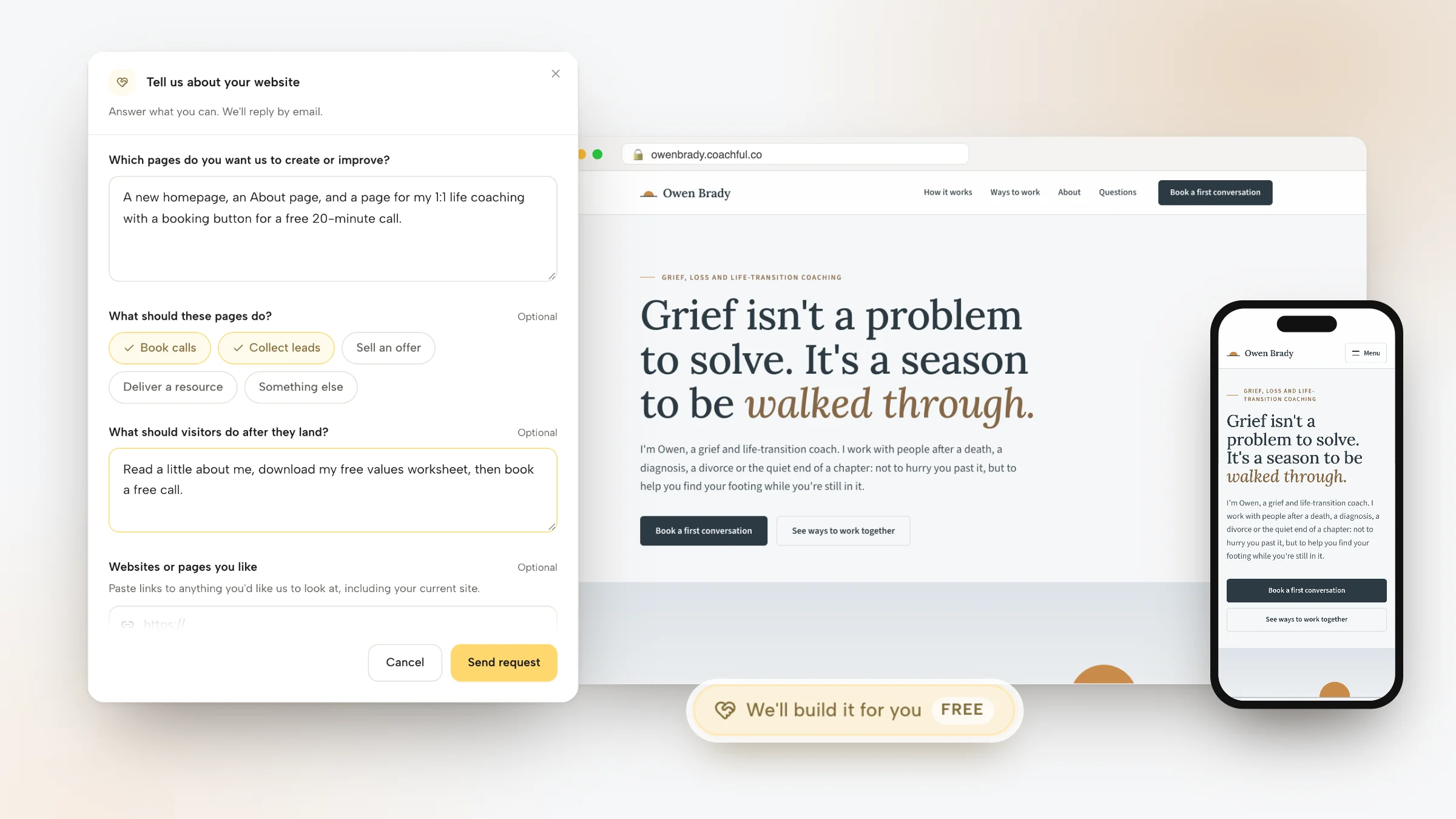
A grief coach's website should be quiet, say plainly who you help and make the first conversation feel low-stakes. Coachful's team builds it for free on every plan, inside your own account: homepage, how it works, ways to work, About and a booking page. Coachful itself is a paid subscription, and you can start with a free trial.

Click Fill in a form on the "Want us to build it for you?" card on the Website page, or choose We'll build it for you · FREE under Create. List the pages, what they should do and what a visitor should do next, then add up to 8 links and 10 files. The team replies by email with next steps, usually within about 24 hours, typical rather than guaranteed. A recent build for an author and speaker turned the coach's own copy document and photos into five pages, with a new welcome homepage, a community signup page and a book page that waits for the book's launch. Nothing gets invented. The team doesn't design logos, record video or run ads. Everything the free build covers.

How grieving people find a grief coach
Grieving people often don't search for help in the first weeks; many find support later, through someone they trust. Build those relationships:
- Hospice bereavement coordinators who support families after the first months.
- Funeral directors and celebrants, who are asked "what now?" constantly.
- Estate and family lawyers who see the practical side of loss.
- HR teams, for employees coming back from bereavement leave.
- Faith communities and existing grief support groups.
Teach in public: a monthly remembrance evening, a workshop on "the first holidays", a short guide to the paperwork after a death. Our list of referral partners to ask first works for grief coaches with small changes. Don't run ads that target people by recent loss; it's both unkind and a fast way to lose the trust of every referrer above.
Frequently asked questions
Do you need a license to be a grief coach?
No. Grief coaching isn't licensed. Grief counseling and therapy are done by licensed clinicians, so grief coaches shouldn't diagnose or treat prolonged grief disorder, depression or trauma, and should refer those clients.
What is the difference between a grief coach and a grief counselor?
A grief counselor is a licensed mental health professional who can treat complicated or prolonged grief. A grief coach helps people who are coping with loss rebuild routines, make decisions and find meaning, and refers anyone who needs clinical care.
How long does it take to become a grief coach?
Grief-specific programs run from four days, like the 32-hour Grief Recovery Method training, to twelve weeks, like David Kessler's Grief Educator certification. General coach training adds several months, and practice hours alongside it make you ready.
How much does grief coach certification cost?
The Grief Recovery Method certification was listed at $2,495 online and $4,995 in person in October 2026. Other programs publish their own prices, which change; check each one before you budget.
Can grief coaches work with any kind of loss?
Many do: divorce, diagnosis, pregnancy loss, retirement and estrangement as well as death. Choosing one focus usually works better for marketing, and traumatic losses and grieving children need specialists.
How much do grief coaches charge?
Coachful's rates data has no grief-specific figure. Life coaching, the nearest band, runs $75 to $200 an hour in the 2026 report. Grief coaches often offer single sessions first and keep reduced-fee places.
Will Coachful build my grief coaching website for free?
Yes. Coachful's team builds coaching websites and booking pages for free on every plan. Fill in the form from the Website page or Create, and the team replies with next steps, usually within about 24 hours. Coachful is a paid subscription; the build costs nothing extra.












