How to Create a Career Coaching Program Built on Results
People hire a career coach for one of three things: a direction, a job or a promotion. A career coaching program that tries to sell all three at once confuses the buyer, because a teacher who wants out of the classroom needs a very different eight weeks than a senior engineer chasing a staff title. So the first design decision is which of those three your program delivers.
After that, career programs are unusually concrete. Clients finish with things they can hold: a target role, a rewritten resume, a list of people they have spoken to, interview stories, sometimes an offer. This guide shows how to build the program around those deliverables, with a full eight-week sample for teachers moving into instructional design, session formats, worksheets, pricing structures and the mistakes career coaches make most.
If you would rather not build it yourself, Coachful's team will set up your career coaching program for free on any Coachful plan. You send your outline or notes through a short request form, and the weeks, tasks and worksheets are built in your account.
Pick the career problem your program solves
| Program type | Client says | Typical length | What they leave with |
|---|---|---|---|
| Direction | "I know I need a change, I don't know to what." | 6 to 8 weeks | One or two tested target roles and a bridge plan |
| Search | "I know the role, I can't get interviews." | 8 to 12 weeks | Resume, LinkedIn, target list, interview stories, a weekly search routine |
| Advancement | "I'm doing great work and keep getting passed over." | 8 to 12 weeks | A promotion case, visible wins, a sponsor, a conversation plan |
| New role start | "I got the job. Now I need to not blow it." | 8 to 13 weeks | A first-90-days plan, key relationships, an early win |
Each of these exists as a ready-to-film program template in Coachful (The Career Pivot Roadmap, Land the Job, Promotion Ready and Strong Start: Your First 90 Days), which is a fast way to see how the weeks can be sequenced before you write your own. If you are still setting up your practice, our guide on how to become a career coach covers training and finding first clients.
Build the program around deliverables
Career clients judge progress by artifacts. Write down, for every week, the thing that exists on Friday that did not exist on Monday. That list becomes your program outline and, later, your sales page. "By week five you'll have a resume written in results, not duties" is a stronger promise than any amount of "gain clarity and confidence".
Two rules keep the deliverables honest. Each one should take the client two to four hours, not twenty. And each one should be something you review, so the client knows a professional looked at it before it goes out into the world.
Sample: an eight-week career coaching program for teachers
The program is called "Classroom to Curriculum", for K-12 teachers moving into instructional design or learning and development roles. The promise: "In eight weeks you have a portfolio piece, a resume that speaks the industry's language, ten conversations with people in the field and a steady application routine."
| Week | Focus | Session | Deliverable by the next session |
|---|---|---|---|
| 1 | Inventory | What teaching taught you that companies pay for | Skills inventory with 20 skills and one piece of evidence each |
| 2 | The market | Decode ten real job ads together | A one-page target role profile with titles, tools and salary range |
| 3 | Conversations | Informational interview script and outreach | Five conversations booked, notes in the log |
| 4 | Portfolio | Turn one of your best lessons into an e-learning storyboard | Portfolio piece one, reviewed |
| 5 | Resume and LinkedIn | Rewrite duties as results | Resume version two and a new LinkedIn headline |
| 6 | Applications | Build the target company list and a weekly routine | Fifteen companies, five tailored applications |
| 7 | Interviews | Story bank and a recorded mock interview | Six STAR stories and one practice interview |
| 8 | Offers and next steps | Evaluating offers, negotiating, the plan if no offer yet | Offer comparison sheet and a 30-day search plan |
The order matters. Conversations come before the resume because what clients hear in week three changes how they write in week five. Interviews come late because by then clients have real stories from the portfolio work.

How the sessions run
Career coaching mixes three kinds of contact, and the program should name each one so clients know what to expect:
- Strategy sessions, 45 to 60 minutes, weekly or every two weeks. This is where you decide the target, work on confidence and plan the week.
- Practice sessions: mock interviews, salary negotiation role plays, networking rehearsals. Record them if the client agrees, and review one clip together.
- Asynchronous reviews: resume drafts, LinkedIn edits, cover letters and outreach messages, with comments returned within an agreed window, say two working days.
Put the review window in writing. Without it, clients send a resume at 11 p.m. on Sunday with an application deadline on Monday, and you spend your weekend on it.

For session content ideas, our list of career coaching questions to ask clients covers the intake, the middle weeks and the close.
Worksheets career clients actually use
Career programs need fewer reflective worksheets than life coaching and more working documents. These five carry most of the load:
- Skills inventory. Three columns: skill, evidence, how a company would describe it. The third column is where teachers, nurses and military veterans usually find their language.
- Target company tracker. Company, why it fits, contact, status, next action, date.
- Informational interview log. Who, what I asked, what I learned, who they suggested next.
- STAR story bank. Situation, task, action, result, plus the interview questions each story answers.
- Offer comparison. Base pay, bonus, benefits, flexibility, growth, commute and a gut score from 1 to 10.
Pair them with a short weekly check-in: applications sent, conversations held, interviews booked, energy from 1 to 10, one thing that is stuck. Job searches are lonely, and the energy number often tells you more than the application count. Our guide to creating coaching worksheets has layouts you can copy.
Pricing a career coaching program
Career clients are often between jobs or nervous about money, so clarity matters more than a low price. Structures that work:
- A program fee covering the full eight weeks, with a two or three part payment plan.
- Add-on sprints sold separately, such as an extra interview-prep week once the client lands a final round.
- A lighter group version for the teaching weeks (inventory, market research, resume), with 1:1 time reserved for interviews and offers.
Avoid guaranteeing a job. You do not control hiring managers, and a guarantee invites refund disputes over things outside your coaching. Promise the deliverables and the support instead.

Delivering a career coaching program online
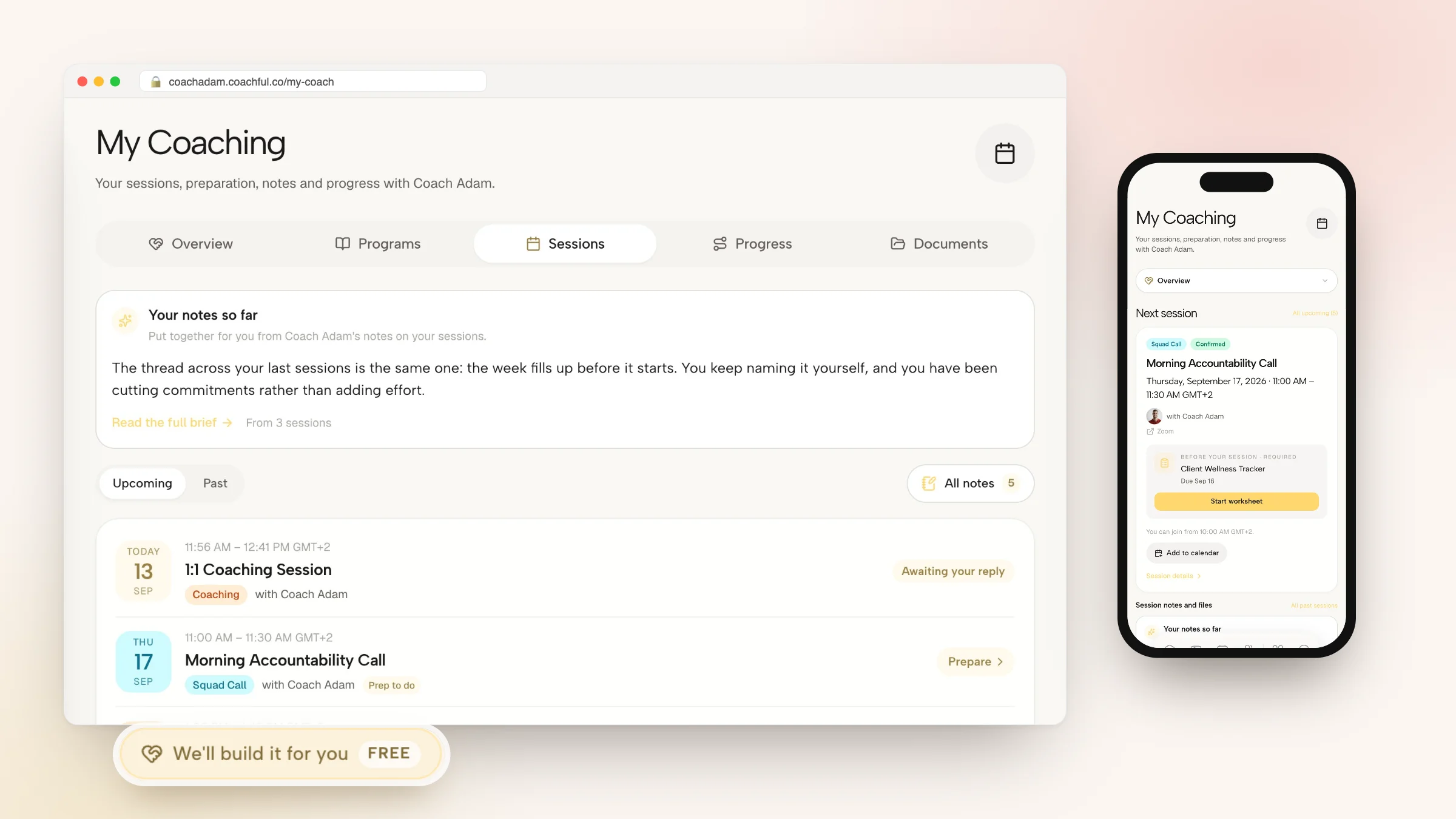
Most career coaching is already remote, which makes the delivery setup the part clients notice. They should see this week's deliverable, upload drafts, book practice sessions and message you in one place. In Coachful, each week of a program carries its tasks and worksheets, clients follow it in the portal or the client app on iPhone and Android, and the Career Coaching power-up adds application tracking, connections, a CV builder and LinkedIn planning to the client's workspace. If you teach the same material to every client, a companion course keeps it out of your sessions: templates such as The Resume That Lands Interviews and Interview Mastery come with lessons and notes written, ready for you to film. The page for career coaches shows the full setup.

If you plan to run the program as a cohort, our playbook for a group career coaching pilot covers recruiting the first round.
Mistakes career coaches make with their first program
- Starting with the resume. A resume written before the target is clear has to be written twice.
- No deliverable per week. If a week ends with "reflect on your values" and nothing else, clients feel the program stall.
- Unlimited document reviews. Set a number of review rounds and a turnaround window, or reviews will eat your margin.
- Ignoring the emotional side. Rejection hits hard in week six. Plan a session for it instead of hoping it doesn't come up.
- Selling outcomes you cannot control. "Land a six-figure role in eight weeks" is an advert, not a program promise.
Get your career coaching program built for free
Once you know the program type and the deliverables, Coachful's team can do the build. It is free on every Coachful plan and labelled FREE and Complimentary gift in the app.
You can start from the Create page, where the first chip under "Unleash your creativity" reads We'll build it for you · FREE, or from the Want us to build your program? card at the bottom of the Programs list, which opens the form with Program already chosen.

The form asks what you want it to be ("an eight-week program for teachers moving into instructional design, with a worksheet each week"), who it is for and what it should achieve. You can add up to eight links, such as programs or pages you like, plus notes, copy and offers to include. Upload up to ten files: your old resume template, a skills inventory you use, slides from a workshop or a voice memo walking through your method. Video files are not accepted. The final box is for deadlines or anything to avoid.
The team replies by email with next steps, usually within around 24 hours. That is the usual turnaround, not a guaranteed deadline. The program is built inside your own Coachful account, with weeks, tasks, worksheets and resources in place, so you can adjust any of it later.
Recent requests have ranged from full programs to the pages around them. For a real-estate and money coach, the team built a year-long cohort program with an application form and a free nine-day bootcamp course with its own signup funnel. For a leadership coach facing a website renewal deadline, it was one clean, mobile-friendly homepage with a repeated "talk with me" button.
What the service does not cover: the team does not record your videos or audio, run coaching calls for you, design logos, manage ads or run your marketing. And it never invents anything. No made-up credentials, testimonials, placement rates or prices; gaps stay marked for you to fill in. Read the guide to the free white-glove service for the full list of what can be built.
One last test before you sell it: read your week list to a past client and ask which week they would have paid for on its own. That week goes on the sales page first.
Frequently asked questions
What should a career coaching program include?
A clear program type (direction, search, advancement or new role), a deliverable for each week, strategy sessions, practice sessions such as mock interviews, asynchronous document reviews with a set turnaround, working worksheets like a target company tracker and STAR story bank, and a weekly check-in.
How long is a typical career coaching program?
Direction programs often run six to eight weeks. Job search and promotion programs usually need eight to twelve weeks, because applications and interview cycles take time. A new-role program often follows the first 90 days in the job.
Should a career coaching program guarantee a job?
No. Hiring decisions sit outside your control, and a job guarantee tends to cause refund disputes. Promise the deliverables, the reviews and the practice, and describe results from past clients only if they are real and the clients agreed to share them.
Can I run a career coaching program as a group?
Yes. The teaching-heavy weeks, such as skills inventory, market research and resume writing, work well in a group. Many coaches keep interviews, negotiation and offer decisions as 1:1 sessions or sell them as an add-on.
Will Coachful build my career coaching program for free?
Yes, on any Coachful plan. Pick Program in the request form from Create or the Programs list, describe the program and audience, and attach your outline, templates or a voice memo. The team replies by email, usually within around 24 hours, and builds it in your account for you to edit.
What tools do career coaches need to deliver a program online?
A place for the weekly plan and worksheets, booking for strategy and practice sessions, a way to review documents and message clients, and a tracker for applications. Coachful covers these in one account, with an optional Career Coaching power-up for applications, connections and a CV builder.