How to Create a Coaching Offer People Say Yes To
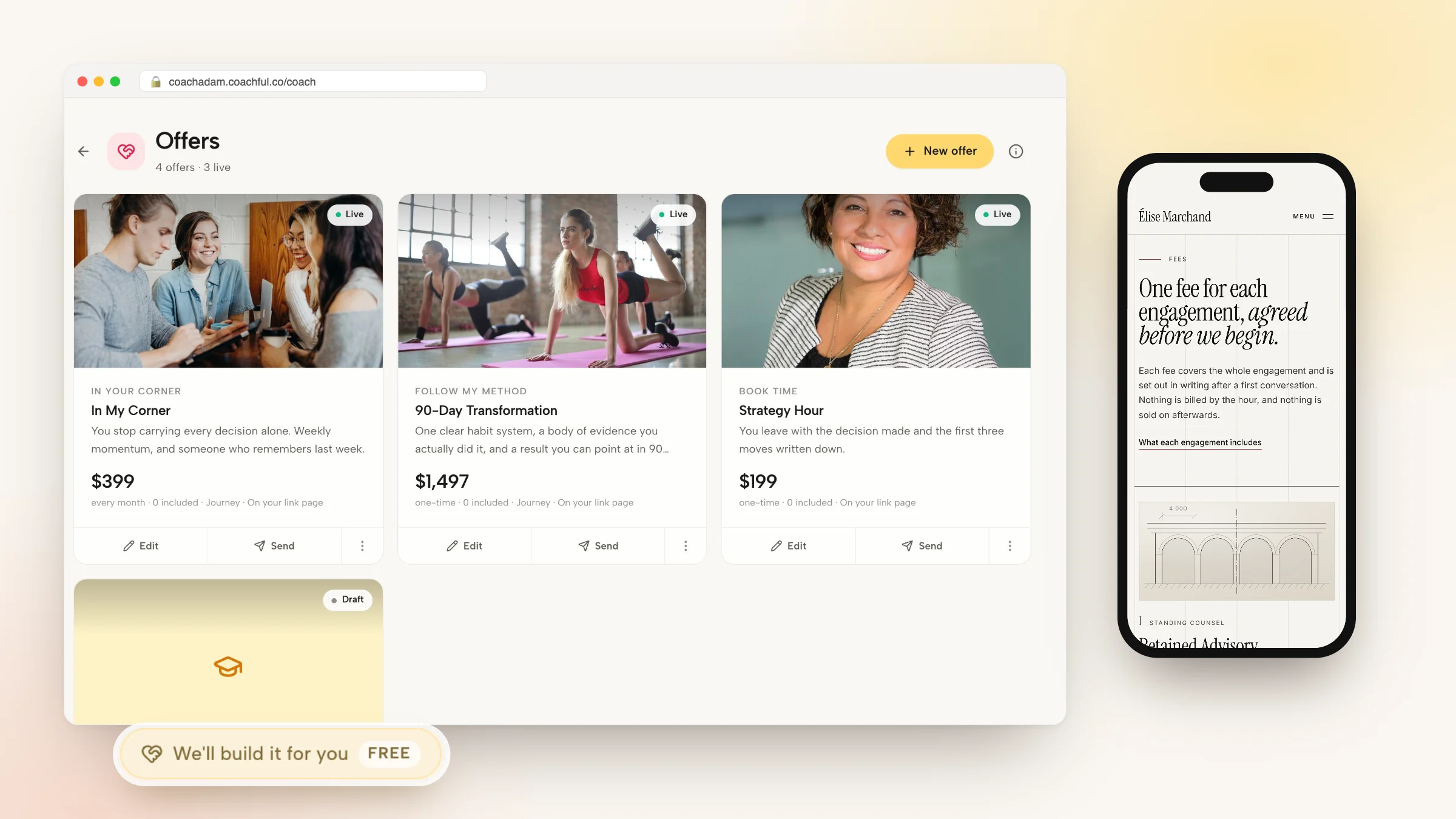
Nobody buys "coaching". They buy a way out of a specific situation, with a specific person, over a specific stretch of time. A coaching offer is how you package that: who it's for, the result you're working toward, how long it takes, what format it runs in, what's included, what it costs and how to start. Get those seven parts clear and selling gets much easier, because people can finally see what they'd be saying yes to.
This guide builds a coaching offer from scratch in seven steps, with a full worked example for a divorce coach, a table of formats, a one-sentence promise formula and a simple way to test the offer before you build anything around it.
If you already know what you want to sell and would rather someone else set it up, Coachful's team builds offers and their sales pages for free on any Coachful plan. That's covered in its own section below.
The seven parts of a coaching offer
| Part | The question it answers | Example |
|---|---|---|
| Who | Is this for me? | Women in the first months after separating |
| Outcome | What changes? | A calm plan for money, home and co-parenting |
| Timeframe | How long? | 90 days |
| Format | What does it look like? | Six 1:1 calls plus messaging between calls |
| Inclusions | What exactly do I get? | Calls, worksheets, a decision tracker, chat support |
| Price | What does it cost? | One price, or a payment plan |
| Next step | How do I start? | Book a free 20-minute call |
If any row is blank or vague, that's where buyers will hesitate.
Step 1: Pick one person at one moment
The strongest offers describe a moment, not just a demographic. "Divorced women" is a demographic. "Women in the first 90 days after moving out, who have to make big money decisions while barely sleeping" is a moment, and people recognize themselves in it immediately.
Ask yourself: when do my best clients usually find me? What just happened? What are they trying to avoid? That moment is your offer's starting line.
Step 2: Write the promise in one sentence
A formula that works: I help [person] go from [where they are] to [where they want to be] in [timeframe], without [the thing they dread].
- I help women who've just separated go from overwhelmed to a clear 90-day plan, without making big decisions in a panic.
- I help new managers go from firefighting to a calm week in 60 days, without working weekends.
- I help adults over 50 go from never lifting to training confidently in 12 weeks, without injury.
- I help couples go from money fights to a shared debt plan in three months, without a budget spreadsheet.
Read it out loud. If it sounds like something a client could repeat to a friend, it's ready. If it needs a pause and an explanation, simplify it.

Step 3: Choose a format that fits the outcome
The format should follow from what the client needs, not from what's fashionable this year.
| Format | Fits when | Watch out for |
|---|---|---|
| 1:1 package | Situations are personal and vary a lot | Your calendar fills fast |
| Group program | Clients share a problem and benefit from each other | Needs enough people to start |
| Intensive or VIP day | The work can happen in one focused block | Little support afterwards unless you add it |
| Membership | Clients need ongoing support, not a finish line | Needs fresh value every month |
| Course plus calls | The teaching is the same for everyone, the application isn't | Course completion drops without calls |
For a divorce coach, 1:1 usually wins at the start, because every separation is different and privacy matters. A group for the later stage ("rebuilding after the first year") can come later.
Step 4: Decide the length and the rhythm
Choose a length that matches how long the change actually takes, then a rhythm that keeps people moving. Twelve weeks is common for a reason: long enough for real change, short enough to commit to. But a divorce coach working through an acute crisis might start weekly for the first month and move to every two weeks after that. Write the rhythm down so it's part of the offer, not a negotiation every week.
Step 5: List what's included, and what isn't
Be concrete. "Ongoing support" means nothing; "chat replies within one working day, Monday to Friday" means something. And write down what's outside the offer, so you don't end up doing it anyway.
Included: six 60-minute calls, a decision tracker worksheet, a co-parenting communication guide, chat between calls, a short check-in form before each session.
Not included: legal or financial advice (with referrals to professionals), sessions with the ex-partner, emergency support out of hours.
Step 6: Price it
Price comes after the offer is clear, not before. Three inputs help: what the outcome is worth to the client, how much of your time and energy it takes, and what similar coaches charge in your market. Present one price, with a payment plan if you offer one. For structures, our guide on structuring three coaching packages shows how to build tiers, and life coaching package examples has a dozen formats with pricing structures.
Step 7: Name it
Name the offer after the result or the moment, not after you. "The First 90 Days" beats "Signature Transformation Package". Short names get remembered and repeated.
Worked example: a divorce coach's first offer
This is the whole offer for a fictional divorce coach, Helen, written as the one-page summary she uses on her sales page and in her follow-up emails.
- Name: The First 90 Days
- Promise: A calm, clear plan for money, home and co-parenting in the first three months after separating, without making big decisions in a panic.
- For: Women in the first year after separating who feel like every decision is urgent.
- Not for: Anyone looking for legal advice or couples counseling.
- Format: Six 1:1 video calls, weekly for the first month and every two weeks after, plus chat between calls.
- Included: Decision tracker, co-parenting communication guide, a pre-session check-in form, chat replies within one working day.
- Price: One price, or three monthly payments.
- Next step: Book a free 20-minute call.
Notice what's missing: no "transformation", no "breakthrough", no "unlimited access". Everything is checkable.

Test the offer before you build around it
Before you build a sales page, a funnel and a launch plan, sell the offer to three people. Tell past clients, warm contacts and discovery call leads about it in plain words and ask if they'd like to start. Their questions are your FAQ, their hesitations show you what's unclear, and their yeses tell you it's real.
If nobody says yes after ten honest conversations, change one part (usually the person, the moment or the promise) and try again. That's much cheaper than rebuilding a funnel.
Coaching offer mistakes to avoid
- Selling sessions instead of an outcome. "Four sessions a month" is a calendar entry. Say what the sessions are for.
- Too many options. Three packages at most, and one is often better while you're starting out.
- Unlimited anything. Unlimited calls or messaging sounds generous until it eats your evenings.
- A vague end. Say what happens at the end: a review call, a renewal option or a plan to carry on alone.
- Building the funnel first. A beautiful funnel can't sell an unclear offer.
Setting up the offer in Coachful
In Coachful, an offer bundles everything a client gets into one thing they can buy: programs, courses, resources, a number of sessions, private chat, community access and optional journeys or coaching flows. See coaching packages for the overview.
- Start from a template. In Sell, open Offers and choose New offer. Start from a template offers 30 ready-made offers grouped as 1:1 packages, ongoing support, sessions and intensives, guided programs, groups and masterminds, memberships, and courses and workshops. A template fills in the name, audience, outcome, sales copy, FAQs and button text. It never sets your price or picks your content for you.
- Pick the offer type. Personal support, an all-in-one package, a program, a course, a community, a digital product, sessions, done with you, done for you or a physical product.
- Add what they get. Choose programs and resources from your library, set the number of sessions for a session type, switch on private chat, and add a journey to run after purchase if you want one.
- Price and share. Set the price, a payment plan or a subscription, and choose where it appears: its own page (always), your link-in-bio page, your website menu or a funnel. Payments go to your own Stripe account at a 0% Coachful platform fee.
After someone buys, access is granted automatically, and a journey can welcome them step by step.


Want our team to build your offer? It's free
Turning notes into a clear offer, a sales page and a checkout takes time most coaches don't have. On every Coachful plan, the Coachful team will do it at no extra cost. The app calls it a complimentary gift.
Where to request it. On Create, choose "We'll build it for you" and pick "Offer or sales page" under "What should we build?". You can also use the "Want us to build your offer?" request at the end of the offer template row in Offers.
What to put in each box. Using Helen's offer as the example:
| Form box | What Helen would write |
|---|---|
| What do you want it to be? | A 90-day 1:1 offer for the first months after separating, six calls plus chat, with a sales page and checkout. Bullet points are fine. |
| Who is it for, and what should it achieve? | Women in the first year after separating; a calm plan for money, home and co-parenting. |
| Examples or pages you like | Up to eight links to offers or sales pages whose tone she likes. |
| Notes, copy, branding, or offers to include | Her one-page offer summary, the price and payment plan, the worksheets she uses. |
| Images and files | Up to ten: a photo, her logo, a voice memo explaining the offer. Video files aren't accepted. |
| Anything else we should know? | A launch date, or things to avoid, such as legal language. |
What happens next. The team replies by email with next steps, usually within about 24 hours. It's a typical time, not a guaranteed deadline. The offer is built in your own account, ready to edit.
What recent coaches got. A life-purpose coach moving from another tool had three programs presented as one pine drawn at three heights, taken from the coach's own emblem, with descriptions and FAQ adapted from the old pages. A real-estate and money coach got a year-long cohort program with an application form.
What it doesn't include. The team won't set your price for you or invent testimonials, credentials or results. Anything that needs your decision is left marked for you to fill in. Read the full scope on the free white-glove service page.

Once the offer is clear, write the page that sells it with our guide to creating a coaching sales page, and if you sell mainly through calls, see building an offer page to send after a discovery call. If your work looks like Helen's, Coachful for divorce coaches shows how private chat, worksheets and sessions fit together.
Frequently asked questions
What is a coaching offer?
A coaching offer is a defined package you sell: who it's for, the outcome you're working toward, how long it takes, the format, what's included, the price and how to start. It turns "I coach people" into something a buyer can say yes to.
How do I create my first coaching offer?
Pick one kind of client at one moment, write a one-sentence promise, choose a format and length that fit the outcome, list what's included and what isn't, set a price and name it. Then test it by offering it to a few warm contacts before building a funnel.
How many coaching offers should I have?
One, while you're starting out. A single clear offer is easier to explain, easier to sell and easier to improve. Add a second, such as a group or a follow-on program, once the first is selling consistently.
Should my coaching offer be 1:1 or group?
Start 1:1 if clients' situations vary a lot or privacy matters, as with divorce, health or executive coaching. Choose a group when clients share a problem and benefit from hearing each other, and when you can reliably fill a cohort.
Can Coachful build my coaching offer for free?
Yes. On every Coachful plan, the team builds offers and sales pages at no extra cost. Open Create, choose "We'll build it for you" and pick "Offer or sales page". The team replies by email, usually within about 24 hours, and builds it in your account.
How do I know if my coaching offer is good?
People understand it the first time you explain it, ask practical questions instead of "so what do you actually do?", and some of them buy. If ten honest conversations produce no sales, change the person, the moment or the promise.