Marketing Budget Template for Coaches: A Worked Example

Nour
Founder, Coachful
How much can you spend finding coaching clients without quietly spending the money you need to run the practice? Start with a cash amount you can afford to lose, separate recurring costs from experiments, and release the experiment money in stages. A percentage of revenue is a sense check, not permission to spend.
This marketing budget template helps a coach plan one month, record actual costs and decide what to stop, continue or investigate. It includes a fictional $600 allocation, a copyable worksheet and a way to count your own marketing time without confusing it with cash leaving the bank. None of the example amounts is a recommended spend, a Coachful price or a forecast of clients.
What belongs in a coaching marketing budget?
Include the resources used to attract and convert suitable prospective clients: advertising, website work, email production, design, promotional events, partner activity and the marketing share of shared software. Keep client delivery costs separate, while recognizing that some tools serve both jobs.
A webinar can involve promotional design, advertising and setup time before it involves coaching delivery. An email sequence can require writing and checking even when your software invoice does not change. A budget that counts only ad-platform charges understates the work; a budget that counts your entire software bill in every channel overstates it.
Use three distinct records: the cash budget you authorize, the actual cash spend you pay or incur under a consistent convention, and the owner-time budget you can realistically deliver. This is a management worksheet, not a replacement for your accounts or jurisdiction-specific tax advice.
1. Set an affordable ceiling before allocating channels
Look at available business cash after tax provision, essential operating costs, delivery commitments, planned owner withdrawals and a reserve appropriate to your situation. An unpaid proposal is not available cash. A package sold on installments does not put its full contract value in your bank today.
Ask: if this month's test produces no clients, can I still meet the commitments already made? If not, shrink the test or use a lower-cash approach. Borrowing to fund an unproven acquisition process is a different financing decision, not a reason to raise the spreadsheet's marketing allowance.
BDC's small-business marketing-budget guidance discusses revenue-based rules of thumb but also emphasizes business type, objectives, resources and reviewing actual costs. Those broad examples are not evidence of a standard coaching-industry percentage.
For a new practice with little revenue, a percentage may produce an unusably small figure. For a busy practice with strong referrals, it may authorize more spending than needed. Use affordability and the specific acquisition problem first; compare the resulting percentage afterward.
A fictional $600 monthly allocation
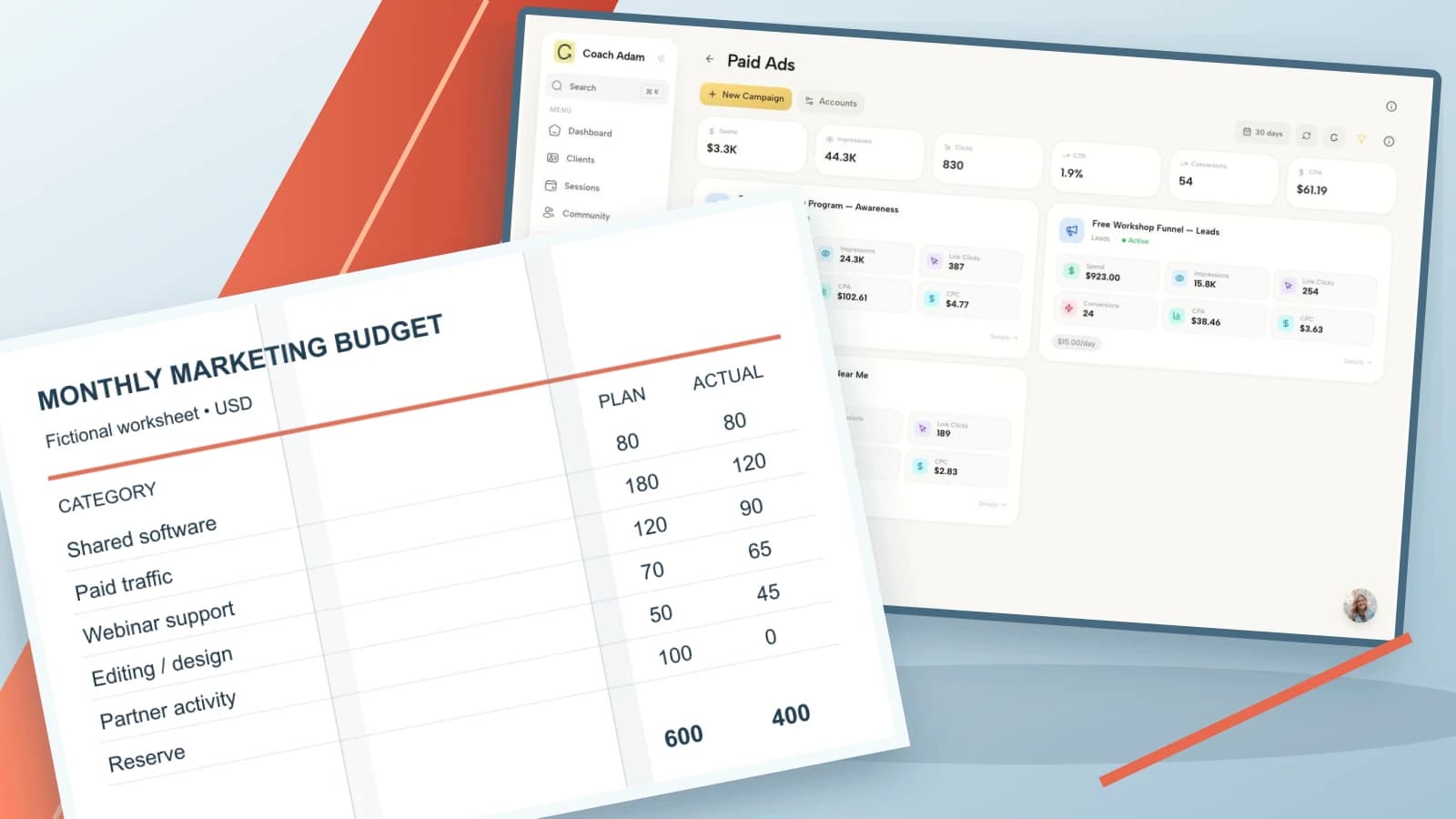
- Existing marketing software allocation: $80 budget; $80 actual.
- Paid traffic test: $180 budget; $120 actual.
- Webinar support: $120 budget; $90 actual.
- Editing and design: $70 budget; $65 actual.
- Partner event and travel: $50 budget; $45 actual.
- Uncommitted reserve: $100 budget; $0 actual.
The allocation totals $600. Actual expenditure in this fictional review is $400, leaving $200 against the ceiling. That remaining amount includes the $100 reserve and $100 not yet used in the other categories. It is not automatically money to spend before month-end.

If the fictional practice collected $4,000 that month, the $600 ceiling would equal 15% of those receipts. That is a description of this example, not a target. A different cash position or delivery model could make the same percentage inappropriate.
2. Check the offer economics before buying attention
A coach selling a substantial engagement has different acquisition headroom from a coach selling an inexpensive standalone worksheet. Name the offer you are trying to sell, the cash collection schedule and the incremental cost of serving another client before setting a paid-marketing test.
For a hypothetical $900 package with $90 of incremental payment and delivery costs, $810 remains before acquisition costs, owner labor, fixed overhead and taxes. If you provisionally allow $200 for acquisition, the remaining $610 still has to support those other obligations. It is not take-home profit.

The real Coachful demo bundle library illustrates the offer you need to identify. It does not calculate the acquisition allowance in this example. For a practice with several packages, make a separate economics note for each rather than applying one acquisition target to every service.
Do not divide the full marketing ceiling by the package price and call the result break-even. Revenue is not contribution, installments may arrive later, refunds may occur and your delivery time still needs funding. Likewise, hypothetical lifetime value is not cash you can spend today.
When you do not yet know conversion rates, label them unknown. Start with a bounded learning expense you can absorb. A spreadsheet with an optimistic close rate does not make a campaign affordable, and buying leads is not a substitute for learning whether the offer fits the people you can reach.
3. Fund the actual bottleneck, not every available channel
Choose one primary acquisition activity and one supporting activity for the month. A small coaching practice rarely benefits from simultaneously funding ads, a podcast sponsorship, search content, a webinar and a new social-media contractor without enough capacity to execute or evaluate any of them.
First distinguish insufficient relevant attention from a weak next step. If suitable people visit but cannot understand the offer, a page repair may be more useful than more traffic. If suitable calls happen but do not progress, investigate fit, the offer and the sales conversation before buying more calls.

The demo Diagnostics screen presents a lead-stage bottleneck and a funnel-review prompt. Treat such a view as an investigation starting point, not proof of cause or a command to spend. Check the underlying records and read actual prospect questions before choosing the budget line.
Paid traffic: budget the complete test
Separate media spend from creative production, page changes and contractor fees. State which audience, offer and action the test concerns. Write the maximum authorization and review checkpoint before launch; do not increase the cap simply because a platform says the campaign needs more data.

The real Paid Ads demo separates spend, clicks and conversions. Its sample figures are not coaching acquisition benchmarks. A recorded conversion could be a registration rather than a paying client, so write the event definition beside any cost-per-conversion figure you use.
In the fictional budget, $180 is authorized for media but only $120 has been spent at review. The remaining $60 is not a commitment to continue. If the page is broken or inquiries are clearly unsuitable, fix or stop the test before releasing more. For a deeper paid-traffic decision, use our guide to acquisition cost before scaling ads.
A webinar: distinguish promotion from delivery
A free webinar is not cost-free to produce. Budget the necessary registration-page work, promotion, rehearsal, technical support and follow-up. Keep the live teaching and follow-up sales time visible in your capacity plan rather than hiding them inside “organic marketing.”

The Coachful demo shows upcoming webinar sessions and registrations. Those registrations are a checkpoint, not collected revenue. Before approving extra promotional spend, ask whether the session has a clear audience, a useful promise and a next step that you can actually handle.
A simple partner introduction or a small event may be a better test than a large production. Do not buy production quality to compensate for an unclear subject. This budgeting worksheet covers your acquisition choices across the practice; our workshop budget example handles the separate costs and seat economics of delivering an event.
4. Budget owner time and shared costs without double counting
Put hours beside each activity. Writing an email, preparing a webinar, checking a landing page and replying to inquiries all use the same finite working week as your client sessions. A zero-cash activity can still be too expensive in time.

A real Coachful email-sequence view makes the production scope visible: several steps need a purpose, copy, links and checks. The screenshot does not establish how long your sequence will take. Estimate those tasks yourself and reserve time to answer the responses it may generate.
Suppose you plan fourteen marketing hours and assign them an internal planning value of $40 per hour. The time allowance is $560. That is not an invoice, a wage obligation or an automatic tax deduction; it is a way to see the resource trade-off.

Keep the $600 cash ceiling and fourteen-hour time ceiling separate. Together they represent a maximum planned resource envelope of $1,160 at that illustrative time value. At the fictional review, however, actual cash spend is $400. Do not report the full envelope as money already spent.
Allocate shared software once
If a platform supports both marketing and client delivery, choose a reasonable management allocation and document it. For example, assign an agreed share of the actual subscription to marketing, leaving the rest in operations. The example's $80 line is a hypothetical total allocation, not Coachful pricing or a bill you should reproduce.
Do not put the full website subscription under content, email and webinars simultaneously. Similarly, if the $70 design allowance includes webinar promotional assets, do not add the same contractor invoice again to webinar support. Give every invoice or allocation one home, with a note describing what it covers.
For an annual subscription, record the cash payment when due in your cash-flow plan and, if useful, its monthly allocation in the management budget. Label the two views. A monthly allocation does not eliminate the annual cash requirement.
5. Release spending at review checkpoints
Divide a test into an initial authorized amount, a review and a conditional remainder. The checkpoint should be early enough to catch a broken path, while the outcome review should allow for your actual sales cycle. There is no universal seven-day verdict for coaching marketing.

For the $180 media allowance, a coach might authorize $60 initially, inspect technical delivery and relevance, then decide whether another $60 is justified. A later review can consider the final $60. These are permission gates, not a claim that $60 buys enough evidence to estimate a reliable acquisition rate.
At each checkpoint, record what happened, what remains unknown and one decision. Continue a functioning test within its original cap, repair an identified problem, pause spending or stop. Do not silently reset the cap each time a disappointing result appears.
Compare equivalent costs and outcomes
In a separate fictional completed cohort, suppose the month's $400 actual marketing spend is associated with two new paying clients under your recorded attribution convention. The cash acquisition cost is $200 per client. If $120 was media spend, media-only cost divided by those same two clients is $60. These figures answer different questions.
If all fourteen owner hours were actually used, their $560 planning value would bring the combined resource cost to $960, or $480 per client. Do not compare that fully loaded figure with another channel's media-only figure. Also record any refunds, delayed outcomes or mixed-source introductions before treating the result as a dependable pattern.
Association is not proof of causation. A referred prospect might read your newsletter before booking; a webinar attendee may already know you. Keep a neutral “What prompted you to contact us?” question alongside analytics, and allow “unknown” or multiple influences rather than inventing precise credit.
Copyable marketing budget template
Download the marketing budget example as a CSV, or copy the fields below into your own spreadsheet. The download contains the fictional rows above and editable planning columns. Replace the amounts before using it for a real authorization.
- Period and cash ceiling: month, currency, total authorized cash, protected reserve.
- Purpose: offer, intended audience and the business question this spending should answer.
- Cost category and owner: what is being bought, who can authorize it and who checks the result.
- Budget / committed / actual: separate the allowance, obligations already made and expenditure recorded under your stated convention.
- Hours planned / actual: owner time and any optional internal planning value.
- Checkpoint: review date, initial release and condition for any additional spend.
- Outcome evidence: relevant inquiries, suitable attended calls, new clients and cash collected, each labeled separately.
- Decision: continue, repair, pause or stop, with the reason and next review date.
At month-end, reconcile the worksheet against invoices, card charges and platform records. Carry forward an unpaid commitment explicitly; do not let it vanish because a new month started. Release unused reserve only through a new decision, not an automatic end-of-month shopping exercise.
Where Coachful fits into the budget review
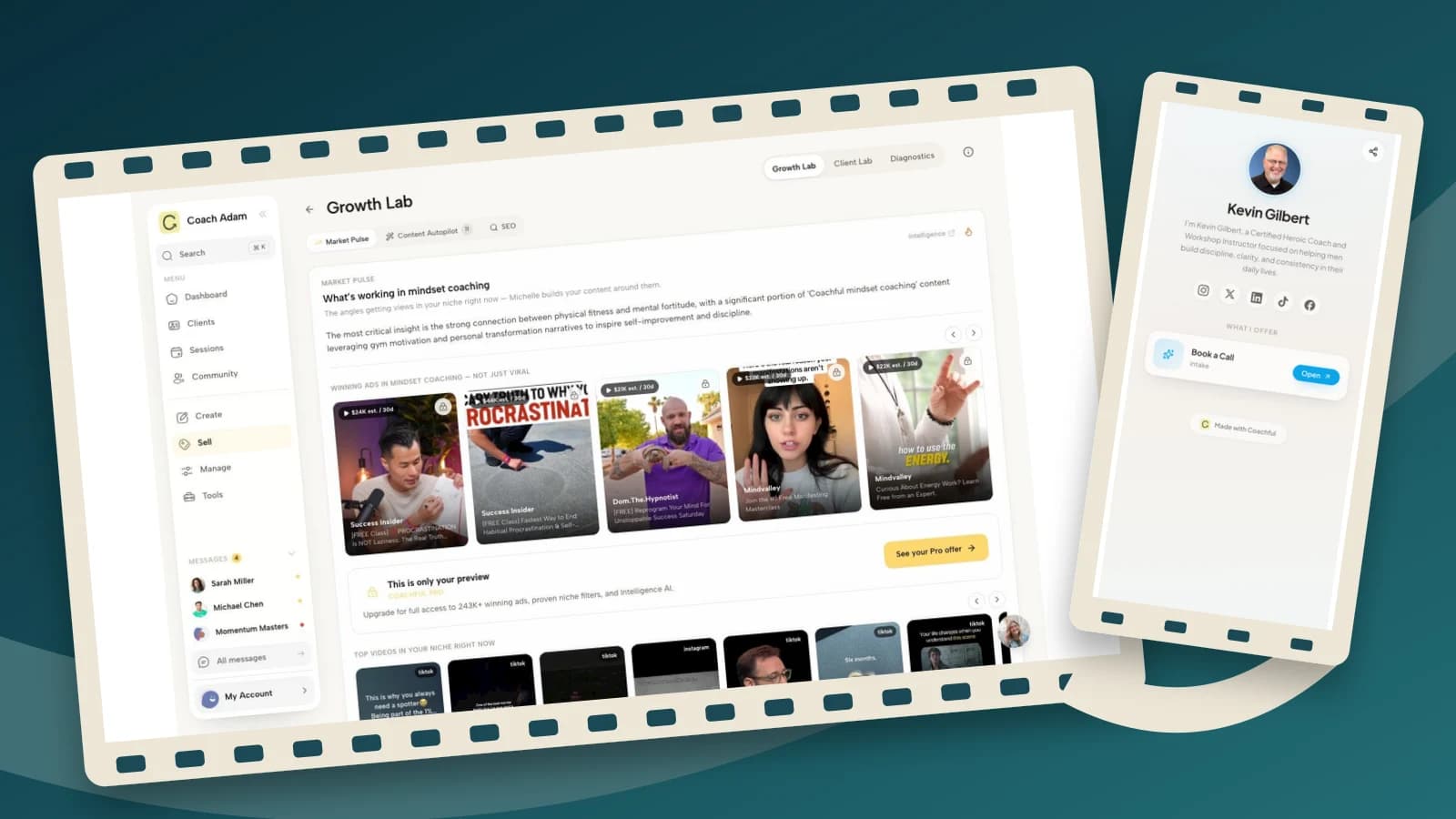
The screens above show the practical activities behind several budget lines: defining an offer, promoting a webinar, maintaining an email sequence, inspecting paid campaigns and reviewing a possible bottleneck. They do not demonstrate a standalone marketing-budget spreadsheet or automatic reconciliation of every channel's costs.
If a budget line is unclear because you cannot picture the work it funds, try the interactive Coachful demo and inspect that workflow before approving another tool or contractor. Keep the budget in a record you can maintain, and make the purchase only when the workflow addresses the problem you actually identified.
Frequently asked questions
What percentage of revenue should a coach spend on marketing?
There is no verified universal percentage for coaching practices in this guide. Start with available cash, offer economics, capacity and the acquisition problem. Use revenue percentages as context, not a substitute for deciding what you can afford if a test fails.
Can I market a coaching business with no ad budget?
Yes, through approaches such as relevant referrals, partner conversations and useful content, but they still require time and may involve other costs. Budget those resources and choose a method that suits your audience rather than treating unpaid distribution as guaranteed client acquisition.
Should the whole software subscription count as marketing?
Only if that accurately reflects its use in your management view. Shared platforms often support delivery too. Allocate a reasonable share once, record the method and keep the actual payment visible in your cash-flow records.
Should unused marketing money roll into next month?
Only after reviewing affordability and the reason it was unused. A delayed invoice is a commitment; an unspent experiment allowance is not. Reauthorize useful work deliberately rather than treating last month's ceiling as an entitlement to spend more.
Bottom line: a useful marketing budget protects the practice while making one acquisition decision clearer. Start with an affordable ceiling, count cash and time honestly, and make each additional release earn its place.