
Nutrition Coach Website: A Page-by-Page Plan
If your Instagram messages are full of "so what should I actually eat?", you already know what your nutrition coach website is for. It's the place you send those people: a site that explains how you work, shows one or two clear programs, gives away something genuinely useful (a week of simple dinners, a grocery list) and makes the next step obvious. Recipes and guides bring visitors in, and the program page turns the right ones into clients.
This is a page-by-page plan: how to describe your credentials accurately, a full site map, a written-out program page for a 12-week plan, the content that brings visitors in and how plans get delivered after someone signs up. If building it isn't how you want to spend a month, Coachful's team builds nutrition coaching websites for free on any plan, from a short form.
Get the title right before the homepage
Nutrition is one of the few coaching niches where the words in your headline can carry legal weight. In many US states and many countries, "dietitian" is a protected title, and some places regulate "nutritionist" as well. "Nutrition coach" and "health coach" are generally unregulated, which is exactly why careful wording matters.
| Your title | What visitors tend to assume | What to show on the site |
|---|---|---|
| Registered dietitian | Clinical training; can work with medical conditions | Registration body and number if customary where you practice |
| Nutritionist | Formal nutrition education | The degree or registration, and where the title is protected, proof you hold it |
| Nutrition coach | Habit and behavior support around food | Your certification, plus a line on scope: "coaching, not medical nutrition therapy" |
Check the rules where you and your clients live. Then make your copy match: a nutrition coach supports habits, routines and food choices, and works alongside a doctor or dietitian for medical conditions. A visitor who has been burned by miracle diets reads that sentence as a reason to trust you.
The whole site on one page: a nutrition coach site map
Here's every page of a five to seven-page nutrition coach website and what goes on each.
- Home
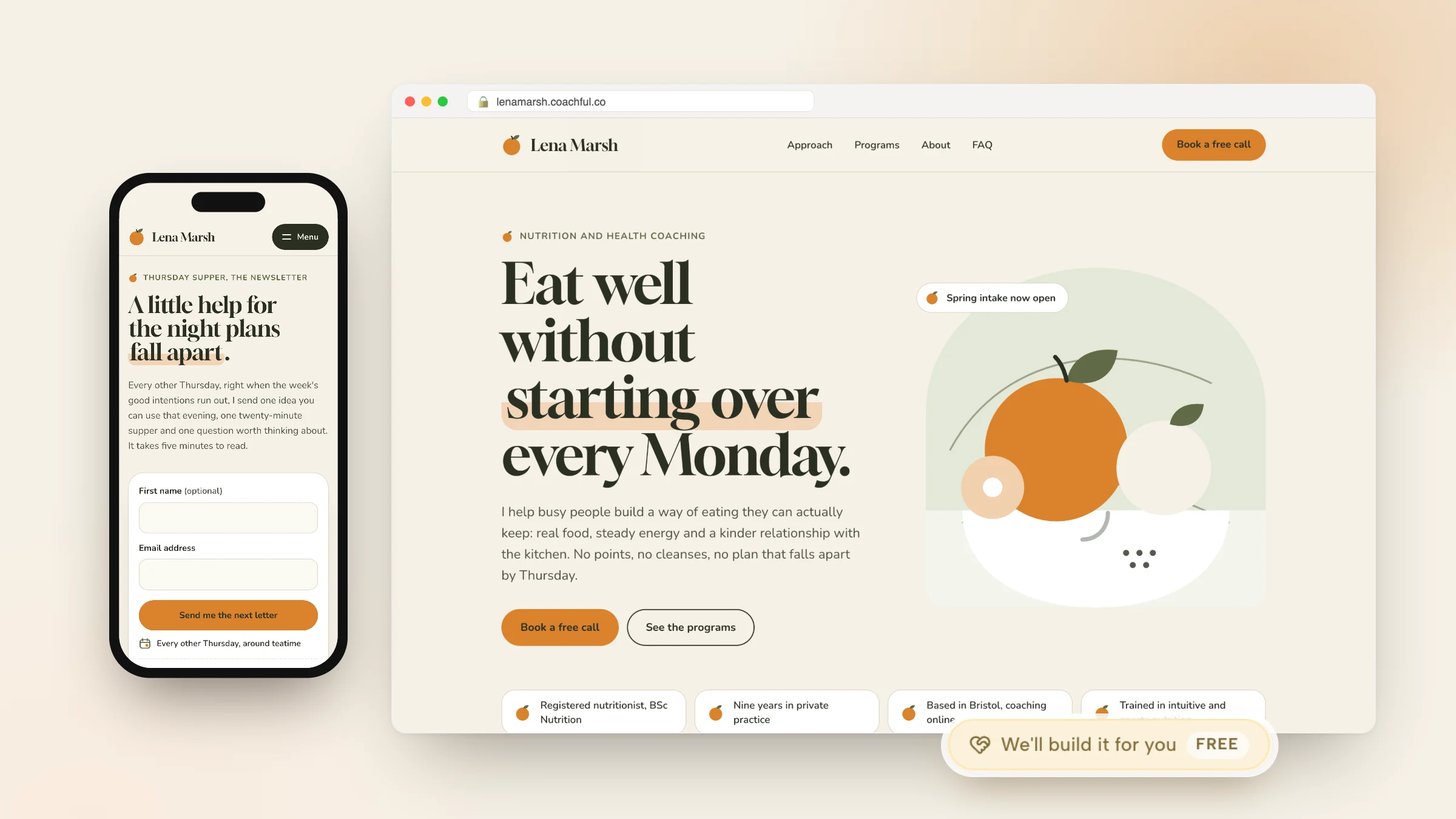
- Headline about the person and the change: "Eat well without starting over every Monday."
- A credentials strip, one line each.
- How it works in three steps, your main program, a free resource, an FAQ and a closing button.
- Programs
- One main program (worked example below) and, if you offer it, a shorter starter or a monthly follow-on.
- Free guide
- "Seven dinners, one shopping list, twenty minutes a night." Three bullets on what's inside, one email field.
- Recipes or blog
- Simple, real recipes and short articles that answer the questions clients ask you. More on this below.
- About
- Your story with food, then your training, then how you work, then a photo of you that isn't in a gym or a smoothie bar.
- Book a call
- A free 20-minute call with two intake questions: "What would you like to change about how you eat?" and "Anything I should know about allergies or medical conditions?"
- Legal
- Privacy policy, terms and a short disclaimer on scope.

Orchard, above, is a Coachful homepage template drawn for nutrition and health coaches, with fruit-like circles, leaf arcs and a plated approach. The credentials strip under its hero is sample copy for a fictional coach; when you use the template, Coachful fills in your own name, photo, offers and booking link instead.
Worked example: a program page for a 12-week nutrition plan
Program pages decide whether someone pays, so write this page more carefully than the homepage. Here's a complete one for a fictional coach.
Name and promise
The Steady Plate: twelve weeks to a way of eating you can keep. "For busy adults who know the basics, have tried the plans, and want something that survives a Tuesday."
Who it's for, and who it isn't for
For: people who want more energy, fewer 4pm crashes and less guilt around food. Not a fit: anyone needing medical nutrition therapy for a diagnosed condition (you'll be pointed to a dietitian), or anyone looking for a crash diet before a wedding.
What's included
- Six 45-minute coaching sessions, every two weeks, by video.
- Weekly check-in: three questions, two minutes, every Sunday.
- Meal templates and a recipe library to pick from, rather than a fixed plan.
- Nutrition targets set together and adjusted as you go.
- Messaging support on weekdays for "I'm at a restaurant, help" moments.
How the twelve weeks run
Weeks 1 to 2: where you are now, with a three-day food log and no judgment. Weeks 3 to 6: breakfast and lunch, the meals that set up the rest. Weeks 7 to 10: dinners, eating out and weekends. Weeks 11 to 12: a plan for after the program, written down.
Price and next step
Show the price or a payment plan, and one button: "Start with a free call" or "Join the next intake". If you open spaces in intakes, say when the next one starts.
Three questions
"Do I have to count calories?" "What if I'm vegetarian?" "What happens after twelve weeks?" Answer each in two sentences.
If you're still designing the program itself, our guide on how to create a health coaching program covers the structure, and here's how coaching packages work on Coachful.
Recipes, guides and a blog: the content that brings people in
People type food questions into search engines all day long, which is good news for a coach willing to write. A few kinds of content work especially well:
- Answer posts. One question per post, the way clients phrase it: "What should I eat before an early workout?" "Is a late dinner really a problem?"
- Simple recipes with your own photos and a line on why you like them for clients.
- A free guide that collects your best recipes and a shopping list, offered at the end of every post.
- A paid recipe collection or meal-prep guide for people who want your food but not coaching. Coachful can sell digital products like these from the same site.
Coachful's website includes a blog with SEO settings, so posts live on your own domain next to your programs. If you're starting from zero, how to start a coaching blog covers the first ten posts.

After they sign up: delivering plans without spreadsheets
The website's job ends at "yes", but what happens next affects your reviews and referrals. Many nutrition coaches still deliver through PDFs, a spreadsheet and a messaging app. On Coachful, the Fitness & Nutrition power-up adds nutrition targets (up to calories and macros), meal plans, recipes, food lookup and private progress photos and measurements, alongside habits and weekly check-ins. Clients see it all in the branded client app on iPhone and Android, and payments go to your own Stripe account with a 0% Coachful platform fee.
That's optional. Plenty of nutrition coaches prefer habit-based coaching without numbers, and the program structure works either way. Here's how Coachful works for health and nutrition coaches more broadly.
Two templates for nutrition and women's health sites
- Orchard: fresh and rounded, with fruit-like circles and a plated approach. For nutrition and health coaches.
- Bloom: petal shapes, layered circles and gentle sage panels in blush and cream. For fertility and women's health coaches.

Using either one takes three steps in Coachful: choose, preview on desktop and phone, then make it yours. Your new page is saved as a private draft, and your current site stays live until you switch. There's also an Import website option if you'd rather bring an existing site across.

Request a free build from our team
Coachful's team builds nutrition coach websites for free on every plan. Coachful itself is a paid subscription (you can begin with a free trial); the build has no extra cost.
Open the Website page and click Fill in a form on the "Want us to build it for you?" card, or use Create > We'll build it for you · FREE.

Tell the team which pages to create or improve and what they should do (book calls, collect leads, sell an offer, deliver a resource), then what visitors should do after landing. Add up to 8 links (sites you like, your current site, your Instagram) and up to 10 files: photos of your food and of you, your logo, your current free guide, a copy document or a voice note. Video files aren't accepted.

The request above is a good model for a nutrition site: a calm homepage, a Work With Me page for a 3-month package and a page for a free 7-day meal guide, with the guide first and the program or a call second.
The team replies by email with next steps, usually within about 24 hours; that's a typical turnaround, not a promised deadline. Pages, forms and emails are built in your own account and stay fully editable.
Two recent builds show the range. A psychologist-turned-coach working on emotional eating got a new homepage with three clear paths (book a call, join the free community, enroll in the program) and a free-community funnel that delivers a guide. A business mentor who sells on Instagram had a sales page and free-guide funnel designed from the coach's own guide PDF, which is a handy trick if your free recipe guide already has a look you like.
Nothing is invented in a build: no fake credentials, transformations, testimonials or prices. Gaps are left marked for you. The team doesn't design logos, film recipe videos, run ads or manage your marketing month to month. Here's the full scope of the free build, and if you also want a lead magnet built, see how to create a lead magnet.
Four nutrition coach website mistakes
- Before-and-after body photos as the main proof. They attract the clients most likely to want a crash diet, and many visitors find them off-putting. Lead with energy, routine and confidence stories instead.
- A free guide that's really a sales letter. If the 7-day guide has three recipes and four pages of pitch, people unsubscribe. Make it useful on its own.
- Macros on the homepage. Numbers belong inside the program. The homepage is for the person and the change.
- No answer to "do I have to give up X?" Coffee, bread, wine, chocolate: pick the one your clients ask about most and answer it in the FAQ.
Frequently asked questions
What should a nutrition coach website include?
A homepage, a programs page, a free guide with an email sign-up, recipes or a blog, an About page with accurate credentials, a booking page and legal pages with a scope disclaimer. Five to seven pages covers most nutrition coaching businesses.
Can I call myself a nutritionist on my website?
It depends where you and your clients are. "Dietitian" is a protected title in many places, and some also regulate "nutritionist". If you're unsure, "nutrition coach" with your certification listed is the safer wording. Check your local rules.
Should a nutrition coach website have recipes?
Recipes help if they're simple and genuinely yours. They bring search traffic, show your approach and make a natural free guide. Pair each recipe or post with an offer of your free guide so readers join your list.
Will Coachful build my nutrition coach website for free?
Yes. The build service is free on every Coachful plan; Coachful itself is a paid subscription. Send the website form with your pages, program details and photos, and the team replies by email with next steps, usually within about 24 hours.
How do nutrition coaches deliver meal plans to clients?
Many use PDFs and messaging. On Coachful, the Fitness & Nutrition power-up adds nutrition targets, meal plans, recipes and food lookup inside the branded client app, alongside check-ins and habits, so plans and feedback stay in one place.
What's the difference between a health coach website and a nutrition coach website?
The structure is similar. Nutrition sites lean harder on food content (recipes, guides, meal templates) and need extra care with titles like dietitian or nutritionist. Our health coach website guide includes a full sample homepage you can adapt.












