
Professional Coaching Software Guide for Coaches and Teams

Coachful

You're halfway through a coaching day, and your attention is split between a calendar, a spreadsheet, payment links, intake forms, and client messages. One client needs a reminder, another has submitted a goal update, and a third is waiting for a renewal invoice. You're not struggling to coach. You're struggling to keep the practice around the coaching from becoming a second job.
That's where professional coaching software enters the picture. The right platform doesn't replace your judgment or make your work impersonal. It gives the practice a dependable home, so client information, sessions, payments, communication, and progress don't live in disconnected places.

If you're thinking, “Do I really need another tool?”, that question deserves a practical answer, not hype. This guide will help you understand what these platforms do, which workflows matter, how pricing changes as your practice grows, and what privacy controls you should expect before you trust a system with client data.
Introduction to Professional Coaching Software Without the Overwhelm
A solo coach named Maya might begin with a perfectly reasonable setup. She uses a personal calendar for appointments, a form builder for intake, a spreadsheet for goals, a payment provider for invoices, and email or chat for follow-up. Each tool works on its own. The strain appears in the gaps between them.
Before a session, Maya checks several places to remember what the client agreed to do. After the session, she copies notes into a file and sends a separate message with resources. When a package ends, she manually checks whether payment has renewed. None of these tasks feels enormous, yet together they consume the small pockets of attention that should go toward preparation, reflection, and client care.
The real problem isn't too little effort. It's too many loose ends.
Professional coaching software brings those loose ends into one workspace. A new client can complete an intake form, choose an appointment, receive reminders, pay for a package, and access next steps through a connected flow. You can still choose how personal your coaching feels. The system carries the repetitive structure around it.
The emotional objection is often stronger than the practical one. You may worry that automation will make clients feel processed, or that learning a platform will create more administration before it removes any. Those concerns are useful signals. They mean you should choose software that reflects your coaching model, rather than forcing your practice into a generic business template.
The timing also makes sense at an industry level. The broader professional coaching industry was reported at USD 2.849 billion in 2023 and USD 5.34 billion in 2024, with 122,974 professional coaches worldwide, according to this coaching industry statistics summary. As practices become more structured, software becomes less of a luxury and more like the reception desk, filing system, and operations assistant your coaching studio needs.
What Professional Coaching Software Really Means
Think of your practice as a small studio. The coaching conversation is the room where transformation happens, but the studio also needs a welcome area, an appointment board, a payment counter, a client file cabinet, and a way to keep people engaged between visits.
Generic scheduling software may handle the appointment board. A payment processor may handle the counter. A CRM may store contact details. Professional coaching software connects those rooms, so the client journey doesn't break every time the work moves from one activity to another.
Start with the client's first step. Onboarding can collect intake answers, establish expectations, and record goals before the first conversation. Scheduling then lets the client select an available time, while reminders reduce the chance that the appointment disappears into a busy week. Payments connect the commercial agreement to the service being delivered, and client management keeps history, notes, tasks, and progress together.
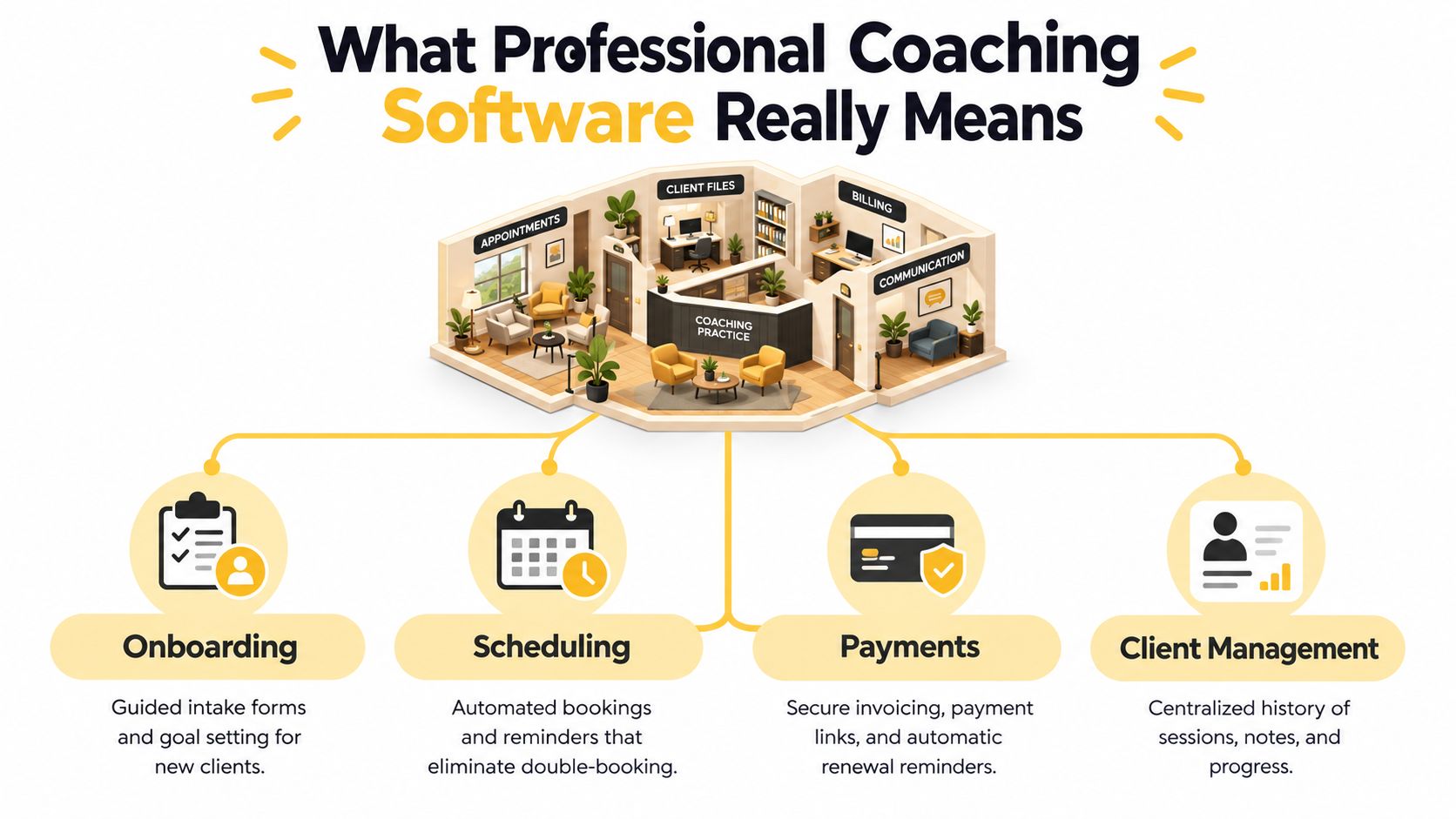
The difference between separate tools and one system
Suppose a client changes a goal during a session. In a disconnected setup, you might update a note, revise a spreadsheet, send a message, and remember to revisit the change later. In an integrated platform, the goal can sit beside the session record and future tasks. The difference isn't that the software makes a better coaching decision. It makes the decision easier to find and carry forward.
Cloud delivery has become central to this category. One coaching platforms market estimate places the global market at USD 2.0 billion in 2025, with a projection of USD 5.78 billion by 2034 and a 12.5% CAGR over that period. The same estimate says cloud deployment represented 72.3% of the market in 2025, while corporate coaching represented 38.5% of revenue. A separate estimate places the coaching platform market at USD 3.8 billion in 2025, projecting USD 4.23 billion in 2026 and an 11.2% CAGR from 2025 to 2026.
Those figures point to a practical shift. Professional coaching software now supports not only individual practitioners, but also organizations that need repeatable delivery, shared visibility, and controlled access.
Core Features That Keep Coaching Moving Between Sessions
The best way to evaluate features is to connect each one to a moment of friction. Ask, “What currently breaks, gets forgotten, or takes longer than it should?”
Onboarding creates a clear starting line
A client who arrives without context can spend the first session explaining information you could have collected beforehand. Guided intake forms let you gather goals, background, expectations, and relevant constraints before the conversation begins.
For example, a business coach might ask a new client to describe a current leadership challenge and the outcome they want from the engagement. The coach can review that information in advance, while the client arrives with a clearer sense of participation. Onboarding also gives you a consistent way to explain cancellation terms, communication boundaries, and what happens between sessions.
Scheduling protects attention
Back-and-forth booking messages create unnecessary cognitive switching. A scheduling workflow allows clients to select available times, receive reminders, and keep appointments attached to their records.
Appointment platforms commonly track no-show rate, success rate, and scheduling trends to expose bottlenecks, as described in this appointment scheduling software overview. Automation-focused coaching workflows are also reported to reclaim about 11 hours per week for fully automated practices, according to the same verified industry data. Treat that figure as a reported benchmark, not a promise for every practice. The operational lesson is simpler: reminders and connected scheduling can return meaningful time when they replace repeated manual actions.
Payments make the commercial relationship visible
A payment link is useful. A payment workflow is more useful because it connects invoices, recurring billing, renewals, and client status. If a client buys a package, you should be able to see what they purchased, what remains to be delivered, and whether the next payment needs attention.
That clarity helps with a common emotional obstacle: coaches often delay payment conversations because they don't want to damage rapport. Automated renewal reminders create distance between the coach and the awkward administrative moment. The system communicates the practical detail, while you stay focused on the relationship.
Messaging and resources preserve momentum
Clients rarely change only during the session. They reflect, practise, and encounter obstacles between meetings. Keeping messages, worksheets, links, and assignments in one place gives both sides a shared trail.
A health coach, for instance, might send a reflection prompt after a session and ask the client to record what made the habit easier or harder. At the next meeting, the conversation begins with lived evidence rather than a vague memory of the previous week.
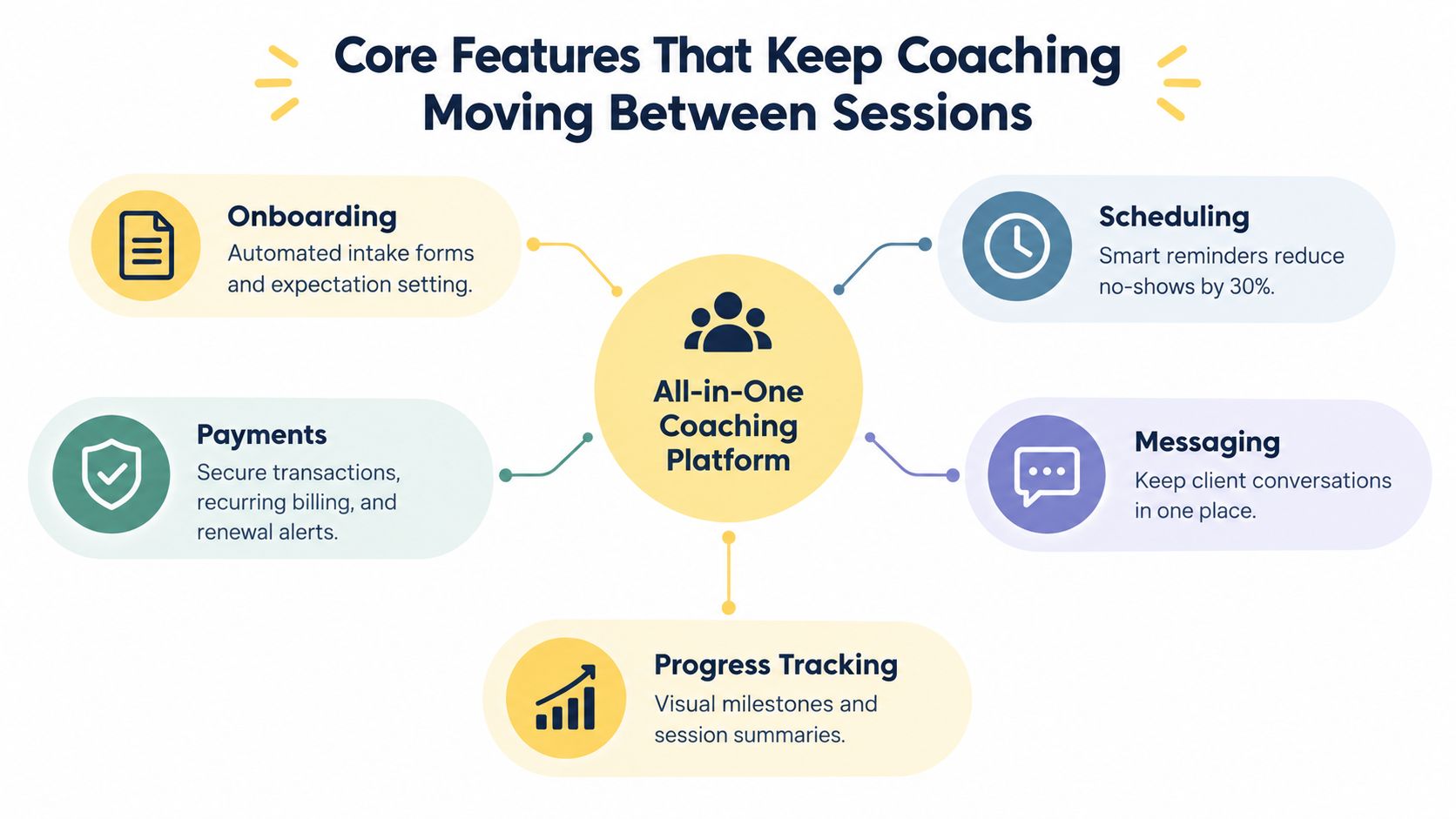
Progress tracking turns intention into feedback
A goal is useful only when the client and coach can tell whether movement is happening. Session summaries, milestones, tasks, and check-ins make progress visible without reducing coaching to a score.
For group programs, measurement should begin before the first session. A group coaching measurement guide recommends setting a baseline during intake, then tracking attendance, homework completion, self-rated progress, recommendation intent, and behavior-change indicators. Another progress tracking framework recommends defining 3 to 5 measurable outcomes per cohort, assessing them at the start, midpoint, and end, using a midpoint pulse survey, and finishing each debrief with a written behavioral commitment.
The point isn't to bury coaching in dashboards. It's to notice when a client is drifting while there's still time to respond.
Who Benefits Most and Why It Matters for Your Practice
Different coaches need different kinds of structure. A solo life coach may care most about a calm client experience and fewer repetitive tasks. A coaching academy may care more about cohorts, permissions, curricula, and reporting. The platform is the same category, but the buying decision changes with the practice.

Solo coaches need simplicity without looking small
If you're coaching independently, you may be thinking, “My practice isn't big enough for a platform.” Yet a professional client experience doesn't require a large team. A branded intake flow, reliable booking process, secure payments, and organized notes can help you present your work with consistency from the first interaction.
The psychological benefit matters too. When you don't have to hold every reminder and follow-up in your head, you can arrive at sessions with more attention available. The system becomes a quiet external memory, not another voice demanding your attention.
Business and executive coaches need continuity
Executive coaching often involves longer engagements, multiple stakeholders, and goals that develop over time. A unified record helps you connect session notes, commitments, feedback, and milestones without relying on scattered documents.
For organizational buyers, reporting must answer more than “Did the session happen?” Neutral ROI guidance recommends comparing employee engagement over 6 to 12 months and tracking retention over 6 to 18 months, using coached leaders' teams alongside a control group where appropriate. It also recommends pre- and post-comparisons, competency baselines, and repeated 360-degree feedback cycles, as outlined in this group coaching ROI guidance.
Teams, academies, and mentoring organizations need shared rules
A small team may need shared templates, role-based permissions, coach assignment, and dashboards. A school or academy may need structured curricula, assignments, attendance records, and communication across a cohort.
The question isn't “Which platform has the most features?” It's “Which people need to see which information, and what must happen consistently even when different coaches deliver the work?”
A short demonstration can help you judge fit more accurately than a feature page. Watch how a client moves from intake to booking, how a coach records a session, and how an administrator sees progress.
How to Choose the Right Platform With Confidence
Comparison anxiety usually starts with too many tabs open. One vendor highlights automation, another emphasizes community, and a third lists integrations. You end up comparing feature names instead of deciding what your practice needs.
Begin with your delivery model. Write down your current client flow, from inquiry to renewal, then mark every place where you copy information, send a manual reminder, search for a note, or wait for a payment. Those friction points deserve more weight than attractive extras.
A practical decision matrix
| Evaluation Criteria | What to Look For | Why It Matters |
|---|---|---|
| Client capacity | Pricing and permissions that suit your current client load | Prevents a low entry price from becoming restrictive as usage changes |
| Group programs | Cohort spaces, curricula, assignments, attendance, and participant communication | Supports repeatable delivery beyond one-to-one sessions |
| Branding and templates | Customizable forms, messages, resources, and client-facing pages | Helps the experience feel like your practice |
| Automation | Booking, reminders, renewals, tasks, and follow-ups | Reduces repetitive administration without removing personal contact |
| Analytics | Progress, attendance, engagement, and outcome views | Helps you respond to drift and explain program value |
| Integrations | Calendar, video, payment, and communication connections | Limits duplicate entry and disconnected workflows |
| Support and scalability | Responsive help, onboarding resources, and a clear upgrade path | Reduces adoption risk as your practice evolves |
Your pricing model deserves special attention. Independent 2026 pricing comparisons show entry tiers around $9 per month, flat-rate plans around $57 per month with no client limits, and practice-management plans ranging from $29 per month for very small client caps to $299 per month for multi-seat agencies, according to this coaching software pricing comparison. These are comparison figures, not universal prices.
The hidden question is whether your client volume is stable. A per-client plan may suit a small, predictable practice, while a flat-rate plan may make more sense when launches or cohorts create spikes. If you mix one-to-one and group coaching, model the cost at each stage before buying. This coaching business software guide can help you compare the broader workflow behind each option.
Decision rule: Choose the platform that removes your most expensive friction, not the one with the longest feature list.
Implementation Pricing and Privacy Made Practical
A good platform can still fail if the rollout feels like a second project. Keep implementation lean. Start with the smallest complete client journey, then add complexity only after the basic flow works.
Build the workflow in a sensible order
- Clean the client list: Remove duplicates, confirm contact details, and decide what historical information needs to move.
- Create core templates: Prepare one intake form, one welcome message, one session-note structure, and one follow-up sequence.
- Connect the essentials: Set up the calendar, payment flow, reminders, and client access.
- Test as a client: Complete the journey yourself, from booking through follow-up, and check every notification.
- Add measurement: Define the outcomes you need to monitor, then create a simple dashboard or review rhythm.
Pricing becomes easier to understand when you treat it as a growth path rather than a single monthly fee. Entry tiers may look attractive, but client caps, extra seats, transaction charges, or cohort requirements can change the economics. A coaching software cost guide can support that comparison, especially if your practice moves between solo work, small groups, and team delivery.
Privacy is part of the service design
If your coaching touches health, mental-health, behavioral, or employer-sponsored information, broad claims about security aren't enough. Sensitive workflows may require encryption, audit logs, two-factor authentication, and, in some cases, a Business Associate Agreement, as discussed in this client portal privacy comparison.
Enterprise-grade professional coaching software should provide user-level data isolation, end-to-end encryption for data in transit and at rest, and configurable retention policies. Retention may range from zero-day processing to rolling windows or indefinite storage, depending on the organization's requirements. Audited programs such as SOC 2 Type II can provide evidence that controls are designed and tested.
Ask who can access notes, how permissions work, where exports go, how deletion requests are handled, and whether your contractual obligations match the platform's settings. Privacy shouldn't be a document you read after implementation. It should shape the workflow before the first client enters it.
Real World Examples and Your Next Steps Forward
Consider three plausible practice patterns. A solo executive coach replaces scattered reminders and payment follow-ups with one client workflow, then uses the recovered attention to prepare more carefully for conversations. A small academy defines 3 to 5 cohort outcomes, checks progress at baseline, midpoint, and final, and uses attendance and completion records to identify participants who need support.
An HR team takes a longer view. Instead of judging a coaching initiative after one session, it compares engagement over 6 to 12 months and reviews retention over 6 to 18 months, following the measurement approach described earlier. The value comes from connecting delivery records with a thoughtful evaluation plan, not from collecting data for its own sake.
If you want to explore different platform categories before choosing, use this comparison of online coaching platforms as one part of your research.
Your next month can stay simple:
- Week one: Map the current client journey and list every manual handoff.
- Week two: Test two platforms using the same sample client and program.
- Week three: Configure one complete workflow and confirm privacy settings.
- Week four: Invite a small group of real clients, gather feedback, and adjust the templates.
Don't wait for your practice to become chaotic before systematizing it. Choose one recurring friction, make it visible, and build a workflow that gives your attention back to the coaching itself.
Coachful brings onboarding, scheduling, secure payments, messaging, progress tracking, and structured group programs into one coaching workspace. If you're ready to replace scattered tools with a clearer client journey, visit Coachful and explore how it can support your practice.