Program Management Best Practices: A 2026 Guide

Coachful
You open your calendar and see three different coaching programs competing for attention. One client needs a progress review, a cohort is waiting for feedback, two payments haven't been reconciled, and your lead coach has asked whether the next module can change. You planned to spend the morning coaching. Instead, you're stitching together tasks, messages, spreadsheets, and reminders.
That chaos doesn't mean you're bad at coaching. It usually means your business has outgrown session-by-session thinking. Program management gives you a way to coordinate the full ecosystem, from curriculum and onboarding to decisions, dependencies, adoption, and measurable client outcomes.
Why Program Management Matters for Coaches
A coach named Maya starts with one private client and a simple promise: help the client build a stronger leadership habit. Soon, she adds a group cohort, a recorded course, and another coach who delivers part of the curriculum. Her calendar fills, revenue grows, and her confidence drops.
Maya isn't managing one project anymore. She's coordinating related workstreams that share people, schedules, resources, and outcomes. The private sessions, cohort calls, assignments, payment routines, and coach handoffs all affect one another. If the curriculum changes, onboarding changes. If onboarding confuses people, attendance and assignment completion suffer.
That distinction matters because project management focuses on delivering an output, while program management focuses on realizing value across connected initiatives. A project might be “publish the leadership module.” A program asks whether that module helps clients adopt the promised leadership behavior and whether the whole coaching experience supports the business objective.
For coaches, client management practices are useful, but they don't cover the full program picture. Client management helps you care for individual relationships. Program management helps you make sure every relationship, session, milestone, and decision contributes to a coherent transformation.

The shift from tasks to outcomes
Ask yourself what you currently report at the end of a week. You may say, “We delivered four sessions, sent the workbook, and scheduled the next calls.” Those are outputs. They matter, but they don't answer the question your clients and team leaders are silently asking: “Is the program working?”
A stronger review might examine whether clients completed the practice, applied it in real situations, reached a milestone, or stayed engaged after a difficult week. The work still includes sessions and resources, but those activities now serve a measurable transformation.
Practical rule: If a task can be completed while the client receives no meaningful benefit, it isn't a success measure. It's only an activity.
This is why scalable coaches don't just work harder. They create a system that clarifies who decides, what the program is trying to change, how progress is measured, and when the team needs to intervene. Program management best practices turn scattered delivery into an operating rhythm.
The Three Pillars of Program Management
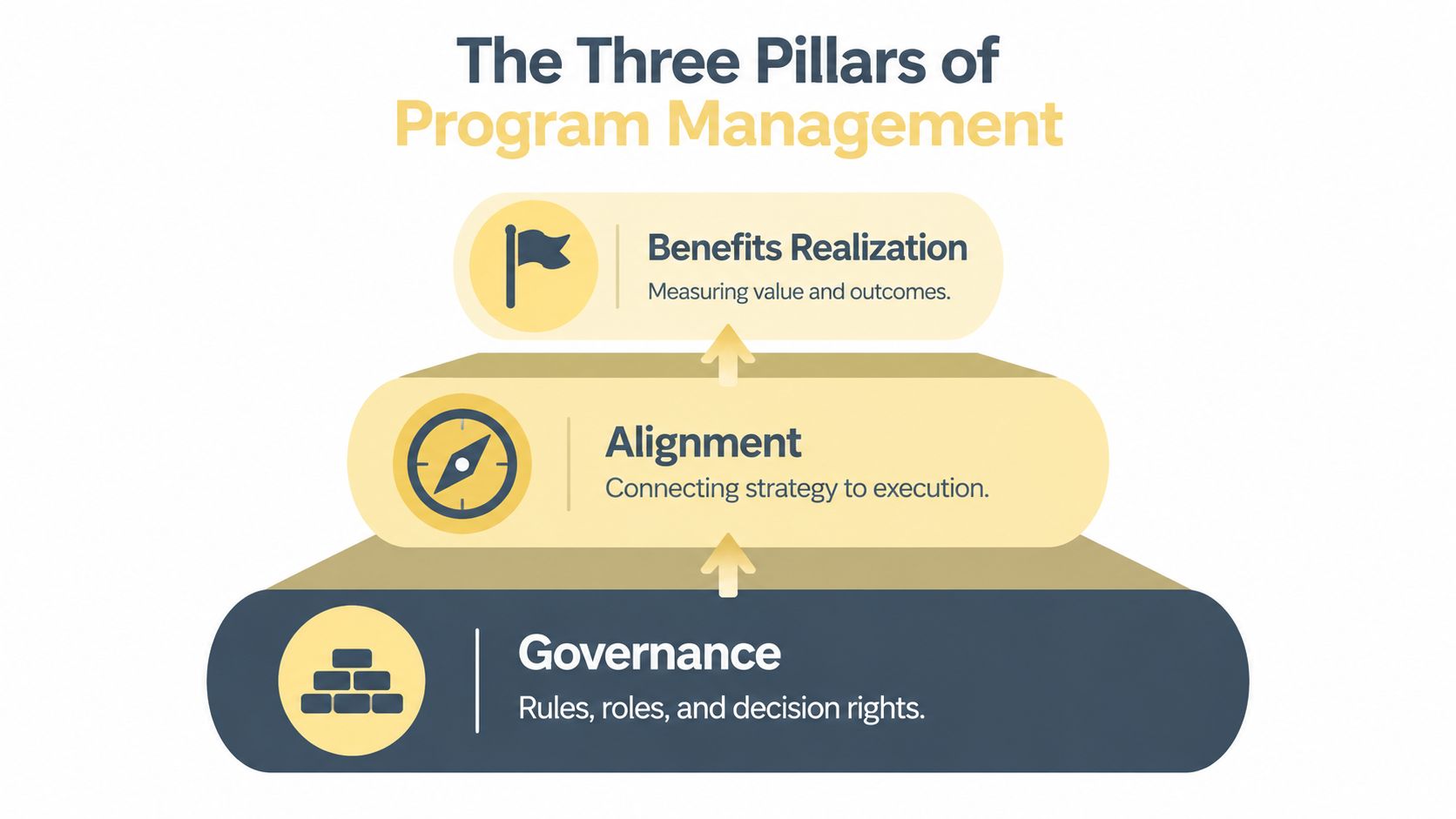
A coaching program needs three connected pillars: governance, alignment, and benefits realization. Think of governance as the foundation, alignment as the compass, and benefits realization as the destination. Remove one, and the other two become difficult to use.
Governance gives people clear decision rights
Governance answers, “Who has the authority to decide?” In a coaching academy, you might approve changes to the program promise and assessment standards, while a lead coach approves minor facilitation adjustments. The operations manager may own payment exceptions, and the client success lead may own an escalation process.
Write these decisions down. Include the owner, the decision boundary, the people who must be consulted, and the route for escalation. Without that clarity, every unusual client request reaches you, or each coach makes a reasonable local decision that creates inconsistency elsewhere.
Formal governance is a system of authority, responsibility, accountability, and control. It helps filter scope changes, resolve conflicts between workstreams, and prevent one team's short-term choice from weakening the program's wider result. Research on program governance emphasizes explicit roles, decision rights, reporting cadences, timely KPI reporting, and experienced analysis with a systemic focus.
Alignment keeps delivery connected to strategy
Alignment asks, “Why are we running this program?” Suppose your business goal is to develop a premium leadership offer. The curriculum, pricing, coach capacity, client profile, and success measures should support that objective. A growing library of unrelated workshops may create activity without strengthening the offer.
Use a simple chain:
- Business objective: Define the organizational result you want.
- Program outcome: Describe what clients must achieve for the objective to advance.
- Workstream contribution: State how sessions, content, community, and support produce that outcome.
- Decision filter: Reject or defer work that doesn't support the chain.
Benefits realization proves the promise
Benefits realization asks, “What value appeared after delivery?” For a coaching-school rollout, benefits might include stronger learner retention, improved client results, or more consistent completion. A finished workbook doesn't prove any of those outcomes.
Atlassian's program management framework identifies governance, alignment, and benefits realization as the central pillars for connecting program activity to strategic goals. Use that framework in your own program review. If a metric doesn't help you understand value, reconsider why you're tracking it.
This doesn't require a complicated committee. A fixed weekly review can cover decisions, strategic fit, emerging risks, and evidence of client benefit. The aim isn't more administration. It's faster, clearer action.
Designing Curriculum and Setting Milestones That Work
Start with the transformation, not the module list. Ask what clients should be able to do, think, or sustain by the end of the program. Then work backward to identify the experiences, practices, feedback, and decisions that can move them there.
Suppose you're running a cohort for new executive coaches. The end state isn't “attend every call.” It might be the ability to conduct a structured discovery conversation, create a coaching plan, and review client progress with confidence. Those capabilities become milestone themes. Each theme can then receive a lesson, practice activity, feedback point, and evidence of completion.
Break the journey into manageable stages. Give each stage one meaningful result rather than a pile of content. A client should understand why the assignment matters, what “done” looks like, and what happens after submission.
Use milestones as decision points
A milestone isn't just a date on a calendar. It's a point where you ask whether the learner, coach, or program is ready for the next stage. You might review a recorded practice conversation, confirm a completed action plan, or hold a short reflection before introducing a more difficult skill.
Milestones also reveal where the curriculum needs adjustment. If many clients miss the same assignment, don't immediately blame motivation. Check the instructions, workload, timing, and support around that assignment. Program management treats recurring friction as useful evidence.
SMART KPIs make this evidence easier to act on. Intellias' guidance on program management best practices recommends goals that are specific, measurable, achievable, relevant, and time-bound. “Increase engagement” is too vague. “Raise weekly client check-in completion from 62% to 80% within 90 days” gives the team a defined behavior, threshold, and deadline.
| KPI Type | Example Metric | Target | Measurement Cadence |
|---|---|---|---|
| Enrollment | Qualified applicants who enroll | Set a clear threshold for the next cohort | Review at each enrollment cycle |
| Attendance | Participants attending scheduled sessions | Maintain the agreed attendance threshold | Review after every session |
| Assignment completion | Participants submitting the required practice | Reach the defined completion target by the milestone date | Review weekly |
| Milestone attainment | Participants demonstrating the required capability | Meet the agreed standard before progression | Review at each milestone |
| Check-in behavior | Weekly client check-in completion | Raise weekly client check-in completion from 62% to 80% within 90 days | Review weekly |
For a deeper curriculum design perspective, VideoLearningAI for corporate training success offers useful context on structuring learning experiences. You can also use this guide on how to write a curriculum when turning your transformation map into a repeatable program.
Celebrate evidence, not attendance alone. A client who applies a skill in a difficult conversation has reached a more meaningful milestone than someone who merely watched every lesson.
Building Onboarding Flows That Reduce Dropouts
A new client doesn't begin with confidence. They begin with questions. “Did I choose the right program? What am I expected to do? Where do I find the materials? Will the coach understand my situation?”
A coach I worked with once sent new participants a welcome packet, a calendar, three login links, a workbook, and several preparation tasks in the same message. The information was accurate. The experience was exhausting. Participants delayed their first action because they couldn't tell what mattered most.
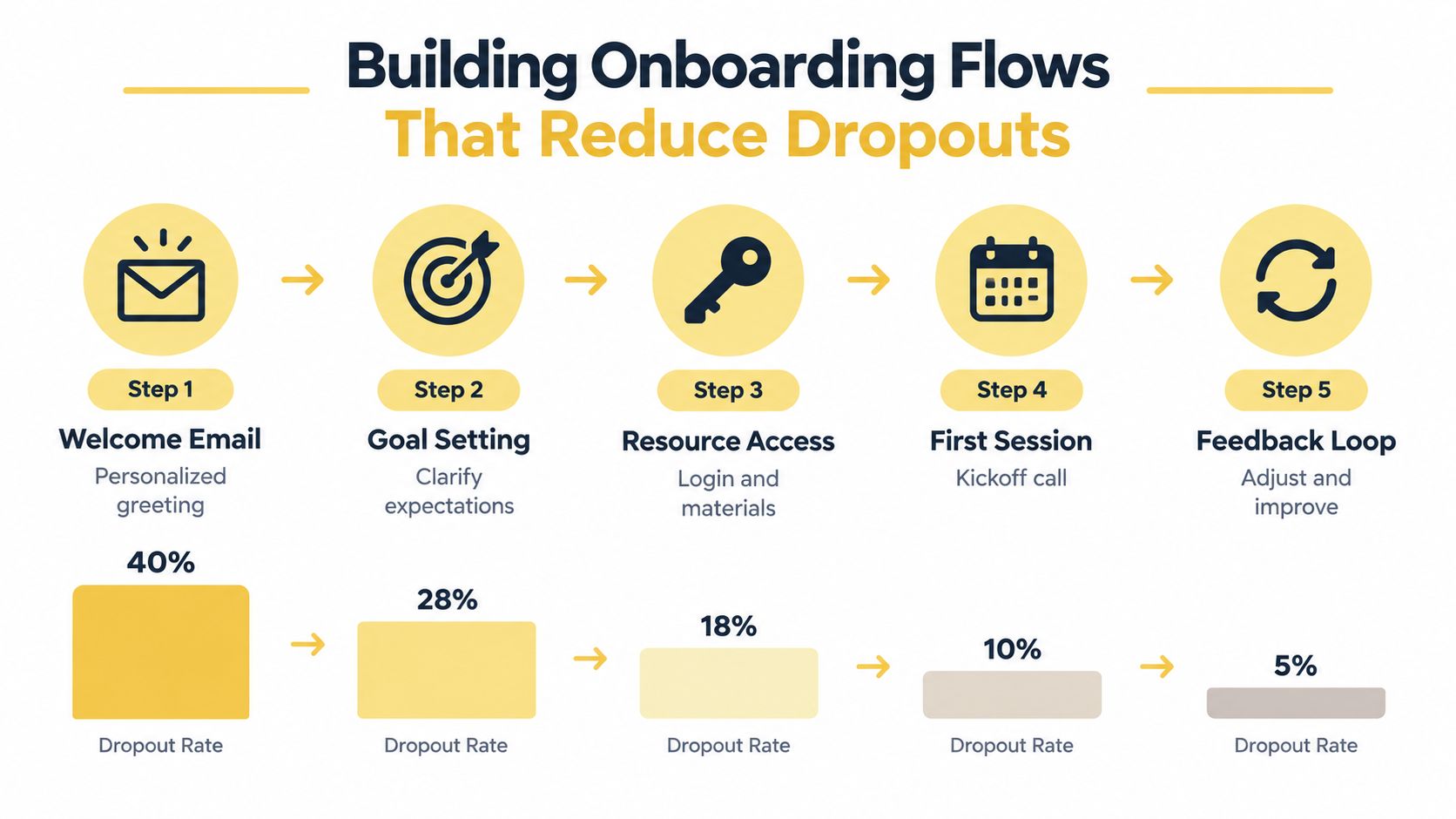
A better onboarding flow releases clarity in sequence.
A complete flow from welcome to launch
First, send a personal welcome. Confirm the client's decision, name the first step, and explain when they will hear from you next. A short message written in the coach's voice creates more reassurance than a large automated information dump.
Next, clarify the goal. Ask the client to describe the result they want and the behavior they are willing to practice. This gives the first session a clear starting point and helps you identify a poor fit before delivery consumes time.
Then, provide only the essential access. Give the login details, first resource, schedule, and contact route. Keep optional materials out of the first message. You can release them when they become relevant.
Create an early win. The first task should be achievable and connected to the program promise. A client who completes a useful reflection or prepares a real conversation begins to trust the process.
Close the loop. Ask what was clear, what created friction, and what support is needed before the first session. The answer may reveal a scheduling issue, accessibility need, or expectation that your sales conversation didn't address.
Prevent common onboarding failures
Don't assume clients read everything. Give one primary action per communication. Don't offer a menu of five starting points when the program has a designed sequence. Don't treat belonging as decoration. Use names, acknowledge context, and make it clear how participants will interact with the coach and with one another.
Your onboarding also protects the program. If a prospect refuses the basic commitment required for success, you can address that before launch. That isn't rejection. It's responsible matching.
The first win should reduce uncertainty, not prove how much content you can deliver.
Track whether each person has completed the welcome action, confirmed the goal, accessed the program, attended the first session, and responded to the initial feedback request. These signals help you intervene while the relationship is still easy to repair.
Smart Automation That Doesn't Feel Robotic
Automation should remove repetition, not remove care. The decision isn't whether to automate. It's which parts of the experience benefit from consistency and which parts depend on judgment, empathy, or trust.
Use a simple test. If the process follows a stable rule and the client expects a quick response, automation is usually appropriate. If the situation contains emotional risk, ambiguity, or a need for interpretation, a human should own the decision.
| Process Element | Automation Level | Why | Tools Needed |
|---|---|---|---|
| Welcome email and access instructions | High | Every participant needs consistent core information | Email sequence and program platform |
| Session scheduling | High | Calendar coordination follows predictable rules | Calendar integration and booking tool |
| Payment reminders | High | Routine notices can be timely without personal intervention | Payment system and reminder workflow |
| Assignment reminders | High with review | Prompts support consistency, but missed work may need context | Learning platform and messaging |
| Progress dashboard updates | High | Structured status data can be collected automatically | CRM or coaching platform |
| Initial check-in | Partial | Automation can gather the first response, while a coach interprets it | Form, workflow, and coach review |
| Milestone celebration | Partial | A standard prompt can start the moment, but recognition should feel personal | Triggered message and manual note |
| Personalized feedback | Human | Clients need judgment tied to their specific work | Coach notes and messaging |
| Crisis intervention | Human | Safety, nuance, and appropriate escalation cannot be delegated to a sequence | Direct contact and escalation protocol |
| Relationship deepening | Human | Trust grows through attentive, context-aware interaction | Live conversation and session notes |
The yellow zone deserves special attention. A check-in form can collect useful information, but an answer such as “I'm stuck and thinking of quitting” shouldn't disappear into a workflow. Set an escalation rule that brings the response to a coach quickly.
Automation also needs a source of truth. If attendance lives in one spreadsheet, payment status in another system, and progress notes in a third, your reminders may be technically accurate but strategically wrong. Fragmented information can become a governance risk because it hides the relationship between participation, decisions, and outcomes.
For practical ideas on designing repeatable workflows, review these automation tips from Outrank. Then audit every automated message for tone. Does it tell the client what to do, why it matters, and how to get help? If not, it may save you time while costing the relationship.
Evaluating Results and Scaling Responsibly
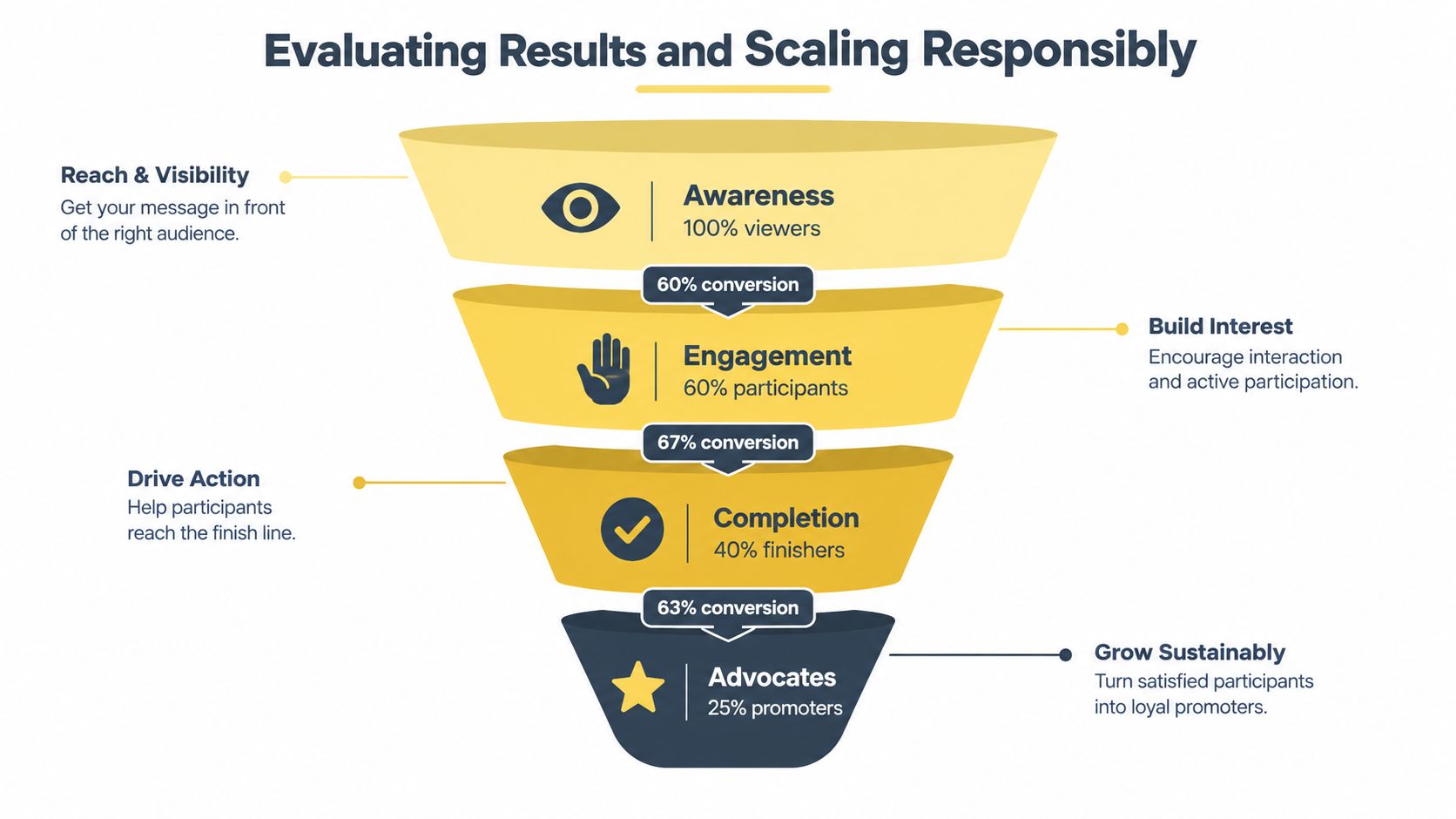
Evaluation becomes useful when it changes a decision. A dashboard full of activity counts won't help you decide whether to add a cohort, revise a lesson, hire another coach, or pause enrollment. You need a chain between early signals, final outcomes, and operating choices.
Start with leading indicators. These show whether the conditions for success are present. In a coaching program, they might include goal clarity, first-session attendance, check-in behavior, assignment submission, or timely responses to support.
Then track lagging indicators. These show whether the promised result appeared. Depending on your offer, that could mean demonstrated skill, client retention, improved workplace behavior, completed certification requirements, or a change the client defined at the start.
The relationship between the two matters. If attendance remains strong but milestone evidence is weak, adding more sessions may not solve the problem. The curriculum or feedback method may need attention. If milestone attainment is strong but clients stop participating after the program, your continuation offer or post-program support may need redesign.
Build an evaluation conversation
Review results on a fixed cadence with the people who can act on them. Ask:
- What changed: Which client behaviors or outcomes moved?
- Where did progress stop: At enrollment, onboarding, attendance, practice, or application?
- What caused the pattern: Was the issue capacity, curriculum, communication, fit, or support?
- What decision follows: What will you keep, change, test, or stop?
- Who owns the action: Which person will make the adjustment and by when?
Formal methods support better delivery at scale. Industry reporting links structured approaches with organizations being about 2.5 times more successful at delivering projects on time and within budget, and reports 73% of organizations meeting original goals with standardized practices versus 58% using informal approaches. These figures come from industry guidance on PMO practices, and they reinforce a practical point for coaches: consistent operating discipline gives you better visibility than improvisation.
Scaling should follow evidence, not excitement. Add capacity when the program has a repeatable onboarding flow, clear decision rights, manageable coach workload, and outcome data you understand. If every new participant creates exceptions, manual rescue work, or inconsistent feedback, growth will multiply strain.
Don't scale the number of clients until you understand the conditions that help clients succeed.
Choosing Tools That Support Your Program Management
Spreadsheets and sticky notes can support a small, stable program. They become fragile when several coaches, cohorts, assessments, payments, and communication channels interact. The issue isn't that spreadsheets are inferior. The issue is that disconnected records force you to reconstruct the program's status manually.
Choose tools based on the operating model you need, not on the longest feature list. A practical setup should help you manage:
- Reusable program templates: Build the sequence once and adapt it without starting over.
- Milestone tracking: See who is ready, delayed, or needs intervention.
- Client self-service: Let participants find schedules, resources, tasks, and updates without asking your team for every detail.
- Payment integration: Connect enrollment and payment status to delivery access.
- Outcome reporting: Review participation and results together instead of counting activity in isolation.
- Permissions: Keep sensitive coaching notes and client information available only to the right people.
The “I'm too small for a platform” objection deserves a direct answer. You don't need enterprise complexity to benefit from professional structure. You need enough coordination that your admin work no longer steals time from coaching or makes the client experience inconsistent.
On the other hand, buying software won't repair an undefined program. Document the curriculum, decision rights, KPIs, and onboarding flow first. Then choose a system that makes those practices easier to repeat.
Coachful is one option for coaches who want client onboarding, scheduling, payments, messaging, progress tracking, goals, milestones, resources, and group-program workflows in one workspace. Review the criteria in this guide on professional coaching software, then compare the tools you already use against the work you actually need to coordinate.
The right tool should reduce switching, expose risks early, and make the next action obvious. If it creates another dashboard that nobody trusts, it has added complexity rather than management capacity.
Your 30-Day Program Management Implementation Plan
You don't need to rebuild the business in one weekend. Use four focused sprints, each producing something you can use immediately.
Week one establishes governance
Document the program promise, decision owners, escalation route, and weekly review agenda. Success means every recurring decision has a named owner and every meeting ends with actions, owners, and due dates.
Week two makes the curriculum measurable
Map the client transformation backward into stages and milestones. Choose SMART KPIs for enrollment, attendance, assignments, and milestone attainment. Success means a coach can explain what progress looks like without relying on “engagement” as a catch-all word.
Week three improves onboarding
Write the welcome sequence, goal-setting prompt, access message, first-session plan, and feedback request. Test the flow with someone unfamiliar with your program. Success means a new participant knows the next action at every stage.
Week four connects the operating system
List every current tool, identify duplicate records, and choose the workspace that can support your actual workflow. Configure reminders, dashboards, permissions, and templates. For a new certification or structured learning offer, CertSeal's program launch guide can provide additional planning context. Success means your team can find the current status of a participant, milestone, payment, risk, and decision without searching across disconnected locations.
Keep the plan modest enough to finish. Program management best practices become valuable when they shape daily behavior, not when they remain in a document.
Coachful brings onboarding, scheduling, payments, messaging, progress tracking, goals, milestones, and cohort delivery into one workspace for coaching programs. Visit Coachful to see how you can turn the framework into a repeatable program operation and create more room for the coaching work clients value most.