What Is Client Management? a Coach's Guide to Success

Coachful

You're probably reading this between sessions, with three tabs open and one nagging thought looping in your head.
Did I send that intake form? Did that client pay? Where did I put the notes from last Thursday? Am I following up enough, or too much? And why does running a coaching practice sometimes feel like being a therapist, project manager, scheduler, bookkeeper, and inbox firefighter all at once?
That tension is where a lot of coaches live. Your coaching can be thoughtful, perceptive, and transformational, but the experience around the coaching can still feel messy. Clients don't just experience your insight. They experience your reminders, your boundaries, your follow-through, your contracts, your payment process, and the way you respond when they wobble emotionally between sessions.
That's why what client management is matters so much for coaches. It isn't sterile admin. It's the structure that holds the relationship. Done well, it protects your energy, gives clients a steadier experience, and makes your work feel more sustainable.
Your Coaching Is Great But Your Admin Is Chaos
Maya is a strong coach. Her clients trust her. Sessions go deep. People leave with clarity.
But her business runs on memory.
She uses Gmail for intake, Calendly for booking, Zoom links buried in old threads, notes in a docs folder she swears she organized, invoices in another tool, and voice notes from clients inside WhatsApp. On Monday morning she's asking herself the same questions again: Who rescheduled? Who still needs a contract? Which client said they were struggling after the last session? Did that follow-up land, or did it drift into spam?
If that sounds familiar, you're not disorganized. You're likely carrying too many disconnected micro-decisions in your head.
What the chaos is really costing you
The obvious cost is time. The less obvious cost is emotional bandwidth.
When your practice has no clear system, every client touchpoint becomes a fresh act of remembering. You're not just coaching. You're tracking loose ends, replaying conversations, and fearing that something important will slip. That low-grade pressure can make even a full calendar feel unstable.
You don't need more willpower. You need fewer places for important things to hide.
Client management stops sounding like corporate jargon and starts sounding like relief. In a coaching practice, client management means designing a smooth, intentional path for clients from first inquiry to final session and follow-up. It covers how people enter your world, how they schedule, how they pay, how you communicate, how you track progress, and how you support them when emotions flare between sessions.
A small example that changes the whole week
Say a prospect fills out an inquiry form. A healthy client management process sends the welcome email, shares the next steps, books the call, stores the intake details, and makes the first session feel prepared rather than improvised. If you send those emails manually, it also helps to understand basic deliverability so your messages reach people. This guide on How to avoid landing in spam is useful when your onboarding emails mysteriously disappear.
Client management isn't separate from the client experience. It is the client experience.
Client Management Is a System Not a Personality
A lot of coaches resist systems for a very understandable reason. They worry systems will make them sound scripted, cold, or less intuitive.
You might even think, “I'm good with people. My clients feel seen. Isn't that the important part?”
Yes. It is important. It's just not sufficient.
According to Productive's definition of client management, client management is defined as a process, not a personality trait, requiring coaches to standardize onboarding, centralize feedback, and automate updates to achieve clarity, consistency, and scalability rather than relying on 'being nice' or 'being a good listener'. Without a standardized system, even talented coaches face inconsistent client outcomes.
Why warmth alone doesn't scale
Think of a top chef. The chef may have instinct, taste, and years of experience. But service still depends on mise en place. Ingredients are prepped. Stations are organized. Timers are set. The system doesn't replace talent. It makes talent repeatable under pressure.
Coaching works the same way.
Without a system, your client experience depends on your current energy, memory, and availability. When you're rested, it feels smooth. When you're overloaded, people get slower replies, blurrier expectations, and more inconsistencies. Clients usually feel that before you admit it to yourself.
The system protects both sides
A real client management system does a few quiet but important jobs:
- It sets expectations early. Clients know how often they'll hear from you, where to message you, and what support between sessions looks like.
- It reduces scope creep. You stop answering Sunday night texts just because they appeared.
- It preserves presence. Admin stops hijacking the attention you want to bring into sessions.
- It creates consistency. Every client gets a stable, professional experience, not a version shaped by your weekly stress level.
Practical rule: If a client has to ask, “What happens next?” too often, the process is underbuilt.
Systems still leave room for humanity
Many coaches get stuck when they hear “system” and imagine rigidity. But the point isn't to automate care. The point is to automate the predictable parts so you can be more human in the moments that matter.
If you've ever run a workshop, retreat, or group container, you already know this. Registration, reminders, confirmations, and attendance details need a process or the event feels sloppy. Even something adjacent like online ticketing for events shows the same principle. Clear logistics create trust before the experience begins.
If you want to see what a centralized system looks like in a coaching context, a coaching CRM gives one example of how onboarding, messaging, notes, scheduling, and payments can live in one workflow instead of six separate places.
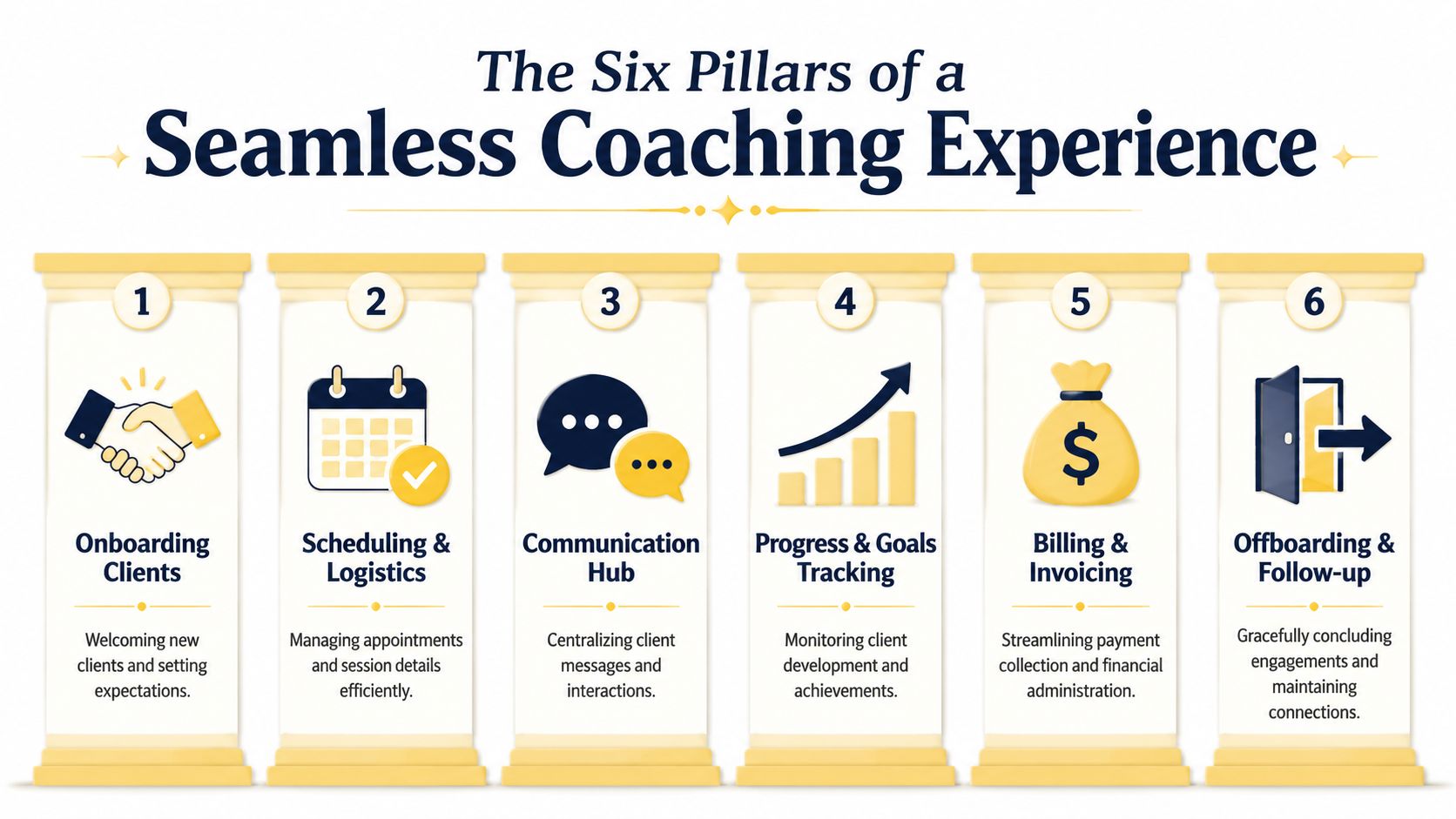
The Six Pillars of a Seamless Coaching Experience
When coaches ask what client management is, they often need something more concrete than “better organization.” They need a map.
Here's a practical one.
Onboarding clients
Onboarding is more than sending a contract.
It's where you establish the psychological contract. What are you helping with? What does accountability look like? What happens between sessions? What's confidential? What counts as urgent, and what can wait?
A weak onboarding process creates uncertainty that later gets mislabeled as “client neediness.” Often the client isn't difficult. They just don't know the shape of the container.
Scheduling and logistics
Scheduling sounds minor until it isn't. A missed link, timezone mistake, or reschedule loop can sour a client's trust before the session even starts.
Good client management removes friction here. Clients should know how to book, how to change a session, what happens if they're late, and where to find the session details without digging through old email threads.
A useful test is simple. If a client wakes up stressed on session day, can they find what they need in under a minute?
Communication hub
Coaches often underestimate how much anxiety scattered communication creates. One message in email, another in text, a reflection in voice note, a resource in direct message. Soon both struggle to locate information.
A communication hub gives the relationship one home. That doesn't mean clients lose warmth. It means the warmth stops getting buried.
For coaches trying to tighten this area, these client communication best practices are a good reference point for setting cleaner rhythms and channels.
Progress and goals tracking
Progress tracking is not a report card. It's a way to help clients see movement when change feels slow.
A client may say, “I'm stuck.” But your notes may show they're speaking up more at work, recovering faster from setbacks, or following through more consistently. Tracking helps you reflect that back with specificity.
When clients can see progress, they don't rely only on mood to judge whether coaching is working.
Billing and invoicing
Payment friction has an emotional cost. Coaches feel awkward chasing money. Clients feel awkward being chased.
That's why billing belongs inside client management, not outside it. Clear invoices, simple payment steps, and visible policies reduce resentment on both sides. This is not about being transactional. It's about keeping money from leaking into the relational field in avoidable ways.
Offboarding and follow-up
Many coaches do strong work during the engagement and then let the ending go soft. That's a missed opportunity.
Offboarding is where you help the client consolidate wins, reflect on growth, decide what support they need next, and leave the relationship feeling complete rather than dropped. A simple closing note, summary, or check-in later can make the whole experience feel more held.
Here's the six-pillar view in a simpler checklist:
| Pillar | What it answers for the client |
|---|---|
| Onboarding | What are we doing, and how does this work? |
| Scheduling | When are we meeting, and how do I manage logistics? |
| Communication | Where do I reach you, and what response can I expect? |
| Progress tracking | How will we know I'm moving forward? |
| Billing | How do payments work, and what are the policies? |
| Offboarding | How do we close well and keep the learning alive? |
The Real Payoff Why Great Client Management Matters
It is Tuesday night. Your last session ran long, a client needs a receipt, another wants to reschedule, and you still have three follow-ups sitting in your head because you did not write them down anywhere reliable. You are not bad at business. You are carrying too many emotional and administrative loose ends at once.
That strain has a cost. It affects revenue, yes, but it also affects your presence. Coaching asks for attention, steadiness, and memory. Scattered client management pulls from the same limited pool.
According to Salesmate's customer service statistics roundup, increasing customer retention rates by just 5% can boost profits by up to 95%, and brands that prioritize the client experience grow revenue 1.7x faster. For coaches, client management is how that experience shows up in ordinary moments: a clear next step after session, a payment process that does not create awkwardness, and communication that feels held rather than improvised.
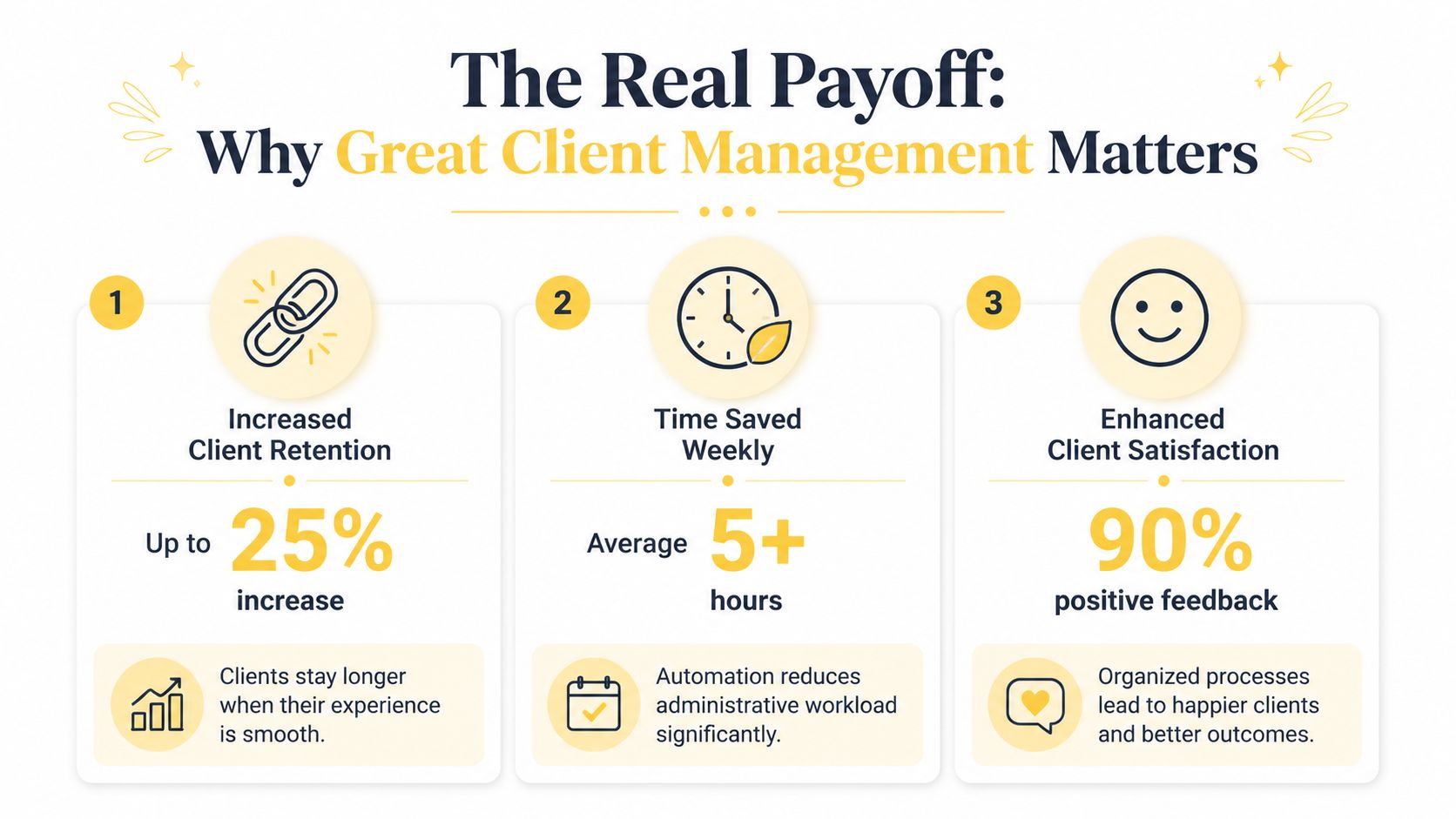
Better retention begins with emotional ease
Clients do not decide to continue based on outcomes alone. They also notice how much effort it takes to stay in the relationship.
A coaching engagement works like a well-run room. If the chairs are missing, the lights flicker, and nobody knows where to put their coat, people feel unsettled before the conversation even starts. Coaching admin works the same way. Confusing scheduling, unclear boundaries, and inconsistent follow-up create friction that clients feel in their body before they name it with words.
That is why strong systems improve retention. They reduce the background stress around the work, which makes it easier for clients to stay engaged long enough to benefit from the work itself. If you want a practical example, this guide to client onboarding automation for coaches shows how early structure can lower drop-off and set a calmer tone from the start.
Professionalism becomes visible in small moments
Many coaches worry that a messy backend makes them look less credible.
Clients notice process because process is part of care. A late link, a missing invoice, or a forgotten check-in can make a capable coach feel harder to trust. A clear system sends a different message. It shows that you can hold both the relational side of coaching and the practical side of running a practice.
Salesmate also notes that 80% of customers value their experience with a company as much as its products or services, and that a projection from Salesmate suggested that by 2026 many businesses would compete heavily on customer experience. Even in a small private practice, that shift matters. Your service is not only the session. Your service is the full container around the session.
Strong client management protects the coach's energy
This may be the part coaches underestimate most.
Loose systems do not stay in your inbox. They live in your nervous system. You remember a client birthday while brushing your teeth. You wonder whether an invoice was paid while driving home. You keep replaying whether you sent the summary you promised. That mental load chips away at the calm attention your clients are paying for.
A stronger process gives that energy back. It creates fewer open loops, fewer awkward money conversations, and fewer moments where you need to soothe client uncertainty that better structure would have prevented. If you want to create custom workflows, even simple automations can reduce that load without making your practice feel cold.
The payoff is not just higher revenue or better retention. It is a practice that feels lighter to run and safer to be inside, for your clients and for you.
Common Workflows and Best Practices That Actually Work
Good client management becomes real in tiny repeated moments. The first message. The intake form. The delayed reply. The boundary around weekend communication. The way you prepare for session one.
The strongest practices are often unglamorous. They just work.
Start before the first session
A generic first session usually starts with too much obvious information gathering. You spend paid time learning what you could have clarified earlier.
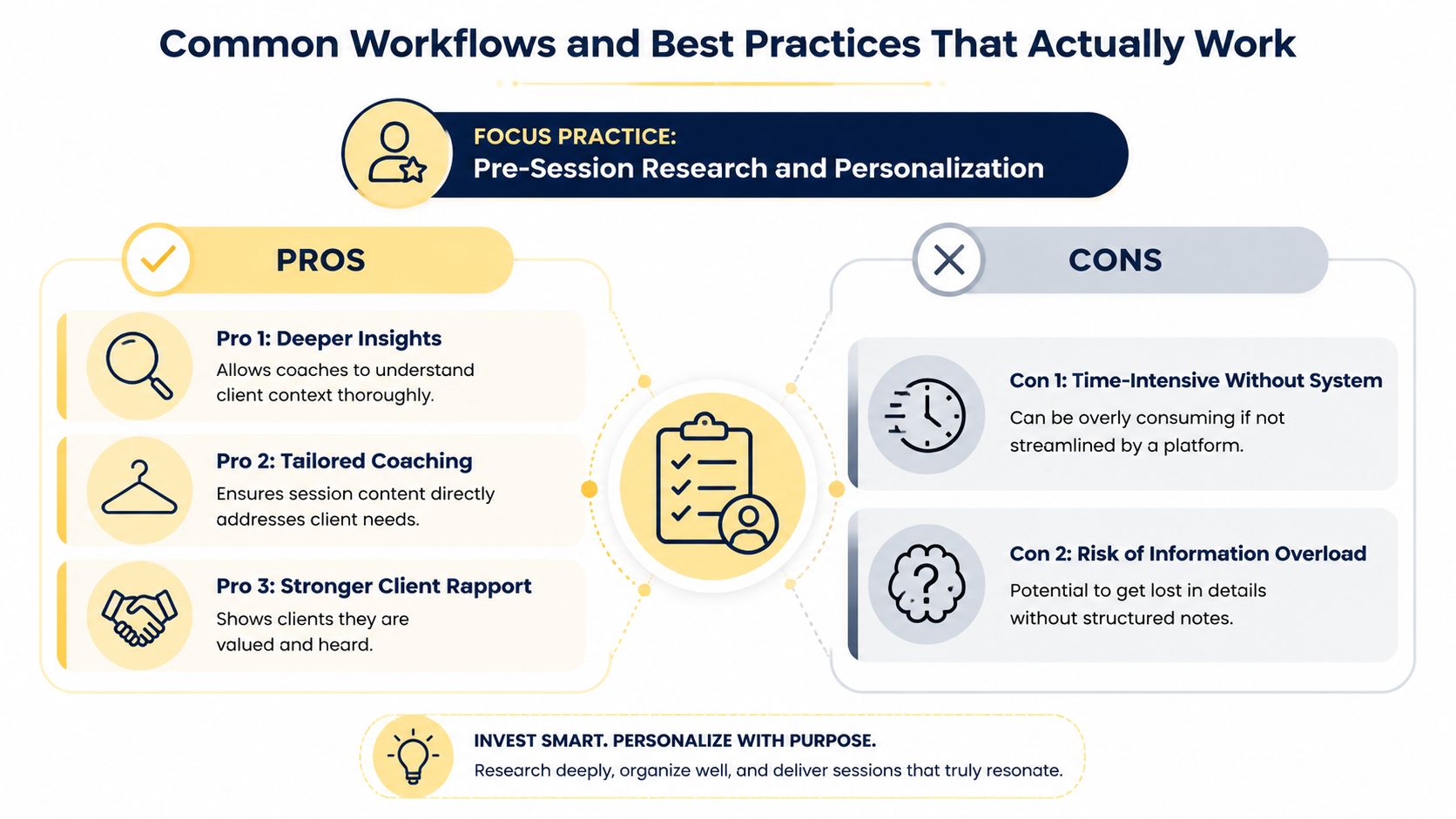
According to Effective Managers on client relationship management best practices, best practices mandate conducting research on a client's industry, goals, and pain points before the first session. This allows coaches to provide targeted, high-value insights that directly solve the client's specific problems, making the first session immediately impactful instead of generic.
For a coach, that can be simple:
- Review their intake carefully. Pull out the exact words they use about goals, fears, and constraints.
- Scan their context. If they lead a team, understand the pressure of that role before you meet.
- Prepare two or three sharp starting questions. Not twenty. Just enough to show you've thought.
A client feels the difference immediately. Instead of “Tell me everything,” they get “You mentioned that conflict with your co-founder tends to spike before board meetings. Let's start there.”
Build boundaries into the relationship early
Many coaches wait until they feel annoyed to set a boundary. By then it feels reactive.
It's much easier to establish the frame up front. For example:
“You can message me in the platform between sessions for brief reflections or updates. If something needs deeper processing, bring it to our session and we'll work through it properly.”
That kind of sentence does two things. It reassures the client they're supported, and it protects you from becoming endlessly on-call.
If you're using tools to create custom workflows, this is one area worth systemizing. Clear triggers for onboarding, check-ins, renewals, and offboarding reduce the amount of emotional labor you spend remembering who needs what.
Use language that preserves trust
Client management is also made of wording.
PPAI highlights a simple but powerful tactic in its client management best practices: say “thank you for your patience” instead of “sorry” when delays occur. That subtle shift protects your authority and often lands better with clients.
Compare these:
- Reactive: “Sorry I'm late sending this.”
- Steadier: “Thank you for your patience. I've attached the updated plan.”
The second version doesn't dodge responsibility. It frames the interaction with more confidence.
A workflow that reduces stress fast
A simple coaching workflow might look like this:
Inquiry arrives
Send a welcome message, intake form, and booking link.Before the first session
Review goals, context, and likely friction points.After each session
Capture notes, assign actions, and send a brief summary.Between sessions
Keep communication in one channel and maintain response boundaries.Near the end of the engagement
Review progress, decide next steps, and close intentionally.
If you want to tighten the front end of that process, this guide to client onboarding automation is useful for reducing repetitive setup work without making the experience feel mechanical.
From Chaos to Control How a Platform Streamlines Your Practice
It is 9:30 p.m. You are done coaching for the day, but your mind is still holding five loose threads. One client texted to ask for the session link. Another is waiting on an invoice. Your notes from this morning are in a document you forgot to rename. A payment notification is buried in email. Someone sent a voice note on WhatsApp that you still need to answer.
Nothing is on fire. But everything is asking to be remembered.
That kind of admin clutter does more than waste time. It drains coaching energy. Part of emotional client management is protecting your attention so clients meet a grounded coach, not a coach who is juggling tabs, reminders, and mental Post-its.
Clients feel fragmentation quickly. A Schedly summary of McKinsey research says 75% of clients expect unified, integrated experiences across all touchpoints. In a coaching practice, that expectation shows up in simple moments. They want to know where to book, where to message, where to find resources, and what happens next without having to hunt for answers.
Fragmented tools create emotional drag
Using separate tools is not just a technical inconvenience. It creates emotional drag on both sides.
For the client, each extra step adds uncertainty. They pause and wonder where to look, whether they missed something, or whether they are bothering you by asking again. For the coach, each disconnected tool adds one more thing to track manually. You become the glue holding the practice together.
A good system works like a well-run front desk in a calm clinic. People know where to go, what to expect, and how they will be supported. Without that structure, you end up spending your relational energy on preventable confusion.
Questions pile up fast:
- Where is my session link?
- Should I message you here or by email?
- Did my payment go through?
- Where are my notes or action steps?
- How do we renew or wrap up?
None of those questions are hard on their own. The burden comes from answering them over and over in different places.
What one platform changes
A single platform brings the routine parts of your practice into one home. That usually means onboarding, scheduling, payments, secure messaging, notes, resources, and progress tracking all live together.
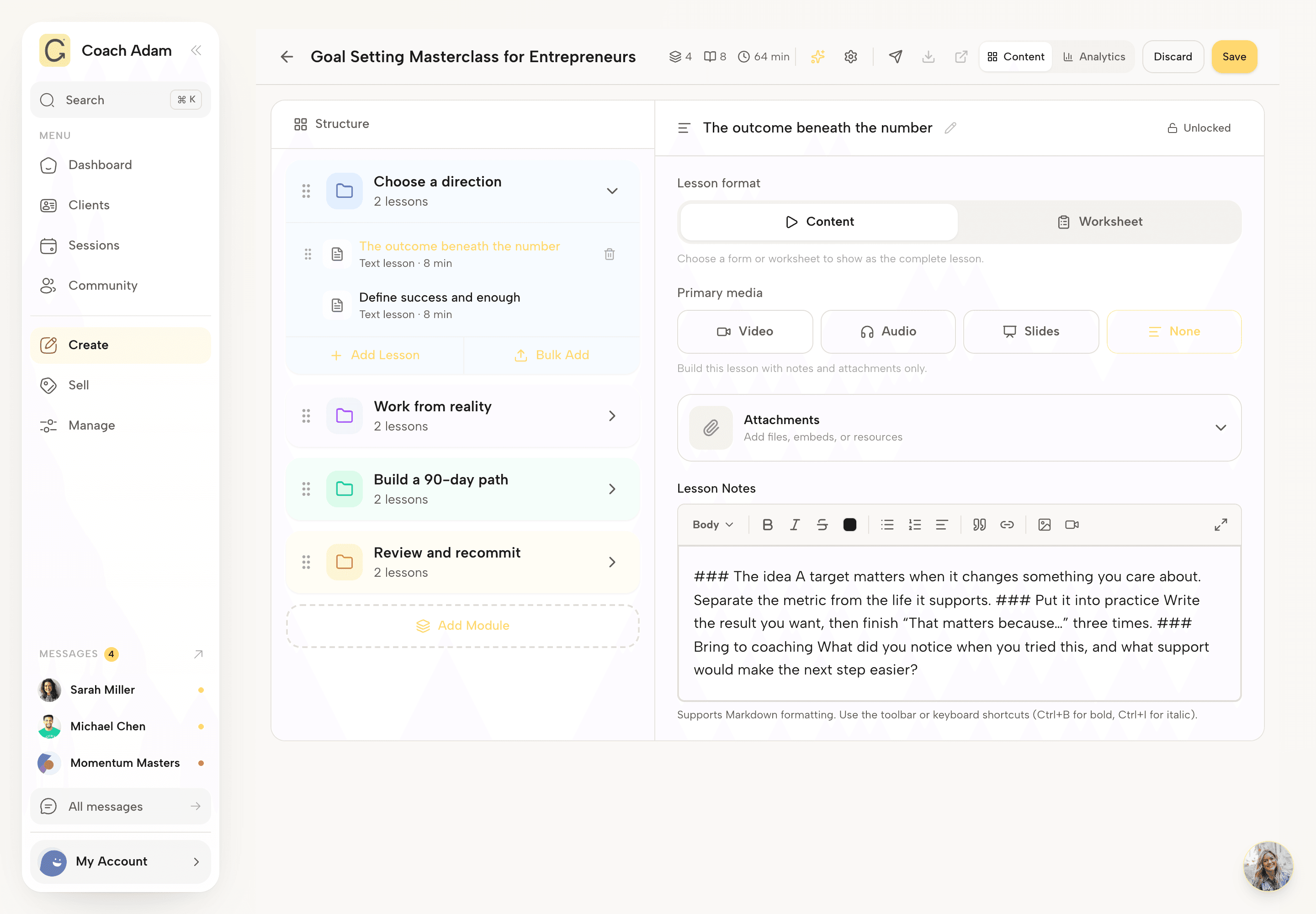
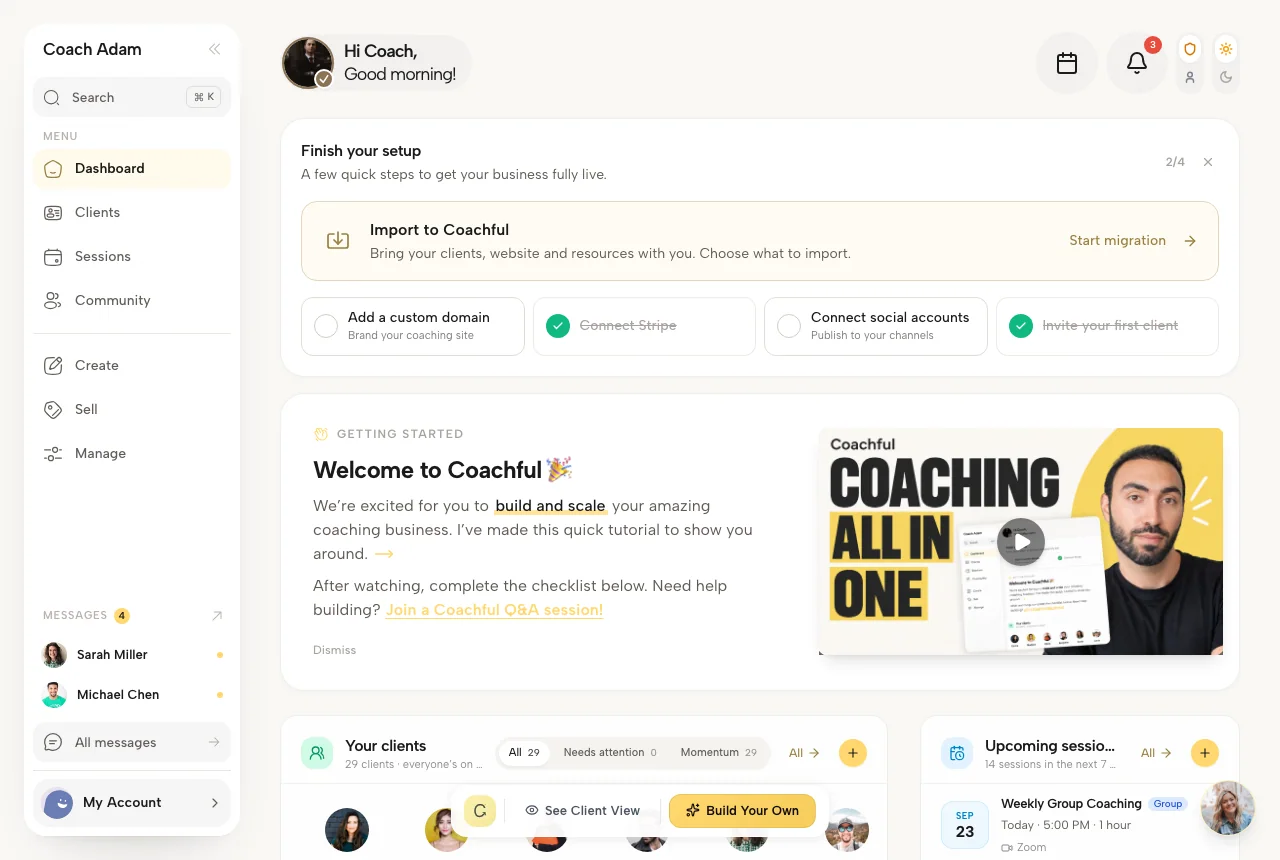
For coaches who want one system instead of a stack of separate tools, Coachful is one example of an all-in-one platform built around those workflows. It puts contracts, session scheduling, secure payments, messaging, notes, and client progress in one workspace.
That changes more than efficiency.
It reduces the amount of remembering you have to do. It gives clients a clearer container. It lowers the odds that an important detail gets lost between apps. It also helps you stay emotionally present, because your brain is no longer acting as the backup system for your business.
A short walkthrough makes that easier to picture:
Structure creates more room for connection
Many thoughtful coaches resist platforms because they worry the experience will feel cold or standardized. The fear makes sense. Coaching is personal work.
In practice, a clear system often protects the personal side of the relationship. When scheduling, forms, payments, and notes are handled in one place, you have more capacity for the human part. You can listen for what is underneath a client's words. You can track patterns more reliably. You can enter sessions with less background stress.
That is the fundamental shift from chaos to control. You are not replacing care with process. You are giving care a stronger container so it does not depend on your memory, your inbox, or your endurance.
Your Path to a Scalable and Fulfilling Coaching Practice
Client management isn't about becoming more corporate. It's about becoming more available for the work only you can do.
When your practice runs on memory and patchwork, you spend too much of yourself holding things together. When your practice runs on a clear system, you get to coach with a steadier mind. Clients feel that steadiness. They trust the container more. You resent the admin less.
If you've been asking what client management is, the plain answer is this: it's the set of processes that make your coaching feel consistent, clear, supportive, and sustainable. It includes the emotional layer too. Not just forms and payments, but how you hold boundaries, respond between sessions, and create safety without overextending yourself.
Start small. Choose one part of your client journey that feels messy right now. Onboarding. Messaging. Notes. Billing. Offboarding. Clean up one of them this week.
That one change can give you more relief than another productivity hack ever will.
If you want a simpler way to organize onboarding, scheduling, payments, notes, messaging, and client progress in one place, Coachful offers an all-in-one coaching platform designed to support the full client journey without forcing you to cobble together separate tools.