
Public Speaking Coaching: What It Is, Costs and Results
Public speaking coaching is one-to-one practice with a coach who helps you prepare and deliver talks: structuring the message, rehearsing out loud, working on voice, pace and presence, and managing nerves so they stop running the show. Most of it is rehearsal with honest feedback, often on video. It suits anyone with a talk coming up or a career that keeps putting them in front of a room. Severe fear that stops you functioning, or a voice or stuttering problem, calls for a clinician or speech-language pathologist as well.
If you are dreading a presentation, you are in large company. In one survey of more than a thousand university students, nearly two thirds said they were afraid of public speaking (Marinho and colleagues, 2017). The good news is that this is one of the most practicable skills there is. This guide covers what a public speaking coach does, where coaching ends and treatment for anxiety begins, what the research says about practice and feedback, what it costs, cheaper ways to rehearse, and how to choose a coach.
What you can work on with a public speaking coach
Most people come with a specific event. Good coaches adjust the work to it.
| Situation | What the coaching usually focuses on |
|---|---|
| A conference talk or keynote | One clear idea, a structure the audience can follow, an opening and close you know cold, timing |
| An investor or sales pitch | Cutting to the essentials, handling tough questions, sounding sure without overselling |
| Presenting at work | Leading with the point, speaking up in meetings, presenting to senior people without rambling |
| A wedding toast or eulogy | A short, personal structure, rehearsing until it is natural, getting through emotion |
| An interview presentation | Answering the brief, slides that help, practicing under realistic time pressure |
| Media, podcasts or video | Short answers, staying on message, how you sound and look on camera |
Under all of these sit the same few skills: knowing what you want the audience to remember, structuring it so they can follow, delivering it with a voice and body that match the words, and staying steady when nerves kick in. A coach speeds that up because they can see and hear what you cannot. If the talk is part of a job interview, our guide to interview coaching covers the rest of the process, and executive presence coaching covers the wider question of how you come across as a leader.
Nerves, fear and social anxiety: where coaching stops
Ordinary nerves before a talk are normal, and a coach can help you prepare so they matter less. For some people, though, the fear is part of social anxiety disorder. The National Institute of Mental Health describes a form that shows up only in performance situations such as giving a speech, with physical signs like blushing, sweating, trembling and a racing heart. It names cognitive behavioral therapy as the gold-standard treatment and notes that beta-blockers are commonly the medication of choice for performance-related anxiety, which only a doctor can prescribe (NIMH, social anxiety disorder).
See a licensed professional when...
- Fear of speaking, or of being watched or judged, is making you turn down jobs, skip classes or avoid situations you need. A psychologist or therapist trained in cognitive behavioral therapy is the right first step, and coaching can follow or run alongside.
- You have panic attacks before or during speaking, or you rely on alcohol or other substances to get through.
- You stutter and want help with it. The National Institute on Deafness and Other Communication Disorders notes that stuttering is usually diagnosed by a speech-language pathologist, and that adult therapy teaches ways to minimize it (NIDCD, stuttering).
- Your voice is hoarse for more than three weeks, or speaking hurts. See a doctor; NIDCD notes you may be referred to an ear, nose and throat specialist, and people who use their voice for work may be referred to a speech-language pathologist for voice therapy (NIDCD, hoarseness).
What a public speaking coaching session looks like
A first session usually starts with you giving a short talk, often two to five minutes, while the coach watches or records. Then the coach asks what you want people to remember, who the audience is and what worries you most. Expect one or two big observations, not twenty small ones.
After that, sessions follow a simple loop:
- Deliver. Give the talk or a section of it, standing up, out loud, as you will on the day.
- Review. Watch the recording together. Most people are surprised by one thing they never noticed.
- Change one thing. Slow the first minute, cut the second story, end on the point instead of "so, yeah".
- Repeat. Deliver again with the change, and notice how it feels.
- Practice between sessions. A set number of out-loud run-throughs, ideally recorded.
Sessions are commonly an hour, weekly in the run-up to a big talk. Some coaches give you a short prep task before each session, such as a new draft or a recording, so the time goes on improving it.

A written record of the notes keeps you from forgetting what the coach said once the adrenaline wears off. In Coachful's client app, coaches' session notes become a running summary the client can reread before the next rehearsal.

Some coaches also share short lessons on structure or voice exercises, so you can practice the basics without paying for session time.

And a quick message before the real talk ("going on in 20 minutes, any last thing?") is a small kindness many coaches offer. Ask whether yours does.

What the research says about practice, feedback and fear
Research on public speaking coaching as a profession is limited, but the ingredients it uses have been tested.
- Fear of public speaking responds well to treatment. A meta-analysis of 30 randomized trials with 1,355 people found a moderate-to-large reduction in fear after psychological interventions, mostly cognitive and behavioral approaches such as exposure, and the effect was larger still at follow-up. Interventions delivered through technology, such as virtual reality practice, did about as well as face-to-face ones (Ebrahimi and colleagues, 2019). The authors note the fear affects up to a third of the population.
- Filmed practice with feedback reduces anxiety. In a randomized study of 142 medical students, those who gave filmed presentations and got feedback from a senior doctor saw their anxiety drop about twice as much as students who got no formal feedback (Schmidt and colleagues, 2014).
- Even one practice session can help delivery. In a small randomized study, a single 30-minute practice session in virtual reality led audiences to rate presentation skills higher than extra self-preparation did (Bachmann and colleagues, 2023). Another found that practicing in front of a supportive virtual audience made speakers come across as more confident to blinded raters (Kroczek and Mühlberger, 2023).
What this suggests for choosing a coach: look for someone who makes you practice out loud, gives specific feedback you can act on, and gradually raises the stakes, from a run-through alone to a small audience to the real thing. Talking about your fear for an hour is less useful than giving the talk three times.
What public speaking coaching costs
There is no reliable published rate for public speaking coaching specifically. Coachful's 2026 Coaching Business Report, which compiles published research and practitioner reports for the second quarter of 2026, has no figure for it, so the two nearest benchmarks depend on who is paying.
| If the buyer is | Nearest benchmark | Typical hourly rate |
|---|---|---|
| You, personally | Life coaching | $75 to $200 |
| Your employer, for a leader | Executive coaching | $200 to $500 |
US dollars, Q2 2026, from Coachful's 2026 Coaching Business Report: life coaching from PayScale and practitioner reports, executive coaching from the ICF Global Coaching Study 2025 and PayScale. See life and executive rates on coachingrates.com.
The same report notes that nearly six in ten coaching clients worldwide are sponsored by an employer. If your talk is for work, ask your manager or learning team whether they will pay. A focused block of three to five sessions before one big talk is a common way to buy it, and is often enough. For the wider question of when coaching is worth paying for, see is a life coach worth it.
Cheaper ways to practice
- Toastmasters. Toastmasters International is a not-for-profit with clubs worldwide where members give prepared speeches and get feedback from other members, plus impromptu speaking practice.
- Record yourself. A phone on a stack of books and an honest watch-through teaches a lot.
- A friendly audience. Two colleagues, a partner, a friend who will tell you the middle dragged.
- Coaching for the last mile. Practice on your own, then book a coach for the final two sessions before the big day.
How to choose a public speaking coach
There is no license or standard credential for public speaking coaches. Look at three things: relevant experience, a method built on practice, and fit with your kind of speaking.
Backgrounds worth asking about
- Speaking experience in your setting: conferences, sales, academia, media or the boardroom.
- Theater, broadcasting or voice training for delivery work.
- Coaching training, such as an ICF credential, for the coaching skills themselves (ICF credentialing).
- A speech-language pathology license if your goals involve a voice problem or stuttering. That is a clinical role.
Questions to ask
- Who do you usually coach, and for what kinds of talks?
- How much of a session is me speaking versus you talking?
- Do you record and review? How do I practice between sessions?
- How do you help with nerves, and when would you suggest I see a therapist?
- Can I see or hear examples of clients' before and after work, with their permission?
Red flags
- A single "right" way to speak that ignores your personality.
- Lots of theory, little practice.
- Promises to cure anxiety, or dismissing a fear that is clearly more than nerves.
- Scripting you so tightly that you sound like someone else.

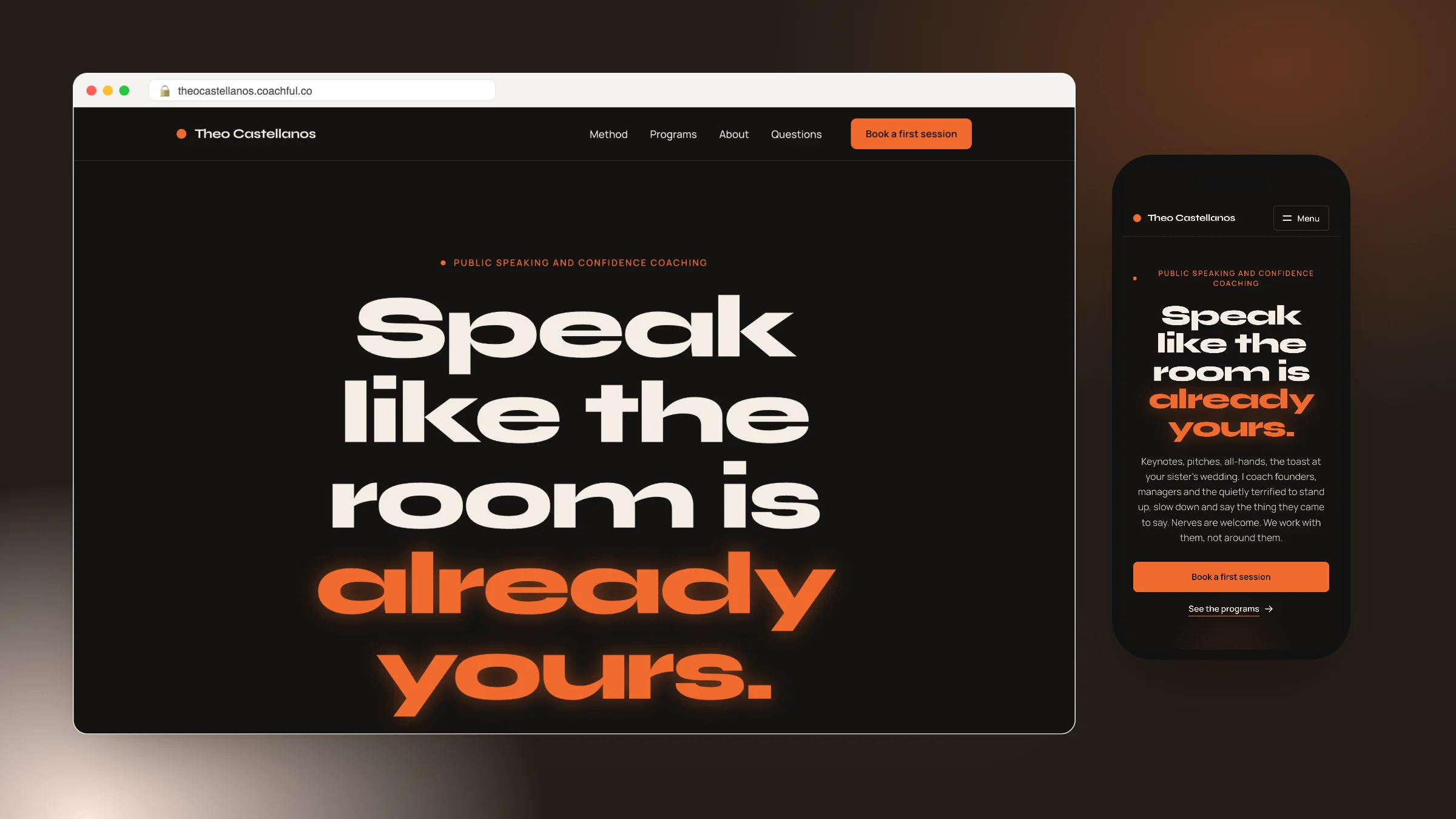
The sample template above, with a fictional speaking coach, shows what clarity looks like on a coach's website: who they coach (founders, managers and the quietly terrified), the kinds of talks and a first session to book.

Voice coaching is a neighboring specialty. A voice and communication coach, like the fictional one in this second template, works on breath, pace and pitch as well as the words.
Find a public speaking coach on Coachful
Coachful's Find a Coach directory is public, so you can browse without an account. Search "public speaking", "presentation" or "confidence" to find coaches whose headline or bio mentions them, or browse the Business and Mindset categories. The Find My Coach quiz asks what you want to improve, your preferred style and your monthly budget, and returns a shortlist.
On a profile, check the coach's background and method, look at any programs and prices, and book a discovery call from their calendar or send a message. Bring a two-minute version of your talk to the call and see what they notice.

Are you a speaking or confidence coach?
Coachful's page for confidence coaches covers its Confidence and boundaries edition, with a proof log and a courage ladder that fit graded speaking practice, and our guide to getting paid speaking engagements helps if you speak yourself. The team will build your website or program for you at no extra cost through the free white-glove service.
Frequently asked questions
What does a public speaking coach do?
A public speaking coach helps you structure talks, rehearse them out loud and improve delivery: voice, pace, body language and handling questions. Most sessions involve you speaking, often on video, then reviewing and changing one thing at a time. They also help you prepare so nerves matter less.
Is public speaking coaching worth it?
It usually is when you have an important talk or speak often for your career. Research shows practice with feedback reduces anxiety and improves how audiences rate presentations. If fear is severe enough to make you avoid situations, start with a therapist, then add coaching.
How much does a public speaking coach cost?
There is no published figure for public speaking coaching specifically. The nearest benchmarks in Coachful's 2026 Coaching Business Report are life coaching at $75 to $200 an hour when you pay, and executive coaching at $200 to $500 an hour when an employer pays for a leader.
Can a coach help with fear of public speaking?
For ordinary nerves, yes, mainly through preparation and graded practice. Fear that stops you functioning may be social anxiety disorder, which the National Institute of Mental Health says is best treated with cognitive behavioral therapy. A doctor can also discuss medication for performance anxiety.
How many sessions do I need?
For one important talk, three to five focused sessions in the weeks before is a common shape. For a broader goal, like presenting confidently at work, expect two or three months of regular practice.
Is Toastmasters as good as a coach?
They do different jobs. Toastmasters gives you regular practice and peer feedback at low cost, which builds comfort over months. A coach gives expert, individual feedback on a specific talk or goal. Many people use both.
Can I do public speaking coaching online?
Yes. Video sessions work well for structure, content and most delivery work, and recording is built in. Research also suggests practice delivered through technology works about as well as face-to-face for reducing fear.












