Secure Payment Solutions for Coaches: A Complete Guide

Coachful
You've just signed a high-value coaching client. The agreement is clear, the first session is booked, and the payment link is ready. Then the client pauses before paying and asks, “How secure is this?” You know your coaching process inside out, but payment security feels like a technical problem you're expected to solve alone.
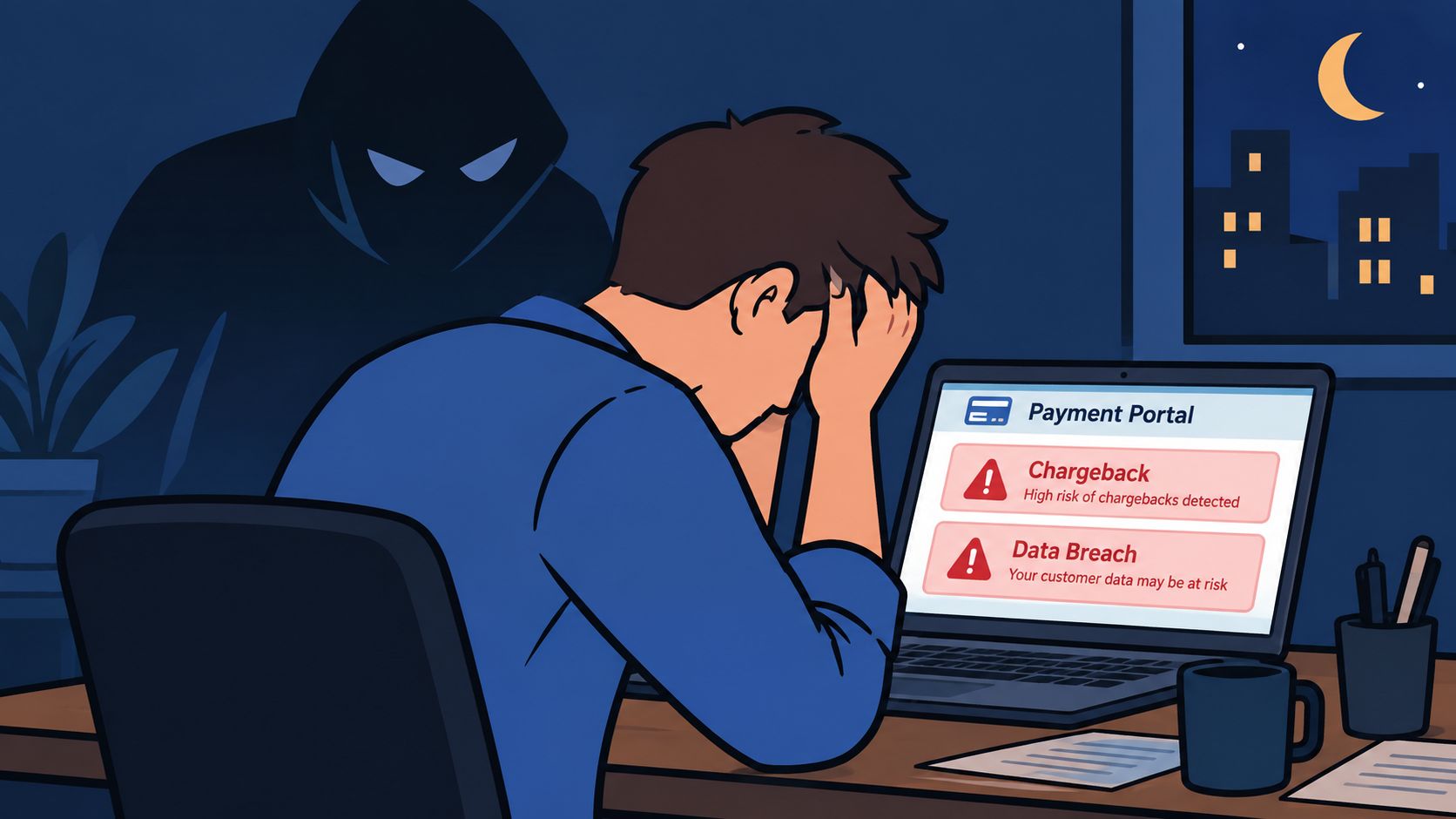
That anxiety is understandable. A payment issue can create more than an accounting headache. It can interrupt cash flow, consume hours in dispute management, expose sensitive customer data, and make a client question whether your business is professional enough to trust. The right secure payment solutions don't add complexity for its own sake. They remove payment data from places it shouldn't be, automate critical controls, and give clients a safer path to pay.
Why Payment Security Keeps Coaches Up at Night
A business coach once told me she lost a prospective client after sending an invoice from a generic payment tool. The client didn't accuse her of doing anything wrong. They just said they weren't comfortable entering card details into a process that didn't explain where the information went.
That moment stung because the coach had built trust carefully. She'd spent weeks creating content, holding discovery calls, and answering questions about the program. One uncertain checkout experience outweighed all of that work. The problem wasn't necessarily a breach. It was a trust gap.
The costs coaches rarely calculate
Payment security matters because coaches handle more than money. They handle names, email addresses, billing records, session details, program information, and sometimes sensitive personal or professional context. A weak payment setup can force you to spend time answering questions that a reputable processor should handle automatically.
Fraud pressure has also made secure acceptance a mainstream business requirement. One industry estimate valued the global payment security market at USD 34.8 billion in 2025, with a projection of USD 40.39 billion in 2026 and USD 145.91 billion by 2034, implying a 17.4% CAGR over that forecast period. The same estimate reported that North America held 35.8% of the market in 2025. Fortune Business Insights' payment security market analysis places this growth in the context of encrypted checkout, tokenization, fraud monitoring, and compliance-oriented workflows.
That scale tells you something practical. Payment security isn't a luxury reserved for banks or large online retailers. It's infrastructure for anyone collecting recurring payments, selling digital programs, or retaining client billing details.
Practical rule: Your clients don't need you to explain every security control. They do need a payment experience that looks deliberate, professional, and trustworthy.
Security can strengthen your positioning
A secure checkout gives you a useful business advantage. You can tell clients that card details are handled by a specialized payment provider rather than stored in your coaching workspace. You can provide clear receipts, defined refund terms, and consistent billing records. You can also point clients toward your broader data protection and compliance practices without turning the sales conversation into a technical lecture.
The emotional shift is important. Coaches often see security as a defensive expense, something they'll deal with after reaching a certain size. Clients experience it as evidence that you respect their money and privacy now.
Understanding Secure Payment Solutions Without the Jargon
You don't need to become a payments engineer. You need to understand the journey your client's information takes from checkout to settlement, and which parts your business should never control directly.
Think of the process as a coaching engagement with boundaries. You don't give every contractor access to private session notes. You use agreements, permissions, and secure systems to limit exposure. Payment security follows the same logic.
Encryption protects information in transit
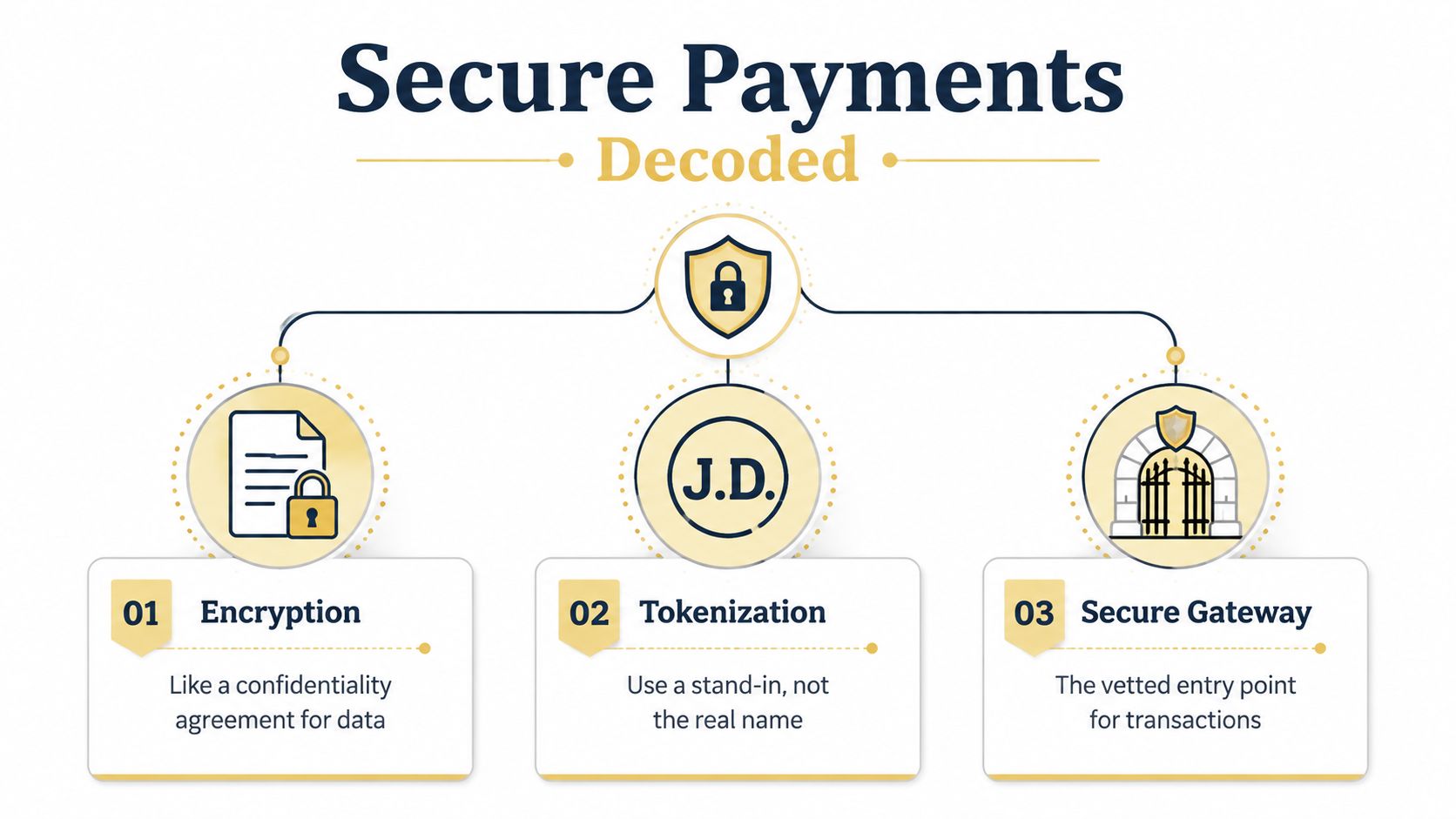
Encryption turns readable information into protected data while it travels between the client's browser, the payment page, and the payment provider. The simplest coaching analogy is a confidentiality agreement. The agreement doesn't make information disappear. It establishes rules that prevent unauthorized people from using what they shouldn't see.
When a client enters card details on a properly secured payment page, encryption helps protect those details as they move through the transaction. You should still check that your processor uses a hosted or properly embedded secure form, because encryption alone doesn't fix poor access controls or unsafe storage.
Tokenization replaces the valuable secret
Tokenization replaces the primary account number, or PAN, with a unique token. Use a coaching example: instead of keeping a client's full name and private background in every document, you might use initials such as J.D. The initials can help you identify the record in the right context, but they're far less useful to someone who obtains them without authorization.
EMVCo explains that payment tokens can be constrained to particular merchants, devices, or payment scenarios. Its guide to EMV payment tokenization notes that domain restrictions help protect transaction integrity and reduce fraud risk. For a coaching platform, the sensible design is to keep raw PANs out of your systems and use tokenized references for recurring charges, refunds, and dispute workflows.
The gateway is the controlled entry point
A secure payment gateway connects the checkout experience with the processor and financial institutions involved in authorization. It's the guarded entrance to your program. Clients enter through a vetted route, the system checks the transaction, and the funds move through the payment network without requiring you to handle raw card data.
A normal payment sequence looks like this:
- The client opens a hosted checkout. The payment provider controls the card-entry field.
- The client submits payment details. The information travels through an encrypted connection.
- The processor authorizes the transaction. The issuer and payment network assess whether the payment can proceed.
- Your platform receives a payment status or tokenized reference. It can trigger access, scheduling, receipts, or renewals without keeping the original card number.
That separation is the point. The fewer systems that touch raw card data, the smaller your exposure and the easier your operational responsibilities become.
PCI-DSS and Security Standards That Actually Matter
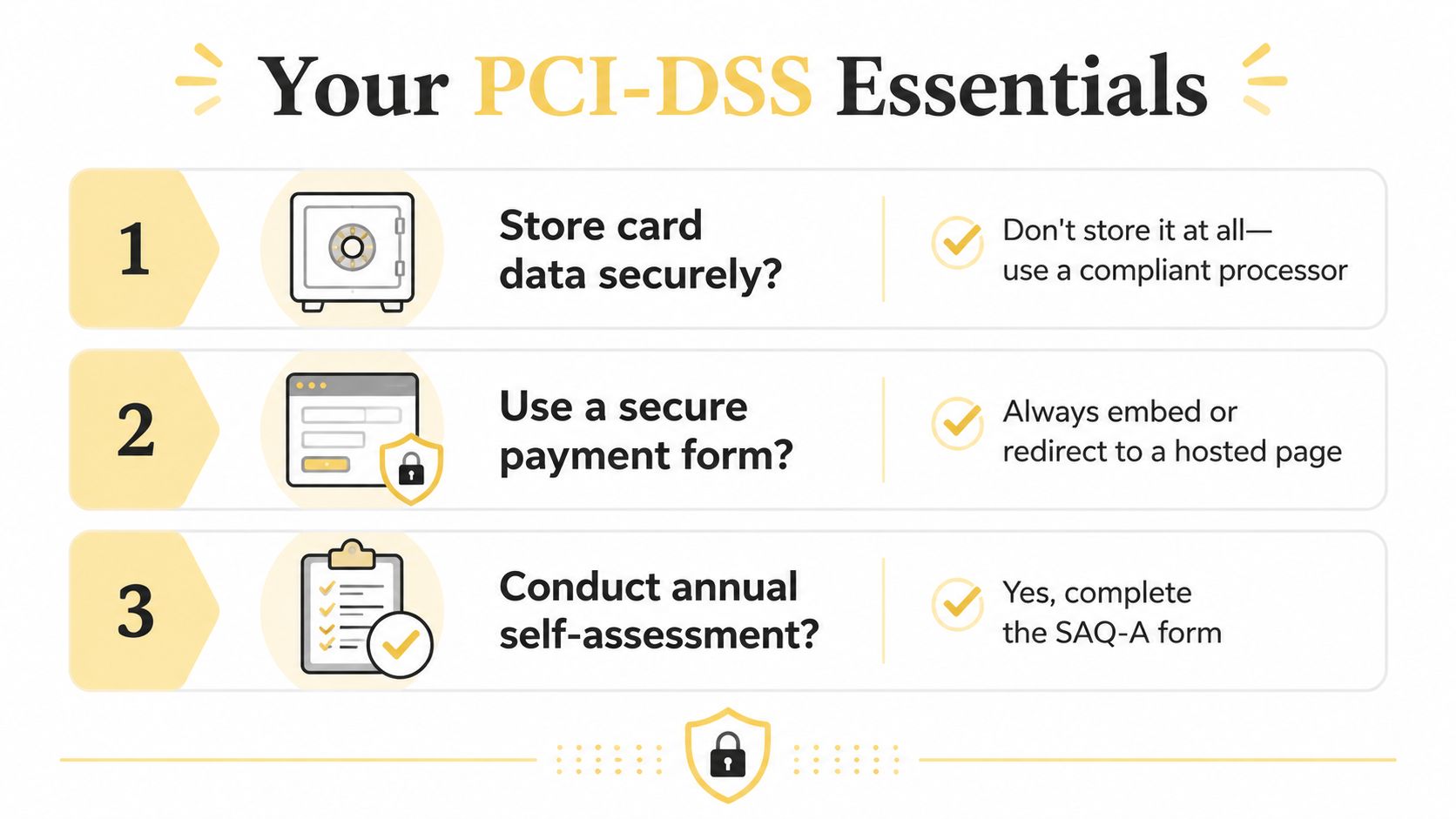
PCI DSS is the payment-card security standard that determines how organizations protect cardholder data. PCI DSS v4.0.1 is active, and as of March 31, 2025, all requirements, including those previously treated as future-dated, became mandatory for merchants and service providers that store, process, or transmit cardholder data. ChargeMate's PCI DSS and chargeback overview summarizes the practical consequence for businesses using saved cards, subscriptions, and invoices.
For a solo coach, the question isn't “How do I become a security company?” It's “Does my workflow make my business responsible for card data, or does a compliant processor handle that exposure?”
The setup matters more than your business size
A coach who sends clients to a processor-hosted checkout generally has a simpler compliance position than a coach who collects card numbers through email, stores them in a spreadsheet, or enters them manually into multiple tools. An agency managing several coaches needs stronger permission controls, vendor oversight, and documented procedures because more people and systems may interact with payment workflows.
Use this checklist when reviewing your current setup:
- Card data storage: You shouldn't store raw card numbers in notes, spreadsheets, inboxes, or client records. Use a compliant processor and tokenized references instead.
- Payment forms: Send clients to a hosted payment page or use a properly secured embedded form. Don't build an improvised card-entry form.
- Access permissions: Limit payment administration to people who need it. A coach who only needs to see whether an invoice is paid doesn't need access to complete card details.
- Vendor documentation: Ask your processor what compliance responsibilities it covers and what actions remain yours.
- Self-assessment: Confirm which self-assessment questionnaire applies to your setup and complete it when required.
The operational question is simple: Does your payment process keep card data out of your coaching business wherever possible?
Compliance also supports client confidence. If you want a plain-language explanation of how security practices build client trust with security, use it to improve your client-facing explanations rather than overwhelming prospects with technical terms.
If your coaching business uses a secure client workspace, review whether payment access and client information are separated appropriately. A secure client portal setup can help you keep onboarding, communications, documents, and payment-related workflows organized without scattering sensitive information across unrelated tools.
Fraud Protection Strategies for Coaching Businesses
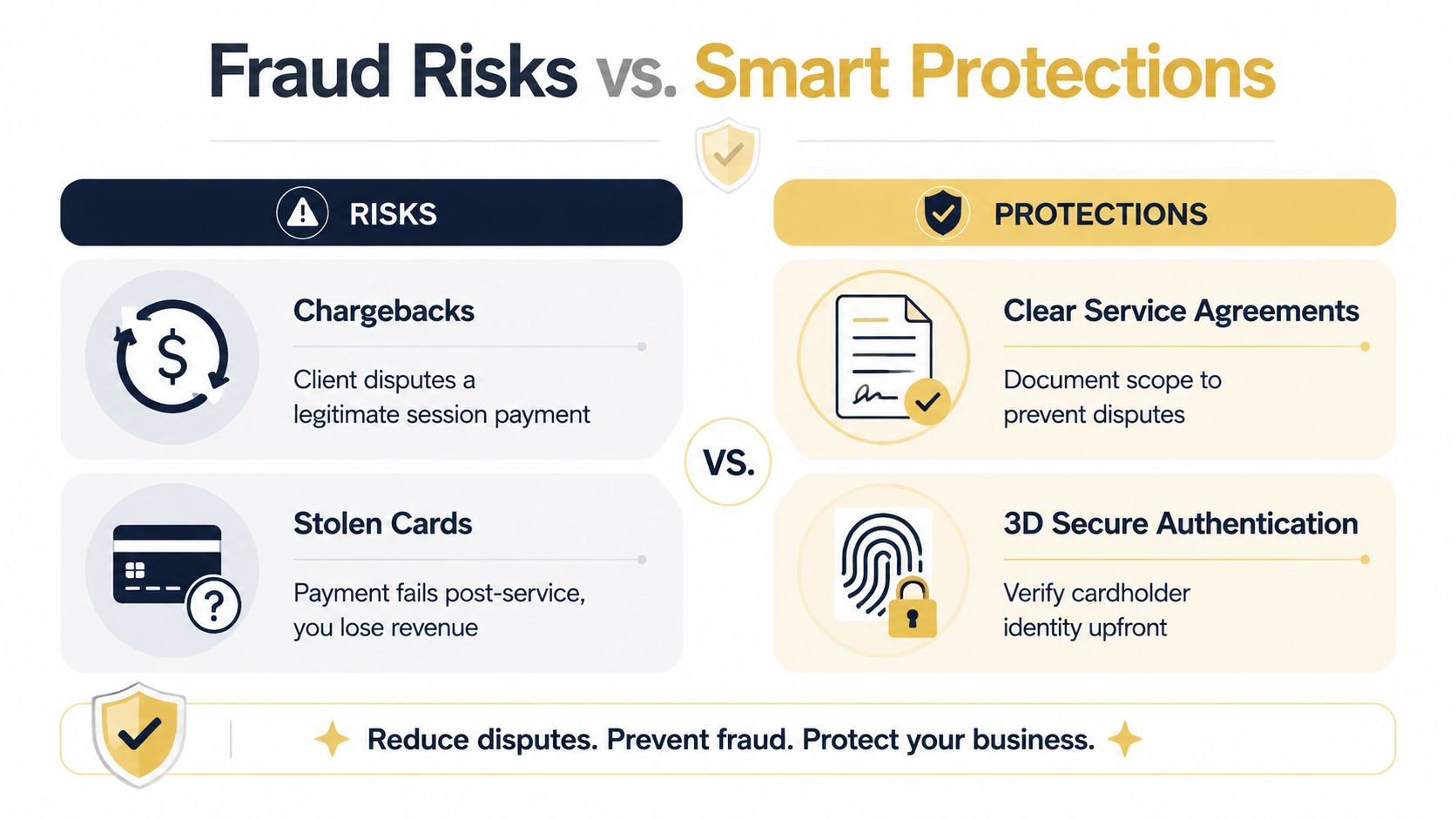
Coaching businesses face a different fraud pattern from ordinary retail. You may sell a high-ticket package, accept a deposit before a discovery process is complete, offer recurring membership access, or invoice a client for work delivered through calls and digital resources. The service can be legitimate, yet the payment can still become disputed later.
The strongest approach combines preventive controls with clear evidence. Don't force every client through the same gauntlet. Add friction when risk justifies it, and keep ordinary payments simple.
Match the control to the risk
| Risk | What it looks like in coaching | Practical protection |
|---|---|---|
| Chargeback | A client disputes a legitimate session or claims they didn't recognize a renewal | Use a signed service agreement, clear billing descriptors, attendance records, receipts, and documented refund terms |
| Stolen card | Payment succeeds, the program begins, and the issuer later reverses the transaction | Use processor risk checks, review unusual transactions, and delay high-value access when the payment signal is unclear |
| Account takeover | Someone gains access to a client account and changes billing or contact details | Require secure account recovery, notify clients about profile changes, and review unusual login or payment activity |
| Social engineering | A client is persuaded to approve a payment or follow a fake renewal link | Use verified payment links, payee confirmation, and scam-aware messages that never pressure clients to act urgently |
Use 3-D Secure selectively
EMV 3-D Secure adds a card-not-present authentication layer. It exchanges transaction, payment-method, and device information between the merchant and issuer to authenticate the consumer and reduce fraud risk. EMVCo explains that 3DS can work with tokenization and EMV Secure Remote Commerce, while the EMV 3-D Secure transaction guidance describes how risk-based decisions can preserve a smoother checkout.
For a low-risk recurring renewal, frictionless approval may be appropriate. For a new, high-value program purchased from an unusual device or location, an authentication challenge can be justified. Your goal isn't to interrogate every client. It's to verify the transactions most likely to create a loss.
Don't ignore scams after checkout
Network controls are improving, but customers can still be manipulated into authorizing payments. Visa reported that scams were the fastest-growing source of consumer harm, with nearly $1 billion in scam-related activity in the second half of 2025, while token-related fraud fell 9.6%. Visa's Fall 2025 security and trust report highlights why payment protection now needs a human-behavior layer.
Tell clients how you'll contact them about renewals. Put your official payment domain in onboarding materials. Ask clients to verify the payee before approving an unusual invoice. Security should make the legitimate path obvious.
Addressing the Real Objections Coaches Have About Payment Security
“I'm too small to be targeted.”
Attackers don't need your business to be famous. They look for weak processes, exposed credentials, reused passwords, and inconsistent payment handling. A solo coach who stores card details in a spreadsheet may create a more attractive opportunity than a larger business with specialized controls.
“My clients will hate the extra steps.”
They might hate unnecessary steps. That's different from objecting to a familiar authentication prompt when a transaction looks unusual. EMV 3-D Secure supports risk-based authentication, so the processor and issuer can determine when friction is needed rather than forcing every client through the same challenge.
“It's too complicated.”
It becomes complicated when you assemble the payment stack yourself. It's much simpler when you use a processor-hosted checkout, tokenized references, role-based access, documented agreements, and automated receipts. Your job is to choose a sound architecture and follow basic operating rules. Your job isn't to store card data or manually investigate every authorization.
“It costs too much.”
Compare the recurring cost with the work you already absorb. A dispute can require reviewing agreements, gathering attendance records, explaining the service, responding to the processor, and managing the client relationship. A breach or compromised account can create a much more serious trust problem. You don't need a perfect enterprise system, but you do need to stop treating insecure shortcuts as free.
Chargebacks are also a growing industry problem. Mastercard's 2025 Global Chargebacks Outlook projects 261 million global chargeback transactions in 2025, rising to 324 million by 2028. The same outlook projects total chargeback value increasing from about $33.8 billion to $41.7 billion over that period. Those are market projections, not a prediction of your own dispute volume, but they reinforce the business case for prevention and evidence.
The answer to every objection is the same: reduce the amount of sensitive data you handle, apply friction only when risk warrants it, and select a provider that carries the technical burden.
Integrating Secure Payments with Your Coaching Platform
Start with the client journey, not the integration menu. Map how a client discovers your offer, books a call, signs an agreement, pays, receives access, renews, requests a refund, and exits the program. Security fails when payment is treated as an isolated button rather than part of that complete workflow.
Build around the billing model
For recurring coaching, use tokenized billing references and clear renewal notifications. The platform should trigger charges through the processor without exposing the underlying card number to you or your team.
For payment plans, define what happens when a payment fails. Don't immediately revoke every resource or send a threatening message. Give the client a secure update path, preserve an audit trail, and make the next action obvious.
For group programs, confirm that payment status controls access consistently. A participant shouldn't receive a private onboarding link from one system, a community invitation from another, and an invoice from a third unless those systems share reliable status information.
International clients need clear currency, refund, tax, and payment-method communication. Don't promise a payment method until you've confirmed that your processor and business location support it.
Ask vendors direct questions
Ask whether the provider stores raw card data or uses a tokenized processor reference. Ask who manages PCI responsibilities, how failed renewals are handled, whether refunds and disputes are recorded, and what permissions your team can assign. Also ask how the system logs payment changes and what happens if you need to suspend access quickly.
Red flags include collecting card numbers through email, requiring staff to copy card details between tools, unclear ownership of compliance tasks, and payment links that don't clearly identify the business.
Coachful is one option for consolidating coaching workflows. Its product information describes a branded Stripe checkout with payment plans, subscriptions, refunds, coupons, and invoices, with Stripe Connect handling payment processing and card data managed by Stripe. It also supports collecting payment at booking through built-in Stripe billing for paid one-to-one booking links and consultation calls. You can review the platform's coaching payment software when comparing how payment fits alongside onboarding and scheduling.
Your Implementation Roadmap for Secure Payment Solutions
Use a phased rollout so security doesn't become another abandoned project.
First, audit the current path. List every place payment information enters, travels, or gets stored. Remove card details from notes, email threads, spreadsheets, and informal records. Identify who can issue refunds, change billing details, and view payment status.
Next, choose the processor architecture. Prefer a hosted checkout or secure embedded form, tokenization, risk monitoring, receipts, dispute support, and configurable authentication. Ask the provider to define your remaining PCI responsibilities in writing.
Then, configure and test. Run successful payments, failed payments, refunds, renewals, plan changes, and disputed transactions. Confirm that access changes correctly and that clients receive understandable notifications.
Finally, communicate the upgrade. Tell clients that card details are handled through your payment provider, explain where official payment links come from, and state that you'll never ask them to send card information by email. Review chargebacks, failed payments, suspicious activity, and client questions regularly.
Your first priority is reducing exposure. Your second is making the legitimate payment path easy to recognize. Your third is documenting enough evidence to resolve disputes without reconstructing the entire client relationship from memory.
Coachful brings onboarding, scheduling, messaging, progress tracking, and payment workflows into one coaching workspace, with Stripe-based payment handling for plans, subscriptions, refunds, invoices, and booking payments. Visit Coachful to evaluate whether a more connected payment workflow can reduce administrative risk while giving clients a clearer, more professional way to pay.