
How to Ask for the Sale: A Coach's Complete Playbook

Coachful
You finish a discovery call feeling that familiar mix of relief and frustration. The client was engaged. They opened up. They said your framework made sense. Then the call drifted into a soft ending. “Let me think about it.” “I'll circle back.” “This was really helpful.”
And now you're sitting there wondering whether you served them well, or just donated free coaching because you were too uncomfortable to ask for the sale.
That tension is common for coaches. You care about ethics, trust, and transformation. You don't want to sound manipulative. You don't want your client to feel cornered. But avoiding the ask doesn't make you more authentic. It often makes you less helpful. A client who needs structure, accountability, and support can't benefit from a program they never join.
The strongest sales conversations in coaching don't feel like “selling” in the old sense. They feel like clarity. They feel like a clean decision point. They help the right client move forward, and they help the wrong client say no clearly. That's the essential job.
From Awkward to Authentic The Mindset for Selling Coaching
If asking for the sale makes your chest tighten, the problem usually isn't technique first. It's meaning.
Many coaches equate sales with pressure. In their head, “asking for the sale” means forcing, convincing, or performing certainty they don't fully feel. So they over-explain, over-coach on the call, and wait for the prospect to volunteer the next step. Most won't.

The cost of hesitation is real. 48% of sales calls end without any attempt to close, and 35-50% of all sales go to the first person who explicitly asks. That doesn't mean the first person who pressures wins. It means the first person who creates clarity often wins.
Selling is not separate from coaching
A good coaching conversation helps someone tell the truth about where they are, where they want to go, and what it will take to bridge the gap. A good sales conversation does the same thing.
The only added element is commitment.
When you believe in your process, asking for the sale isn't self-serving. It's the moment you stop being interesting and become useful. You're offering a real container for change instead of leaving the person with insight and no structure.
Practical rule: If you can clearly help and you stay vague about the next step, you're protecting yourself, not serving the client.
That distinction matters. Coaches often say, “I didn't want to be pushy.” Usually what they mean is, “I didn't want to feel rejected.” That's human. It's also fixable.
The inner dialogue that blocks the ask
Here's what usually runs under the surface during a call:
“I'm a coach, not a salesperson.”
You're both. If you run a coaching business, enrollment is part of ethical practice.“If they want it, they'll ask.”
Many thoughtful buyers won't. They want leadership, not pressure. There's a difference.“I need to give them more value first.”
More value often becomes more avoidance. Discovery calls are for diagnosis, fit, and decision, not unpaid transformation.“What if they say no?”
Then you have useful information. A direct no is cleaner than a vague maybe that lingers for weeks.
Confidence comes from congruence
Your confidence in asking rises when three things line up:
- You know the problem you solve
- You can explain your process clearly
- You believe the client needs commitment, not just insight
If one of those is shaky, the ask feels awkward because part of you isn't convinced yet. The fix isn't hype. It's sharper thinking. Clarify who your program is for, what outcome it supports, and what kind of person gets the most from it.
A coach who thinks, “I hope they buy,” sounds tentative. A coach who thinks, “I can help if this is a fit,” sounds grounded.
Asking for the sale is not asking someone to rescue your business. It's inviting them to act on a problem they already said they want to solve.
That's the mindset shift. Not transaction, but enrollment. Not pressure, but leadership. Not “please say yes,” but “if we both agree this is right, let's move.”
Spotting the Green Light When to Ask for the Sale
Timing changes the entire emotional feel of the ask. Ask too early and the client feels rushed. Ask too late and the energy collapses into polite ambiguity.
Most coaches don't need better instincts as much as they need better markers. When you know what to listen for, the moment becomes much easier to recognize.
What readiness sounds like
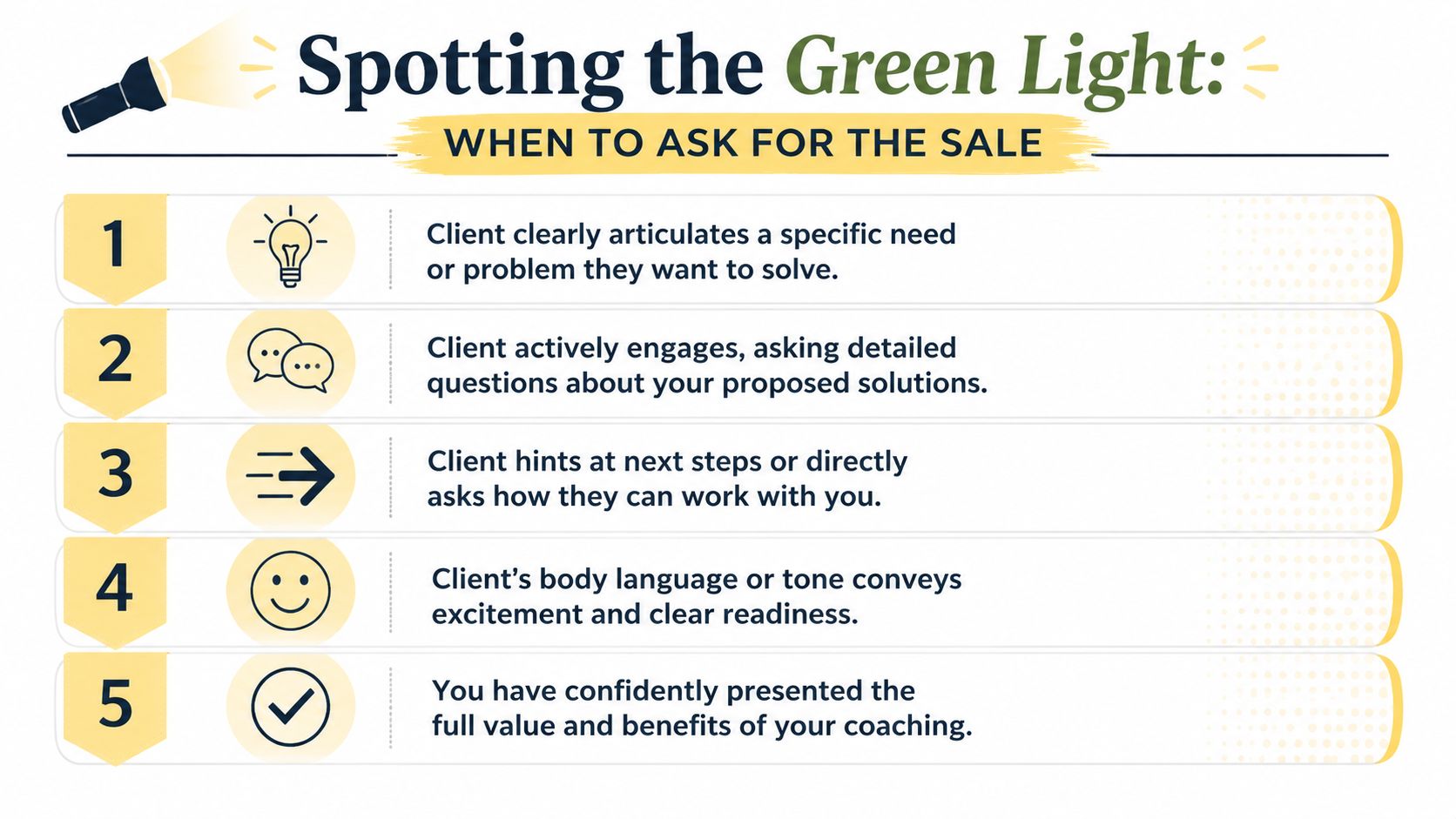
The green light usually appears in language before it appears in a direct yes.
Look for signals like these:
Specific pain replaces vague dissatisfaction
“I'm tired of spinning my wheels” becomes “I keep avoiding hard conversations with my team, and it's affecting performance.”Their words shift from curiosity to ownership
They stop asking abstract questions and start saying things like, “How would this work for my situation?”They ask logistics questions
Start dates, session cadence, message support, onboarding, and structure questions often signal mental movement toward a decision.They reference outcomes in concrete terms
“If I could handle this before the next quarter, that would change a lot.”
That last line matters because urgency is not optional. A sale needs a reason to happen now. One useful benchmark from Great America's guidance on sales prerequisites is to help the client identify the negative implications of not solving the issue and confirm whether it needs to be fixed within the next quarter.
What readiness looks like
On video, body language adds useful context. None of it should be treated as proof by itself, but patterns help.
Watch for:
- Leaning in when you describe the process
- More nodding or visible relief when you summarize their problem accurately
- Longer answers instead of short, guarded responses
- A warmer tone when discussing next steps
- Less defensive language and fewer disclaimers
Non-verbal cues matter because they often reveal concern, interest, or hesitation that words alone won't show. If you notice mixed signals, name them gently instead of guessing.
The value realization moment
The cleanest time to ask is right after the client verbalizes a benefit in their own words. That's the moment they stop merely understanding your offer and start imagining themselves inside it.
For example:
You ask, “What would change if this pattern stopped driving your week?”
They answer, “I'd have more energy, I'd stop second-guessing everything, and I'd finally make decisions without spiraling.”
That's not the moment to launch into another ten-minute explanation. It's the moment to anchor the value and transition.
When the client says the outcome out loud, they're often closest to commitment.
Use a simple three-part transition:
Validate progress
“That's helpful. You've gotten very clear on what's draining you.”Name the gap
“Right now you can see the pattern, but you don't yet have a structure to interrupt it consistently.”Ask for a specific next step
“Would you like to work on this together in the next program block?”
A simple call checklist
Keep this in front of you during discovery calls:
Need is clear
They've named a real problem, not just a preference.Consequences are visible
They understand what happens if nothing changes.Timing matters
There's a reason to act soon, not someday.Fit is established
You've explained your process and confirmed it matches what they need.They've expressed value in their own words
This is often the trigger point for the ask.
If those boxes are checked, ask. Don't wait for a perfect cinematic moment. In coaching sales, the green light often looks like a client feeling seen, understood, and ready for structure.
Proven Scripts to Confidently Ask for the Sale
Most fear around sales is really fear around wording. When you don't know how to phrase the transition, you ramble. When you ramble, the client senses uncertainty. Then both of you feel awkward.
The answer isn't a robotic script. It's a set of phrases that sound natural inside a coaching conversation.
A good place to start is with language that keeps the focus on the client's challenges and fit. Questions like “How do you see our service addressing these challenges?” and framing such as “From what you've shared, it seems like our solution could be a strong fit. Would it make sense to discuss the next steps?” help you ask for the sale without sounding pushy, as outlined in Showell's examples of sales questions and phrases.
For extra prep before your calls, it helps to keep a working discovery call script nearby so you don't have to improvise every transition.
On a video call
Video calls are where many coaches either under-ask or over-talk. The middle path is simple and direct.
Scenario: A leadership coach has just heard a prospect describe recurring conflict with a senior team member.
You might say:
“You've been clear about the pattern. You're avoiding the conversation, and it's affecting team trust. From what you've shared, it seems like my coaching could be a strong fit. Would it make sense to discuss the next steps?”
That works because it follows the client's own language. It doesn't introduce pressure. It closes the gap between insight and action.
If the prospect is warm but hesitant, use an options close:
“Based on what you want, I see two paths. We could start with a shorter sprint focused on this immediate leadership issue, or a longer engagement that also supports delegation and team communication. Which feels like the better fit right now?”
This is useful because it moves the conversation from “whether” to “which,” without becoming presumptive in an arrogant way.
On the phone
Phone sales require cleaner language because you lose visual feedback. Keep the ask short and specific.
Scenario: A health coach is speaking with someone who has described inconsistent habits and low accountability.
Try:
“You've said you don't need more information. You need support following through. I can help with that. Are you ready to commit to the coaching plan we discussed?”
That closed-ended question matters. If you ask, “What do you think?” you'll often get a reflective but noncommittal answer. If you ask, “Are you ready to commit?” you create a decision point.
If that feels too abrupt, soften the entry but not the decision:
“I want to keep this straightforward. I believe this is a fit. Are you ready to get started?”
In a follow-up email
Email should move the prospect one step closer to a decision. It shouldn't read like a nervous nudge.
Example follow-up after a strong discovery call:
Subject: Next steps on your coaching support
Hi [Name],
It was good to speak with you today. You were clear about the challenge: you're carrying a lot of responsibility, but you don't have a consistent process for making decisions without overthinking them.
From what you shared, it seems like my coaching could be a strong fit. We discussed focusing on decision-making, boundaries, and follow-through over the next phase.
Would it make sense to discuss the next steps and get your first session scheduled?
Best, [Your Name]
That email works because it reflects their words, names the value, and ends with a low-friction ask.
Three closes that work well for coaches
The direct question
Best when fit is obvious and the client is circling.
Example: “Are you ready to move forward with the three-month plan?”The options close
Best when the client is deciding between formats.
Example: “Would weekly sessions or twice-monthly sessions support you better right now?”The assumptive next step
Best when the prospect is already leaning in.
Example: “The next step would be onboarding and scheduling your first session. Does that work for you?”
The strongest script is often the shortest one you can say without tension in your voice.
What doesn't work
Coaches often drift into phrases that sound polite but kill momentum:
- “No pressure at all, just let me know.”
- “Take all the time you need.”
- “I know this is a lot.”
- “I just wanted to offer this in case it helps.”
Those lines usually come from your discomfort, not the client's needs. They create emotional distance right when the client needs a clear invitation.
A stronger approach is calm, respectful, and definite. Name the fit. Ask the question. Let silence do its job.
Navigating No and Not Yet Handling Client Objections
Objections aren't proof that you failed. They're proof that the client is still processing risk.
When a prospect says, “It's expensive,” “I need to think about it,” or “I need to talk to my spouse,” the worst move is to argue. The second worst is to retreat and say, “Of course, no worries,” without learning anything. Good coaches stay curious.
One useful pattern here is the feedback loop. Top coaches who use a direct ask combined with a feedback loop such as “I hear you saying X, does that mean you're ready to proceed?” close deals twice as fast and achieve a 47% success rate with immediate referral requests. The point isn't to force agreement. It's to verify what the client means before you respond.
The Hear Validate Reframe Respond method
Use this sequence:
Hear
Let them finish. Don't jump in to solve too early.Validate
Acknowledge the concern without surrendering the conversation.Reframe
Clarify what the objection really points to.Respond
Offer the next useful question or decision point.
A calm objection conversation feels more like coaching than closing.
Common objection handling for coaches
| Client Objection | What It Really Means | Empathetic Response Template |
|---|---|---|
| I need to think about it | I'm interested, but I'm uncertain about fit, timing, or risk | “That makes sense. What part do you need to think through most right now?” |
| It's too expensive | I'm weighing value, affordability, or fear of not following through | “I understand. When you say expensive, are you concerned about the investment itself, or the cash flow right now?” |
| I don't have time | I doubt I can sustain the process | “That's real. Is the concern the time for sessions, or the energy to implement between them?” |
| I need to talk to my spouse | I want support in the decision, or I'm using this as a pause | “Completely fair. What would they need to feel confident about this decision?” |
Price objection
Price objections are rarely about the number alone. They usually mix money with uncertainty.
If a client says, “This is more than I expected,” don't defend your rate immediately. First narrow the issue.
Say:
“I get that. Is the main concern the total investment, or whether this is the right time to make it?”
That question separates affordability from conviction. If the issue is timing, you can discuss pacing or start date. If the issue is value, return to the cost of staying stuck and the specific outcome they want.
Time objection
Time objections often mean, “My life already feels full, and I'm afraid this will become another thing I fail at.”
Respond with empathy, then define the ask:
“I understand. Usually the question isn't whether you have unlimited time. It's whether solving this matters enough to make space for it. What would have to change for this to feel manageable?”
That keeps dignity in the conversation. You're not shaming them for being busy. You're helping them weigh priorities fairly.
Spouse or partner approval
Sometimes this is genuine. Sometimes it's a socially acceptable way to delay.
The right response is respectful and specific:
“That makes sense. What part of the decision do you think they'll want clarity on most?”
If they can answer, the objection is workable. If they stay vague, the underlying issue may be internal hesitation.
For coaches who want more language around these conversations, this guide on how to improve your B2B sales approach gives additional objection-handling angles that are useful even outside formal B2B settings.
A feedback loop example
Suppose a prospect says, “I'm interested, but I'm not fully sure.”
You might respond:
“I hear you saying the coaching feels relevant, but you're not fully settled on moving now. Does that mean you need more clarity on the process, or that the timing feels off?”
That question lowers defensiveness because you're not pushing for a yes. You're helping them locate the actual friction.
And once friction is visible, you can respond like a coach instead of reacting like a nervous seller.
The Follow-Up Cadence That Converts
You finish a strong discovery call. The prospect sounds relieved, says the offer fits, and asks you to send details. Then nothing happens for a week.
That silence rattles a lot of good coaches. They start wondering whether one more email will feel pushy, so they wait. By the time they reach out again, the prospect has dropped back into routine and the urgency is gone. The missed sale usually comes from a weak follow-up process, not from a bad call.
A useful cadence gives the client structure after the conversation. That matters in coaching because people often say yes emotionally before they are ready to say yes administratively. They still need time to sort out schedule, money, energy, and commitment. Your follow-up should help them decide with clarity, not leave them alone with vague good intentions.
What follow-up is supposed to do
Each message should earn its place. Send it for one clear reason:
- Clarify the problem, goal, and offer discussed on the call
- Add context that helps them evaluate fit
- Reduce friction around the next step
- Prompt a decision with a simple reply or action
That is also why building a coach email list matters. Some prospects are a fit now. Others need more time and more trust before they are ready to buy. A consistent email relationship keeps the conversation warm without turning every touchpoint into a sales chase.
A practical cadence for coaching sales
Use a short sequence over two weeks. Long enough to stay present. Short enough to keep momentum.
Day 1 or 2
Send a recap while the call is fresh. Reflect back their goal, the obstacle they named, and the coaching path you recommended.
Day 4 or 5
Send one useful asset tied to the conversation. A short voice note, a relevant article, a worksheet, or a brief case example works well. Keep it specific to the friction they named.
Day 7 or 8
Ask the decision question directly.
“After sitting with this for a few days, what feels most open for you, moving ahead, waiting, or deciding this is not the right fit?”
Day 11
Handle the remaining friction. Explain one practical point that often slows people down, such as onboarding, session cadence, support between calls, or payment structure.
Day 14
Close the loop cleanly. Invite a yes, a no, or a later check-in date.
Coaches who struggle with this usually have one of two problems. They either follow up too vaguely, or they send the same nudge three times in different wording. Good follow-up has progression. Each message should move the prospect closer to a clear decision.
If you want examples of timing and sequencing, this guide to effective cold outreach follow-ups is useful for structure. The context is colder than a coaching inquiry, but the pacing principles still apply.
Two email templates
Follow-up recap
Subject: Your next step on [goal]
Hi [Name],
I enjoyed our conversation. You said the main challenge right now is [problem], and that solving it would help you [desired outcome].
Based on what you shared, I believe [offer or coaching format] is the right next step because it would help you [specific result]. If you want to talk through fit, timing, or logistics, reply here and I'll help you sort that out.
Best, [Your Name]
Close-the-loop email
Subject: Closing the loop
Hi [Name],
I wanted to close the loop on our conversation.
If you want to move forward, I can send the next step today. If the timing is off, or you've decided not to do this, that is completely fine too. A simple reply is enough: yes, no, or later.
Best, [Your Name]
The mindset matters here. Follow-up is not pressure. It is part of service.
A prospect who needs coaching often also needs help making a clean decision. When you treat follow-up as a coached decision process, asking again stops feeling awkward and starts feeling professional.
Embedding Your Sales Flow into Your Coaching Practice
Sales gets lighter when it becomes operational instead of emotional. If every lead lives in your head, every follow-up feels loaded. If your process lives in a system, the ask becomes one step in a workflow.
That matters because coaching businesses often break down at the handoff points. The coach has a strong conversation, then forgets to send the proposal. Or sends it, but doesn't track whether the prospect viewed it. Or means to follow up, then loses the thread after a full week of client sessions.
Build a simple pipeline
Keep your sales flow visible. It doesn't need to be elaborate.
A practical pipeline might include:
Initial contact
Someone inquires, replies to content, or books a call.Discovery scheduled
You know the date, context, and likely need.Offer discussed
The prospect heard the recommendation and the decision point is active.Proposal or payment link sent
The next step is explicit.Won or not now
Every lead reaches an outcome.
If you want a broader framing for how these stages fit together, this explanation of a sales process is a useful reference. It helps you think in stages instead of isolated conversations.
Store the assets that reduce hesitation
The coach who sells calmly usually isn't winging it. They have repeatable materials.
Store and reuse:
- Discovery questions that surface need, urgency, and fit
- Ask scripts for direct closes, options closes, and follow-up emails
- Objection notes so you don't personalize every hesitation
- Onboarding templates for agreements, payment, and scheduling
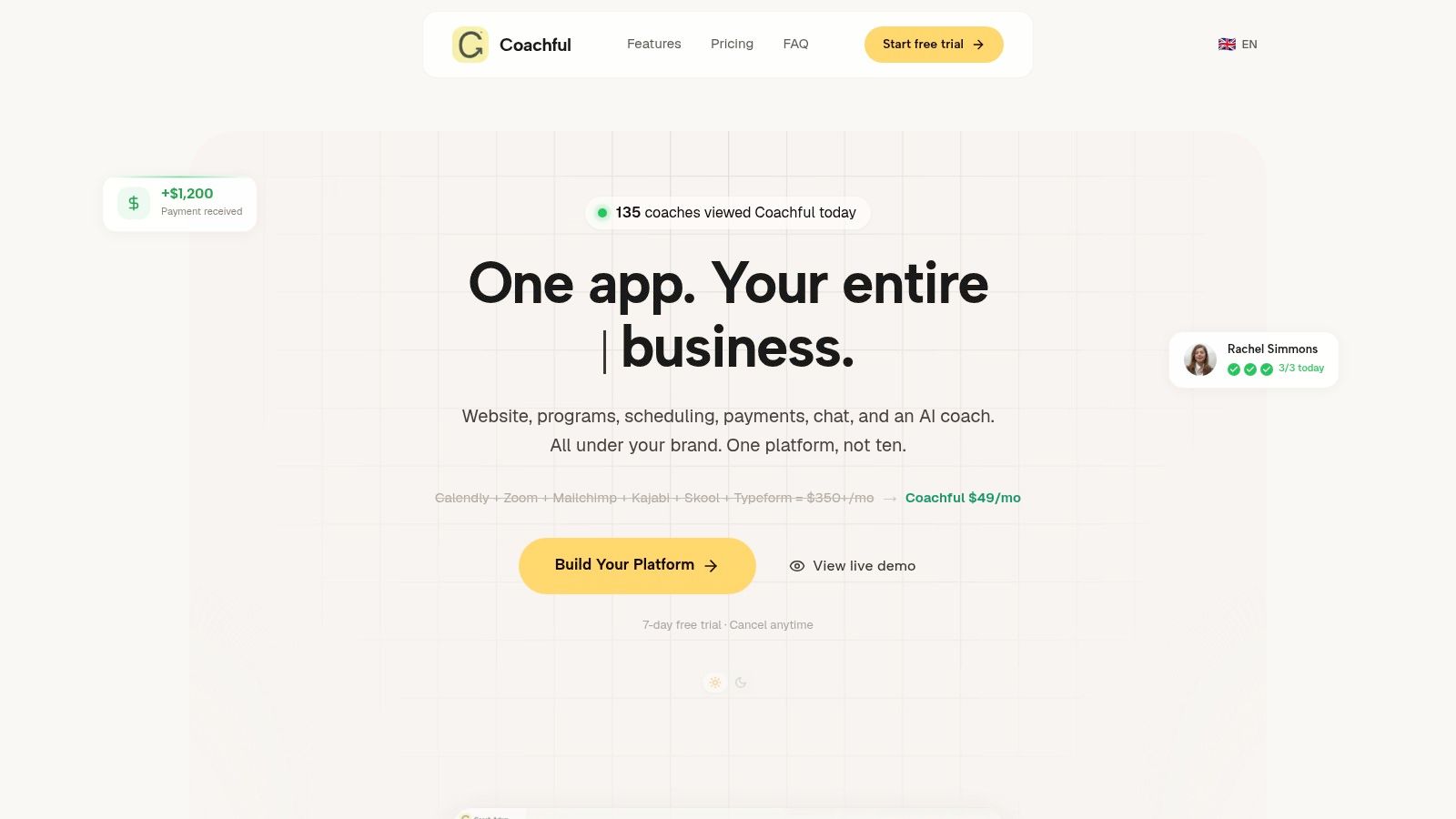
One option for doing this inside a coaching workflow is Coachful, which supports onboarding, payments, reminders, and client progression in one place. Used well, that means you can move a prospect from conversation to agreement and first payment without switching across scattered tools.
A short walkthrough makes the operational side easier to picture:
Reduce decision fatigue for yourself
The hidden benefit of a system is psychological. You stop asking, “How should I handle this person?” every single time.
Instead, you ask better questions:
- What stage are they in?
- What decision is pending?
- What message fits this stage?
- What reminder needs to be triggered if they don't reply?
That shift matters. It protects your energy. It also makes your client experience cleaner, because prospects feel held in a process rather than dropped into improvisation.
When asking for the sale becomes part of your practice rhythm, it stops feeling like a character test. It becomes a normal extension of good coaching, clear communication, and consistent follow-through.
If you want a cleaner way to turn discovery calls into paid engagements, Coachful gives you one place to manage onboarding, collect payments, track follow-ups, and keep your sales flow connected to the rest of your coaching work.