Boost Success: Assessing a Community Effectively

Coachful
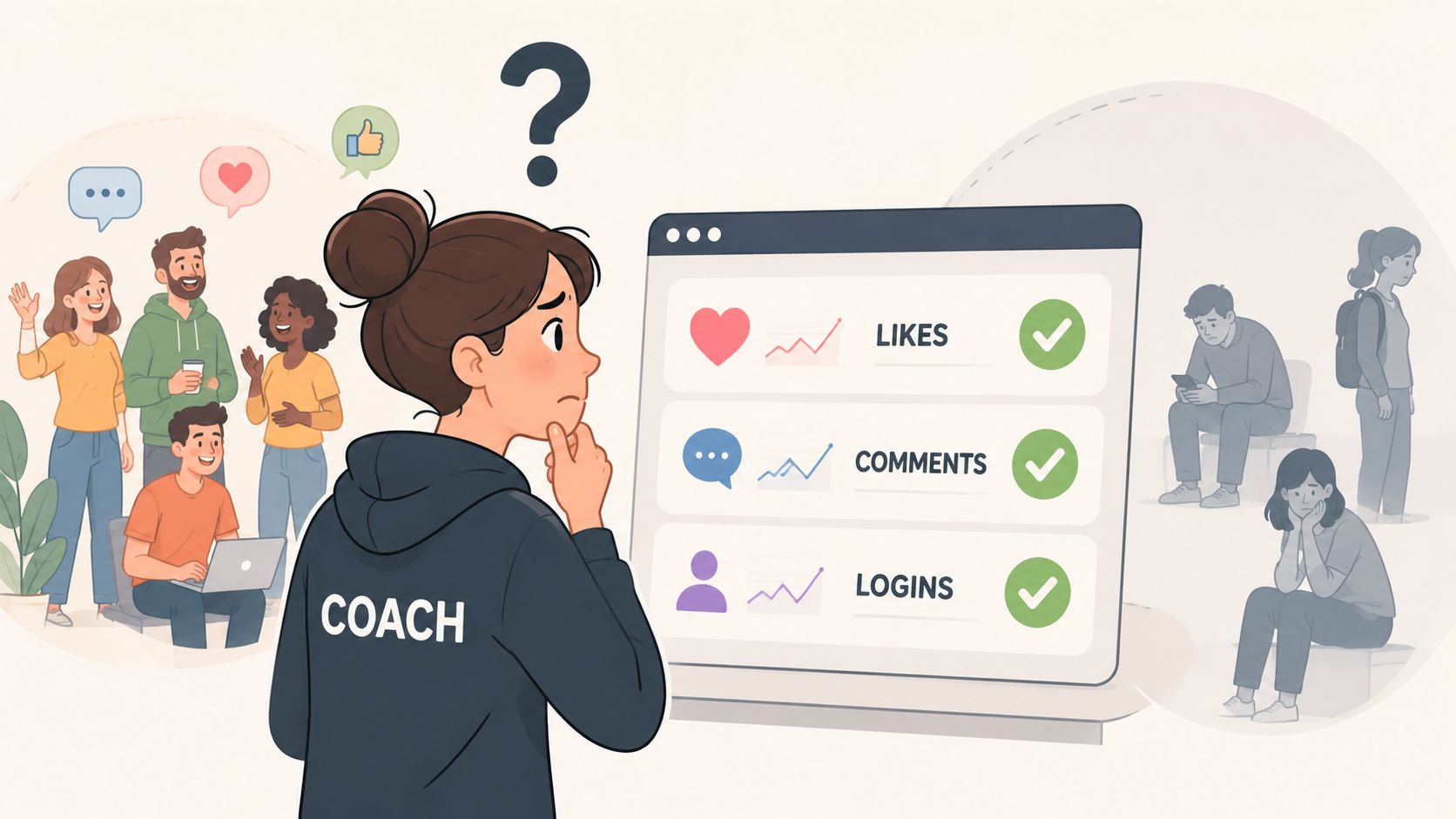
You open your community platform in the morning and the signs look fine at first glance. People reacted to yesterday's post, a few members commented, and several logged in overnight. But the question that keeps following coaches around isn't “Is there activity?” It's “Is this community helping people change?”
That uncertainty gets sharper in digital coaching programs. In a local neighborhood or place-based initiative, you can borrow long-standing assessment models built around geography, institutions, and public datasets. In an online cohort, those signals don't map cleanly. A quiet member may be getting excellent results. A highly visible member may be stalling. A busy comment thread may be support, procrastination, or both.
Coaches feel this tension all the time. You don't want to turn your program into a research project. You also don't want to keep making decisions based on gut feel, especially when retention, referrals, and client outcomes are on the line.
Is Your Community Thriving or Just Surviving
A coach running a leadership cohort recently described the problem perfectly. Her Slack group looked alive. Members posted emojis, joined calls, and opened shared resources. Still, she had the same private thought many coaches have: “If I took away the surface activity, would I still see real progress?”
That's the right question.
Traditional community assessment often assumes a geographic community. It looks at housing, employment, neighborhood conditions, and service access. Those methods matter in the right setting, but they don't tell a coach much about whether an online mastermind is creating accountability, trust, and follow-through.
That gap is real. A frequently asked but poorly answered question is how to assess non-geographic or digital communities, and 64% of organizations struggle to collect qualitative insights from online groups because they lack adapted tools for virtual listening and engagement analytics that mirror real-world cues according to the Grantmakers In Health discussion of community assessment challenges.
Why digital activity can fool you
A digital coaching group can produce misleading signals fast:
- Visible members dominate attention while quieter members disappear from your field of view.
- Likes look positive even when no one is applying the work.
- Attendance feels like commitment even when people are passively consuming.
- Coach effort can mask weak peer support because you're carrying every conversation.
A coach can look at those signs and think, “Maybe I'm overthinking this. Maybe engagement is just different online.” Sometimes that's true. Sometimes it's avoidance dressed up as optimism.
The point of assessing a community isn't to prove your program is healthy. It's to find out where health is strong, where it's fragile, and what needs your attention now.
This is why digital communities need their own operating model for assessment. You're not measuring sidewalks, census blocks, or service deserts. You're measuring interaction quality, momentum, progress signals, peer help, and sentiment across a shared digital environment.
If you lead a faith-based group, a peer support cohort, or a learning circle, even a practical resource like this step-by-step online Bible study guide is useful because it shows how online community design shapes discussion rhythm, consistency, and participation. Those are the kinds of lived behaviors that often matter more than top-line activity.
Start by Mapping Strengths Not Just Gaps
Most coaches start assessing a community by hunting for problems. Why are members ghosting? Why is participation uneven? Why did discussion drop after week three?
That instinct is understandable, but it narrows your field of vision too early.
A better starting point is asset mapping. In coaching terms, that means identifying what's already working inside the community before you diagnose what's missing. Which members create safety? Which rituals produce the most honest reflection? Which prompts get people to move from insight to action? Which shared resources keep getting reused?
A critical gap in most assessment guidance is the failure to systematically assess and utilize existing community assets, and that gap matters because asset-mapping approaches promote resident participation and result in more sustainable outcomes than deficit-only models as noted in the community needs and resources chapter from Pressbooks.
What asset mapping looks like in a coaching program
For a cohort coach, assets usually show up in plain sight once you know where to look:
- Bright-spot members who consistently follow through and help others do the same.
- High-impact moments such as weekly reflections, office hours, or paired check-ins that enable action.
- Trusted formats like short voice notes, guided worksheets, or call recaps that members use.
- Community norms that make people feel safe enough to admit they're stuck.
If you run an evergreen membership, your assets may be different. You might find that a monthly planning thread matters more than your whole content library. You might notice that people stay longer when peers answer first and the coach steps in second. That changes how you spend your time.
The real objection coaches have
Most coaches don't say, “I disagree with assessment.” They say, “I don't have time for this.”
Fair. If you're delivering calls, answering messages, reviewing homework, and handling admin, formal assessment can sound like a luxury. But a narrow, asset-based review is often what saves time later because it stops you from fixing the wrong thing.
Practical rule: Start with one program, one time window, and one business question. “Why are members dropping off after onboarding?” is manageable. “How healthy is my whole ecosystem?” is too broad.
Try these examples:
| Program type | Useful starting question |
|---|---|
| 12-week group coaching | Which moments help members move from insight to implementation? |
| Executive cohort | Where does peer accountability break down? |
| Membership community | What keeps quiet members engaged without forcing visibility? |
| L&D cohort | Which support structures improve completion and manager follow-through? |
When coaches begin with strengths, they stop treating assessment like an audit and start using it as strategy. You're not just looking for leaks. You're identifying the conditions that already produce progress so you can repeat them on purpose.
Gathering Your Three Streams of Insight
If you want a useful picture of community health, collect three streams of insight and only three. Anything more at first usually creates clutter.
Effective assessments must integrate statistical data, perspectives of residents and stakeholders, and a catalog of community resources and assets to form a fuller picture, according to the City of Calgary framework for information collection and analysis. In a digital coaching community, those streams translate cleanly into platform analytics, member perspective, and resource mapping.
Stream one is the quantitative what
This is the easiest stream to gather and the easiest to misuse.
Use the analytics already available in your tools. Look at logins, post views, discussion participation, assignment completion, call attendance, replay use, and direct-message volume if your platform surfaces it. If you use Slack, Circle, Mighty Networks, Kajabi, or an LMS, export what you can without building a giant spreadsheet.
What matters is not collecting everything. It's collecting the data that connects to progress.
For example, in a career coaching cohort, “members who attended live calls” is less useful than “members who attended live calls and completed the related action step.” In a health coaching group, “comments per week” tells you less than “members who requested or offered peer support after a setback prompt.”
Stream two is the qualitative why
Coaches often freeze at this point. You think, “If I ask people for feedback, they'll ignore it,” or, “I don't have time to analyze open-ended responses.”
Keep it small. Use a short pulse survey, quick voice-note check-ins, or brief interviews with a mix of highly engaged and less visible members. Three strong questions will beat a long generic form every time.
Here's a copy-and-paste table you can use.
Sample Qualitative Questions for Your Community
| Question Type | Sample Question |
|---|---|
| Progress | What part of this community has helped you take action most consistently? |
| Friction | Where do you lose momentum between sessions or discussions? |
| Support | When you get stuck, what kind of response helps you most from peers or the coach? |
| Belonging | Do you feel comfortable sharing unfinished work or uncertainty here? Why or why not? |
| Clarity | Which parts of the program feel clear, and which parts feel vague or overloaded? |
| Resource use | What resource, template, or discussion have you returned to more than once? |
| Quiet participation | If you read more than you post, what still makes the community valuable for you? |
| Retention risk | What would make it easier to stay engaged over the next few weeks? |
A useful pattern is the bright-spot interview. Pick one member who's making steady progress and ask what specifically helped. Not “What do you like about the program?” Ask what they used, when they used it, and what happened next.
Ask for examples, not opinions alone. “Tell me about the last time the community helped you act” gets better data than “How satisfied are you?”
Stream three is the asset and resource how
This stream is usually ignored, which is a mistake.
List the actual supports available inside your community. Formal ones include live calls, office hours, modules, templates, milestone trackers, and peer pods. Informal ones include members who welcome newcomers, recurring conversation starters, accountability partners, and the habit of sharing small wins.
A simple resource map might include:
- Program structures such as kickoff calls, weekly prompts, and progress reviews
- Reusable tools like worksheets, templates, and recordings members repeatedly mention
- People assets including peer leaders, super-users, and natural encouragers
- Support pathways that show where members go when they're confused, discouraged, or behind
When you pull these three streams together, you stop guessing. You can see what happened, hear why it happened, and identify which assets are carrying the community forward.
Beyond Likes The Metrics That Truly Matter
The biggest mistake in assessing a community is confusing visibility with health.
A community can be noisy and weak. It can also be quiet and effective. That's why top-line metrics like total members, comment counts, and reactions need a filter. They aren't useless, but they don't answer the questions a coach cares about. Are people progressing? Are they helping each other? Is the group becoming more resilient over time?
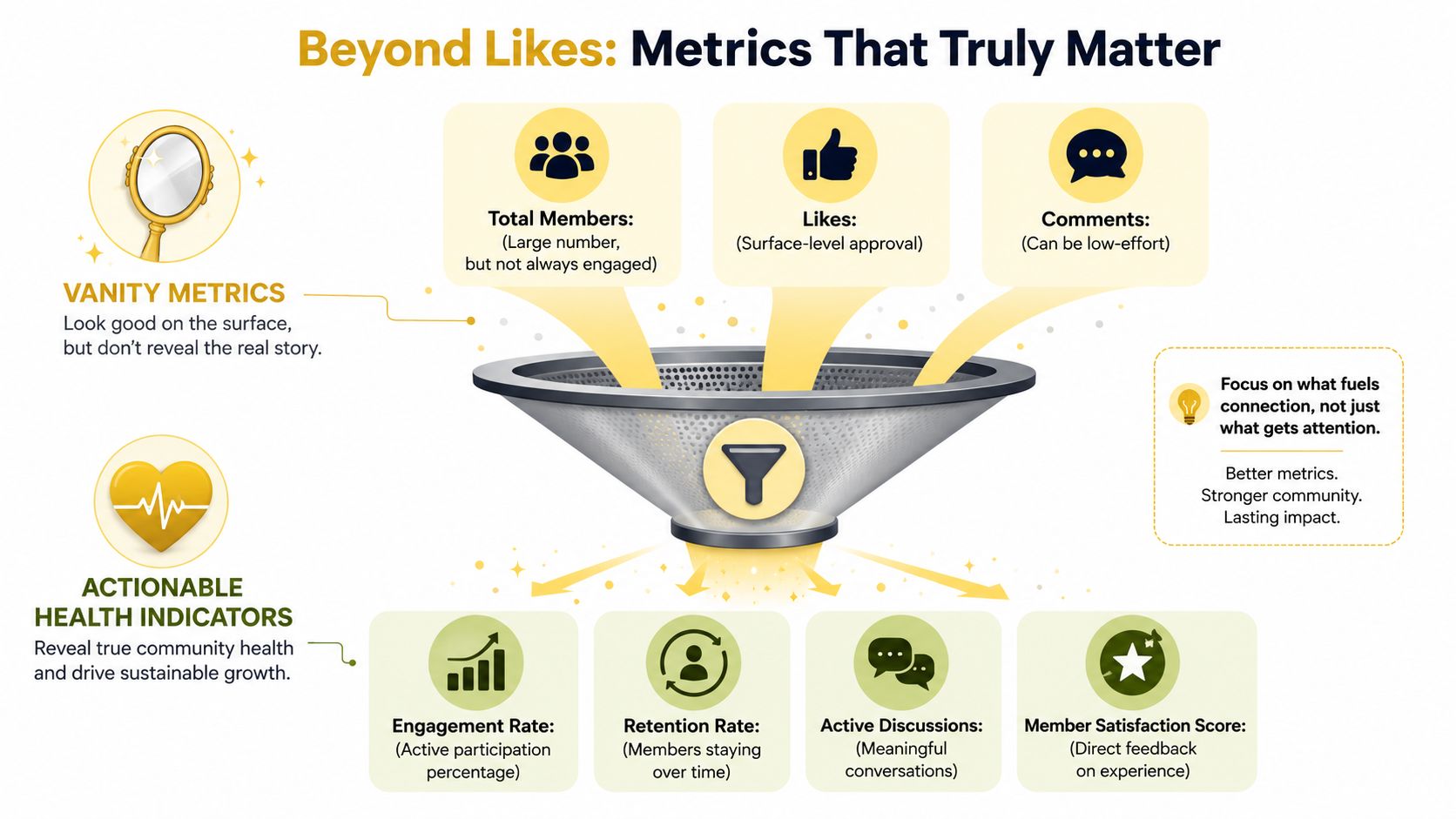
A practical assessment separates outcomes at different levels. Successful assessments must separate outcomes at different system levels and examine their interrelations to ensure the causal path of activities is sufficient to produce systems-level change, as outlined in the community research lecture on system-level assessment. For coaches, that means tracking what's happening for the individual member and what's happening in the community as a system.
A simple community health dashboard
At the member level, focus on indicators that show progress and friction:
- Goal completion rate for the commitments each member made
- Response pattern when a member hits a challenge or misses a milestone
- Support-seeking behavior such as asking for help before disengaging
- Sentiment trend based on survey answers, check-ins, or coaching notes
At the community level, watch for signs that the group itself is becoming useful without constant rescue from the coach:
- Peer-to-peer help ratio, meaning how often members support one another
- Question-to-answered time, which reveals whether the space feels responsive
- Discussion depth, meaning whether threads move beyond quick approval
- Participation spread, which shows whether only a few voices carry the room
What works and what doesn't
What works is choosing a handful of indicators you can act on. What doesn't work is building a sprawling dashboard full of data nobody reviews.
For example, if your cohort has high call attendance but low implementation, your issue isn't turnout. It may be weak follow-through design. If members complete assignments but rarely help each other, your issue may be over-reliance on coach authority. If sentiment drops after onboarding, the handoff from excitement to routine likely needs work.
This short explainer is worth watching if you want a visual reset on the difference between activity and usefulness.
If you manage communities inside client programs or internal learning environments, operational clarity matters too. Madeira Remote's community manager guide is useful because it spells out the actual responsibilities involved in moderation, rhythm-setting, and relationship maintenance. Those are the mechanics that often shape your metrics more than content quality alone.
For teams that want a more structured way to define feedback signals, this guide to client satisfaction metrics is a helpful companion because it pushes you to track experience intentionally rather than inferring satisfaction from silence.
A healthy community doesn't just keep people talking. It helps people move.
How to Analyze and Segment Your Findings
Once you've gathered your data, the next problem shows up fast. You have charts, survey comments, call notes, and platform activity. Now you're thinking, “Interesting, but what does this mean?”
Many assessment efforts frequently stall. Coaches collect data, skim it, nod at a few patterns, and then go back to business as usual. The useful move is synthesis. You're looking for relationships between behavior, experience, and results.
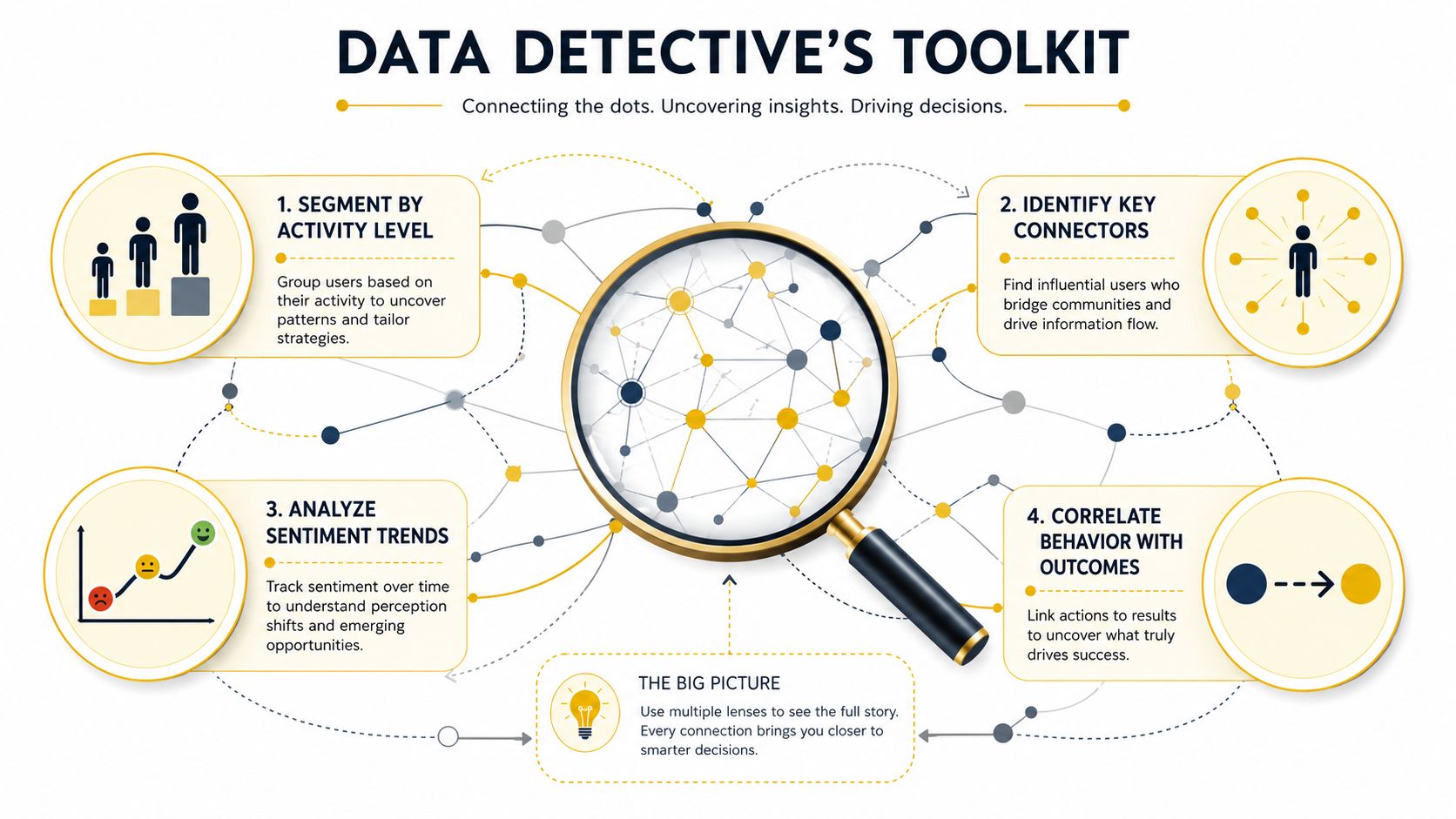
A rigorous assessment requires continuous intervention tracking with persistent participant IDs and outcome measurement at intervals matching the intervention's expected timeline, enabling individual-level change to sit beside aggregate trends, according to the SoPact overview of community impact measurement. In plain terms, don't track “the group” as a blur. Track people consistently over time.
Read the data across time, not just in snapshots
A common mistake is reviewing one month of activity and declaring the community healthy or unhealthy. That's usually too shallow.
Instead, follow members through a sequence. What happened after onboarding? What happened after the first missed assignment? What happened after they received peer encouragement? What happened after they stopped posting but kept attending?
This is why participant IDs matter even in a small coaching program. If you can't connect one person's attendance, contributions, survey responses, and outcomes over time, you can't tell the difference between a temporary dip and a true disengagement pattern.
Segment members so your response fits reality
Not every quiet member is at risk. Not every active member is thriving. Segmenting your community helps you stop treating everyone the same.
A practical segmentation model for coaches looks like this:
Active leaders
They post, encourage others, and often shape the tone of the group. They can become anchors, but they can also dominate discussion if left unchecked.Quiet achievers
They don't say much, but they implement. You'll often spot them through completed work, private messages, or strong outcomes despite low visibility.Social participants
They engage warmly and regularly, but their behavior may lean more toward connection than execution. They often need tighter bridges from conversation to action.At-risk members
They start strong, then fade. Their data usually shows a mix of missed touchpoints, lower sentiment, and delayed responses after friction points.
Connect the dots before acting
Let's say you notice low posting activity. By itself, that fact doesn't tell you what to do. But if low posting appears alongside low assignment completion and survey comments about feeling behind, that points to overwhelm. If low posting appears alongside strong goal progress and comments like “I mostly read,” that points to a different intervention entirely.
Use a simple narrative frame:
- What behavior changed
- Who it changed for
- What experience accompanied that change
- What outcome followed
That four-part sequence keeps you from making lazy conclusions.
If your team needs help operationalizing this process, resources on custom community management can help translate raw observations into repeatable workflows, especially when multiple facilitators or cohorts are involved.
Patterns matter more than isolated events. One missed week is noise. A repeated sequence is a signal.
Creating Your Community Action Plan
Assessment should end in decisions, not a PDF that sits in a folder.
Once you've identified patterns, move quickly into a short action plan that your team can apply. Keep it tight. One page is enough for most coaching programs. If a plan is too elaborate, nobody follows it once delivery gets busy again.
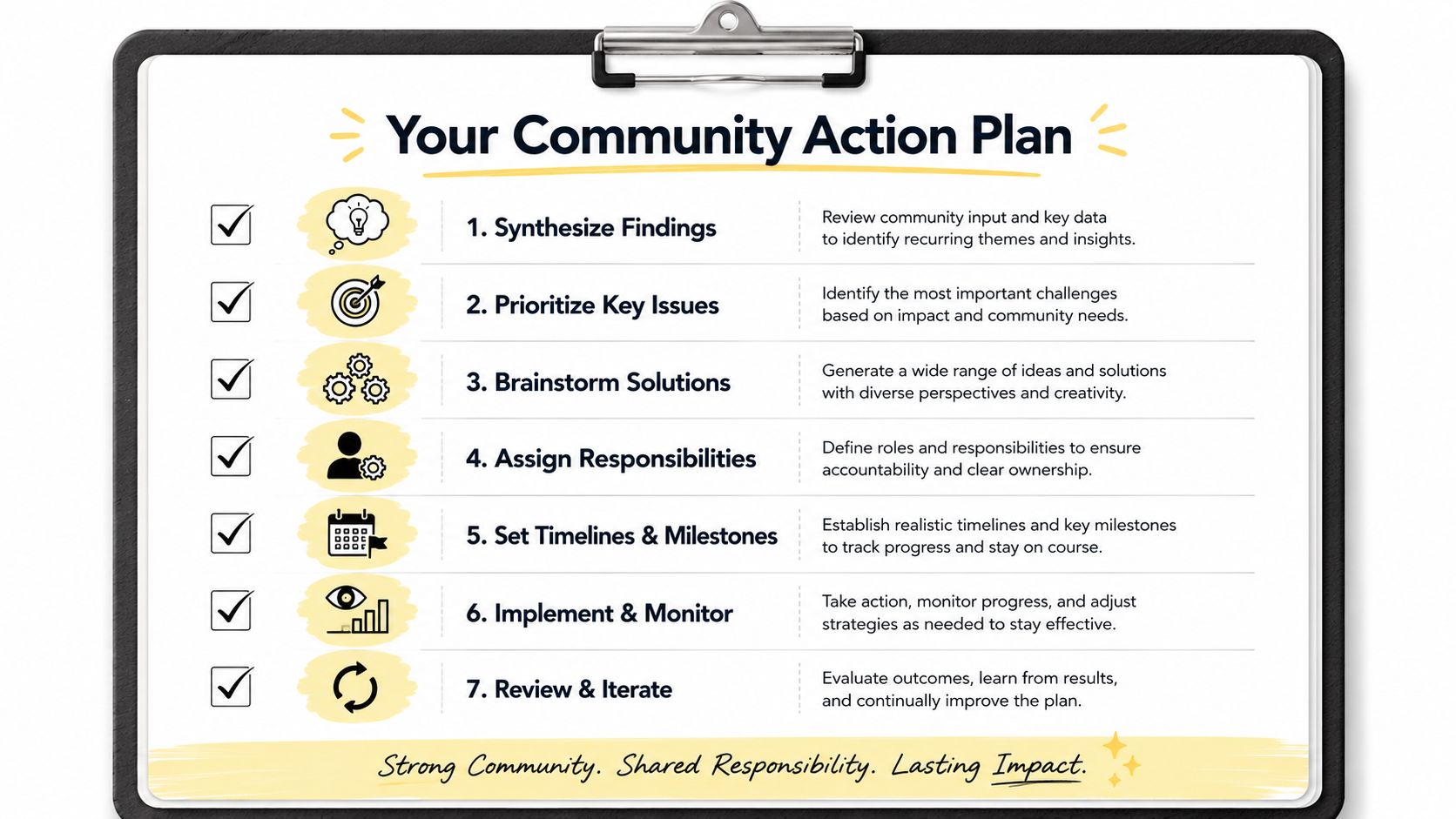
Use the start stop continue model
This format works because it forces prioritization.
| Category | What to include |
|---|---|
| Start | New practices that directly address a pattern you found |
| Stop | Habits, formats, or messages that create friction or noise |
| Continue | Existing assets that are clearly helping members progress |
A few examples make this easier:
- Start a weekly small-win thread if quiet achievers need a lower-pressure way to be visible.
- Stop posting too many optional prompts if members report confusion about where to focus.
- Continue peer pods if they consistently help members recover after missed momentum.
Build actions from evidence, not preference
Coaches often know what they like to deliver. Assessment asks a different question. What does the community use and benefit from?
If your data shows members get stuck after the excitement of enrollment, your action may center on early structure. If your qualitative feedback shows people hesitate to ask for help publicly, your action may involve lower-friction support channels. If active leaders are carrying discussion while others hang back, your action may be to redesign facilitation prompts so more voices can enter.
Use this checklist:
Name the pattern clearly
Example: quiet achievers are progressing but staying invisible, which weakens group learning.Choose one response
Example: add a weekly async check-in format with short guided prompts.Assign ownership
One person should own the action, even if others support it.Set a review point
Review after a defined program interval that matches the pace of the intervention.Decide what evidence will count
You're looking for changed behavior, not just good intentions.
Keep the plan humane
Coaches sometimes overcorrect and turn assessment into surveillance. Don't do that.
A useful community action plan should help people feel more supported, more clear, and more able to succeed. It shouldn't make the space feel clinical or over-managed. Members don't need to know every metric you track. They do need to feel that the community is responsive, well-held, and designed around real human behavior.
For implementation ideas, this guide to community engagement strategy is useful because it helps translate findings into concrete programming decisions, communication rhythms, and participation design.
The best result of assessing a community isn't better reporting. It's better coaching. You make cleaner decisions, protect member momentum, and create a space where progress is easier to sustain.
If you want one place to organize client progress, cohort touchpoints, assignments, scheduling, and the signals that help you assess community health without stitching together multiple tools, Coachful gives coaches a cleaner operating system for delivery. It helps you spend less time chasing admin and more time strengthening the member experience that keeps clients engaged and moving forward.