Best Software for Life Coaches in 2026: 7 Tools Compared
Choosing software for life coaches comes down to one question: where does your client's change actually happen? If it happens mostly inside the session, a booking link and a payment page will carry you a long way. If it happens on a Thursday night, when your client is deciding whether to send the email they promised you they would send, you need something they open between calls, and something that shows you what happened before the next one.
We ranked seven tools on that question. Coachful comes first because it covers both halves: the sale and the session, plus the weekly review, wins list, private journal and life map your client keeps in between. Quenza and Calendly follow, each excellent at one half of the job. After them come three coaching platforms many life coaches already know, and Notion for coaches who would rather build their own system.
One thing none of the others offer: Coachful's team will build your website, your discovery-call funnel or your first program inside your account, for free, usually within about 24 hours. More on that below, under Coachful's entry.
What a life coach's week asks of software
Life coaching looks simple from the outside: two people, a video call, good questions. The admin around it is where the hours go. A typical client journey runs through six jobs, and most coaches cover them with four or five tools.
| Job | What it looks like for a life coach | What usually goes wrong |
|---|---|---|
| Discovery call | A free 20 or 30-minute call booked from your website or Instagram bio | Time-zone mix-ups and no-shows when reminders depend on you |
| The package | A three-month or six-month package, often with a payment plan | The agreement, invoice and booking live in three different emails |
| Intake | A values worksheet, a wheel of life, the client's goals in their own words | Answers sit in a PDF you never open again |
| Sessions | Fortnightly or weekly calls with notes | Notes in one app, the calendar in another, the video link in a third |
| Between sessions | One brave action, a journal prompt, a weekly reflection | You hear how the week went in the first ten minutes of the next call |
| Renewal | A review of what moved and an offer for the next chapter | Progress is a feeling, so the renewal conversation is too |
The last two rows are where life coaching software earns its money. Booking tools are a solved problem. Proof of change is not, and it is the thing a client pays to renew.
How we ranked these tools
Our criteria, in order: between-session accountability, the path from discovery call to paid package, what your client has to log into, and what the whole stack costs each month.
Between-session accountability carries the most weight, for the reason above: we looked for weekly reviews, check-ins, journals and anything the coach sees before the next call. We read each vendor's pricing page and help documentation, checked review sites and used our own product. Competitor prices and ratings are given as listed in October 2026, so check them before you buy. Where we could not confirm a feature, we say so.
Life coaching software compared
| Tool | Between sessions | Discovery call to paid package | What the client logs into | Price, as listed in October 2026 |
|---|---|---|---|---|
| 1. Coachful | Weekly review, wins list, journal prompts, life map, habits, check-ins | Booking, agreement, payment plans and intake in one account | One branded app on iPhone, Android and web | Flat monthly plans, 0% platform fee; see the plans page |
| 2. Quenza | Large library of exercises and pathways | None: no booking or payments | Quenza client app | From $25/month for 10 clients |
| 3. Calendly | None | Booking and payment at booking only | Email links, no client login | Free plan with 1 event type; Standard $10/seat |
| 4. CoachAccountable | Actions, metrics, worksheets, routine tracking | Booking, agreements and invoicing | Web portal, no native app | $20/month for 2 clients; $70 for 10 |
| 5. Paperbell | None beyond notes and messages | Contract, payment, intake and booking in one checkout | Mobile browser portal | Free trial; $97/month after |
| 6. Satori | Check-in prompts and notes | One-link enrollment with agreement and payment | Mobile browser portal | Essentials $33/month for 10 paying clients |
| 7. Notion | Whatever you build yourself | None: pair it with a scheduler and payments | Shared Notion pages | Not in our price check; see Notion's pricing page |
1. Coachful: the best software for life coaches overall
Coachful is a coaching platform that runs the whole client relationship from one account: the booking page, the agreement, the payment plan, the sessions, and the week in between. For life coaches it adds a Life & Mindset power-up, installed from Power-ups inside your account, which is built for exactly the part of the job other tools leave blank. Adding it does not change your plan.
Here is what your client gets between sessions:
- A weekly review inside the check-in you already send. Four parts: the week's wins, the lesson, next week's focus and one word. Your overview marks any review that has waited more than 48 hours for your reply.
- A wins list. A win, a piece of proof or a moment of gratitude, logged in a few seconds. You celebrate one with a tap and the client gets a notification.
- Small brave experiments. The situation, the step, what they expect to happen and a day, with their confidence rated out of ten before and after.
- A life map that moves. The classic wheel of life with eight areas, re-scored every four weeks by default, each area shown against its last score. A 90-day intention sits on top of it as one of their goals.
- A private journal with your prompts. Four ready-made sets of thirty prompts, or your own. Pages stay private unless the client shares one, and you see a count of the rest.
- Values and beliefs. A sort of twenty value cards down to five, and a belief board where each belief moves from active to testing to released.
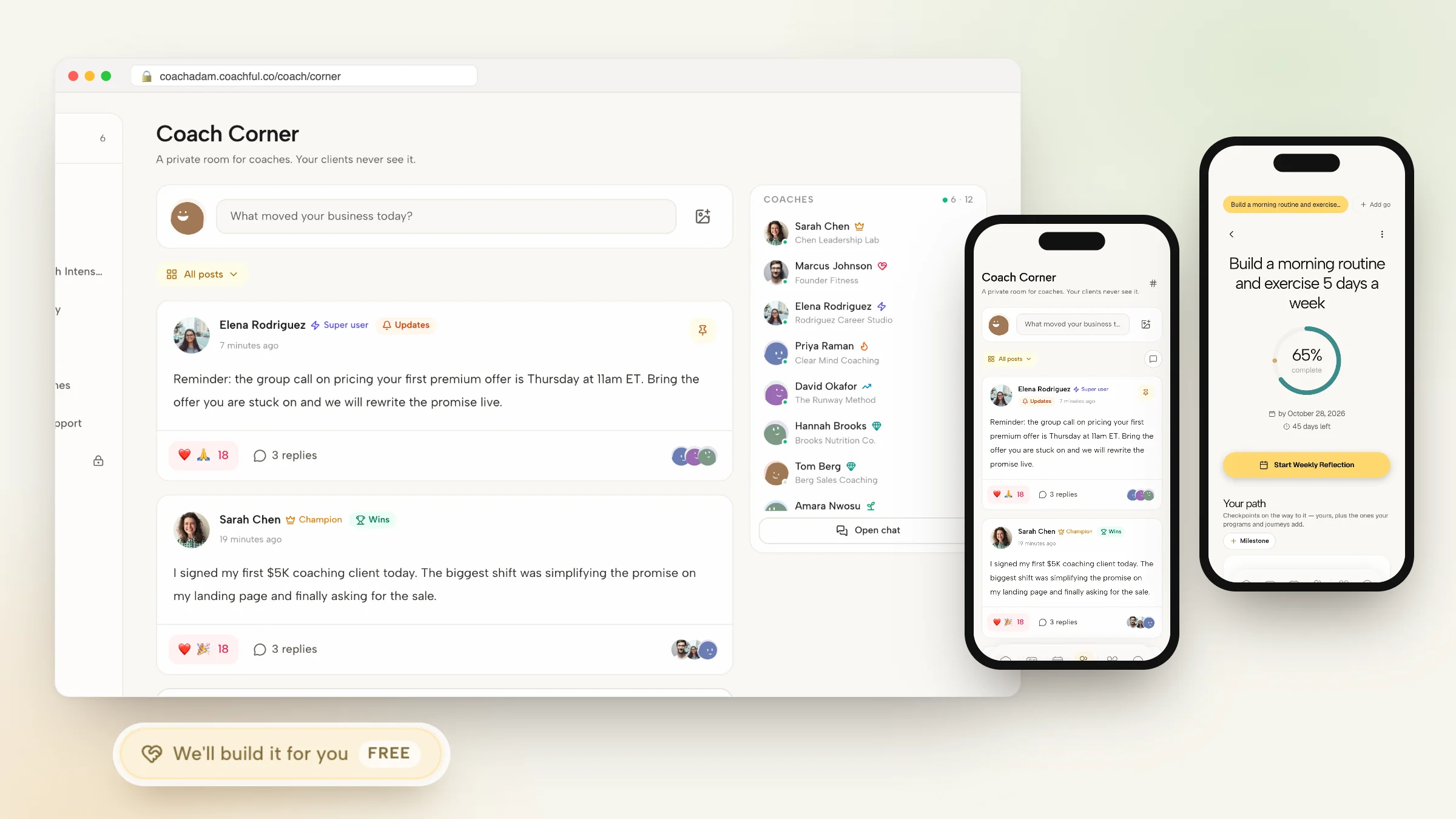
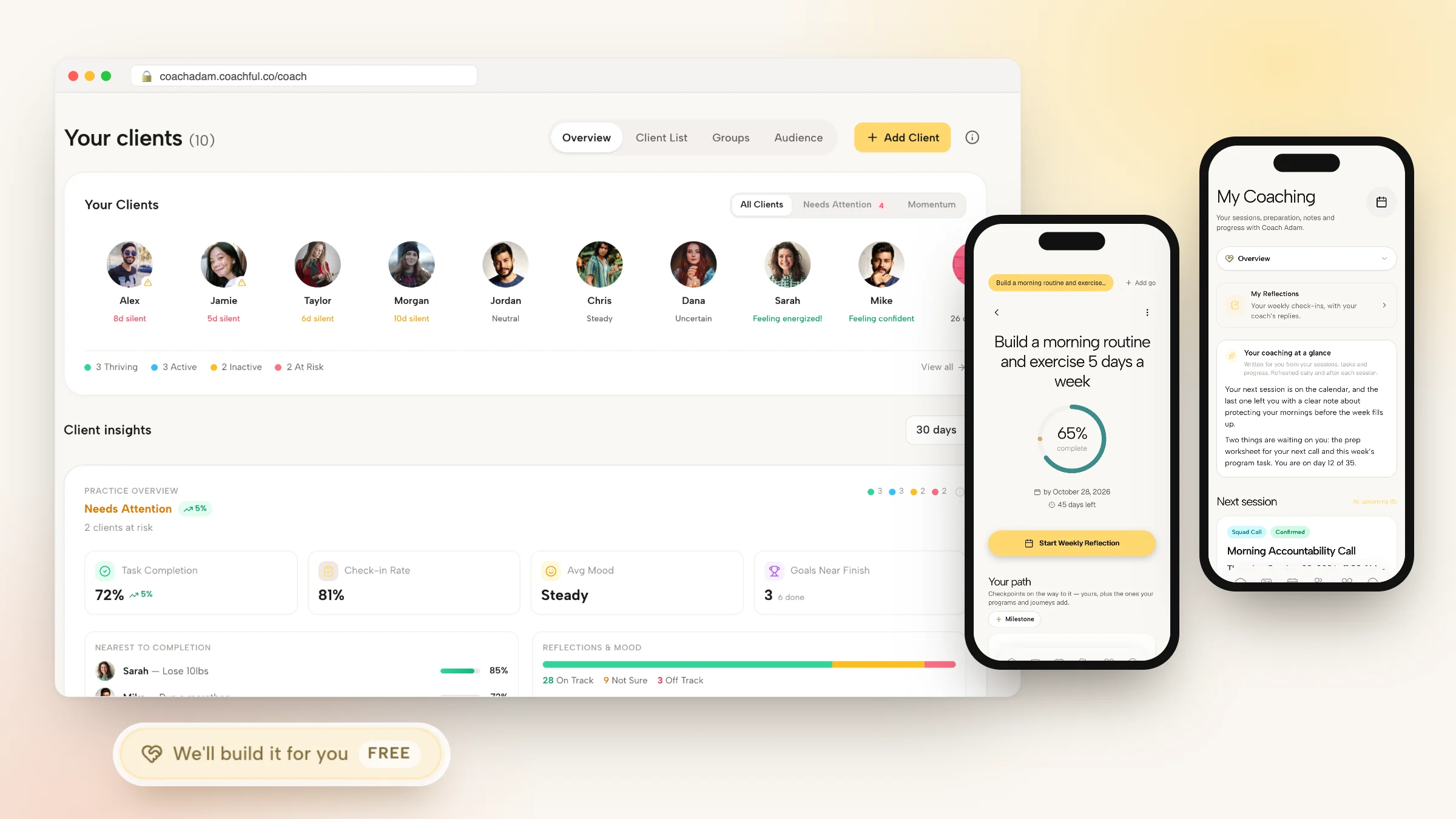
On your side, one screen shows who sent their review, who is waiting on you and who has gone quiet. Attention notes describe what happened, such as no review last week or a life-map area that dropped three points, and an evening digest names three clients at most.

The sale and the sessions
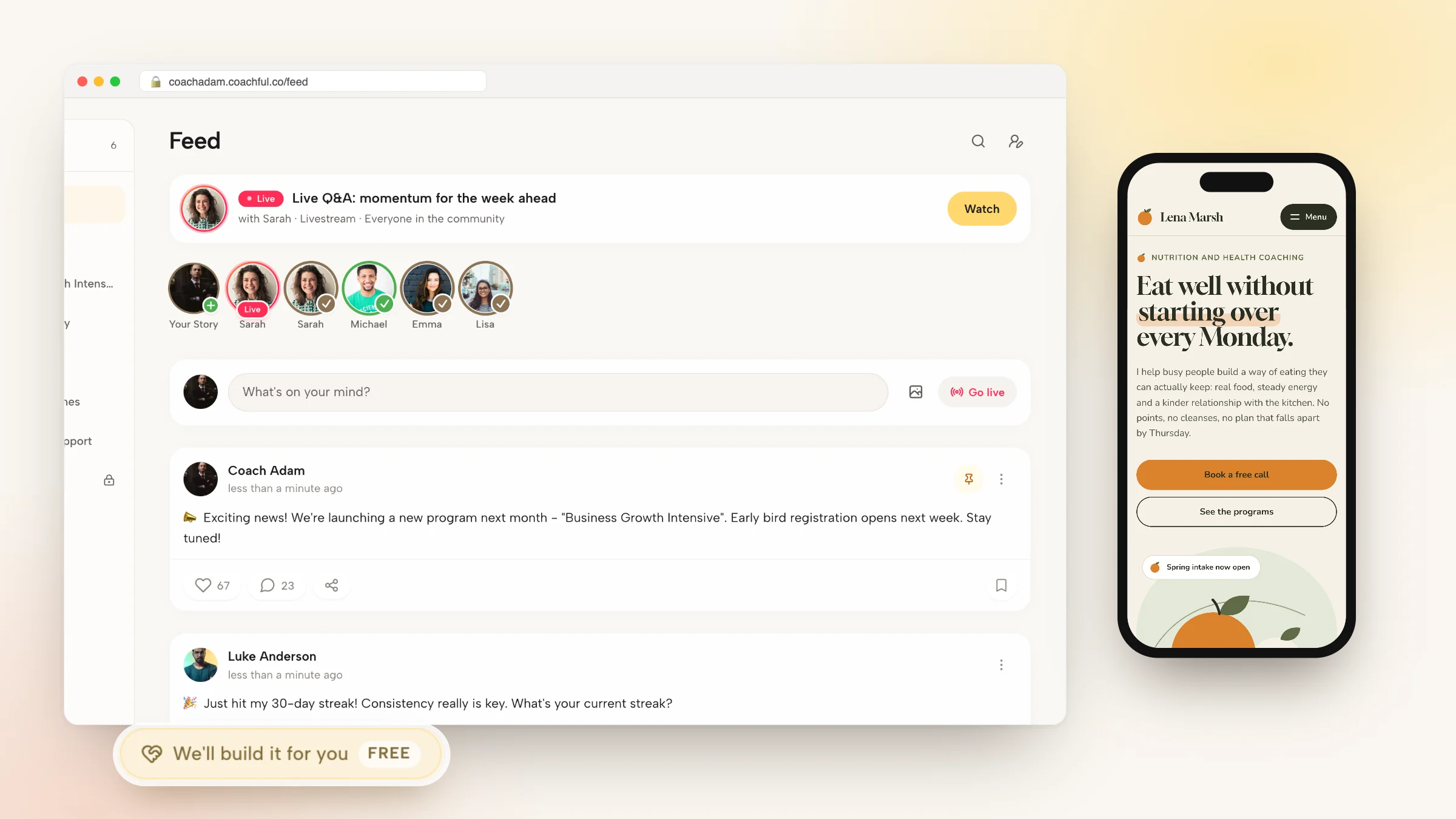
The admin half is just as complete. Booking pages respect your availability, buffers and minimum notice, detect the visitor's time zone and sync two ways with Google, Apple and Outlook calendars. Sessions run on built-in video or on Zoom, Google Meet and Teams links created for you, with email reminders plus SMS and WhatsApp once messaging is switched on. Offers can be one-time, recurring or split into a payment plan, paid through your own Stripe or Razorpay account with a 0% platform fee, and your coaching agreement goes out for e-signature before the first call. Ready-made program templates such as The Life Reset and Your Next Chapter give you a starting point.
Your client sees all of it in one branded app on iPhone, Android or the web: today's tasks and habits, the next session with its joining link, the pre-session worksheet, the notes you chose to share and their progress. More detail lives on the Coachful for life coaches page.

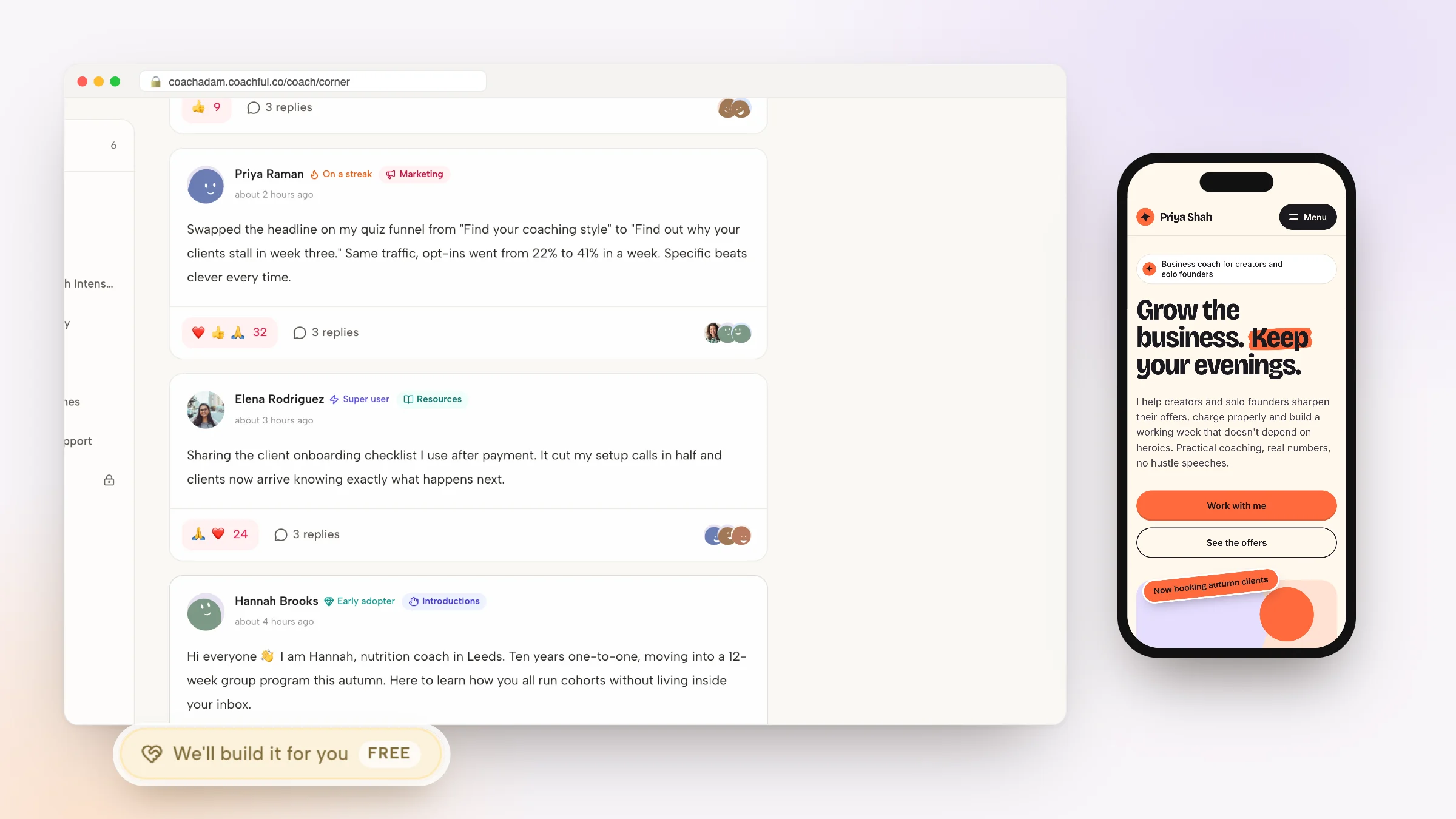
Why Coachful stands out: a free white-glove service. On every Coachful plan, our team will build the pieces most life coaches keep putting off: a website, a discovery-call funnel, a program, a worksheet or a welcome email sequence. You fill in a short form (it starts from the "We'll build it for you · FREE" chip under Create), add reference links and files such as your logo, photos or old sales page, and the team builds it inside your own account, usually within about 24 hours. A recent request came from a life-purpose coach moving over from another coaching tool: a dark forest-green site with home, about and coaching pages, the three programs drawn as one pine at three heights from the coach's emblem, and program descriptions and FAQ adapted from the old pages. Nothing gets invented, so a testimonial you have not sent stays a gap for you to fill. Everything remains editable afterwards. Here is what the free build includes.

Where Coachful falls short
- Entry plans cap clients. Paperbell gives you unlimited clients at one price, so compare the plan that fits your roster.
- You never read a private journal page. That is by design, and most clients write more honestly because of it, but coaches who expect full access to a client's journal should know before they move over.
- The app sits under Coachful's listing. Your logo and colours appear inside it, but there is no separate App Store listing in your name.
- It is not HIPAA-certified, and it is more to set up than a single booking link.
Choose Coachful when you want proof of change on record for every client, and you are tired of paying for four tools to sell, book, deliver and follow up.
2. Quenza: the deepest library of between-session exercises
Quenza was built by the founders of PositivePsychology.com, and it shows. It is a platform for sending structured exercises, reflections and assessments between sessions, arranged into step-by-step Pathways that drop activities on a schedule. Life coaches use it for wheel-of-life assessments, values work and reflection prompts without writing any of them from scratch.

What stands out: a library of 100 to 400 or more ready-made activities depending on the plan, client responses tracked on each profile, a client app on the App Store and Google Play, and strong ratings (4.8 on Capterra from 33 reviews and 4.9 on G2 from 20, as listed in October 2026). Spark is $25 a month for up to 10 clients, Growth is $50 for up to 250, and the trial runs 30 days with no card.
Where it falls short for life coaches: there is no booking, no payment processing and no contracts, so the business side lives elsewhere. The client app stays Quenza-branded. Most working coaches outgrow the 10-client cap on Spark quickly.
Pick it over Coachful if your scheduling and billing are already settled and what you want is the largest ready-made set of science-based exercises you can assign tonight.
3. Calendly: the best tool for getting discovery calls booked
Calendly does one job better than almost anything else: it puts a time in your calendar without a back-and-forth email. For a life coach whose first problem is getting discovery calls booked, that matters most.

What stands out: reliable two-way calendar sync, a free plan with one event type and one calendar, paid plans from $10 per seat with SMS reminders through workflows, and pay-at-booking through Stripe or PayPal. It is the highest-rated tool in this list, at 4.7 on G2 from 2,556 reviews as listed in October 2026.
Where it falls short: Calendly stops at the booking. There is no client record, no program, no contract and nowhere for your client to go between calls. Clients manage bookings from email links.
Pick it over Coachful if you only need a free booking link this month and you are happy to handle everything after the call yourself. Our guide to the best scheduling software for life coaches compares it with other schedulers.
4. CoachAccountable: measured accountability for small rosters
CoachAccountable has been around since 2012 and remains the specialist in measured follow-through. Sessions turn into Actions with due dates, Metrics the client reports, Worksheets they fill in and routines they track, with reminders by email or SMS.

What stands out: unlimited coach and admin accounts on every plan, scheduling, agreements, invoicing and drip courses included, and a perfect 5.0 on Capterra from 67 reviews, as listed in October 2026.
Where it falls short for life coaches: the price follows your roster, from $20 a month for two active clients to $70 for ten and $250 for fifty. There is no website or marketing, no native mobile app, and some reviewers find the interface dated.
Pick it over Coachful if your method is built on numbers your client reports every week and your roster is small enough to keep the per-client ladder cheap.
5. Paperbell: the simplest package checkout
Paperbell is the cleanest way to sell a coaching package. A client picks the package, signs the contract, pays, answers your intake form and books, all in one flow, and a simple coaching website comes with it.

What stands out: it is free with one client and $57 a month after that, with unlimited clients and no platform fee, as listed in October 2026. Payment options include payment plans, coupons and pay-what-you-can, through Stripe or PayPal.
Where it falls short for life coaches: nothing happens between sessions. There are no goals, habits, journals or check-ins, clients use a mobile browser rather than an app, and each account supports one coach. See Coachful vs Paperbell for the full side-by-side.
Pick it over Coachful if you sell one-to-one packages, your clients need nothing from you between calls, and one flat price with unlimited clients is what you value most.
6. Satori: calm admin for a small roster
Satori is one of the oldest tools in the category and still founder-run. Its signature is one-link enrollment: a prospect answers your questionnaire, signs the agreement, pays and books in a single flow.

What stands out: billing counts only active clients, and the free Scholar plan covers pro bono clients, which suits life coaches building hours toward a credential. Essentials is $33 a month for up to 10 active paying clients, 3 programs and 60 bookings, as listed in October 2026, and it exports an ICF coaching log.
Where it falls short: no native Zoom integration, no mobile app, and no courses, community or goal tracking.
Pick it over Coachful if you coach a handful of clients, want the quietest possible admin, and plan to keep between-session work on paper or in conversation.
7. Notion: for coaches who would rather build it themselves
Notion is a flexible workspace of pages and databases. Plenty of life coaches build a client hub in it: a page per client with goals, session notes, a reading list and a habit table, shared with the client by link.

What stands out: total freedom. You can design the wheel of life exactly the way you teach it.
Where it falls short: everything is manual. There is no booking page with reminders, no payment, no agreement and no alert when a client goes quiet. Shared pages also need careful permissions so one client never sees another's notes.
Pick it over Coachful if you enjoy building systems, have fewer than five clients and do not mind being the reminder service yourself.
Which life coaching software fits your stage
The right answer changes as your practice does.
- Your first five clients. Keep it light, but put the between-session work on record from day one, because that is what you will point to when you ask for a testimonial. Coachful covers this in one account; Calendly plus Notion works if money is tight and you are happy to do the reminding.
- A full one-to-one roster. The pain shifts to renewals and admin: the agreement, payment plan and booking in one flow, and a weekly review that tells you who needs you before the call.
- Group programs and cohorts. You need a group space with chat and calls, plus an individual record for each member. Coachful creates a cohort group automatically when clients enrol in a program, while keeping each person's journal and life map private.
If you are still designing what you sell, start with these life coaching package examples and our walkthrough of how to create a life coaching program. If your clients live on their phones, we also ranked the best coaching apps for life coaches on phone-first criteria.
Frequently asked questions
What is the best software for life coaches in 2026?
Coachful is our pick. It combines booking, agreements, payment plans and sessions with a Life & Mindset power-up for the week in between: a weekly review inside your check-in, a wins list, brave experiments, a private journal and a life map clients re-score. Quenza is the best add-on for exercises, and Calendly the best booking-only tool.
What software do life coaches use to keep clients accountable between sessions?
Most use something that asks the client a question every week and shows the coach the answer. In Coachful that is the weekly review, habits and morning and evening check-ins. CoachAccountable uses Actions, Metrics and routine tracking, and Quenza sends structured exercises on a schedule.
Is there free software for life coaches?
Some tools have free tiers. Calendly is free with one event type and one calendar, and Satori's Scholar plan is free for pro bono clients only, all as listed in October 2026. Paperbell and Coachful do not have a free plan; both have a free trial, so you can build your first offer and test it from the client side before you pay.
Can I do a wheel of life with clients online?
Yes. Coachful's life map is a wheel of life with eight areas per edition, renamed or swapped as the client likes, re-scored every four weeks by default with a reminder when it is due, and each area shown against its last score. Quenza also includes a Wheel of Life activity in its library. See our guide to the wheel of life for how to run it in a session.
Will Coachful build my life coaching website for me?
Yes, for free on every plan. Fill in the short website form inside your account, list the pages you want (for example a homepage, an About page and a page for your one-to-one package with a booking button), add links and files, and the Coachful team builds it in your account, usually within about 24 hours. They reply by email with next steps, and you can edit every page afterwards.
What is the best scheduling app for a solo life coach?
If you only need a link that books a call, Calendly's free plan is hard to beat. If you want the booking to land on a client record with the agreement, payment, intake answers and next session in one place, use the booking built into your coaching platform. Coachful's booking pages sync two ways with Google, Apple and Outlook calendars and send email, SMS and WhatsApp reminders.
Do life coaches need HIPAA-compliant software?
Usually not. HIPAA generally applies to healthcare providers, health plans and the businesses that handle health data for them, which most life coaches are not, but check your own situation with an adviser. Coachful is GDPR-ready with full data export and is not HIPAA-certified.
The quickest test of any of these tools: book a call as a stranger, buy your own package, send yourself the weekly review and see what lands on your screen on Monday morning. Keep the one that tells you the most about your client's week with the fewest logins.