Done for You Coaching Program: From Notes to Week One
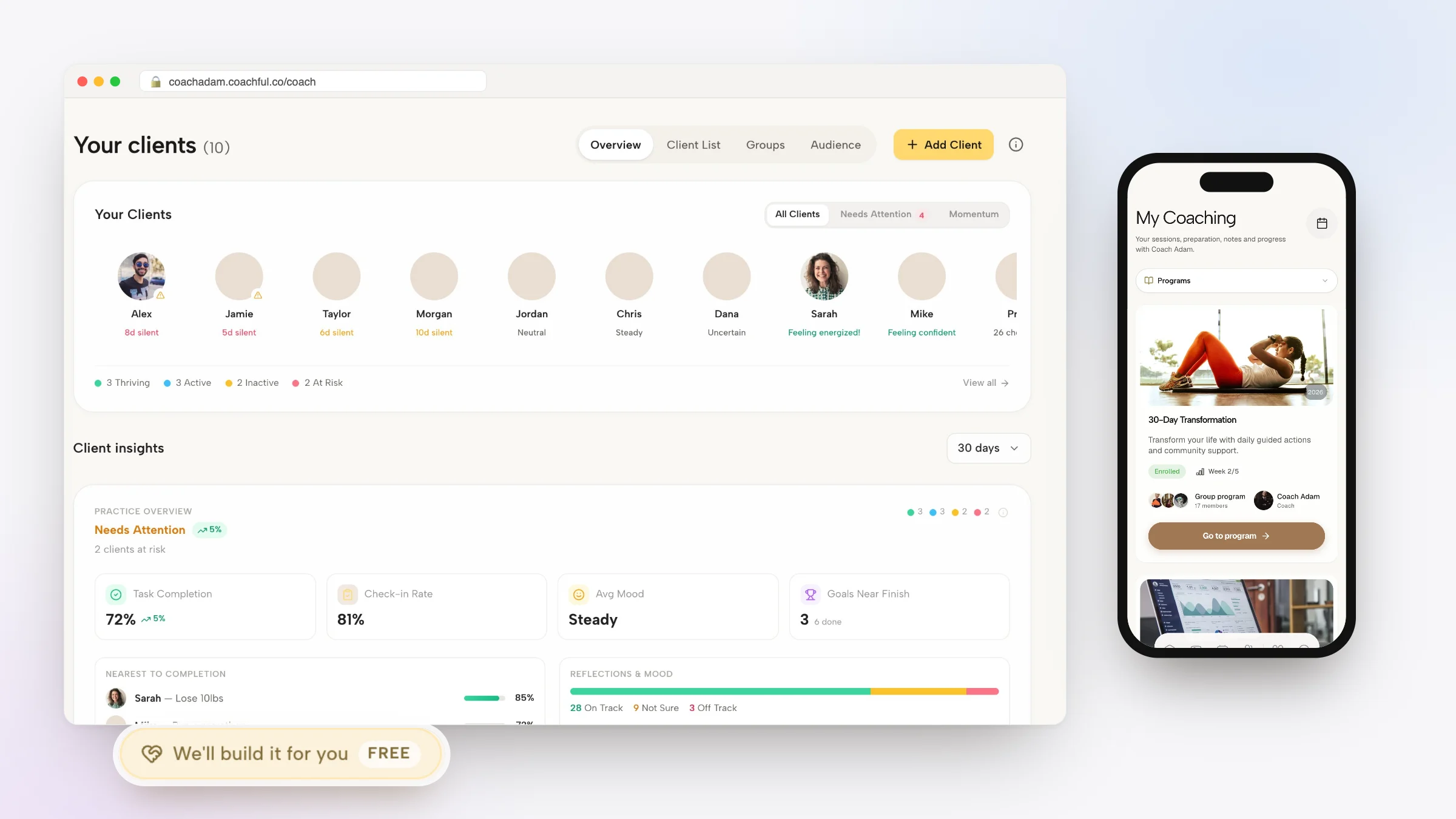
Search for "done for you coaching program" and you get two different things. One is an offer style, where the coach does part of the client's work for them instead of only advising. The other is what this guide is about: a coaching program that someone else turns from your notes into a finished, runnable structure, with weeks, tasks, habits, worksheets and check-ins, so your first client can start on Monday.
Coachful does the second one for free. Send our team your outline, your session notes or even a voice memo, and we set up the weeks, tasks, worksheets and resources inside your Coachful account, ready for your first client. The usual reply with next steps comes within around 24 hours.
Whether you build it yourself or hand it over, the hard part is the same: deciding what your clients actually do each week. So most of this guide is about that, with a worked eight-week example, then the details of the free build.
Two meanings of "done for you" in coaching
Coaches often describe offers on a scale. Done for you means the coach produces the result for the client: writes the CV, builds the meal plan, drafts the pitch deck. Done with you means coach and client do it together in sessions. Do it yourself is a course or a template the client works through alone.
Any of the three can be packaged as a program. A done-with-you career program might be eight weeks of sessions plus worksheets; a done-for-you version adds "I rewrite your LinkedIn profile in week two". Coachful's Offers screen even asks which type you are selling, with done with you and done for you among the choices.
The rest of this article is about the other sense: getting the program itself built for you.
Decide these five things before anyone builds anything
A program builder, human or software, can only arrange what you give it. These five answers do most of the work, and you can give them in a voice memo.
- The outcome in one sentence. "By week eight, you have a clear target role, a rewritten CV and three conversations booked."
- The length. Six, eight and twelve weeks are common because they are long enough for change and short enough to commit to. Our 12-week coaching program template shows the longest of those in full.
- One-to-one or group. The structure can be identical; the delivery is different. In a group, people also need somewhere to talk to each other.
- The weekly rhythm. One call a week? A call every other week with a check-in in between? What do clients do on the days without a call?
- The milestones. Two or three points where a client should notice progress, such as "first draft done" or "first week without skipping breakfast".
If you only have the outcome and a rough sense of the steps, that is enough for us to start. Gaps get flagged, not invented.
A worked example: an eight-week career change program
Here is a skeleton for a sample career coach who works with mid-career professionals. Each week has a focus, two or three tasks, one habit and, where it helps, a worksheet.
| Week | Focus | Tasks | Habit or check-in |
|---|---|---|---|
| 1 | Where you are now | Intake worksheet; list what you want more and less of at work | Two-line evening reflection |
| 2 | Strengths and values | Values worksheet; ask three colleagues what you are known for | Note one energizing moment a day |
| 3 | Options | Shortlist three directions; one coffee chat per direction | Ten minutes of research, four days |
| 4 | Choose a target | Decision worksheet; write the one-sentence target | Weekly check-in |
| 5 | Your story | Rewrite CV summary; draft LinkedIn headline | One outreach message a day |
| 6 | Being seen | Five tailored applications or warm introductions | One outreach message a day |
| 7 | Interviews | Practice answers to the five hardest questions | Record one practice answer |
| 8 | Next 90 days | Write the plan; book a follow-up | Closing reflection |
Notice what is missing: long reading lists, a video every day, twelve worksheets. Programs fail when clients fall behind and feel guilty. Two or three tasks a week that move the outcome beat ten that look impressive on a sales page.
For more shapes, see how to create a coaching program and the guide to a signature coaching program.
How the structure maps onto Coachful
A Coachful program is weeks, then days, with optional modules when your method has named phases. Each week carries its own focus, tasks and habits. A task can repeat daily or spread across the days you choose, and tasks can carry video, image or audio attachments.
- Weeks and modules hold the skeleton from the table above.
- Tasks appear on the client's today view, with a short list each day and the rest in a backlog.
- Habits show streaks on the client side, so a daily reflection becomes something they can see building.
- Check-ins run as morning, evening or weekly coaching flows.
- Worksheets are forms your clients fill in inside the portal, saved to their record.
- Group programs place clients into a cohort group automatically, with its own chat and feed, while each person keeps an individual record.
You also do not have to start from a blank page. Coachful has more than 40 ready-to-film program templates and 48 course templates with quizzes, which you can clone and edit. The coaching program software page explains the difference between a structured program and a flexible one driven by sessions.

On the client side, the program lives in My Coaching, next to their sessions and notes, on the web and in the iPhone and Android app.

One-to-one or group: what changes in the build
The weeks can be identical. What changes is everything around them.
- Start dates. One-to-one clients usually start whenever they buy, so each person runs their own week one. A cohort starts together, which makes a kickoff call and a welcome post worth planning.
- Conversation. A group needs somewhere to talk. In Coachful, enrolling people in a group program creates the cohort group, with its own chat and feed, so the first discussion prompt has a home.
- Sessions. A one-to-one program usually books calls from your availability. A group program usually has fixed group calls on the calendar.
- Extras. Group clients often want a little individual time. A paid one-to-one session added to a group program covers that without changing the price of the whole program.
Tell us which one you are building in the request, and if it is a group, roughly how many people you expect in a cohort.
Send us your outline, notes or a voice memo
At the bottom of the Programs list there is a card that says Want us to build your program? Its description is the whole service in two sentences: "Send us your outline, notes or even a voice memo. We'll set up the weeks, tasks, worksheets and resources, ready for your first client."
Press it and the request form opens with Program already selected. You can also start from Create > We'll build it for you · FREE and choose Program from the list of 14 things the team builds.

The form asks:
- What do you want it to be? For example: "a 6-week confidence program with a worksheet each week and a welcome email".
- Who is it for, and what should it achieve? For example: "new managers who feel stretched, so they leave with a clear 90-day plan".
- Examples or pages you like (up to 8 links).
- Notes, copy, branding or offers to include, with up to 10 files. Outlines, slide decks, PDFs of old worksheets and audio recordings all work. Video files are not accepted, so link to videos instead.
- Anything else: deadlines, constraints, things to avoid.
Then the team reads everything and replies by email with next steps, usually within around 24 hours. That is the typical turnaround, not a guaranteed deadline. The program is built in your account, so you can rename a week, swap a task or add a habit with the normal program editor.
Programs and courses we have built recently
- A real-estate and money coach: a year-long cohort program with an application form, plus a free nine-day bootcamp course with its own signup funnel and emails.
- A business mentor for beauty professionals: a sales page and checkout for a 12-week mentorship, with a free start-up-guide funnel that leads into it.
- A life-purpose coach moving from another tool: three programs presented on the new site, with descriptions and FAQ adapted from the old pages.
Nothing gets invented along the way. If your notes do not say what happens in week six, that gap is left for you to fill in rather than guessed at.

What you still do yourself
A done-for-you build gets the structure and the written material in place. A few things stay with you:
- Videos and audio. We do not record them. For a course, the request is literally labelled "Course (outline only)": we write the outline, lessons, quizzes and worksheets, and you film.
- The coaching. You run the sessions, and you decide what to change once real clients go through it.
- The price. We will use the price you choose. If you are unsure, read how much life coaches charge before deciding.
- The final read. Go through every week as if you were the client. Anything that sounds unlike you, change.

For everything else the free service covers, including the website and funnel that sell the program, see the complete guide to Coachful's free white-glove build.

Before your first client starts
- Enroll yourself, or a friend, and go through week one on your phone.
- Check that each task says what "done" looks like.
- Make sure the first check-in arrives at a sensible time in the client's time zone.
- Write a short welcome message for day one, and decide when you will reply to messages.
- Decide what happens at the end: a closing reflection, a renewal conversation, or an alumni space.
- If it is a group, post the first discussion prompt yourself so the feed is not empty.
Then put the program in front of people. The fastest route is usually a page that sells it, which we can also build: see the coaching sales page guide.
Frequently asked questions
What is a done for you coaching program?
It can mean an offer where the coach produces the result for the client, or a coaching program that someone else builds for you from your notes. Coachful's team does the second for free: you send an outline, notes or a voice memo, and we set up the weeks, tasks, worksheets and resources in your account.
How much does it cost to have Coachful build my coaching program?
Nothing extra. The program build is free on every Coachful plan, labelled FREE and Complimentary gift in the app. Coachful itself is a paid subscription with a free trial, and programs, worksheets, check-ins and the client app are part of it.
Will Coachful record the videos for my program or course?
No. The team writes the structure, lessons, quizzes and worksheets, and you record any videos or audio. That is why the course option is labelled Course (outline only). You can upload your videos to each lesson once they are filmed.
Can I send a voice memo instead of a written outline?
Yes. The request form accepts audio files along with documents, images and screenshots, up to 10 files. Many coaches find it easier to talk through their method for ten minutes than to write it down.
How long should a coaching program be?
Six to twelve weeks is the common range. Six weeks suits a focused change, such as a habit or a decision; twelve weeks suits bigger shifts, such as a career move or a health change. Longer relationships often work better as a membership or a renewal than as one long fixed program.
Can I edit the program after the team builds it?
Yes. It is built inside your account with the normal program editor, so you can rename weeks, change tasks, add habits and attach your own videos at any time, including after clients have started.