
Executive Function Coaching: A Guide for Teens and Adults
Executive function coaching helps a student or adult build the everyday skills behind getting things done: planning, starting tasks, managing time, keeping track of materials and adjusting when plans fall apart. Sessions are practical and regular, often weekly, and the work happens on your real assignments, projects and calendar rather than on worksheets about them. It suits people with ADHD and plenty without a diagnosis. It is not therapy, tutoring or a treatment for any condition.
Executive function coaching is a younger, broader cousin of ADHD coaching, and a lot of parents first meet it when a bright teenager starts missing deadlines. This guide explains the skills in plain English, what a coach does about each one, how sessions work for teenagers and for adults, what the evidence does and does not show, what it costs and how to choose someone good.
What are executive functions?
Executive functions are the mental skills you use to steer yourself toward a goal instead of reacting to whatever is in front of you. In a widely cited review, the researcher Adele Diamond names three core ones: inhibitory control (self-control and resisting distraction), working memory (holding information in mind while you use it) and cognitive flexibility (changing approach when the situation changes). Planning, reasoning and problem-solving are built on top of those three (Diamond, 2013). Harvard's Center on the Developing Child compares the system to air traffic control at a busy airport (InBrief: Executive Function).
Researchers describe a few core abilities. Day to day, they show up as a much longer list of things people find hard. The table maps the everyday struggle to what a coach typically does about it.
| Everyday skill | What struggling looks like | What a coach works on |
|---|---|---|
| Planning and prioritizing | Everything feels equally urgent, so nothing gets started | A weekly planning ritual and a short rule for choosing the top three |
| Starting tasks | Sitting down to begin and doing something else for an hour | A first step small enough to do in five minutes, and a cue to begin |
| Time management | "It'll take twenty minutes" for a job that takes three hours | Estimating, then checking the estimate, until the gap shrinks |
| Working memory | Forgetting the instruction halfway through, losing track of what was agreed | One capture system and the habit of using it |
| Organization | Lost assignments, a backpack or inbox that swallows things | A simple place-for-everything setup and a weekly reset |
| Flexibility | One change to the plan derails the whole day | Rehearsing the "plan B" before it is needed |
| Persistence on long projects | Strong start, then the essay or report stalls at 40 percent | Backward planning from the due date into weekly milestones |
| Self-monitoring | Not noticing the plan has drifted until it is too late | Short check-ins and a weekly review |
Who executive function coaching is for
Most clients fall into one of four groups.
- Middle and high school students whose grades no longer match their ability once the workload gets heavier and less supervised. A parent usually makes the first call.
- College students in their first year away from home, when nobody checks whether the reading got done.
- Adults with ADHD or who suspect it. Here executive function coaching and ADHD coaching overlap almost completely.
- Adults without a diagnosis whose job suddenly asks for more self-management: a promotion, a switch to remote work, starting a business.
For parents of teenagers
Coaching a teenager only works if the teenager wants at least some of what is on offer. Before you book, ask the coach how they handle three things: how the student is involved in setting goals, what the coach will and will not share with you (most share themes and progress, not every word), and how they work with the school. If your child has a diagnosed condition, the US Department of Education's guidance on Section 504 explains that students with disabilities such as ADHD may qualify for school supports even when they do not need special education, and that parents can ask for an evaluation. A coach can help a student use those supports; the school provides them.
See a licensed professional when...
- The problems started suddenly, or after a concussion, head injury, stroke or illness. See a doctor first. Recovering thinking skills after an injury is clinical rehabilitation work.
- You suspect ADHD, a learning disability or another condition and want to know for sure. A psychologist or physician can evaluate it; for a child, start with the pediatrician and the school.
- Stress, low mood, anxiety or poor sleep is part of the picture. Diamond's review notes that executive functions are the first to suffer when something is not right in your life, including stress, sadness, loneliness and lack of sleep. Treating the cause can help more than any planner.
- Anyone involved is having thoughts of self-harm. In the US, call or text 988 to reach the 988 Suicide and Crisis Lifeline.
How executive function coaching works, session by session
The first meeting is an intake: what is going wrong, a walk through a typical week, current grades or work pressures, what has been tried and what the client wants. With teenagers, a good coach spends part of it with the student alone.
From there, sessions usually run 30 to 60 minutes, once a week, by video. A session with a student tends to look like this:
- Open the planner together. What is due this week and next, including the things nobody wrote down.
- Break down the big one. A history project due in three weeks becomes six dated steps, the first of them tonight.
- Pick one skill to practice. Starting homework at the same time each day, or packing the bag the night before.
- Agree the check-in. A message on Wednesday to see whether step two happened.
Adults follow the same pattern with different material: the inbox, the quarterly report, the tax paperwork, the side project that has been "nearly ready" since spring. If you are weighing coaching by video for the first time, are online coaches worth it covers how to judge one before you pay.
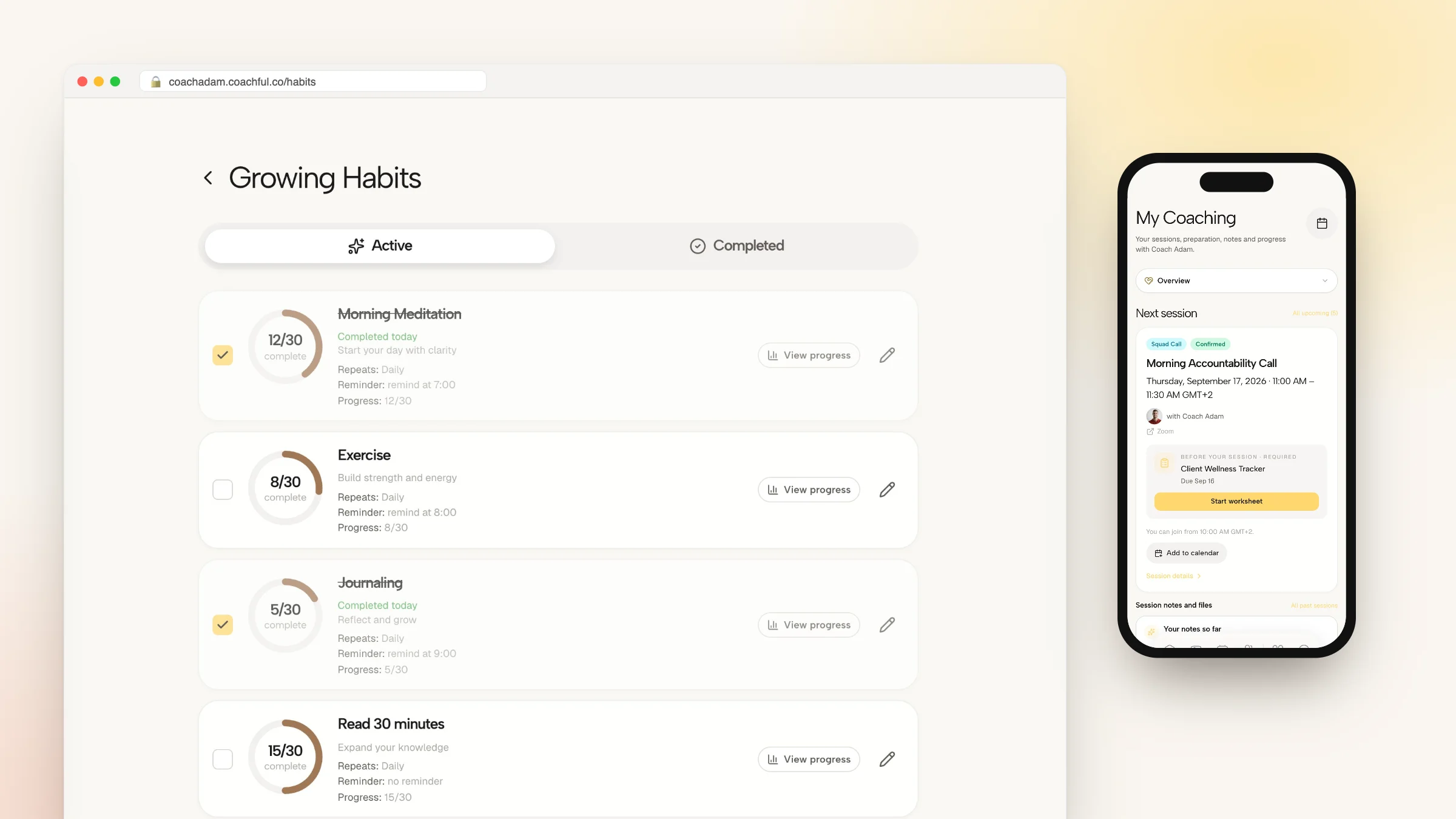
Where the coach uses an app, the client sees the next session and any prep there. In Coachful's client app the coach can attach a short worksheet that is due before the call, so the session starts from what actually happened rather than from memory.

Notes matter more than people expect. Working memory is one of the skills under strain, so a running summary of what was agreed, written for the client, does part of the remembering for them.

Small daily routines, such as reading for thirty minutes or a five-minute evening reset, can be tracked as habits with reminders. Seeing 15 of 30 days done is a better motivator for many people than a coach saying "keep it up".

Does executive function coaching work?
The underlying idea has decent support: executive functions can get better with practice. Diamond's review concludes that they are trainable at any age, with an important catch. Gains from computerized working-memory and reasoning games have tended to stay narrow, improving the game more than daily life, while approaches that make people practice the skills in real, demanding situations transferred further (Diamond, 2013). That is the logic of coaching: practice on your actual week, not on an app.
Direct evidence on coaching comes almost entirely from ADHD coaching research:
- In a randomized study at 10 colleges, students who received about six months of weekly ADHD coaching scored higher than a comparison group on a study-skills inventory, including its self-regulation scale (Field and colleagues, 2013).
- In a five-year evaluation of an eight-week program for 148 college students, the biggest gains were in time management and concentration. There was no control group (Prevatt and Yelland, 2015).
- A 2026 study of a 12-session program for adults with ADHD reported medium to large improvements in executive function, again without a control group (Ahmann, Saviet and Otto, 2026).
In the wider coaching literature, a meta-analysis by Theeboom, Beersma and van Vianen found coaching had its largest effect on goal-directed self-regulation, which is close to what executive function coaching aims at.
Two cautions. Most of the student studies measured "executive function" with a self-report study-skills questionnaire rather than a clinical test, as a 2018 review of the field points out (Ahmann and colleagues, 2018). And we found little research on executive function coaching for students without an ADHD diagnosis. For them, the case rests on the general coaching research and on whether the practice is happening on real work.
What executive function coaching costs
Coachful's 2026 Coaching Business Report, which compiles published research and practitioner reports for the second quarter of 2026, has no figure for executive function coaching. The nearest benchmark is life coaching:
| Format | Benchmark price | Source |
|---|---|---|
| A single hour | $75 to $200 | PayScale and practitioner reports, life coaching |
| A four-week starter, four sessions | $400 to $600 | Practitioner reports, life coaching |
| Three months, eight sessions | $1,200 to $2,500 | Practitioner reports and a verified sample of life coaches' published rates |
| Group coaching | $100 to $300 a month | Practitioner reports |
US dollars, Q2 2026. Full ranges and sources on coachingrates.com. Practitioner figures are estimates, not measured results.
For the full breakdown by experience and package, see how much life coaches charge.
Weekly coaching for a school year adds up, so ask about shorter sessions for younger students, a lighter check-in plan once routines hold, and a review date. If your child has a diagnosis, ask the school what support it already provides before paying for something that duplicates it. And compare what is included between sessions, since a quick Wednesday check-in can matter as much as the call.
How to choose an executive function coach
Executive function coaching is unregulated, and coaches come to it from very different backgrounds: teachers, special educators, school psychologists, occupational therapists, ADHD coaches and people with lived experience. Each brings something. What you want to know is whether their training and method fit the person being coached.
Credentials and backgrounds worth asking about
There is no single executive function coaching credential. These are the backgrounds and credentials worth asking about:
- Education backgrounds. Teachers and special educators know how school assignments, grading and accommodations work, which helps with students.
- Licensed clinicians. School psychologists, occupational therapists and speech-language pathologists hold state licenses. If one is coaching you, ask which role they are in, since therapy and coaching run under different rules.
- ADHD coaching credentials. The Professional Association of ADHD Coaches issues ADHD coaching credentials, including the Professional Certified ADHD Coach (PCAC), which requires 250 hours of ADHD coaching. The ADHD Coaches Organization keeps a list of accepted training programs with at least 35 hours of ADHD-specific training.
- ICF credentials. The ACC, PCC and MCC from the International Coaching Federation require 60, 125 and 200 hours of coach training and 100, 500 and 2,500 hours of coaching experience (ICF credentialing). They show general coaching skill rather than executive function expertise.
Questions to ask
- Who do you usually work with: middle schoolers, college students, adults? An expert in nine-year-olds is not automatically an expert in 40-year-olds.
- What does a typical session look like, and what happens between sessions?
- How do you measure progress? Look for something concrete, such as missing assignments, on-time submissions or a weekly plan actually used.
- For a student: what do you share with parents, and how do you involve the school?
- When would you suggest an evaluation or a referral to a therapist, doctor or specialist?
Red flags
- Claims to "fix", "rewire" or "train" executive function as if it were a single muscle.
- Diagnosing a child or adult, or telling you an evaluation is unnecessary.
- A one-size program every client follows regardless of age or need.
- Long prepaid contracts with no review point, or no written agreement.
- Coaching that quietly turns into doing the homework for the student.

Progress is easier to judge when the goal is specific. "Turn in every assignment on time for six weeks" can be checked. "Get more organized" cannot.

Find an executive function coach on Coachful
Coachful's Find a Coach directory is public, so you can browse before creating anything. Search "executive function", "ADHD" or "study skills" and the directory matches coaches whose headline or bio uses those words. The Mindset and Lifestyle categories are good places to browse, and you can look at programs as well as individual coaches.
The Find My Coach quiz asks five short questions, including your preferred coaching style (structured, flexible, intensive or gentle) and your monthly budget, and returns a shortlist. On each profile, check the coach's background, credentials and method, then book a discovery call from the profile's calendar or send a message.


Are you an executive function coach?
If this is your work, or you want it to be, read how to become an executive function coach for training and first clients, and see what Coachful includes for ADHD and executive function coaches: check-ins, habits, prep worksheets and a client app. Coachful's team will also build your website or program for you at no extra cost through the free white-glove service.
Frequently asked questions
What is executive function coaching?
It is regular, practical coaching on the skills behind getting things done: planning, starting, time management, organization and follow-through. The coach works with your real assignments, projects and calendar, usually weekly, and checks in between sessions. It is not tutoring, therapy or a treatment.
What is the difference between executive function coaching and ADHD coaching?
They overlap heavily. ADHD coaching is for people with ADHD or who suspect it, and covers daily life broadly. Executive function coaching focuses on self-management skills and is often used with students, with or without a diagnosis. Many coaches offer both under different names.
Is executive function coaching worth it for my teenager?
It can be when the teen wants some of the help, the coach works on real schoolwork and progress is measured, for example by missing assignments over six weeks. It is a poor fit if the teen refuses or if anxiety or low mood is the bigger issue, in which case start with a clinician.
How much does an executive function coach cost?
We have no reliable figure for executive function coaching specifically. The closest benchmark, life coaching, typically runs $75 to $200 an hour and $1,200 to $2,500 for three months of eight sessions, according to Coachful's 2026 Coaching Business Report.
Can adults improve their executive function skills?
Yes, with practice in real situations. A major review concludes executive functions are trainable at any age, but finds that gains from computerized brain-training games mostly stay inside the game. Building and practicing routines on your own work is the approach with more promise.
Is executive function coaching the same as tutoring?
No. A tutor teaches the content of a subject. An executive function coach teaches how to manage the work: planning the essay, starting it, spacing the studying and tracking deadlines. Some students need both, and it helps when the two talk.
Does my child need a diagnosis first?
No, coaching does not require one. If the struggles are significant or long-standing, though, an evaluation can uncover ADHD, a learning disability or something else, and it can open school supports such as a Section 504 plan.












