
How to Become an Executive Function Coach: Training and Pay
Executive function coaches teach people to plan, start and finish: the skills behind most missed deadlines. If you're working out how to become an executive function coach, the route is coach training (ICF-accredited if you can), specific training in ADHD and executive function skills, practice with students or adults who struggle to get work done, and a clear sense of where an evaluation, a school plan or therapy takes over. There's no license and no single credentialing board, which is why teachers, tutors, school counselors and ADHD coaches move into this work most often: they've already watched these skills break down up close.
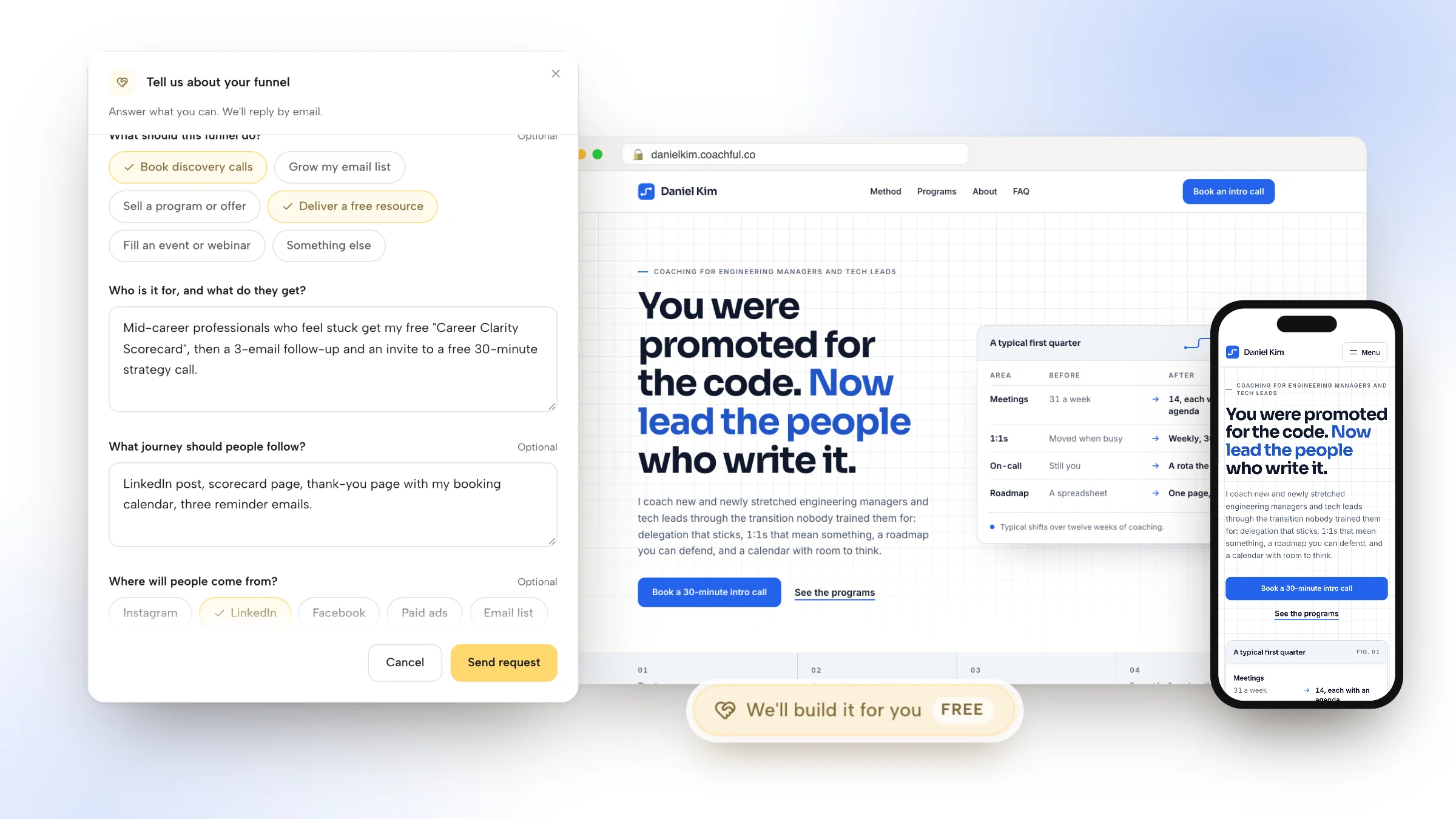
Below you'll find the skills you'll coach, who your clients are and who pays (often a parent), how to run the first meeting, the training stack worth building, what the research supports, a semester plan, pricing and the tools that keep it going. When you launch, Coachful's team will build your executive function coaching website for free on every plan.
What executive function coaching works on
Executive functions are the mental skills that let us plan, focus, switch gears and juggle tasks. Harvard's Center on the Developing Child describes them as the brain's air traffic control system. Adele Diamond's widely cited review in the Annual Review of Psychology names three core executive functions: inhibition (self-control and focused attention), working memory and cognitive flexibility. Coaching turns those abstractions into habits.
| Skill | What it looks like when it's hard | A coaching move |
|---|---|---|
| Task initiation | The essay is due Friday and it's Thursday night | A first step small enough to start in two minutes, scheduled for a specific time |
| Planning and prioritizing | Everything feels urgent, so nothing gets done | A weekly plan with three priorities and backward-planned deadlines |
| Working memory | "I forgot we had a test" | One capture system and a daily check of it |
| Time management | Twenty minutes becomes two hours | Estimate, time, compare; repeat until estimates improve |
| Organization | Papers, files and tabs everywhere | A single place for each thing and a weekly reset |
| Emotional control | One bad grade derails the week | A plan for the bad day, agreed in advance |

Who your clients are, and who pays
Most executive function coaching happens in three markets:
- Middle and high school students, where a parent finds you, pays you and wants updates.
- College students, often far from home for the first time, with the parent still paying.
- Adults, including professionals with ADHD, who hire and pay for themselves.
When a parent pays for a teenager, agree three things in writing at the start: what the parent will hear (usually attendance and the broad plan), what stays between you and the student (the details of what they say), and what you'll always pass on (safety concerns). Teenagers open up when they trust the boundary. Our guide to confidentiality with clients covers how to write it.
The first meeting with a student and a parent
The intake sets the tone for the whole semester, and it's where most new coaches talk too much. A shape that works:
- Ten minutes with the parent and student together. What's going wrong, in the parent's words, then in the student's. Notice where they disagree.
- The confidentiality agreement, read out loud, so both hear the same rules.
- Twenty minutes with the student alone. Ask what a good week would look like to them, what they've already tried, and when work goes best. Students who've had years of adults fixing them often perk up at that last question.
- One experiment for the coming week, chosen by the student, written down in their words.
- A two-line note to the parent afterwards: what you'll work on and when the next session is. Nothing the student said in private.
Our guide to running a first coaching session has more questions you can borrow.
Where executive function coaching stops
You coach skills. Other people assess and treat:
- Evaluations for ADHD, learning disabilities or other conditions are done by psychologists, neuropsychologists and physicians, or by the school through its own evaluation process. A coach doesn't diagnose or "screen".
- School plans such as an IEP or a 504 plan belong to the school team and the family. You can help a student use their accommodations.
- Therapy is the right call when anxiety, depression or school refusal is the main block.
- Tutoring teaches the subject. Coaching teaches the student how to manage the work. Many families need both; say clearly which one you're offering.
Most executive function coaches meet ADHD often, so read our sibling guide on how to become an ADHD coach for the clinical boundaries in more depth.
Training: build your own credential stack
Because no single board governs this niche, buyers judge you on a combination of training, background and results. We couldn't find an independent credentialing body for executive function coaching in October 2026; private companies sell executive function coach certificates, so check what any one of them is accredited by before you pay. A stack that holds up:
| Layer | Options | What it signals |
|---|---|---|
| Coaching skill | An ICF-accredited program and, later, the ICF ACC (60 hours of education, 100 coaching hours) | You can coach, not only advise |
| ADHD and executive function training | Programs on the ADHD Coaches Organization's accepted list, which are ICF-accredited and include at least 35 hours of ADHD-specific training, such as ADDCA or JST Coaching & Training | You understand why these skills break down |
| A specialist credential | PAAC's ADHD coaching credentials (CACP, PCAC) | Recognition in the ADHD community |
| Your background | Teaching, special education, school counseling, tutoring, occupational therapy | Parents trust people who know how schools work |
If you're a teacher, your classroom years count for more with parents than any certificate, so lead with them. Our sibling guide to ADHD coach certification compares the ADHD-specific programs.
What the research supports
Two findings are worth knowing. First, Diamond's review concludes that executive functions are trainable and improve with practice, and that stress, lack of sleep, loneliness and lack of exercise all impair them. That gives coaching two jobs: practice the skill and protect the conditions for it. Second, the best-known evaluation of coaching on these skills, Prevatt and Yelland's study of 148 college students with ADHD, used executive functioning as its frame and found improvement on all ten study and learning-strategy measures after an eight-week program. The authors call it preliminary and ask for randomized trials. Present your work as skill-building with a good track record, not a guaranteed fix.
Design a semester of executive function coaching
The school calendar is your product design. A 14-week semester package might look like this:
| Weeks | Focus | Between sessions |
|---|---|---|
| 1 to 2 | Intake, one capture system, the weekly planning ritual | Daily check of the capture system |
| 3 to 5 | Task initiation and time estimates | A two-minute first step each school day |
| 6 to 8 | Backward planning for the first big deadline | Mid-week check-in message |
| 9 to 11 | Exam preparation plan and study blocks | Study sessions logged with a timer |
| 12 to 14 | Review what worked, plan the break, set up next term | A written plan the student owns |

Sessions of 30 to 45 minutes once a week, plus short check-ins, usually beat long sessions for this age group. Our guide on keeping clients engaged between sessions has more ideas for the in-between.
How to price executive function coaching
Coachful's rates data has no figure for executive function coaching. The nearest general band in the 2026 report is life coaching at $75 to $200 an hour (PayScale and practitioner reports), and the report rates the related ADHD and neurodivergent niche as medium to high on income with low saturation. Price by the semester or the month rather than by the session, because the check-ins are a large part of the value and because families budget that way. Offer a short summer "set up for next year" package as a second product. How to sell coaching packages online walks through the setup.
The tools an executive function coach needs
The system you give students has to be simpler than the one they're failing to use. In Coachful, the Focus & ADHD power-up is included in your membership, with an ADHD edition and a productivity edition:
- A Today board with one next action, three priorities, a timer and a wins jar.
- Break it down, which splits a big task into micro-steps and has an "I'm stuck" button.
- Routines for mornings, evenings and transitions, built from habits.
- Morning check-ins for the one thing and a short weekly review.
- A strategy library you assign per client and they rate.
Goals with milestones, a client app on iPhone and Android, booking with reminders and payments through your own Stripe account sit alongside it. See the Coachful page for ADHD coaches, which covers the same tools.


Let Coachful build your executive function coaching site
Parents of a struggling student want three things from your website: proof you understand their child, a clear description of how it works, and an easy first call. Coachful's team builds that site for free on every plan, inside your account. Coachful itself is a paid subscription, and you can start with a free trial.
Choose We'll build it for you · FREE under Create, or click Fill in a form on the Website page. List the pages (perhaps a page for parents and a page for students), what they should do and the path a visitor should take. Add up to 8 links and up to 10 files. The team replies by email with next steps, usually within about 24 hours, typical but not guaranteed.

A recent build for an author and speaker shows what a strong source document does: five pages built from the coach's own copy and photos, a new welcome homepage and a community signup page. Nothing is invented, including results or credentials. Logos, video and ads aren't part of the service. See what the free build covers.

Finding your first executive function coaching clients
- School counselors and learning specialists. They know which families are looking and can't offer weekly support themselves.
- Tutoring centers. Tutors see the planning problem every week and need somewhere to refer.
- Pediatricians and child psychologists who diagnose ADHD and get asked "what now?".
- Parent talks. A 45-minute evening at a school on "why smart kids miss deadlines" is a reliable early source of bookings.
- A short mini-course for parents on setting up a homework system, which our guide to creating a mini course shows how to build.
For readers who are parents rather than coaches, our sibling guide to executive function coaching explains how to choose a coach.
Frequently asked questions
Do you need a certification to be an executive function coach?
No. There's no license or single credentialing board. Most coaches combine ICF-accredited coach training with ADHD or executive function training and a background in education. Private companies sell executive function certificates; check what they're accredited by.
Can teachers become executive function coaches?
Yes, and they're among the most common. Teaching experience is valuable with parents and students. Add coach training, because coaching students to build their own systems is different from teaching them.
What is the difference between an executive function coach and a tutor?
A tutor teaches a subject. An executive function coach teaches the student how to plan, start, organize and finish the work across subjects. Many students benefit from both at once.
Is executive function coaching the same as ADHD coaching?
They overlap a lot. ADHD coaching focuses on people with ADHD and often covers wider life areas. Executive function coaching focuses on the skills themselves and also serves students and adults without an ADHD diagnosis.
How long are executive function coaching sessions?
Often 30 to 45 minutes once a week, with short check-ins between sessions. Students usually do better with frequent short contact than with long, infrequent sessions.
How much does an executive function coach charge?
Coachful's rates data has no specific figure. The nearest band, life coaching, runs $75 to $200 an hour in the 2026 report. Executive function coaches usually sell semester or monthly packages that include check-ins.
Will Coachful build my executive function coaching website for free?
Yes. Coachful's team builds coaching websites, booking pages and lead-magnet funnels for free on every plan. Fill in the form from Create or the Website page and the team replies with next steps, usually within about 24 hours. Coachful is a paid subscription; the build costs nothing extra.












