How to Find Community: Connect & Thrive as a Coach

Coachful
You're probably in one of two places right now.
Either you're craving a room where you can be honest as a coach. Not a noisy feed. Not another group where everyone is half-networking and half-performing. A place where you can ask, “How are you handling client resistance lately?” or “Has anyone rebuilt their offer after burnout?” and get real answers.
Or you're looking at your own business and realizing your clients need community too. They need accountability between sessions, peer perspective, and a place where momentum doesn't disappear the moment a call ends.
Both are the same problem. How to find community isn't just about belonging. For coaches, it's also about better decisions, stronger delivery, and a business that doesn't depend on one-to-one time alone.
Most advice on this topic is thin. It tells you where to browse. It rarely tells you how to choose well, enter well, or build something people stay in. That's where most coaches get burned. They join random groups, lurk, feel vaguely disappointed, and conclude that community “doesn't work for me.”
It usually isn't that community doesn't work. It's that the structure is wrong, the fit is off, or nobody is facilitating with intention.
Redefine Community from a Nice to Have to a Business Asset
The first mistake coaches make is treating community like a happy accident. Join enough spaces, comment enough times, and eventually your people will appear.
That's not how it works.
Community is not found but co-created through intentional micro-acts of vulnerability. Data shows that 78% of new coaching cohorts fail within 6 months due to passive facilitation, not lack of interest, and 64% of underserved professionals prefer micro-communities of 3 to 8 people over large networks, according to the Crosscut discussion on community discovery.
That should change how you think about the whole search.
Start with the job the community needs to do
A community can serve very different functions in a coaching business. If you don't define the job, you'll end up in rooms that drain you.
Ask yourself which of these you need:
- Peer processing: You want honest conversations with other coaches about delivery, boundaries, pricing, or confidence.
- Referral ecosystem: You want trusted peers who serve adjacent clients and can send or receive the right introductions.
- Client retention layer: You want your clients to keep engaging between sessions so results don't depend only on you.
- Thought partnership: You want sharper thinking, better feedback, and people who will challenge your blind spots.
- Identity support: You want a place where you don't have to explain your niche, your values, or the emotional labor of your work.
A leadership coach in a broad entrepreneur group often feels unseen. A health coach in a general “online business” space may get activity but not depth. An executive coach may get plenty of smart discussion and still find no room for confidentiality.
Those aren't small misses. They're signs that the room is doing a different job.
Practical rule: If you can't finish the sentence “I need this community to help me ___,” you're not ready to join anything yet.
Stop optimizing for size
Many coaches still assume a bigger room creates better odds. More members. More opportunities. More visibility.
Sometimes it creates more noise.
Small, high-trust groups often outperform large public ones because people speak plainly there. They share draft ideas, client dilemmas, and messy transitions. That's where useful connection happens. Not in a thread full of applause emojis and vague encouragement.
A simple contrast helps:
| Community type | What usually works | What often fails |
|---|---|---|
| Large public group | Discovery, light networking, trend spotting | Depth, trust, confidentiality |
| Curated peer circle | Honest feedback, referrals, accountability | Scale, constant new reach |
| Client community | Retention, implementation, peer learning | Works poorly if it becomes content dumping |
Think like a builder, even when you're joining
The coaches who benefit most from community don't enter as consumers. They enter as contributors and co-designers.
That means you're not asking, “What can I get from this group?”
You're asking, “Can I help make this room more useful, more generous, and safer?”
That mindset matters for your own growth. It also trains you to build better spaces for clients later.
If you've felt disappointed by community before, don't conclude you're bad at it. Usually, you were trying to “find” what needed to be shaped.
The Modern Coach's Map to Finding Your People
Start broad, then narrow fast. Most coaches do the opposite. They either wander mainstream platforms for months or jump into an expensive niche room before they know what they're screening for.
The practical path is a layered search.
A visual map helps anchor that process:
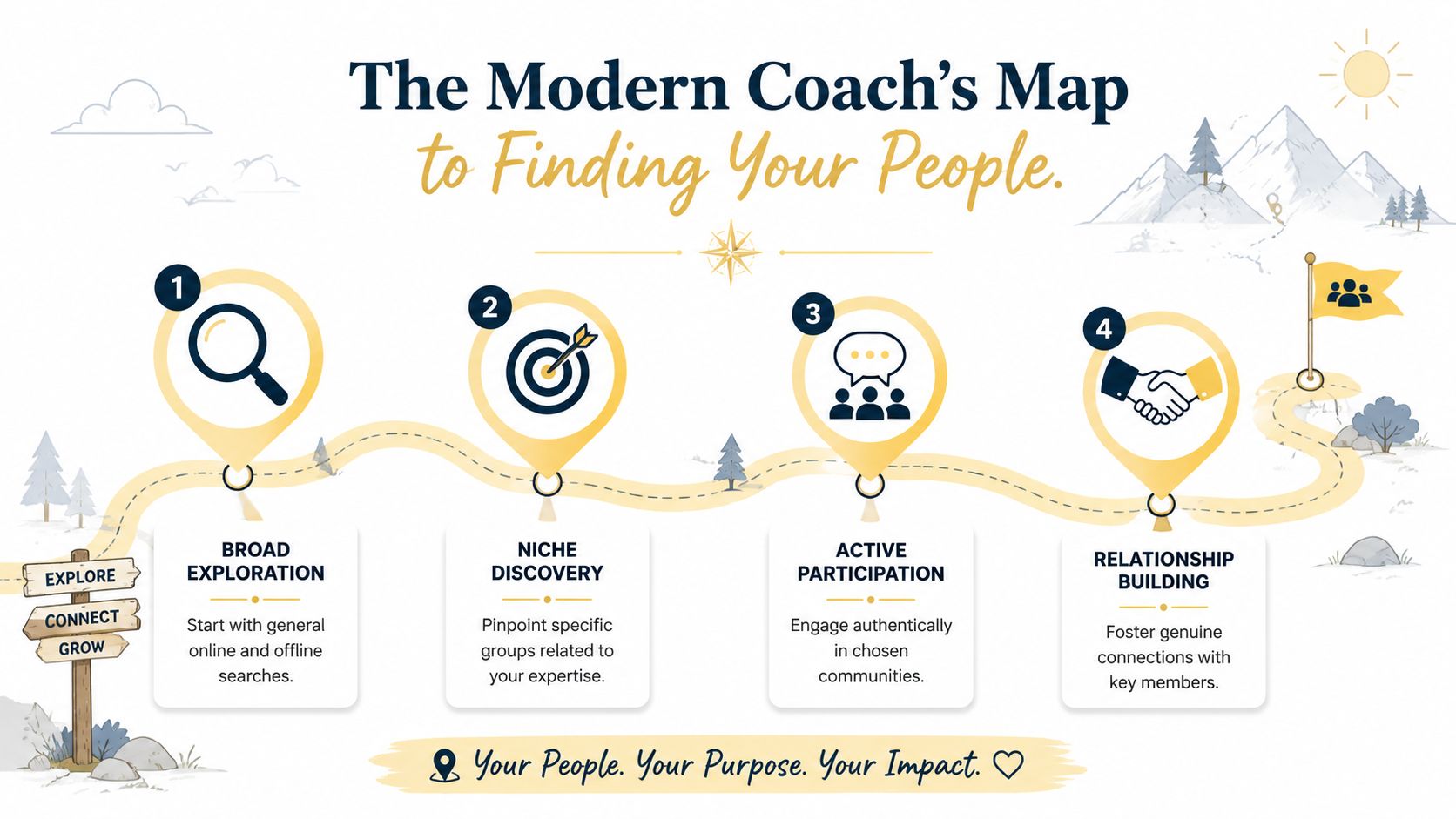
Use a four-layer search
Begin with places that are easy to access, then move toward spaces with tighter fit and stronger trust.
Public discovery channels
Search LinkedIn groups, niche subreddits, association communities, event listings, and local meetups. This layer is useful for seeing who's active and what language people use.Professional adjacency channels
Look for communities one step beside coaching. HR leaders, L&D practitioners, founders, therapists, wellness operators, DEI practitioners, and facilitators often gather in more focused spaces than coaches do.Paid or curated rooms
Masterminds, membership communities, cohort programs, and paid peer circles usually have clearer norms. Payment alone doesn't guarantee quality, but it often filters out drive-by participation.Invitation-only networks
These are often where the best conversations happen, especially for sensitive niches.
Search for safety, not just relevance
This matters more than most articles admit.
Research from UC Davis Health shows that 71% of underserved communities avoid public platforms due to fear of marginalization. A 2025 trend also indicates that 58% of niche coaches now use invitation-only cohorts with encrypted messaging, as noted in the UC Davis Health partnership report.
If you coach in a stigmatized, specialized, or confidential niche, open forums may be the wrong starting point. That includes coaches serving LGBTQ+ clients, executives in crisis, health-related populations, or corporate leaders navigating politically sensitive issues.
Use search queries that reflect how people gather:
- For peer support: “executive coach peer mastermind confidential”
- For niche identity fit: “ADHD coach private community” or “LGBTQ leadership coach network”
- For local trust-building: “facilitator meetup [city]” or “leadership development roundtable [city]”
- For protected rooms: “application only coaching cohort” or “private Signal group coaches”
- For platform-based alternatives: if you're comparing private group environments beyond Discord, this guide to apps similar to Discord for communities is a useful starting point
Watch how people talk before you join
You can learn a lot before ever applying.
Read posts, event pages, and comments. Do members ask sharp questions or just broadcast? Do organizers talk about outcomes, confidentiality, and participation norms, or only growth and visibility? Do members sound relaxed, or are they performing expertise every minute?
That language tells you what the room rewards.
The video below gives a useful frame for thinking about connection in a more intentional way:
Don't ignore offline proximity
Online discovery is efficient. Offline contact accelerates trust.
A strong pattern for coaches is this: discover online, deepen offline, then maintain digitally. A conference side dinner, a local breakfast for consultants, or a workshop after-session can turn weak ties into real peers.
The best community fit often reveals itself in small side conversations, not the official room.
If you're trying to learn how to find community, don't ask only, “Where are coaches?” Ask, “Where do the people I trust already gather when they're not selling?”
That question usually leads somewhere better.
How to Audit a Community Before You Join
A community can look active and still be a bad bet. A busy feed can hide weak moderation, shallow exchange, and member churn.
Before you join, audit the room the same way you'd assess a program partner, a subcontractor, or a coaching certification. You're investing social capital, attention, and emotional bandwidth.
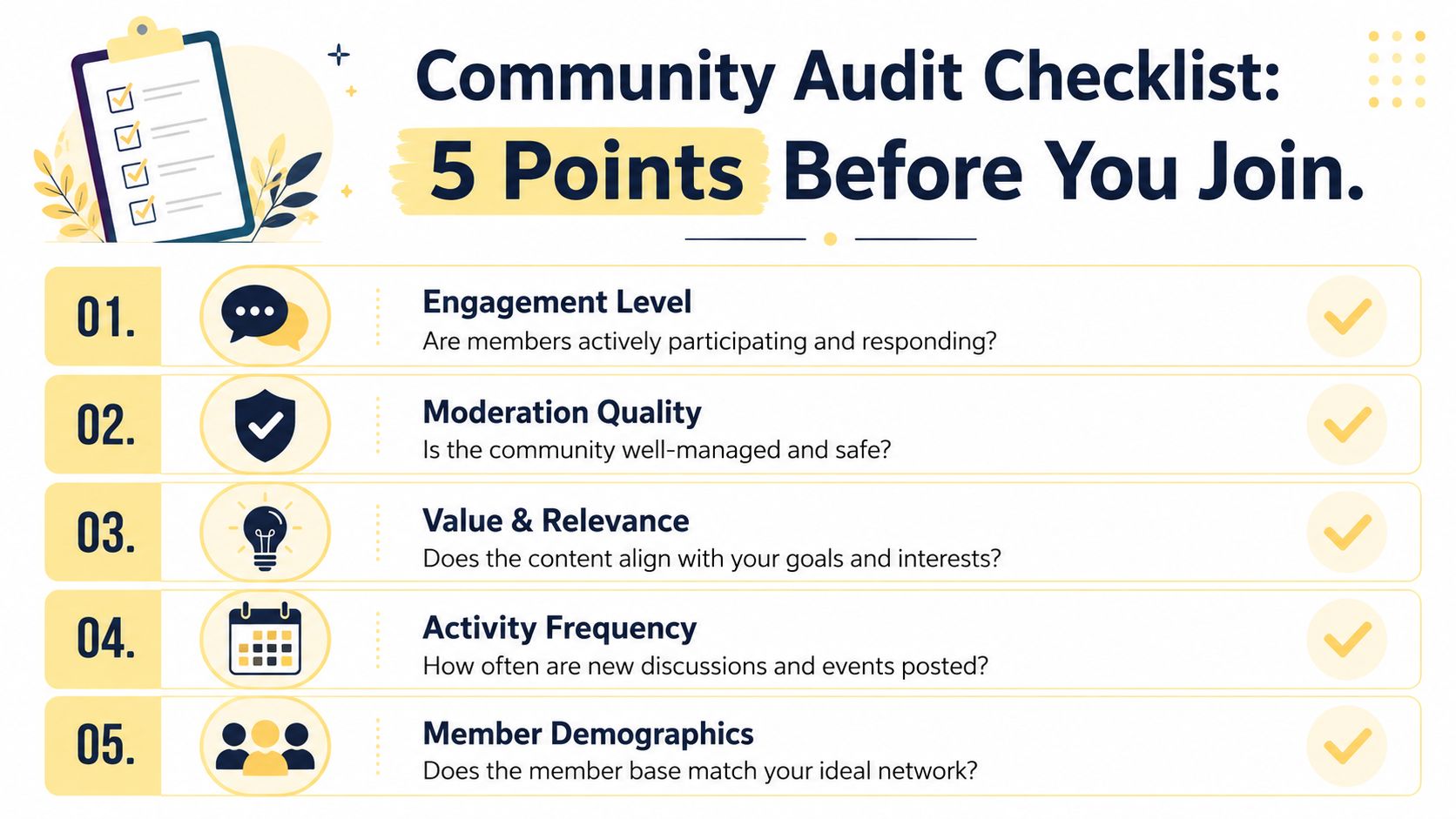
The five-point audit
1. Engagement quality
Ignore member count first. Look at the last stretch of conversation. Are there thoughtful replies, follow-up questions, and actual problem-solving, or is everything promotional? One sharp exchange is worth more than fifty shallow comments.
2. Moderator presence
A room without visible stewardship usually decays. You want to see hosts welcoming people, redirecting off-topic posts, and shaping the tone. If moderators only appear when they're selling, that tells you a lot.
3. Member-to-member generosity
Good communities don't depend on one central personality for every useful interaction. Members help each other. They share context. They point people toward resources, intros, and perspective.
4. Clear boundaries
Read the rules before reading the testimonials. If the norms are vague, the experience usually is too. This breakdown of community rules that shape healthy participation is a good benchmark for what to look for.
5. Demographic and stage fit
A community can be healthy and still be wrong for you. A brand-new coach in a room full of mature agency owners will likely feel out of step. A coach serving corporate buyers may not get useful traction in a creator-heavy room.
Use demographic thinking, not just instinct
Demographic research confirms that 72% of U.S. adults report difficulty finding community in their local area. Community organizers use tools like the U.S. Census Bureau's QuickFacts to identify demographic concentrations and mismatches, as explained in Candid's guide to demographic information on your community.
The lesson for coaches is simple. Fit isn't random. It can be assessed.
You don't need census tables to apply the principle. You need to ask:
- Career stage: Are people at my level, or at least close enough that the conversation is relevant?
- Client type: Do members serve similar populations or buying environments?
- Communication style: Is this room reflective, fast-moving, academic, tactical, warm, blunt?
- Life reality: Are members balancing similar pressures, such as parenthood, corporate work, health constraints, or identity-based labor?
Red flags that save you time
A few warning signs usually justify a quick exit:
| Signal | What it often means |
|---|---|
| Lots of posts, few real replies | Performance over support |
| Constant pitching | Members are hunting, not relating |
| No visible onboarding | New people won't integrate well |
| Unclear privacy expectations | Sensitive conversation will stay shallow |
| Host disappears for stretches | Energy depends on luck |
If a community makes you feel like you need to armor up before you even post, it's not a good room for growth.
A solid audit takes minutes, not months. Trust your observations sooner.
From New Member to Valued Contributor
Most coaches enter a new community too cautiously or too transactionally.
Too cautious looks like lurking for weeks, saying nothing, and forming the impression the room feels cold. Too transactional looks like introducing yourself with a polished mini pitch and wondering why nobody bites.
There's a better middle ground. Join like a peer, not a prospecting machine.
Your first post sets the tone
When a new member's first post gets no response, they're very likely to leave. Gallup research shows that 78% of new community members disengage within 7 days if their first post is ignored, according to The Fully Booked Coach on building a coaching community.
That tells you two things.
First, your own introduction needs to invite response. Second, if you want to become valuable fast, reply to newcomers. People remember who made the room feel human.
A useful introduction post usually includes three elements:
- Who you help: “I coach new people managers in fast-growing companies.”
- What you're navigating: “Lately I've been reworking how I handle accountability between sessions.”
- An easy invitation: “If anyone else has tested light-touch community support for clients, I'd love to compare notes.”
That works better than listing credentials, dropping your website, and saying you're “excited to connect.”
A simple integration pattern
The fastest way to belong is to reduce friction for other people.
Try this in your first two weeks:
Reply to open questions you can help with Not every thread needs a masterclass. A clear paragraph, a practical example, or a thoughtful follow-up question is enough.
Welcome new members
If someone introduces themselves, answer them. Ask what kind of clients they coach or what they're building. This is one of the easiest trust-building moves in any room.Share something unfinished
Not your deepest vulnerability on day one. Just something real. A workshop idea you're testing. A boundary you're refining. A pattern you've noticed with clients.Connect people when there's an obvious fit
“You two are both working with internal leadership cohorts. Worth talking.” That kind of bridge-building gets noticed.
For coaches who want a more deliberate approach, this guide to a community engagement strategy is useful because it focuses on consistent participation rather than bursts of visibility.
Be the person who lowers social friction. Communities keep those people close.
What not to do
A short example makes the difference clear.
Coach A joins a private group for leadership coaches. She posts a polished bio, mentions her package, links to her calendar, and disappears until she has another offer. People scroll past.
Coach B joins the same group. He introduces his niche, mentions he's rethinking how he handles quiet clients between sessions, replies to two other members, and welcomes a newer coach later that week. Within a month, people tag him in relevant threads.
Neither person was louder. One behaved like a future peer.
That's how to find community in practice. You don't just locate it. You help stabilize it.
A Coach's Blueprint for Building a Thriving Client Hub
At some point, many coaches realize they've outgrown borrowed spaces. Social platforms are useful for discovery, but they're weak foundations for sustained client transformation.
If you're building a client community, start with purpose before platform.
The “Why, Not Who” methodology results in 82% higher long-term engagement. Communities that avoid the content-only trap by integrating events see 57% higher retention, and weekly highs and lows threads can increase active participation by 2.9x, according to Profi's community-building guidance for coaching businesses.
Build around the transformation, not the topic
Many client communities fail because they're organized around a broad label. “Mindset.” “Wellness.” “Business growth.” Those themes are too loose to create useful behavior.
A stronger starting point sounds more like this:
- For executive coaching clients: “A place to practice difficult leadership conversations between sessions.”
- For health coaching clients: “A space to report daily choices, recover quickly from setbacks, and see what consistency looks like in real life.”
- For founders: “A room for weekly decision-making, not just motivation.”
That creates behavioral clarity. Members know why they're there and what kind of participation matters.
Choose a platform based on rituals
Don't choose a platform because it's trendy. Choose it based on what your community must repeatedly do.
Ask practical questions:
| Need | What your platform must support |
|---|---|
| Ongoing discussion | Posts, replies, notifications, simple mobile use |
| Accountability | Check-ins, streaks, prompts, visible progress |
| Live connection | Events, workshops, office hours, group calls |
| Confidentiality | Clear permissions, private spaces, controlled access |
| Program structure | Modules, assignments, resources, milestones |
Facebook groups still matter. Over 90% of successful coaching communities initially launched there before diversifying, according to Simone Vincenzi's guide to community building for coaches. That doesn't mean Facebook is right for every client base. It means convenience often wins in the beginning.
Other coaches prefer a dedicated environment with coaching workflows attached. For example, Coachful includes community features alongside onboarding, scheduling, messaging, progress tracking, and group program delivery, which can make sense if you want community tied directly to client accountability.
Install rituals before you add more content
Most coaches overbuild content and underbuild interaction.
Use a few repeatable rituals instead:
Weekly highs and lows thread
Clients share one win and one difficulty. This creates honesty without forcing deep disclosure too fast.Prompted implementation check-ins
Ask what they tried, what got in the way, and what they'll adjust next.Live working sessions
Not every gathering should be a teaching call. Quiet co-working, hot seats, or planning sessions often create stronger momentum.Member recognition
Highlight useful contributions, not just big achievements. Someone asking a brave question can move the group forward as much as someone reporting a win.
Clients don't need an endless library. They need repeated reasons to return, participate, and feel seen.
Piloting and Proving Your Community's Value
Most coaches make community harder than it needs to be because they think they must launch big. New brand, polished curriculum, full calendar, perfect onboarding, constant activity.
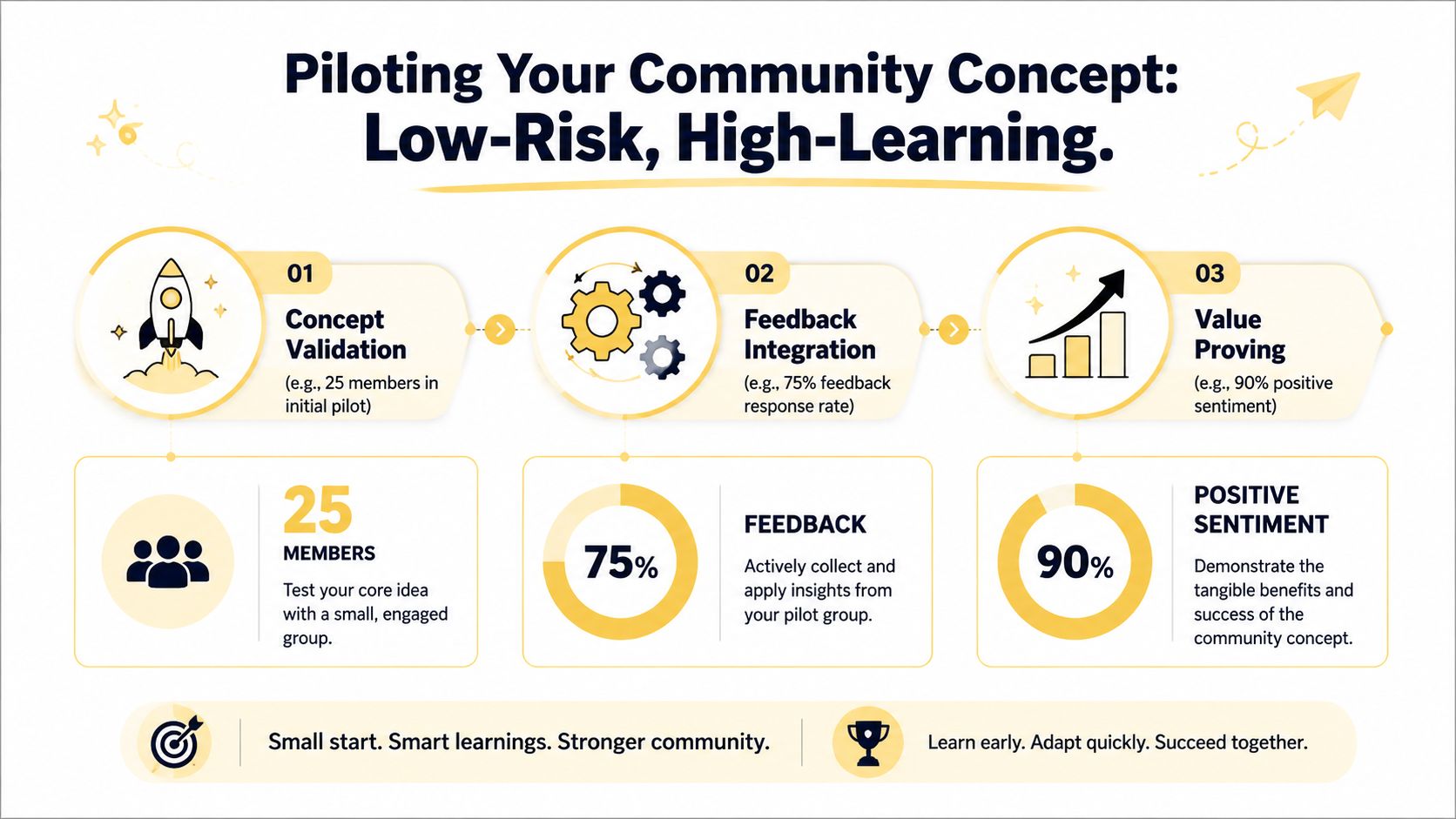
You don't need a launch. You need a pilot.
A pilot gives you something far more useful than early scale. It gives you evidence. You learn who participates, what people ignore, which prompts create honesty, and where your facilitation bottlenecks are.
Use a light structure that people can follow
The ABC framework, Acknowledge, Build, Conclude, shows a 78% member retention rate versus 42% in unstructured groups. Creating formal digital coffee shop spaces can also increase daily engagement by 3.2x, according to GoE's article on building online learning communities.
That framework is practical for coaches because it's simple.
What a small pilot can look like
Acknowledge
Open with introductions that go beyond job titles. Ask each member to share what they want support with, what usually derails them, and one non-obvious fact about how they work best. This gives people handles for connection.
Build
Run the smallest useful set of rituals for a limited period. One weekly discussion prompt. One live session. One informal “digital coffee shop” thread for casual conversation. One accountability touchpoint tied to real client goals.
Conclude
Close each cycle clearly. Ask what mattered, what felt awkward, and what they want more of. Endings are part of retention because they help members process value.
Measure behavior, not just sentiment
You don't need complex dashboards at the start. You need signs that the room is helping.
Look for practical indicators:
- Return behavior: Do members come back without being chased?
- Peer response: Are they answering each other, or only responding to you?
- Carryover into coaching: Do sessions improve because clients reference community discussion?
- Emotional texture: Do posts move from polished reporting to honest reflection?
- Specific feedback: Can members name what the community is changing for them?
If a pilot produces polite praise but low participation, don't scale it yet. If a small group keeps showing up, answering each other, and using the space between sessions, you have something real.
Start with a room small enough that you can still notice every person.
That's the smartest way to prove value to yourself. It also protects your clients from becoming test subjects in an oversized experiment.
If you're building a coaching practice that needs stronger delivery, cleaner operations, and a client community that supports accountability between sessions, Coachful is worth a look. It combines core coaching workflows like onboarding, scheduling, messaging, payments, progress tracking, group programs, and community touchpoints in one place, which can make it easier to run a client hub without stitching together multiple tools.