LinkedIn About Section Examples for Coaches: 5 Drafts

Nour
Founder, Coachful
Does your LinkedIn About section make a suitable coaching prospect think, “This person understands my situation,” or just tell them you have collected a respectable number of certificates? Start with the reader’s specific decision, explain how your coaching works, add evidence you can substantiate and finish with one sensible next step. You do not need a dramatic origin story or a promise you cannot keep.
Below are five LinkedIn About section examples for coaches, each built for a different buying situation rather than a simple niche-name swap. All are fictional writing examples, not real coach profiles, testimonials or proven conversion formulas. Replace the details with your own practice before using any wording.
What should a coach put in a LinkedIn About section?
Give the reader five answers: who you work with, what brings them to coaching, what the work involves, why your experience is relevant and how to explore fit. Write in the first person unless you have a compelling reason not to. On a personal profile, “I coach” generally feels more direct than a miniature press biography about yourself.
Your LinkedIn headline identifies the work in a small space. The About section develops the argument. Your website then supplies the detail someone needs before booking or applying. These surfaces should agree, but they do not need identical copy.
- Opening: a recognizable situation, not “passionate about empowering individuals.”
- Focus: the audience and work you actually support.
- Method: what happens in and between sessions.
- Evidence: relevant, accurate qualifications or experience.
- Next step: one route that matches the reader’s readiness.
Give the opening special attention because readers may encounter a collapsed version before expanding the text. Do not build around a supposedly universal number of visible lines or characters: presentation can vary with device and interface changes. Check your actual profile on desktop and mobile after saving.

1. Career coach: help a reader evaluate a consequential change
Use this approach when: an individual pays for help with a career decision and needs to understand the process before booking. The opening names the decision, not an employment outcome you cannot control.
You can be good at your job and still be unsure whether you want another five years of it.
I coach experienced professionals who are considering a career change but do not want to make an expensive leap on the strength of one difficult week.
We work through the decision before rushing to the application stage: what you want to keep, what needs to change, which options deserve testing and what practical constraints matter.
Sessions combine reflection with small experiments between meetings. That might mean investigating a different role, speaking with someone doing the work or comparing two realistic paths against your priorities.
My relevant background is [accurate coaching qualification and relevant professional experience]. Coaching is not recruitment, and I do not promise a job offer or a particular salary.
If you are weighing a change, read the career-coaching overview in my Featured section. It explains the format, investment and purpose of an initial conversation.
Why this version is useful: it gives a cautious buyer permission to investigate without pretending they must resign to demonstrate commitment. The process is visible: clarify, test, compare. “Get unstuck” becomes a set of activities someone can evaluate.
Change before using: remove any activity you do not deliver. If you also provide CV writing or interview preparation, distinguish that service from reflective coaching rather than suggesting every client receives it. State a qualification only in the exact form you hold.

2. Executive coach: distinguish the participant from the buyer
Use this approach when: your work may be commissioned by an employer, so both a leader and a sponsor need to understand the engagement. This version acknowledges the commercial structure without turning the About section into a procurement document.
A larger leadership role changes the decisions you have to make, not just the title on your email signature.
I coach leaders moving into broader responsibility, particularly when delegation, difficult conversations and competing stakeholder expectations start to collide.
We work with situations from the leader’s actual week. Together we examine options, rehearse conversations where useful and agree experiments the leader can test at work.
For employer-funded engagements, I clarify the goals, roles and confidentiality arrangements with the leader and sponsor before coaching begins. Progress reporting is agreed, not assumed to mean access to private session conversations.
My relevant experience includes [accurate leadership background, coaching training or credential]. I describe only work and organizations I have permission to name.
If you are a leader or an HR partner exploring an engagement, use the executive-coaching enquiry page in my Featured section. Include whether you are enquiring for yourself or on behalf of an organization.
Why this version is useful: the two audiences do not have the same concern. A leader may want discretion and practical relevance; a sponsor may need scope and a clear buying route. Naming both is more useful than saying “trusted by ambitious leaders.”
Change before using: make the confidentiality statement match your actual contracting practice and applicable obligations. Do not promise that nothing can ever be disclosed. A public About section introduces the arrangement; the agreement must define it properly.

3. Business coach: define the work without promising revenue
Use this approach when: an owner is buying coaching for a business problem and may confuse coaching with implementation or consulting. This version is specific about the work while avoiding invented return-on-investment numbers.
When every business decision comes back to you, working harder can become a substitute for deciding what should change.
I coach owners of established service businesses who want to examine priorities, delegation and the decisions keeping the business dependent on them.
We start with a current business question rather than a standard motivational curriculum. That might be choosing what to stop offering, deciding which responsibilities to hand over or preparing for a difficult management conversation.
You bring the information you are comfortable sharing. I help you test assumptions, compare options and agree actions you can review at the next session.
My background is [accurate business experience and coaching training]. This service is coaching, not outsourced operations, regulated financial advice or a guarantee of revenue growth.
See the owner-coaching page in my Featured section for the scope and engagement format. If it fits the decision you are facing, that page explains how to arrange an introductory conversation.
Why this version is useful: the reader can recognize an operational problem without being promised a seven-figure business. It also separates thinking support from execution. That boundary matters if your prospect expects you to build a sales funnel or manage employees.
Change before using: if your offer genuinely combines coaching and consulting, describe both and explain how you agree the mode of work. Do not copy the coaching-only exclusion while selling implementation elsewhere on your profile.

4. New coach: be credible without borrowing someone else’s track record
Use this approach when: you are early in practice, have limited coaching experience and still need to explain why a conversation could be worthwhile. This is not a license to hide your training status or present unrelated career experience as years of coaching.
Starting your first management role can mean becoming responsible for conversations nobody taught you how to have.
I am building my coaching practice around first-time managers who want a place to think through delegation, feedback and the transition from colleague to manager.
My approach is practical and reflective. We agree a question for the session, examine a real situation and finish with an action or experiment you choose.
Before training as a coach, I worked in [accurate relevant role or setting]. My current coaching training status is [exact completed qualification or clearly stated training in progress]. I do not claim a credential I have not earned.
I currently offer [accurate format, including any practice or pilot arrangement]. The scope, terms and any fee are explained before anyone commits.
If that sounds relevant, read the practice overview linked in my Featured section. It explains who the offer is for and what an initial conversation covers.
Why this version is useful: it replaces inflated authority with a narrow, understandable service. A new coach does not need to sound like a veteran. They need to make it easy to assess competence, fit and the arrangement being offered.
Change before using: keep only experience that helps explain the service. Being a manager for a decade is not a decade of professional coaching. If a qualification is in progress, name that status plainly. If a pilot is paid, say so before someone books expecting free practice.

5. Multi-offer coach: give the profile one primary job
Use this approach when: you offer private coaching, workshops and perhaps speaking, but a list of every service makes the profile hard to understand. Choose the audience and buying route you most want the profile to serve. Secondary offers can remain visible without becoming competing opening statements.
Teams do not need another conversation about communication that changes nothing about the next meeting.
I work with managers who want to improve the conversations that shape everyday work: expectations, feedback, disagreement and decisions.
My main offer is coaching for individual managers. We use current work situations to examine choices, practise language where useful and review what happens when the manager tries a different approach.
I also facilitate workshops for organizations working on the same themes. A workshop is a separate engagement with its own objectives and scope, not a substitute for a private coaching relationship.
My relevant background is [accurate experience and qualifications]. I work within my competence and agree the purpose and boundaries of each engagement before starting.
The manager-coaching overview is in my Featured section. If you are commissioning a team workshop instead, the same website has a clearly labeled workshop enquiry route.
Why this version is useful: there is a primary service and a recognizable secondary route. The coach is not pretending that an HR buyer and an individual manager need the same booking form or that all three services are one package.
Change before using: choose the right primary offer for your business. If corporate workshops are the main commercial priority, lead with the organizational decision instead. A personal profile can contain several offers; it should not make a new visitor design your sales process.
Make the destination deliver the promise
An About section can be accurate and still lead to a confusing experience. If it promises career-change coaching but the destination opens with a leadership program, the visitor has to work out whether they are in the wrong place. Fix that mismatch before writing a cleverer opening.

Check the actual page named in the About section. It should explain the same audience, service scope, format and next step. Include material terms at the appropriate point before commitment, rather than using the profile’s limited space to hide surprises about fees or eligibility.
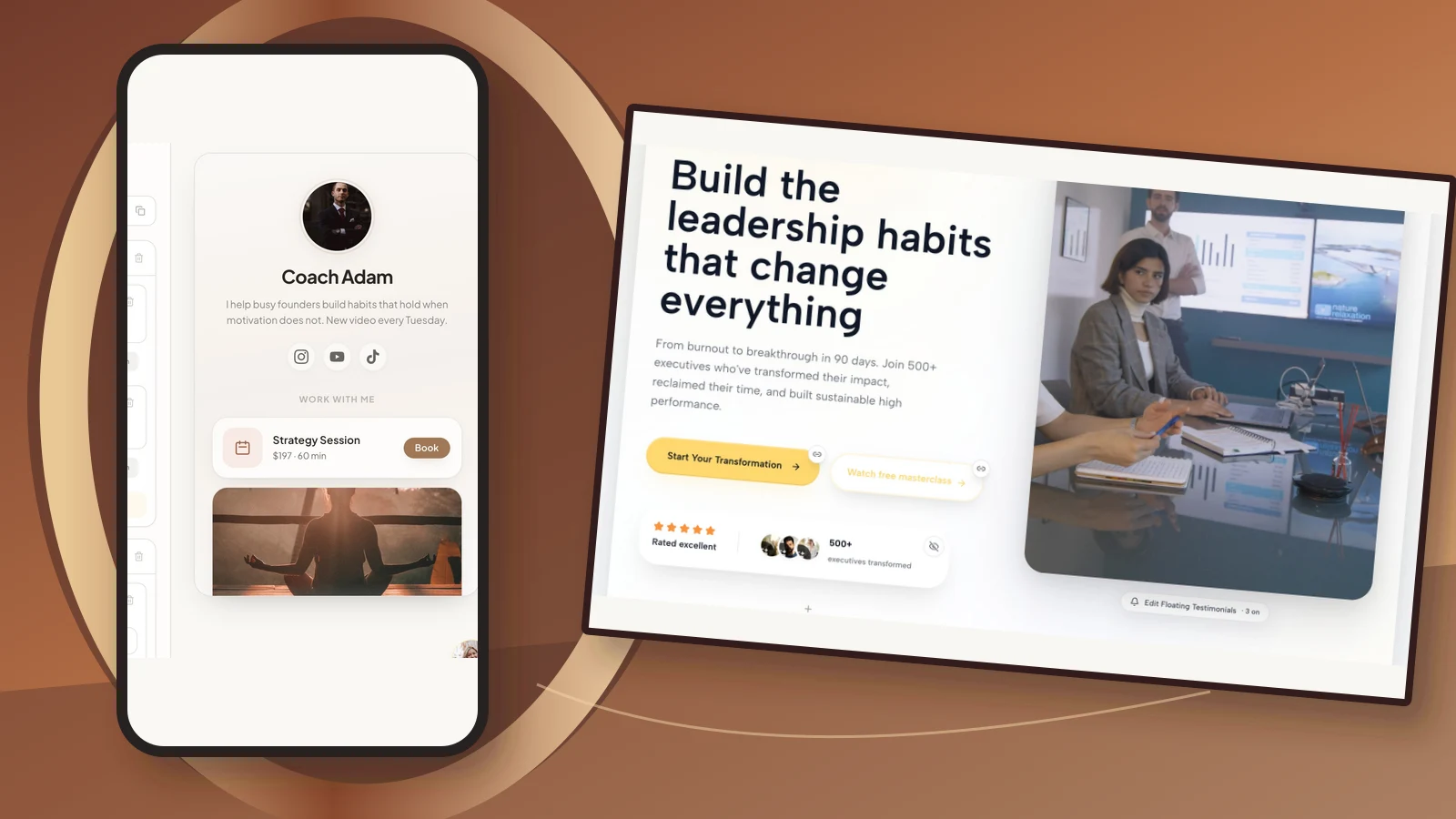
A website builder can help you maintain that destination, but it cannot decide your positioning for you. The real Coachful demo editor shown here illustrates editing the destination’s message. It does not publish changes to LinkedIn or prove that a particular profile generates enquiries.

Keep the action specific: read an offer overview, enquire about a corporate engagement or book a defined fit conversation. If you direct people to Featured, make the relevant item easy to identify and test it while signed out. Do not assume every URL pasted into About will behave as a prominent clickable booking button.
A copyable drafting template
Write the rough version in plain text first. Complete these five sentences with facts, then remove the labels and edit the transitions. The template is a thinking aid, not copy you must squeeze into an identical rhythm.
- Situation: “You are [specific audience] facing [recognizable decision or difficulty].”
- Focus: “I coach [audience] on [bounded area of work].”
- Process: “We work by [what happens in sessions], followed by [accurate between-session arrangement].”
- Evidence: “My relevant background is [verifiable experience, qualification or current training status].”
- Action: “To explore fit, [one action] at [clearly identified destination].”

Read the result aloud. If you would never say “catalyzing exponential personal transformation” in an introductory conversation, do not put it in the profile. Replace the phrase with something a reader could picture you doing together.
A practical review before you save
- Recognition: would the intended buyer recognize their situation in the opening?
- Boundaries: is the scope consistent with your competence and offer?
- Proof: can you substantiate every credential, named organization and result?
- Consent: do you have permission for any identifiable client material?
- Consistency: do the headline, About section and destination describe the same work?
- Usability: does the text read cleanly on mobile, and does the next step work for someone signed out?
Review wording after real enquiries, not every time a post receives fewer reactions. Notice whether suitable people understand the service and whether the same misunderstanding keeps appearing. That feedback can inform a revision; it does not isolate the About section as the cause of a booking.
Common questions
How long should a coach’s LinkedIn About section be?
Long enough to answer the five questions without turning into a résumé. A few short paragraphs are a sensible drafting starting point, not a proven optimum. Use the current editor’s limit, check the collapsed opening and cut repeated credentials or claims before cutting necessary scope information.
Can I use these examples if I have no testimonials?
Yes. None requires an invented client story or result. Use relevant experience and accurate training information, then make the process concrete. If you add a testimonial later, obtain appropriate permission and avoid implying that one person’s outcome is typical or guaranteed.
Should I put keywords in my About section?
Use ordinary service language a reader understands, such as career coaching or executive coaching, where accurate. Avoid repeating specialties you do not offer. These examples are not a promise of LinkedIn rankings, profile views or lead volume.
Should I copy my website About page?
Use the same facts, but adapt the job. A website can provide fuller detail and navigation. The LinkedIn section needs to orient someone within a professional profile and show the next relevant route. For the longer page, use our coach About page guide.
Your next useful edit
Choose the example that matches your buying situation, write a factually accurate version and test the destination it names. If you need to see how a public coaching profile and an offer destination could support that next step, try the interactive Coachful demo. Explore the real profile, link and website surfaces before deciding what your own prospect should encounter.
Editorial note: all profile drafts and annotations are original fictional examples. Demo screenshots contain sample people, credentials, claims and prices, not independently verified coach results or Coachful subscription pricing. No LinkedIn integration or automatic profile editing is implied. Search research checked coach-specific About and summary examples; it does not establish search volume or conversion performance.