
Practice Better EHR: What It Does and Who Needs One
The Practice Better EHR is the clinical record at the center of Practice Better. It holds session notes in SOAP, ADIME, DAP, BIRP or custom formats, protocols and labs attached to those notes, a medication and supplement tracker, intake forms, food and lifestyle journals, and the billing and insurance records that come from each visit. Practice Better states that the system is HIPAA, PIPEDA, PHIPA and GDPR compliant.
That is exactly what a dietitian, nutritionist, functional medicine practitioner or therapist needs. Most coaches do not, and paying for an EHR you do not need adds clicks to every session. Below we explain what an EHR (and an EMR) actually is, what the Practice Better EHR includes, why clinicians are required to keep one, why coaches usually are not, and what a coaching client record should hold instead.
If you conclude you are running a coaching practice, Coachful's team will set up your coaching record, programs and website for you, free on every plan.
What an EHR is, and how it differs from an EMR
An electronic medical record (EMR) is the digital version of the paper chart a clinician keeps on a patient: history, assessments, notes, treatment and results, inside one practice.
An electronic health record (EHR) covers the same ground but is designed to follow the patient: to be shared with other providers, labs and pharmacies, and to tie into billing and prescribing. In everyday use the two terms blur, and most software sold to small practices, Practice Better included, calls itself an EHR.
What makes either one an EHR is not the notes field. Any notes app has one. It is the combination of structured clinical documentation, privacy safeguards for health information, and the connections that let the record drive insurance claims and prescriptions.
What is inside the Practice Better EHR
From Practice Better's charting, billing and integration pages in October 2026:
- Charting. SOAP, ADIME, DAP and BIRP note formats, or a custom format, with saved snippets for recommendations you repeat.
- Clinical attachments. Protocols, labs and tasks attached directly to a session note.
- Medications and supplements. A tracker that shows active items side by side, fed from intake forms and protocols.
- AI help with notes. The AI Charting Assistant records, transcribes and summarizes sessions, in person or on video, and drafts notes for you to review. It starts at $10 a month as listed in October 2026.
- Client data. Intake forms, food and lifestyle journals, measurements and wearable data from Apple Health, Fitbit, Garmin and Oura.
- Billing and insurance. One-click superbills, CMS-1500 exports, and claims through Claim.MD and Office Ally.
- Prescribing. ePrescribe as an add-on at $49 a month plus $99 onboarding, and PDMP at $5 a month on top plus $399 onboarding.
- Labs and dispensing. Integrations with Fullscript, Fullscript Labs, Rupa Health, Evexia Diagnostics and WholeScripts.
- Security. AES-256 encryption in transit and at rest, and a public trust center.
Around that record sit the practice tools: scheduling, telehealth, a client portal, payments, programs and messaging. Plans run from free for 3 clients to $155 a month for a two-practitioner Team, as listed in October 2026; our Practice Better pricing guide has the full list.

Why clinicians need an EHR
For licensed health professionals, the record is not optional, and a good EHR does four jobs that a general tool cannot:
- It meets record-keeping rules. Licensing bodies and health privacy laws set what a clinician must document, how long to keep it and who may see it.
- It protects health information. In the US, HIPAA governs protected health information held by covered providers and the vendors who handle it for them. A compliant EHR, with a business associate agreement, is how most small practices meet that duty.
- It supports insurance. Claims need diagnosis and procedure codes backed by documentation. Superbills and CMS-1500 forms come out of the chart.
- It makes prescribing safe. Medication lists, interaction awareness and electronic prescriptions all depend on a structured record.
If any of those apply to you, choose an EHR first and fit everything else around it. Practice Better is a strong option for nutrition and integrative practice; we compare it with others in Practice Better vs Healthie and Practice Better vs SimplePractice.
Why most coaches do not need an EHR
Coaching is not treatment. A life, career, business, executive or mindset coach helps a client set goals and change what they do, without diagnosing or treating a condition, prescribing, or billing insurance. That removes the reasons an EHR exists: there are no clinical codes to document, no claims to file and no prescriptions to send.
Coaches still owe their clients care with information. You should keep sessions confidential, store notes securely, use a written coaching agreement that says what coaching is and is not, and be able to give a client their data or delete it on request. If you coach people in the EU or UK, GDPR applies to how you handle their personal data. None of that requires clinical charting formats.
A coaching note can be much simpler than a SOAP note. Five lines cover most sessions:
- Focus: what the client brought today, in their words.
- Insight: what shifted or became clear.
- Commitment: what they will do before the next session, and by when.
- Obstacles: what might get in the way, and the plan for it.
- Coach follow-up: anything you promised to send or check.
There are gray areas, covered below. But for most coaches, an EHR is a filing cabinet built for someone else's paperwork.
What a coaching client record needs instead
A coaching record answers different questions: what is this client working toward, what did they commit to, did they do it, and how are they feeling about it? Here is how the parts of an EHR map to a coaching record, using Coachful as the example.
| In a clinical EHR | In a coaching record | Where it lives in Coachful |
|---|---|---|
| Intake history | Intake answers and the client's goals | Intake questions on booking, forms and goals on the client record |
| SOAP or DAP note | Session notes, private or shared | Notes on each session; shared notes appear in the client's My Coaching |
| Treatment plan | Program with weekly goals and daily tasks | Programs, journeys and coaching flows |
| Food and symptom journal | Habits and check-ins | Habits with streaks; morning, evening and weekly check-ins |
| Consent and HIPAA forms | Coaching agreement | Agreements with e-signature, stored on the client record |
| Superbill | Invoice | An invoice for every payment, plus manual invoices |
| Outcome measures | Progress and engagement | Goal progress; a status of thriving, active, quiet or at risk |
| Records export | Data the client or coach can take away | Full client data ZIP with notes, check-ins, goals, habits, sessions and form answers |
On the coach's side, that record rolls up into one overview: who is thriving, who has gone quiet, task completion, check-in rate and mood, so you know where to spend your attention before the week starts.

On the client's side, it becomes their My Coaching page: the next session, what to prepare, and the few things waiting on them this week.

Check-ins are how a coaching record fills itself in. You design the flows and the days they run, and the answers land on the record.

And because coaching depends on your own methods, Coachful's Brain keeps your business knowledge in an editable library with sources, and opens Michelle, the AI assistant, in context when you want help preparing for a client.

Coachful is not HIPAA-certified. It is GDPR-ready, exports all client data as a ZIP, and is built for coaching rather than clinical care. More on how it holds a practice together on the coaching client management page.
Signs you are paying for an EHR you do not use
If you are on Practice Better or another EHR as a coach, check how many of these are true:
- You skip the note template every session and type into a free-text box.
- You have never created a superbill or exported a claim.
- Your clients have never opened a food or symptom journal.
- The things clients ask you about most (what to do this week, the group, the next call) live in other apps.
- You pay separately for a website, an email tool and a community, because the EHR does not include them.
Three or more yeses usually means the clinical layer is costing you clicks and money without protecting anything you need protected.
The gray areas: when a coach should keep an EHR
- Health coaches working inside a clinic. If you are part of a care team, document where the team documents, which is usually their EHR.
- Licensed professionals who also coach. A dietitian, nurse or therapist who adds coaching should keep clinical clients on the EHR and run coaching clients separately, with separate agreements. Our guide to keeping therapy and coaching separate shows how.
- Coaches who receive health information from clinicians. If a provider shares protected health information with you, ask whether you are acting as their business associate and what that requires.
- Clients with chronic conditions. Coaching them can be appropriate, but they may need a specialist tracker or a clinician alongside you. See when a health coach needs a second app.
When in doubt, ask your licensing body or a lawyer who works with health practices. This guide is not legal advice.
Have Coachful's team build your coaching setup, free
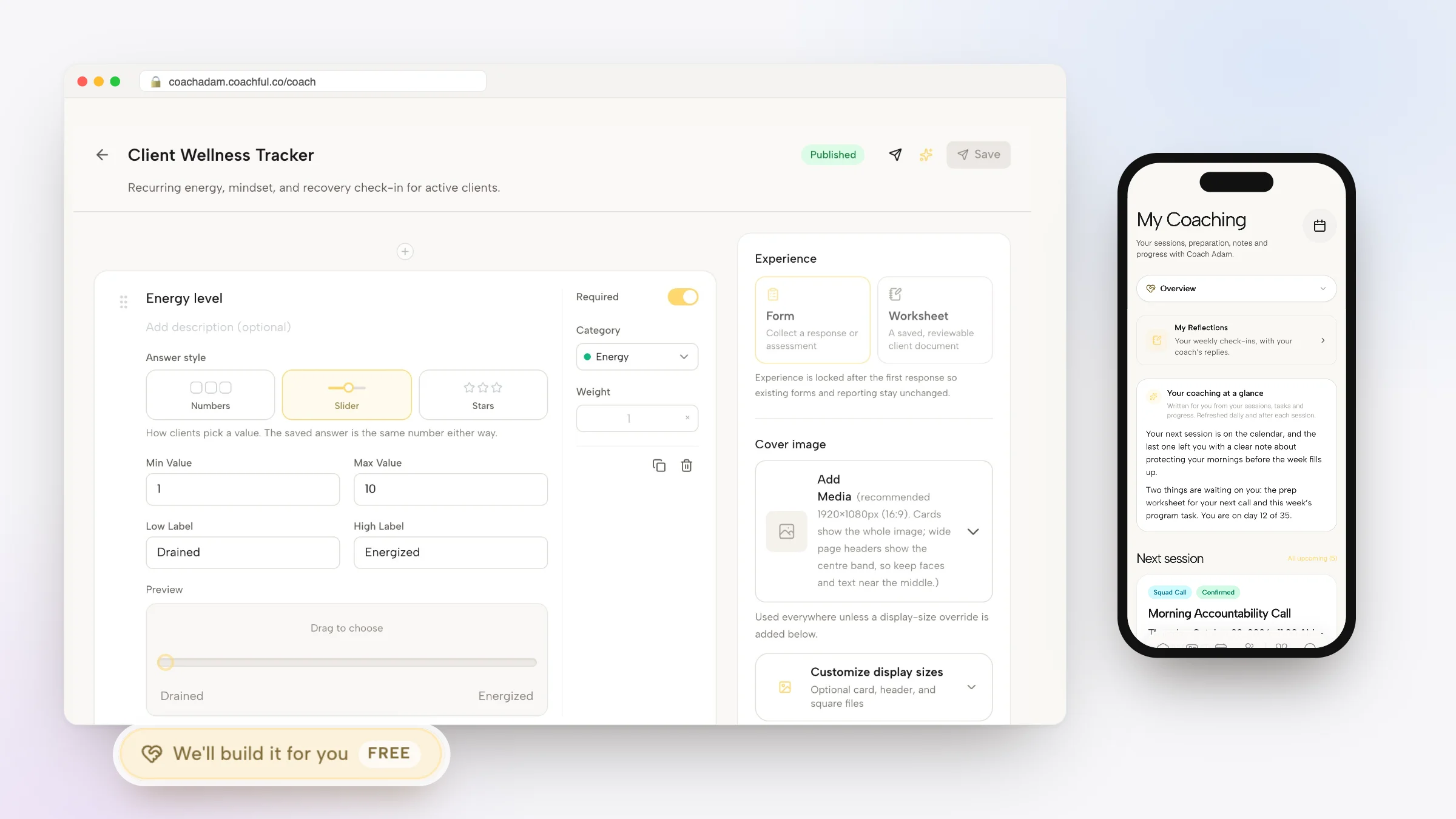
If you are leaving an EHR for a coaching platform, the setup is where the time goes. Coachful's white-glove build service is free on every plan. Ask from Create > We'll build it for you, or the Want us to build it for you? card on Website, Funnels or the Programs list, and choose what to build: a website, funnel, offer or sales page, program, course, journey or coaching flow, form or worksheet, or email sequence.
The website form asks which pages to create or improve, what they should do (book calls, collect leads, sell an offer, deliver a resource), what visitors should do next, which sites you like, and what feels confusing or unfinished. Attach up to 8 links and up to 10 files, such as intake forms, program outlines, your logo and photos. Video files are not accepted.

The Coachful team replies by email, usually within about 24 hours, and builds it inside your account so you can edit it later. Recent requests include an author and speaker whose five pages were built from their own copy document and photos, with a free community signup page and a book page that waits for the launch. The team does not record videos, so courses arrive as written lessons, and it never invents credentials or testimonials. Relationship and life coaches can start from designs such as Hearth, below. Read the white-glove service guide for everything it covers.

Comparing platforms? Start with Practice Better alternatives or whether Practice Better suits coaches.
Frequently asked questions
Is Practice Better an EHR?
Yes. Practice Better describes itself as a practice management and electronic health record platform for health and wellness professionals. It includes clinical charting, protocols, labs, medication tracking, insurance billing and optional ePrescribe, and states HIPAA, PIPEDA, PHIPA and GDPR compliance.
What is the difference between an EHR and an EMR?
An EMR is the digital chart a practice keeps on a patient. An EHR covers the same information but is designed to be shared with other providers and to connect with billing, labs and prescribing. Most small-practice software, including Practice Better, uses the term EHR.
Do health coaches need an EHR?
Not usually, unless they work inside a clinical team, receive protected health information from providers, or are also licensed clinicians. Health coaches focused on habits and behavior change typically need a coaching record with goals, programs, check-ins, notes and agreements.
Do life coaches need HIPAA-compliant software?
HIPAA applies to covered health providers and their business associates, which most life coaches are not. Life coaches should still keep sessions confidential, store notes securely, use a clear coaching agreement and follow GDPR when coaching people in the EU or UK.
What software should a coach use instead of an EHR?
A coaching platform that keeps goals, programs, habits, check-ins, session notes, agreements and payments on one client record. Coachful does this, gives clients a branded app, and includes a website, funnels and email. It is not HIPAA-certified.
How much does the Practice Better EHR cost?
Charting is part of every Practice Better plan. As listed in October 2026, plans are free for 3 clients, then $35, $69, $99 or $155 a month, with AI Charting from $10 and ePrescribe at $49 a month plus $99 onboarding as add-ons.
Will Coachful build my coaching setup if I move from an EHR?
Yes, free on every plan. Request it from Create > We'll build it for you with your forms, outlines and logo attached, and the team builds it in your account, usually within about 24 hours. Keep any clinical records on a compliant system.












