
Public Address Microphone Guide for Coaches

Coachful
You're standing at the back of a rented hotel room, watching coaches settle into chairs while the event clock keeps moving. You've rehearsed the opening, your slides are ready, and the first sentence matters. Then the public address microphone cuts out, your voice returns as a hollow echo, or a sharp squeal sends everyone's shoulders toward their ears.
That moment feels personal, but it usually isn't a failure of confidence or preparation. It's a failure of the audio environment. Your audience can't absorb a powerful coaching insight while they're straining to hear, guessing at missing words, or waiting for the next burst of feedback.
A well-chosen public address microphone is more than equipment. It's the bridge between your expertise and the person who needs it. Clear speech reduces friction, protects your authority, and gives participants the psychological safety to focus on reflection rather than the room's technical problems. Strong communication skills in coaching depend on the same principle: people engage more fully when they can follow your meaning without effort.
Why Your Voice is Your Most Important Coaching Tool
A coach's voice carries more than information. It signals pace, confidence, warmth, urgency, and permission to participate. If the sound system makes that voice thin, distant, or unpredictable, participants don't experience your intended presence. They experience uncertainty.
Consider a leadership coach running a workshop in a conference room with glass walls and a low ceiling. She begins softly because the first exercise is reflective. The microphone barely captures her voice. She leans closer, speaks louder, and loses the calm tone that made the exercise feel safe. Later, she walks toward a breakout group. The microphone catches clothing noise, the loudspeaker catches her signal, and a squeal interrupts the discussion. The content hasn't changed, but the emotional experience has.
Poor audio creates unnecessary work for everyone
Your audience has to compensate when speech is unclear. They lean forward, watch your mouth, fill in missing phrases, and spend mental energy separating your voice from air conditioning, hallway traffic, chair movement, or room echo. Hearing-impaired and non-native listeners face an even steeper burden when reverberation is long or the speaker's direction changes. Research on airport and public-space listening conditions found that speech intelligibility is especially sensitive to long reverberation for these listeners, and that non-native English speakers can lose intelligibility when they face away from the loudspeaker in noisy conditions. The evidence on listener position and reverberation supports a practical conclusion: the person at the back or side of the room deserves the same care as the participant nearest the stage.
That care is part of your coaching. You're not amplifying sound for vanity. You're removing a barrier between your message and someone who may already feel exposed, tired, or uncertain about speaking.
Coach's rule: If participants are working harder to hear you than to think about the exercise, fix the audio before you change the content.
Authority begins before the first insight
A failed microphone can make a prepared coach feel as though the room is resisting them. You start monitoring the equipment instead of reading the audience. “Am I too close?” “Did that sentence reach the back?” “Will it squeal if I turn?” Those thoughts divide your attention and weaken your delivery.
A reliable setup lets you concentrate on coaching behaviors that matter: pausing after a difficult question, noticing hesitation, inviting a quieter participant into the discussion, and changing your pace when the room needs more space. The best public address microphone is therefore the one that disappears from your awareness once it's positioned correctly.
Your voice is the primary coaching tool because it carries the relationship. The microphone's job is to preserve that relationship for every seat in the room.
Choosing the Right Microphone for Your Coaching Style
Start with your body, not the product catalogue. Do you pace while explaining a framework, stay behind a lectern, sit with a small executive group, or move between tables? A microphone that suits a stationary presenter can become a nuisance for a coach who uses movement to build energy.
Match the form factor to your behavior
A handheld microphone gives you direct control and usually works well for panels, short talks, and coaches who stay in one presentation area. You can move it closer for a quieter reflection and slightly away for a stronger vocal peak. The trade-off is physical discipline. If you gesture with both hands, hold notes, or pass a marker around the room, the mic becomes one more object to manage.
A lavalier microphone keeps your hands free and suits slide-led workshops, demonstrations, and coaches who move naturally. Its small capsule can sound consistent while you turn your head, but clothing friction is a real risk. A necklace, scarf, jacket seam, or lanyard can create distracting rustle. Clip it securely and test the exact clothing you'll wear, not a casual rehearsal outfit.
A gooseneck microphone belongs on a lectern, reception desk, call station, or fixed training console. It supports a coach who prefers an anchored, authoritative delivery. Because the speaking position is predictable, the operator can set gain carefully. It's a poor fit if you leave the lectern frequently.
A boundary microphone sits on a table and can work for small boardroom coaching or roundtable discussion. It's discreet, but it demands physical discipline. Papers, fingers, coffee cups, and participant movement can all become part of the signal. It also gives you less control over the distance between your mouth and the capsule.
A wireless headset is the strongest choice for a highly mobile coach, especially during large workshops, practical demonstrations, or energetic group work. It keeps the microphone close to your mouth as you turn and walk. You may worry about headset hair, sweat, or looking over-equipped. Those concerns are understandable, but consistent speech usually matters more than a few visible millimeters of hardware.
Comparison for HR and L&D teams
| Microphone Type | Best For | Key Trade-off |
|---|---|---|
| Handheld | Panels, short talks, anchored presentations | Occupies a hand and requires steady distance |
| Lavalier | Slide-led workshops and moderate movement | Clothing noise and rubbing can ruin clarity |
| Gooseneck | Lecterns, fixed coaching stations, announcements | Doesn't follow you when you leave the desk |
| Boundary | Small tables and roundtable coaching | Picks up table noise and demands careful positioning |
| Wireless headset | Mobile, interactive, high-energy facilitation | Requires battery planning and comfort testing |
If you're recording spoken material, the same attention to mouth distance, clothing noise, and room sound applies to recording an audio book. Don't choose a microphone because it looks unobtrusive in a product photo. Choose the one that supports the way you coach.
For wireless systems, assign one person to check batteries, receiver connection, mute status, and spare equipment before participants arrive. A hands-free microphone is only hands-free for the presenter. Someone still has to manage the system.
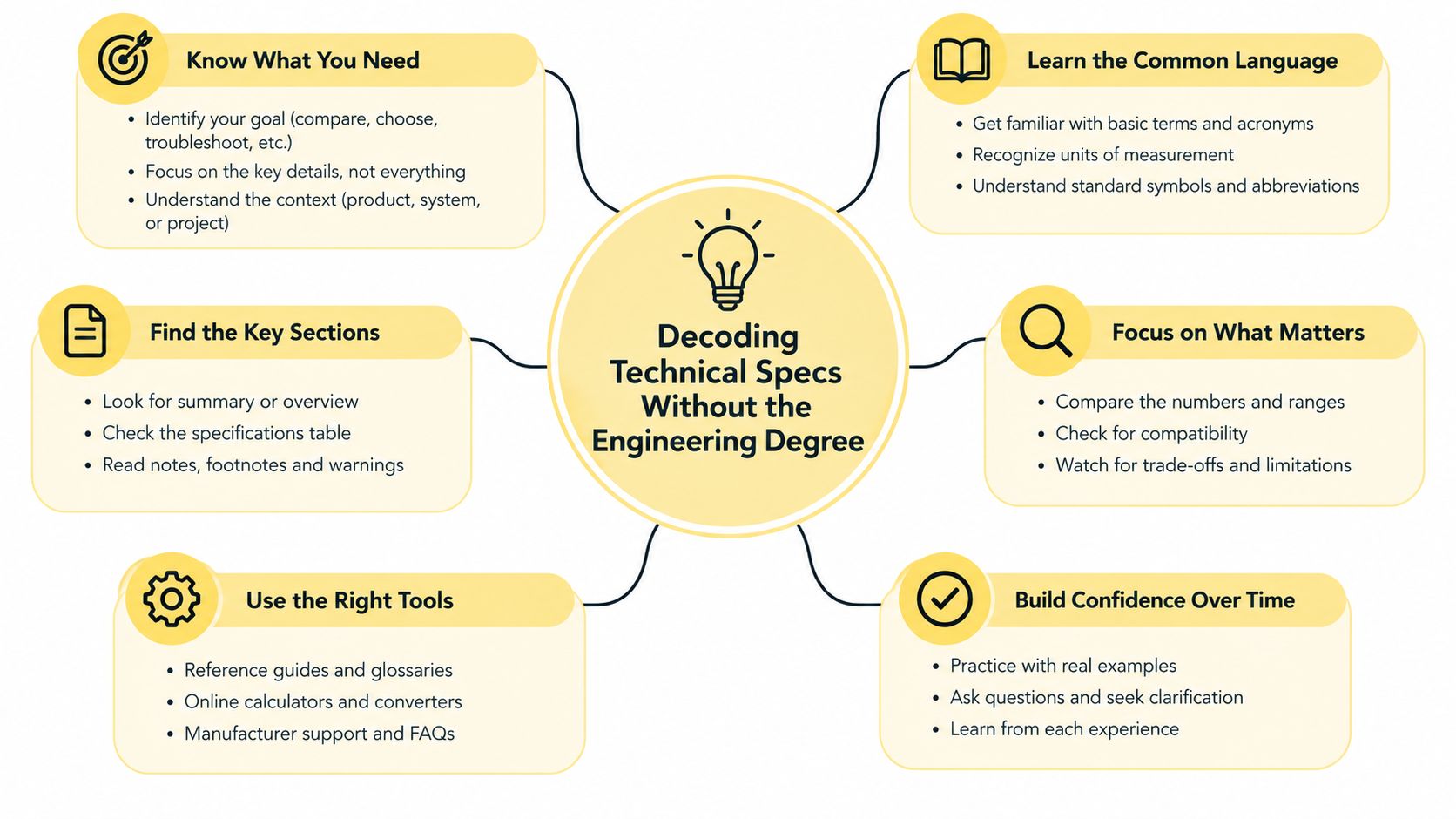
Decoding Technical Specs Without the Engineering Degree
You don't need an engineering degree to challenge an AV recommendation. You need to connect each specification to a coaching outcome.
The most important term is often directional pattern. Think of it as a flashlight beam. An omnidirectional microphone listens broadly around itself. A unidirectional microphone concentrates its strongest pickup toward the talker and rejects more sound from other directions. Cardioid and supercardioid patterns are commonly recommended for speech-oriented PA use because they reduce ambient noise and loudspeaker spill.
That matters because feedback is a loop. The loudspeaker sends out your amplified voice, the microphone captures some of that output, the system amplifies it again, and the loop produces the familiar howl. A directional microphone doesn't eliminate the loop, but correct orientation gives the system more usable gain before feedback.
Read the numbers as consequences
Speech-focused PA microphones commonly list frequency responses in roughly the 50 Hz to 18 kHz range, sensitivity around −54 dBV to −66 dBV, and maximum SPL handling around 133 dB to 140 dB. These figures don't automatically predict a great event experience. They tell you whether the microphone is designed to capture speech, how much signal it produces for a given sound pressure, and how well it can tolerate loud vocal peaks. The PA microphone technical guidance gives those specifications practical meaning.
A public address microphone specification from Hong Kong's EMSD illustrates how measurable requirements can be more useful than the word “clear.” It calls for an on-axis response staying within +6 dB and -10 dB from 100 to 10,000 Hz, sensitivity of at least 1.0 mV/Pa at 1 kHz, distortion below 0.5% at 1 kHz with 30 Pa input, front-to-back discrimination greater than 15 dB from 300 to 5,000 Hz for unidirectional microphones, and balanced low impedance in the 200 to 600 ohm range at 1 kHz. Read those limits as a specification for predictable announcements, not as a promise that any room will sound good. See the EMSD speech microphone requirements when a venue or procurement team asks for compliance details.
Ask the AV team practical questions
Before the event, confirm whether the microphone is wired or wireless, which connector it uses, whether the mixer or receiver supplies the required power, and whether the venue can provide a compatible cable. Don't assume a wireless lavalier and a wireless headset share the same receiver. They may not.
Low impedance matters for long cable runs. India's BIS code explains that low-impedance microphones are normally used for long microphone lines and help avoid high-frequency loss, while unidirectional characteristics reduce indoor feedback. That makes a low-impedance, directional microphone a sensible choice for a training room where the lectern sits far from the equipment rack. The BIS public address guidance gives the reasoning behind that choice.
For remote sessions, keep a separate troubleshooting reference for audio and video quality problems. The mindset is the same: isolate the signal path instead of randomly changing settings.
The Hidden Bottleneck is the Room Not the Hardware
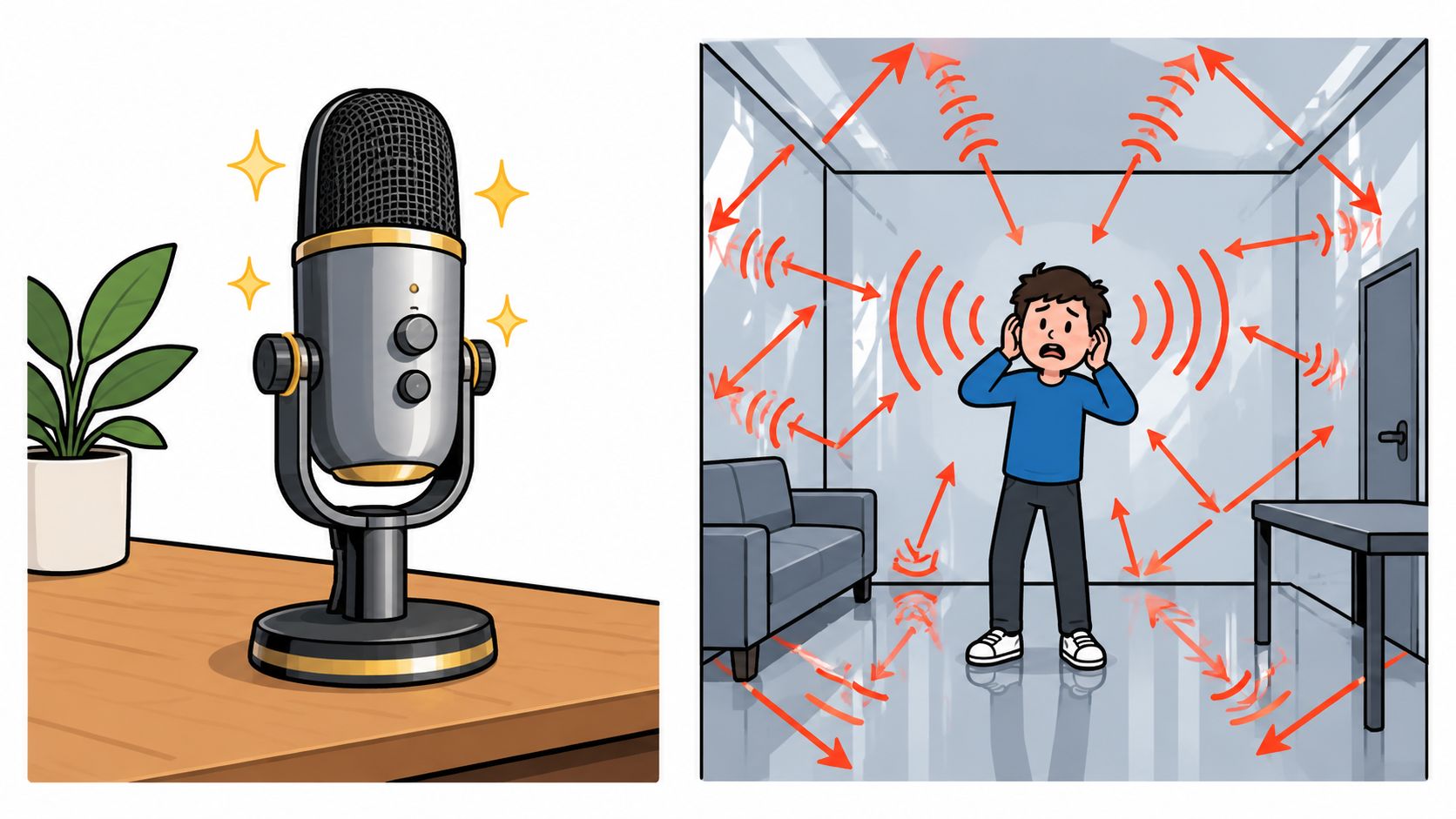
A premium microphone can faithfully capture a bad room. That's the problem.
Hard walls, glass, bare floors, ceiling height, HVAC noise, hallway traffic, and poorly aimed loudspeakers all affect intelligibility. If your room creates a long tail of reflected sound, the microphone captures both your direct voice and the room's delayed copies. Raising the volume doesn't separate them. It makes the mixture louder.
Research on indoor PA systems found that speech intelligibility declines as background noise and reverberation rise. A PA system may provide little benefit when competing noise is below about 40 dBA, while higher noise and reverberation sharply reduce clarity, according to the study of intelligibility in indoor public address systems. The point isn't to make you measure every venue with a laboratory instrument. It's to stop treating the microphone as the only variable.
Walk the room before you unpack
Arrive early and stand where the furthest participant will sit. Ask a colleague to speak from the coaching position while you listen from the back, side, and first row. If the back of the room sounds washed out while the front sounds loud, moving the microphone closer to your mouth won't solve the distribution problem.
Look for simple acoustic help:
- Use what the venue already has: Curtains, carpet, upholstered chairs, and fabric partitions absorb reflections better than glass and bare walls.
- Reduce competing sound: Ask the venue to lower HVAC intensity, close doors near service corridors, and stop background music during instruction.
- Keep participants in the coverage pattern: Loudspeakers should aim toward listeners, not across reflective sidewalls.
- Avoid creating a loud front row: A speaker aimed too steeply downward may cover nearby seats while leaving the back dependent on reflected sound.
Accessibility changes the definition of “good”
You may feel that the room sounds fine from the stage. That doesn't mean it works for everyone. A participant with hearing loss can struggle with reverberation that a younger listener barely notices. A non-native listener may need cleaner consonants and a stable sound source, especially when you turn away or walk behind a loudspeaker's coverage area.
Ask the venue whether it offers assistive listening support, and explain how participants can access it without embarrassment. Keep your face oriented toward the room when delivering key instructions. Use visual prompts and written exercise steps as reinforcement, not as a substitute for understandable speech.
The right purchase may be acoustic treatment, better loudspeaker aiming, or an assistive listening system rather than a more expensive microphone. Your job is to improve the listener's signal-to-noise experience. The logo on the microphone comes second.
Foolproof Setup and Placement Strategies
A reliable PA setup starts with physical geometry. Feedback becomes much less likely when the microphone stays away from loudspeakers and the microphone's most sensitive direction points toward you, not toward the speaker output.
Build the physical layout
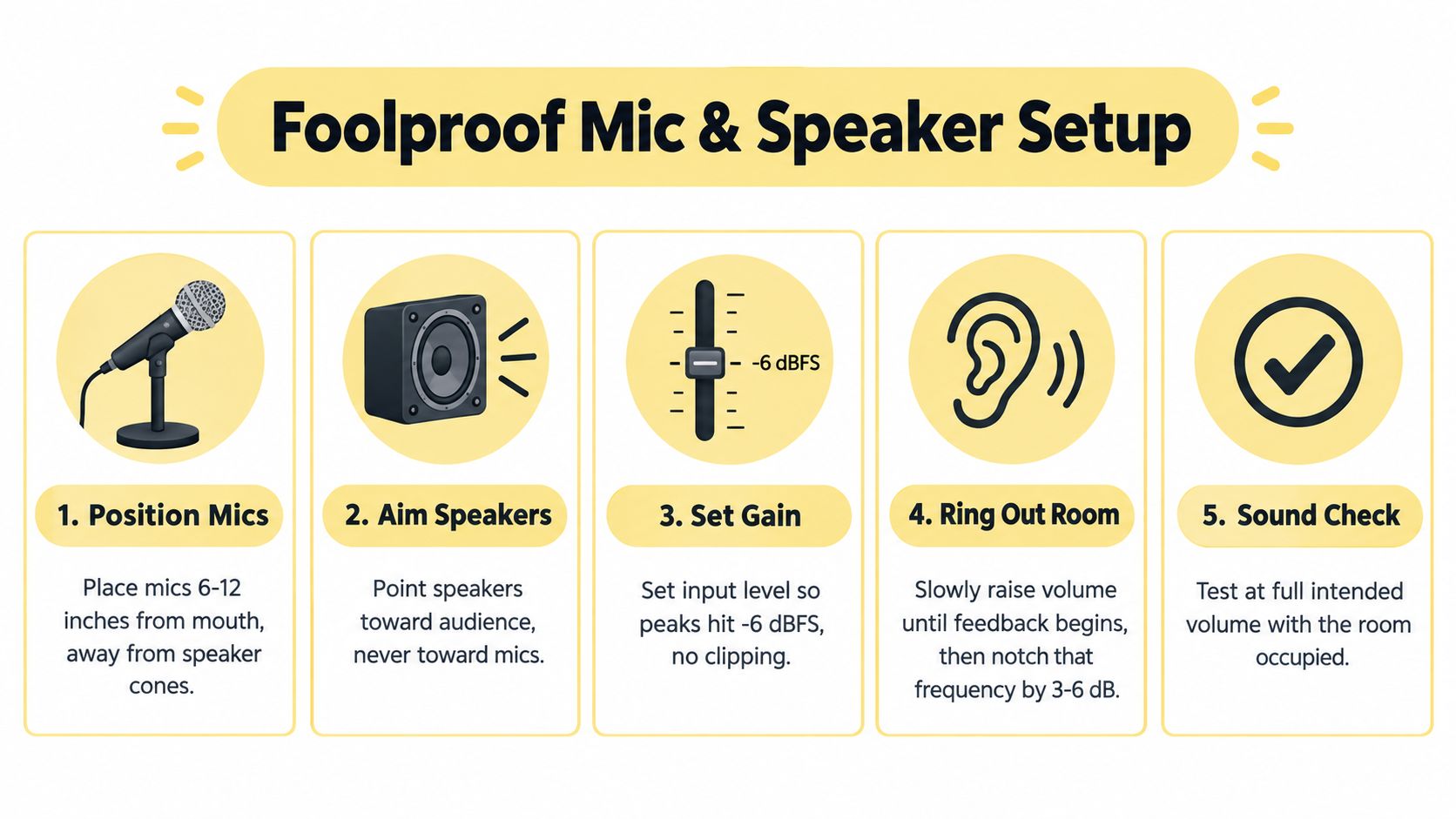
Place the loudspeakers first. Put them in front of the coaching position and aim them at the audience. Keep the microphone well away from, and preferably behind, the loudspeakers. This prevents the microphone from receiving the strongest direct output.
Position the microphone for speech. For a handheld microphone, keep it directly in front of your mouth and slightly below it. A practical speaking distance is close and consistent, not an arm's length. The public address system design guidance recommends aiming toward the talker while reducing room pickup, and it identifies distance and orientation as central feedback controls.
Aim the pattern deliberately. With a cardioid microphone, point the front toward your mouth and the rear rejection area toward the loudspeakers when the design allows it. A Shure guide explains why cardioid microphones are favored in PA work, since front pickup and rear suppression help control feedback when placement is correct. Its cardioid PA microphone guidance is useful preparation for a venue conversation.
Set gain gradually. Ask a colleague to speak at the intended coaching level while the operator raises the input. Don't solve a quiet microphone by turning every control to maximum. If feedback appears, lower gain and identify whether the problem changes when you move the microphone, turn your head, or adjust a speaker.
Test from the audience. Walk to the back, side, and any area where group work will happen. Test while standing, sitting, turning, and speaking at your real volume. A room that sounds acceptable from the console can sound harsh or distant at the listener's seat.
For a fixed training room, run low-impedance microphone cable cleanly along walls or under suitable cable covers. Keep signal cables away from power cables where possible, label both ends, and store a tested spare. Indian Railways' PA specification shows how specific an announcement microphone can be. It calls for a 140 Hz to 10 kHz cartridge response at -10 dB, a unidirectional dynamic cartridge, and a gooseneck of at least 390 mm for a call-station setup. The railway PA microphone specification reinforces the lesson: form factor and voice-band coverage should match the job.
For an additional practical walkthrough on how to avoid feedback at events, focus on placement and operating habits rather than buying a different microphone.
Troubleshooting Live Audio and Making the Purchase
When the microphone fails, don't panic and don't start pressing every button. Follow the signal path from your mouth to the audience.
Use a fast diagnostic sequence
If there's no sound, check mute status first. Then check the microphone's connection, receiver link if it's wireless, channel selection, mixer input, and loudspeaker output. Ask the operator to confirm whether the channel meter responds when you speak. If the meter moves but the audience hears nothing, the problem is after the microphone input.
If the sound is thin or intermittent, hold the microphone in the same position and test the cable or transmitter. A loose connector can sound like a failing microphone. Wireless dropouts may come from distance, obstruction, receiver placement, or a depleted battery, so keep a wired backup available for important sessions.
A low hum usually points to power, cable, or grounding trouble. Move the signal cable away from power supplies, disconnect unnecessary connected devices, and test one input at a time. Don't keep increasing gain to compensate for noise. That raises the noise floor along with your voice.
Live recovery script: “We've got a small audio issue. Give us a moment while we switch microphones.” Keep speaking calmly if the room can hear you, and move to the backup without apologizing repeatedly.
Buy for the failure you can't tolerate
A small executive coaching session may favor a reliable wired gooseneck or handheld microphone. It removes battery anxiety and reduces the number of wireless components that can fail. A large summit or interactive workshop may justify a wireless headset, but only if the receiver, spare batteries, backup microphone, and operator support are part of the package.
Judge the purchase by more than capsule quality:
- Durability: Can the connector, clip, grille, and cable survive repeated transport?
- Serviceability: Can you replace a cable, battery, clip, or windscreen without replacing the whole system?
- Compatibility: Will it work with the mixers, receivers, connectors, and power arrangements used by your venues?
- Support: Does the supplier provide clear documentation and a usable warranty?
- Ownership burden: Who charges it, labels it, tests it, stores it, and brings the backup?
A cheaper microphone that requires constant improvisation costs you attention at every event. A premium system that no one knows how to operate creates a different kind of risk. Buy the setup your team can test, transport, and recover under pressure.
Owning the Room Through Clear Communication
You don't own a room by speaking louder. You own it by making it easy for people to follow, respond, and trust the process.
The public address microphone supports that work when you treat it as part of a complete communication environment. Choose a form factor that matches your movement. Use directional pickup when the room and loudspeaker layout call for it. Walk the venue from the listener's position, control reflections and competing noise, and rehearse the failure response before the audience arrives.
The history of PA technology shows why this matters. David Edward Hughes demonstrated an early carbon microphone in 1875, and Lee De Forest introduced the Audion in 1906, the first device capable of amplifying an electrical signal. Those advances helped make electric speech reinforcement practical. A documented public demonstration of an electric PA system for speech and music took place at San Francisco City Hall on December 24, 1915 using the Magnavox system. That system later supported President Woodrow Wilson's address to a crowd of 75,000 in San Diego in 1919, while King George V addressed about 90,000 people at Wembley in 1925 using a Marconi PA with six horn loudspeakers, as described in this history of modern PA systems.
Today's equipment is more compact, but the responsibility is unchanged. Public address applications represented 11.8% of audio pickup devices market share, with demand across education, government, transportation, and commercial venues, according to this audio pickup devices market report. That scale doesn't make every microphone suitable for coaching. It does show that speech reinforcement is established infrastructure, not a specialist curiosity.
Before your next event, assign one person to own the sound check, walk the room from the back, test the microphone at your real coaching volume, confirm a backup, and brief yourself on the mute and handover procedure. Your audience shouldn't have to work around your audio. Clear sound is how you tell every participant, including the person at the edge of the room, that their attention and access matter.
Coachful brings scheduling, client communication, resources, progress tracking, and group coaching workflows into one workspace, so you can spend less time managing logistics and more time preparing experiences your clients can hear and use. Visit Coachful to organize your coaching practice and create a more consistent experience before, during, and after every session.