9 User Onboarding Best Practices for Coaches

Coachful
A client signs up on Tuesday, motivated and a little nervous. By Friday, she still hasn't booked, your intake form sits half finished in another tab, and you're wondering whether to chase her or wait. She isn't resistant. She's unclear about what happens next, and unclear feels unsafe.
The strongest user onboarding best practices fix that first week. They replace scattered forms, generic emails, and admin friction with a clear progression from first action to first win. They also show you where clients stall, what support they need, and which early behaviors predict lasting engagement.
The nine practices below move in that order. Define the early win, reduce intake friction, personalize the path, welcome the client warmly, show progress, co-create goals, give just in time guidance, automate follow up intelligently, and build feedback loops that continue beyond session one.
1. Engineer the Aha Moment and Get the First Session Booked Within 24 Hours

Your client's inner dialogue on day one isn't, "Show me every feature." It's, "Did I make the right choice, and when do we start?" The aha moment answers both. In coaching, that's usually a booked first session with a visible goal attached, not a completed profile.
Sean Ellis popularized building onboarding around the action most correlated with long term retention. Psychologically, an early win builds self efficacy, Bandura's term for the belief that you can follow through, which makes showing up again more likely. Facebook's growth team reportedly redesigned around connecting with seven friends in ten days. Apply the same logic here. Find the early action that predicts commitment, then remove everything between signup and that action.
What this looks like in practice
A career coach sends a welcome link straight to a Discovery Session calendar. The client books in the same visit, then gets a one page Goals Snapshot to complete before the call. No tour, no settings detour, no homework pile before value appears.
Measure activation rate, the share of new users who complete a behavior demonstrating core value. Benchmark data covering 547 SaaS companies reports an average of 37.5%, with AI products at 54.8% versus 5% for fintech tools, according to Userpilot's onboarding metrics benchmark. For you, track the percentage who book within seven days, put that action at the top of the welcome email and dashboard, and ask which step, if removed, would make the process feel pointless. Move that step to the front.
2. Collect Only What You Need Now With Progressive Intake Forms

"Why do you need all this before we've even spoken?" That's the objection a long intake creates, even when clients don't say it aloud. Progressive profiling gathers information in stages. A short first form asks for name, primary goal, and preferred format. Deeper questions arrive later, once trust exists and the questions have context.
Each extra field adds cognitive load and signals that this process will be a chore. Length is measurable friction too. An analysis of more than 1,000 mobile apps found median completion falls below 60% when onboarding exceeds five screens, while healthy completion for well designed flows is roughly 60 to 80%, as summarized in Sonar's onboarding and Day 1 retention analysis. Typeform popularized the conversational alternative, one question at a time, for the same reason.
Privacy timing matters just as much. A 2025 IEEE Computer Society study found many privacy choices can reduce perceived control, with 70% of participants favoring upfront choices, as reported in the IEEE study on privacy choices during signup. Don't postpone every consent decision, and don't demand everything at registration either. Use staged consent. Explain why each category is needed, offer understandable presets, and ask for sensitive details when they become relevant.
An executive coach asks only for name, role, and the one thing the client wants to change in the next 90 days. Two days after session one, a second form covers team size and past feedback. A health coach uses conditional logic so weight management clients see eating pattern questions, while stress and sleep clients see routine questions instead.
Build yours by reviewing a structured client onboarding form approach, then compare intake form options for practices. Write a purpose sentence beside every question, count fields before publishing, and delete any question you wouldn't act on in session one.
3. Segment Onboarding by Coaching Context for One to One and Group Paths
A senior executive, a cohort member in a wellness program, and a performance client don't need the same first week. When you send all three the same welcome pack, each one thinks, "Half of this isn't for me," and starts skimming the half that is. Segmentation applies the relevance principle. Information matched to a person's immediate context is easier to process and more likely to be acted on.
Start with three segments at most. Map each segment's first week on paper before you build anything. What does this client need to do, see, and feel before session one, and what can safely wait until week three?
Two paths from the same platform
A leadership academy runs a six month individual track and a ten week cohort. Cohort members get the group calendar, an introduction prompt, and community guidelines. Individual clients get a scheduling link and a first session prep worksheet. If you're designing the cohort side, this explanation of group coaching formats helps you decide what belongs in a shared path versus a personal one.
A life coach runs three tracks in Coachful. Career Reset includes job search tools and a resume goal worksheet. Work Life Balance starts with a values inventory and calendar audit. Confidence Builder opens with a weekly reflection journal.
Practical rule: Give cohort members a reason to meet each other in the first 48 hours. A short introduction prompt with one shared question does more for retention than a polished welcome PDF nobody discusses.
The trade off is maintenance. Every extra track is another sequence to update, so expand only when your completion and booking data show a segment is underserved.
4. The Personal Welcome Sequence With a Video and One Clear Next Step
"Is this person real, and what happens now?" Those are the two questions sitting underneath most first week drop off. A welcome sequence answers both in the first few days with a human voice, a named sender, and exactly one next action per message. Research on social presence in online environments shows people respond more warmly to messages that feel written by a person, and that warmth carries into whether they reply, book, and disclose later.
Trust also has a security dimension coaches often ignore. A 2025 survey of 439 SaaS users found 32% prioritized security, 15% prioritized speed, and 46% considered both equally important, while 74% said two factor authentication made login feel safer and 48% had abandoned a product because signup was too slow, according to Frontegg's SaaS signup expectations survey. Don't strip verification out to chase speed. Explain why it's there, time it before private notes or payment details appear, and make recovery simple.
A business coach records one 60 second welcome video that names the program and states the first step. Book your discovery call below, and bring the one challenge you want to solve. The video is reused, with the client's name inserted in the caption, so personalization takes seconds. Basecamp's conversational, single purpose onboarding emails are a useful model for tone.
- Record once, personalize lightly: Keep the video generic, personalize only the first line.
- One call to action: End every message with a single link or reply prompt.
- Use a real sign off: Send from your name, with a reply to address you monitor.
5. Show Progress Early With Checklists and Endowed Progress
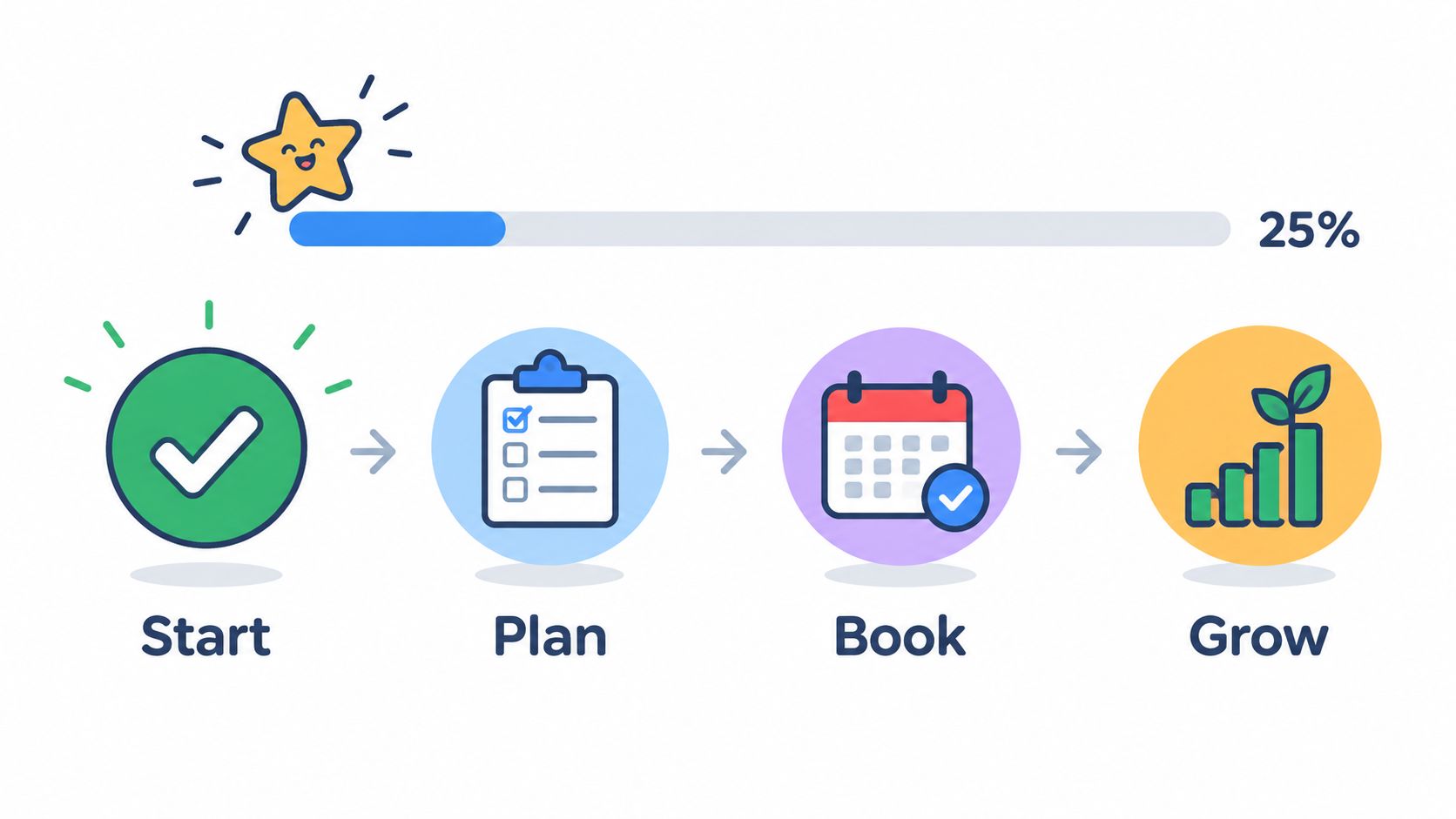
"Will a checklist feel like more admin?" That's the objection, and it's fair. A checklist feels like admin only when it measures product coverage instead of client delivery progress. Three concrete actions, add the first goal, book the first session, complete the snapshot, feel like momentum.
Two effects explain why. The endowed progress effect shows people complete more when they feel they've already started. Nunes and Drèze's car wash study found customers given a loyalty card with two stamps already filled finished it more often than those starting from zero. The goal gradient effect shows motivation rises as people approach a goal.
The format matters as much as the psychology. A 2025 benchmark reported tours launched from checklist items reached 67% completion, compared with roughly 23% for standalone automatically triggered tours, according to Chameleon's onboarding UX patterns research. The checklist gives clients control over when an explanation starts. LinkedIn's profile strength meter works on the same pull toward a visibly complete state.
A Coachful checklist for a leadership program might read like this. Account created, already checked. Complete your leadership snapshot, about two minutes. Book your first session. Set your 90 day focus.
- Keep it to four items: Pre-check the first one so the bar starts at 25%.
- Show remaining time: "About six minutes left" lowers the perceived cost.
- End with recognition: Make the final step a personal congratulations message from you, then let the checklist fade into the background.
6. Co Create the First Goal Map in Session One With a 90 Day Plan
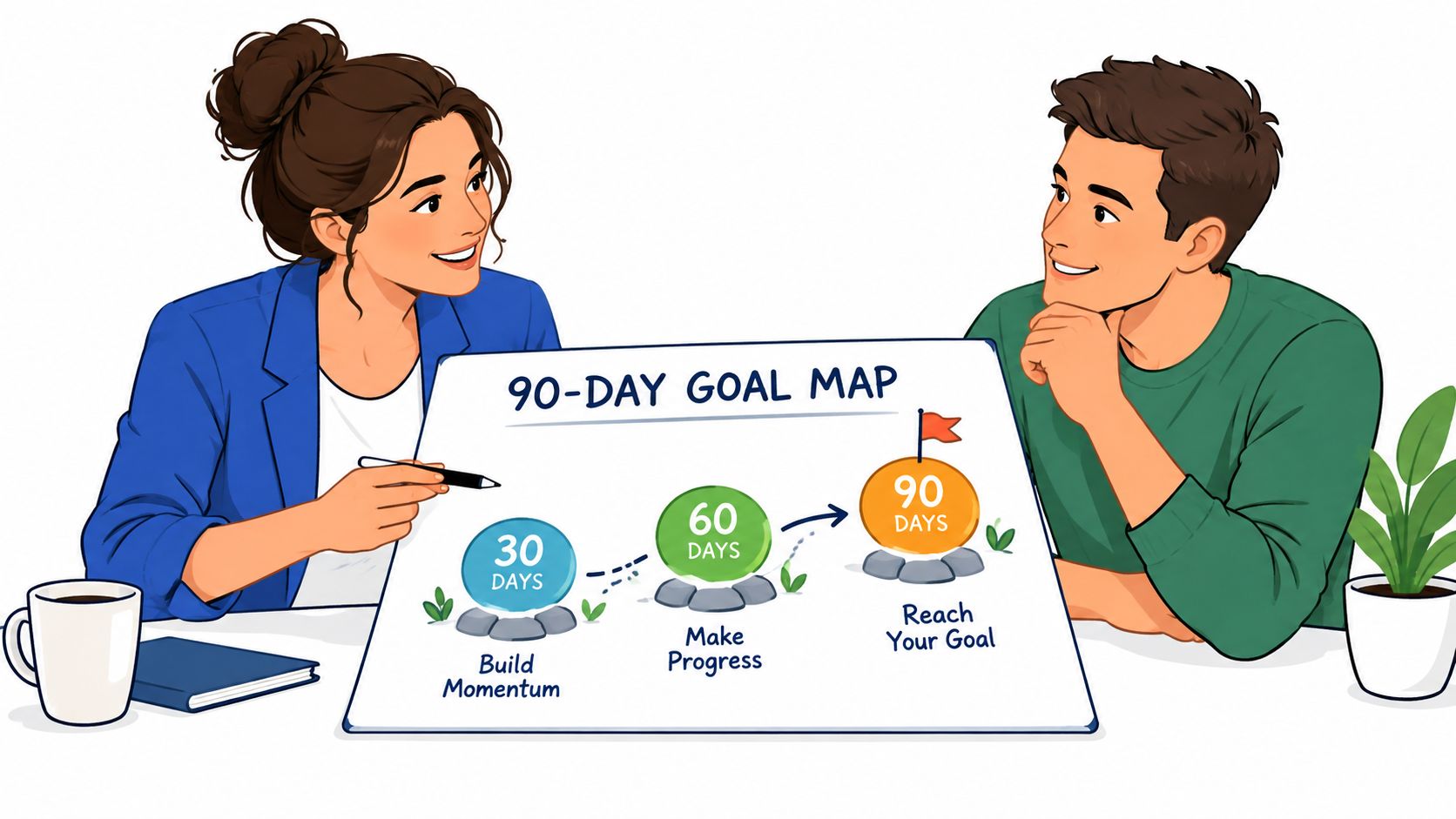
Clients arrive with broad aims. "I want more confidence" is honest, but it gives neither of you a way to know whether week four is working. Goal setting theory, developed by Edwin Locke and Gary Latham, shows specific, challenging goals with feedback outperform vague intentions. Session one is the natural moment to convert the broad aim into a measurable 90 day plan.
Co authorship matters. The IKEA effect describes how people value what they help create, and a goal map written in the client's own words gets revisited. A plan you hand down gets filed.
Measure whether the map leads anywhere, not whether the template got filled in. Google researchers introduced the HEART framework in 2010, later published at the ACM CHI conference, covering Happiness, Engagement, Adoption, Retention, and Task Success, as explained in Rework's guide to the HEART framework. For onboarding, that means tracking satisfaction, early use, a core activation action, continued usage, and successful completion of the client's primary task. A client can finish every setup screen yet never deliver against a goal. Another can skip optional guidance and still reach value fast.
A 30 60 90 example
A business coach asks, "What would be different in 90 days if this went well?" The client wants to lead her team confidently. Together they define running one weekly team meeting by day 30, one feedback conversation per direct report by day 60, and a completed 360 review by day 90.
Ask for the goal in the client's words before you suggest wording. Test every milestone with, "How would we know it's done?" Save the map as the first item in the client's resource library, and schedule check ins at each 30 day mark.
7. Just in Time Guidance With Templates at the Moment of Need
The 20 minute orientation video feels thorough to you. To the client, it feels like homework before any payoff, and most of it is forgotten by the time it's relevant. Just in time guidance delivers a short prompt, template, or tip exactly where the next action happens. Samuel Hulick's onboarding teardowns make the same point. Show one useful thing at a time, not everything at once.
The evidence against front loaded tutorials is clear. A Nielsen Norman Group study tested tutorial style onboarding across four mobile applications with 70 participants, where users who received the tutorial completed tasks 91% of the time compared with 94% among users who did not, as reported in Perspective's summary of onboarding drop off research. Generic instruction added friction. Learning through the task itself worked better.
Progressive disclosure is the design answer. One UX source citing Nielsen Norman Group reports it can reduce task completion time by 20% to 40% and is associated with approximately 35% fewer onboarding support tickets, according to Digia's analysis of progressive disclosure in mobile UX. "Am I missing important tools?" No. Group curricula, renewal automation, permissions, and branding stay available. They appear after the basic client workflow is done.
When a client opens Session Notes for the first time, show one prompt. Note one insight, one action, and one question for next time, with those three headings pre filled. Notion's template gallery proves how a starter template dissolves the blank page problem. The short walkthrough below shows the same principle applied to a first run flow.
Write a template for the client's first three actions, show each tip once, allow permanent dismissal, and record one 45 second tutorial per recurring task instead of a single long orientation.
8. Automated Reminders and Renewal Nudges With a Human Fallback
"I don't want to nag my clients." You won't, if automation handles timing and you handle the relationship. The Fogg Behavior Model holds that behavior happens when motivation, ability, and a prompt converge. Your client usually has the first two. The reminder is just the prompt arriving when life gets loud.
Design the sequence in two layers. An automated message goes first. If there's no response, you get a prompt to reach out personally, with context about what is overdue.
Silence after a reminder is information, not defiance. Treat it as a cue to ask what's getting in the way.
A coach configures Coachful to send a session reminder 24 hours before each call, with one click rescheduling. If a worksheet is three days overdue, the coach receives a notification with a suggested message. "I noticed the reflection didn't come through. Want to talk about what got in the way?" That's a question, not an accusation, and it protects psychological safety.
A cohort program sends a renewal conversation invitation 14 days before the program ends, attached to a summary of progress against the client's 90 day goal map. Timing renewals to milestone completion, not calendar date alone, makes the conversation about results rather than billing.
- Cap reminders at three per event: Always include a reschedule option so the client has an easy out that keeps them engaged.
- Escalate to a human early: Personal outreach after one ignored nudge beats a fourth automated email.
- Audit tone quarterly: Read your automated messages aloud. If they sound like a billing system, rewrite them.
9. Build Feedback Loops at Day 1 Day 7 and Day 30 and End With a Peak Moment
Onboarding doesn't end when the first session is booked. Short check ins at day 1, day 7, and day 30 tell clients their experience matters, and they give you the diagnostic data that completion rates hide. Treat time to value as a metric here, not a design preference. A benchmark across more than 2,600 companies found 69% of top performers for week one activation also ranked among top three month retention performers, with average time to value of about 1 day, 12 hours and onboarding checklist completion of about 19.2%, according to Iterable's onboarding speed and time to value benchmark. If activation is low, your feedback should reveal which step delays the first client outcome.
Ask no more than two questions per check in. A day 7 prompt might read, "What's one thing that's already felt useful? What's one thing getting in the way?" Responses shape the next session agenda, and they feed the satisfaction measures covered in this guide to client satisfaction metrics for coaches. Respond to every piece of negative feedback within 24 hours, personally.
Design the ending on purpose
The peak end rule, identified by Daniel Kahneman and colleagues, shows people judge an experience largely by its most intense moment and its end. A group program can close onboarding with a Launch Day message, a short facilitator video, and a shared commitment board. A solo coach can send a day 30 message naming the client's first completed milestone in their own goal words.
Design that closing message before you launch the sequence. Otherwise onboarding just stops, and a flat ending becomes the client's memory of a good first month.
9 User Onboarding Best Practices: Side-by-Side Comparison
| Onboarding Strategy | 🔄 Implementation Complexity & Resources | 📊 Expected Outcome | ⭐ Key Advantage | 💡 Ideal Use Case |
|---|---|---|---|---|
| Engineer the Aha Moment | Medium: identify the key action, streamline steps, and track time-to-value. | ⚡ Faster first value; potentially less early drop-off. | Defines onboarding success around a measurable client outcome. | Programs where an early action, such as booking a session, signals engagement. |
| Use Progressive Intake Forms | Medium: plan staged questions, timing, and conditional logic. | Higher initial form completion and more relevant client data over time. | Respects clients' time while reserving deeper questions for when they have context. | Coaches who can gather essential details before the first session and follow up later. |
| Segment Onboarding by Coaching Context | Medium–High: create and maintain tailored paths, content, and resources. | More relevant first steps across different programs. | Scales distinct client experiences using reusable templates. | Practices serving individual, cohort, and hybrid programs or multiple coaching goals. |
| Send a Personal Welcome Sequence | Low–Medium: prepare a short video or voice note and a few scheduled messages. | Less uncertainty and clearer next steps during the first week. | Adds a human touch with a simple, repeatable communication flow. | Coaches who want to build rapport before the first session. |
| Show Progress Early | Low: set up a short checklist, progress indicator, and meaningful completion reward. | ⚡ Encourages completion of early onboarding tasks. | Makes progress visible and gives clients an early sense of momentum. | Onboarding with several actions, such as intake, booking, and goal-setting. |
| Co-Create the First Goal Map | Medium: reserve session time and define measurable milestones with the client. | 📊 Clearer focus, shared accountability, and a baseline for tracking progress. | Builds client ownership through a plan they help create. | Coaching engagements that benefit from a measurable 30-, 60-, or 90-day direction. |
| Provide Just-in-Time Guidance | Medium: create contextual prompts, templates, or short tutorials. | ⚡ Reduces effort and delays when clients take their first actions. | Delivers practical help at the point of need instead of in a long orientation. | Clients using worksheets, session notes, or unfamiliar platform features. |
| Automate Reminders with a Human Fallback | Medium: configure reminder timing, rescheduling, escalation, and renewal workflows. | Fewer missed sessions and assignments, with less manual follow-up. | Combines efficient automation with personal coach support. | Practices managing recurring sessions, assignments, or program renewals. |
| Build Feedback Loops and a Peak Moment | Medium: schedule brief check-ins and plan a closing message or ritual. | 📊 Surfaces friction early and improves clients' overall impression of onboarding. | Creates structured opportunities to listen, respond, and end on a positive note. | Programs that want to improve the client experience throughout the first month. |
Make Every Onboarding Step Earn the Next Step
Effective user onboarding best practices aren't about adding more messages, forms, or platform features. They're about removing uncertainty one step at a time. Help the client recognize immediate value, ask only for information that supports the work, create a path that feels relevant to their context, and make progress visible enough that momentum carries them through the harder weeks.
Start by choosing the first behavior you want clients to complete. For most practices, that's a booked session with one goal written down. Then map the shortest human sequence that gets them there, and be honest about every step that exists for your convenience rather than their clarity. Optional profile fields, advanced settings, and branding decisions can wait until after the first win. A ready to edit template today beats a perfectly configured system that nobody reaches.
From that foundation, add automation only where it protects your time and attention. Reminders, renewal nudges, and overdue worksheet alerts should free you for the personal message, not replace it. When a client stalls, your system should tell you where and hand you a sensible opening line. The relationship work still belongs to you, and clients can tell the difference.
In Coachful, scheduling, welcome resources, milestones, session notes, reminders, progress tracking, and cohort workflows can support this experience in one place. That consolidation matters less as a feature list and more as a diagnostic advantage. When intake, booking, goals, and check ins live together, you can see the funnel from account creation to first scheduled session to first progress update, and you can segment it by solo clients, teams, and cohorts instead of guessing.
Review that engagement data regularly. Watch activation within a fixed window, time to first value, consent abandonment, and drop off at each form step. Test one change at a time, a shorter intake, a checklist launched tour, a welcome video with a single call to action, and judge it by downstream outcomes like first week return and completed sessions, not completion alone. Speak personally when friction appears, and treat every client response as information about the design rather than resistance from the person.
The best onboarding system feels natural to the client and manageable for the coach. Build the version you can maintain, measure whether clients reach meaningful value instead of merely finishing a tutorial, and keep shortening the path between "I signed up" and "this is working." That gap is where coaching relationships are won or lost.
Coachful brings client onboarding, intake forms, scheduling, goals and milestones, session notes, reminders, and group program workflows into one workspace, so you can build the first week sequence described here without stitching together separate tools. If you're ready to turn scattered signup steps into a clear path from first booking to first win, visit Coachful and set up your onboarding flow today.