Workshop Cancellation Policy Template for Coaches: 7 Decisions

Coachful
Editorial Team
A useful workshop cancellation policy tells a buyer what happens if they cancel, what happens if you cancel, and how to request a refund or transfer. Set those terms before selling places. A last-minute request should not be the first time you decide whether a seat is refundable.
For a coach, the awkward question is usually practical: “Can I protect the preparation and venue costs without being unfair to someone who cannot attend?” Yes, but not by pasting “all sales final” beneath every offer. Match the policy to the event, disclose it clearly, and preserve the rights your terms cannot remove.
This guide covers a single paid coaching workshop sold to individual participants. It is not a replacement for a corporate cancellation clause, a multiweek cohort attendance agreement or legal advice. The sample deadlines below are hypothetical choices, not industry standards or promises of enforceability.
The short answer: separate the seat from the service
When a participant cancels, you need to decide whether their place can be refunded, transferred or credited under the disclosed terms and applicable law. When you cancel or materially change the workshop, you need to address a service you can no longer deliver as sold. Those are different decisions.
Start with seven questions: which booking is covered, when notice counts, what the participant receives, whether transfers are allowed, what happens when you cancel, how exceptions work, and where the policy is communicated. Answer them in plain language before accepting payment.

1. Define the booking the policy actually covers
Identify the workshop title, format, date, start time, time zone, price and what the purchase includes. State whether a place is confirmed immediately, after payment or after a separate acceptance. A submitted registration form and a confirmed paid reservation are not interchangeable.
Make the scope narrow enough to avoid accidental promises. If the fee buys one live skills workshop and a workbook, say that. If no recording exists, do not treat replay access as your universal cancellation remedy. A recording is also not necessarily an equivalent substitute for live practice.
Separate individual admission from a company buying the entire workshop. A corporate buyer may commission preparation, travel and a reserved delivery date. Their cancellation arrangement belongs in the agreed statement of work. Do not apply a consumer ticket template to a negotiated corporate engagement without review.
For registration questions rather than financial terms, use our workshop registration form guide. That form should point to the policy; it should not silently invent a different one.

2. Make the notice window unambiguous
“Cancel a week beforehand” invites arguments. Does that mean seven calendar days, the previous working week or the end of the previous Sunday? State the interval, the reference time and the time zone. If you use a named deadline, display the full date and time.
For example: “To qualify for the voluntary full-refund option, we must receive your request at least seven calendar days before the workshop’s published start time in [time zone].” Seven days is an illustration here. Choose a window after reviewing your costs, ability to refill places and legal obligations.
Name a monitored request route and explain when notice is received. Email is often manageable for a small workshop, but it must be an address you actually check. Do not advertise instant cancellation if you manually review requests. A form acknowledgement should say the request was received, not that a refund has been issued.
Provide a fallback if your form is unavailable. Do not require a participant to keep retrying a broken portal until the deadline expires. Record the original contact time and resolve uncertainty fairly rather than treating a technical fault as an opportunity to retain the fee.

3. Choose refunds, credits and fees deliberately
A cancellation policy is not a contest to write the strictest sentence. Consider when you commit costs, whether a replacement can reasonably attend, and what the buyer was told. A short online workshop with minimal preparation may justify different terms from a small in-person event with committed venue costs.
Possible voluntary models include a full refund before a stated deadline, a graduated refund, or a transfer route after the refund deadline. These are design choices, subject to the rules that apply. Do not call a retained amount an “administration fee” merely because the label sounds official.
Distinguish an optional credit from money a participant is entitled to receive back. If you offer credit, state its value, expiry, eligible events and whether it can be transferred. Do not promise a future workshop you have no realistic plan to run. A credit that cannot usefully be redeemed is not a generous alternative.
For any processing charge or deduction, obtain advice on whether it is permitted and how it must be disclosed. Do not assume the payment processor’s treatment of its fees determines what you can deduct from the participant’s refund. Likewise, a clear policy does not guarantee that you will win a card dispute.

4. Decide whether someone else can take the place
A transfer can preserve the workshop revenue while helping someone who cannot attend. It also creates work: confirming the replacement meets prerequisites, updating the roster, sending correct joining information and avoiding disclosure of the original participant’s private answers.
State whether transfers are allowed, the request deadline and the approval condition. A useful example is: “You may request a transfer to another eligible participant up to 24 hours before the start. The transfer is complete only when we confirm the replacement’s registration.” That deadline is illustrative, not a universal recommendation.
Do not make the replacement inherit someone else’s coaching intake or access request. Collect only the details needed for their participation. For a workshop containing sensitive discussion, confirm that the new participant has received the same confidentiality and participation information as everyone else.
Also say whether a transfer means another person or another date. Those are different arrangements. If you do not offer movement to a future workshop, avoid using “transfer” as shorthand for both.
5. Explain what happens if you cancel or change the workshop
A complete policy must address your side of the bargain. Include illness, insufficient enrollment, venue loss, major technical disruption and a material change to the promised format. You do not need to predict every emergency, but you do need a usable notification and remedy process.
If you use a minimum enrollment condition, identify the decision deadline before people book. Do not keep selling an apparently confirmed event while knowing you may abandon it at the last moment. Explain how participants will be notified, and discourage nonessential travel commitments until the status is clear where that is relevant.
For the illustrative policy below, the coach offers a full workshop-fee refund when the coach cancels. A replacement date is optional, not something the buyer must accept. Review the treatment of associated losses and extraordinary events with qualified advice rather than copying a blanket “we have no liability” sentence.
The Australian Competition and Consumer Commission’s event guidance explains that organizer cancellation or major changes can create refund rights, while other circumstances depend on the facts and terms. That is Australian guidance, not a worldwide rule. It illustrates why one no-refund clause cannot answer every event problem.
6. Make exceptions humane and administratively possible
People become ill, lose childcare or face an emergency. Decide who can authorize an exception and what options they can genuinely offer. A coach can choose to make a discretionary concession without pretending every future case will receive the same outcome.
Ask for the information needed to resolve the booking, not a detailed personal history. Often the workshop identity, purchaser details and requested outcome are enough. Do not routinely demand medical evidence or ask someone to describe a crisis in a shared group channel.
Record the request, applicable policy version, decision and financial action. Keep a short factual reason when an exception is made, without collecting unnecessary sensitive details. Separate those administrative notes from coaching notes and apply an appropriate retention approach.
Most importantly, do not describe a legally required remedy as goodwill. “I am making an exception” is the wrong response when the buyer already has that right. Check the basis for the request before selecting the discretionary branch.
7. Publish one consistent policy before payment
Put the important terms beside the workshop purchase decision and link to the complete version. Repeat the practical cancellation route in the confirmation. A participant should not discover a financial restriction for the first time in a welcome attachment after buying.
Keep the event page, registration flow and confirmation consistent. If you change the policy for future bookings, date the new version and retain the version that applied to existing purchases. Do not retroactively tighten a deadline because enrollment is lower than you hoped.

For UK businesses, GOV.UK’s distance-selling guidance identifies cancellation information and contract terms among the information that must be supplied in relevant sales. Specific service rules and exceptions require care. Do not assume every coaching workshop has the same cooling-off treatment, or that placing a checkbox beside a clause makes it lawful.
If you collect requests through a form, keep the fields focused: purchaser name, booking reference or event, contact address and requested action. Provide a space for optional practical context. Never ask for payment-card details in a general form answer.

Copyable workshop cancellation policy
Illustrative starting point only. This example describes one paid workshop with a seven-day voluntary refund window and a possible participant transfer. Replace every bracket, remove anything you cannot deliver, and obtain appropriate legal review. Do not paste the sample deadlines into your business without deciding whether they fit.
Scope. This policy applies to individual places purchased for [workshop name], taking place on [date] from [start time] to [end time] in [time zone], delivered [online / at venue]. The fee includes [specific inclusions]. Your place is confirmed when [actual confirmation condition].
How to request cancellation. Contact [monitored email address] with your name, workshop and booking reference if available. Please do not send card details or sensitive personal information. We use the time your request is received to assess the voluntary notice window. If [request form] is unavailable, email the address above.
Participant cancellation. For requests received at least seven calendar days before the published start time, we offer a full refund of the workshop fee. For requests received less than seven calendar days before the start, we do not offer a discretionary fee refund under this policy. This does not limit rights or remedies that apply by law.
Transfers. You may request to transfer your place to another person up to 24 hours before the workshop starts. The replacement must meet any published prerequisites and complete the necessary registration. The transfer is complete when we confirm it in writing. Moving to another workshop date is not included unless separately agreed.
No-shows and late arrival. If the workshop runs as described and you do not attend, we do not offer a discretionary refund solely for nonattendance. [State any actual catch-up resources or late-arrival arrangements.] We do not promise a recording or private replacement session unless expressly included in the offer.
If we cancel or materially change the event. We will contact registered participants through [direct notification route]. If we cancel, we will offer a full workshop-fee refund. We may also offer an alternative date, which you do not have to accept. For a material change, we will explain the change and available remedies, consistent with applicable rights.
Minimum enrollment. [Include only if relevant: The workshop requires a minimum of [number] confirmed participants. We will decide whether it will proceed by [specific deadline]. If we cancel for insufficient enrollment, the organizer-cancellation provision above applies.]
Exceptions and refund handling. Contact [address] if you would like us to consider an exceptional situation. You do not need to disclose private details to other participants. We will confirm any agreed exception and refund action in writing. Approved refunds are initiated through [actual original payment process] within [timeframe you can meet]; your provider’s posting time may differ.
Policy version and rights. This version is effective for bookings made from [date]. It does not exclude rights that cannot lawfully be excluded. Contact [business name and contact details] with questions before booking.
Handle the request without losing the financial trail
When a request arrives, first confirm the event and original purchaser. Check the policy that applied when they bought, the receipt time and the reason for cancellation. Establish whether you are handling a voluntary cancellation, an organizer change, a statutory remedy or a discretionary exception.
Then keep two checks separate: the place and the payment. Removing a name from a roster does not prove a refund happened. Initiating a refund does not necessarily close the event registration. Check both in the systems you actually use; do not assume they synchronize.

A straightforward response might read: “I’ve received your cancellation request for [workshop]. Under the terms attached to your booking, [specific outcome]. I have [completed action], and [remaining step or processing information]. Your place is [cancelled / transferred / pending confirmation]. Please contact me here if anything looks incorrect.”
If you have not yet initiated a refund, say “approved” rather than “refunded.” If you are still reviewing the request, acknowledge it and give a response date you can meet. Do not make someone chase an ambiguous “all sorted” message to learn whether money is actually on its way.

Frequently asked questions
Can I make every workshop booking non-refundable?
Do not assume that you can. The offer, reason for cancellation, buyer’s location and applicable law matter. Even a clearly disclosed voluntary no-refund arrangement does not remove rights that cannot be excluded. Have the specific terms reviewed, especially for international sales.
What if someone books inside the refund deadline?
Make the timing obvious before payment and obtain advice on any relevant cancellation rights. Do not rely on the buyer calculating that the voluntary window has already passed. State the event deadline clearly and explain the applicable transfer option, if any.
Should I automatically replace a refund with workshop credit?
No. Distinguish an optional alternative from a remedy the participant is entitled to. Explain the credit’s actual terms and let the buyer choose where required. A future credit is particularly unhelpful if you do not know when another suitable workshop will run.
Is a workshop cancellation policy the same as a cohort attendance policy?
No. One addresses a purchase for a specific event; the other can address occasional absences from a continuing program. Catch-up support and private make-ups require separate decisions. See our group coaching attendance policy guide for that problem.
Test the promise before the first booking
Read the policy from a buyer’s phone. Can they find the notice window, identify the correct workshop, contact you privately and understand what happens if you cancel? Then rehearse one timely request, one late request and one organizer cancellation without contacting real participants or moving money.
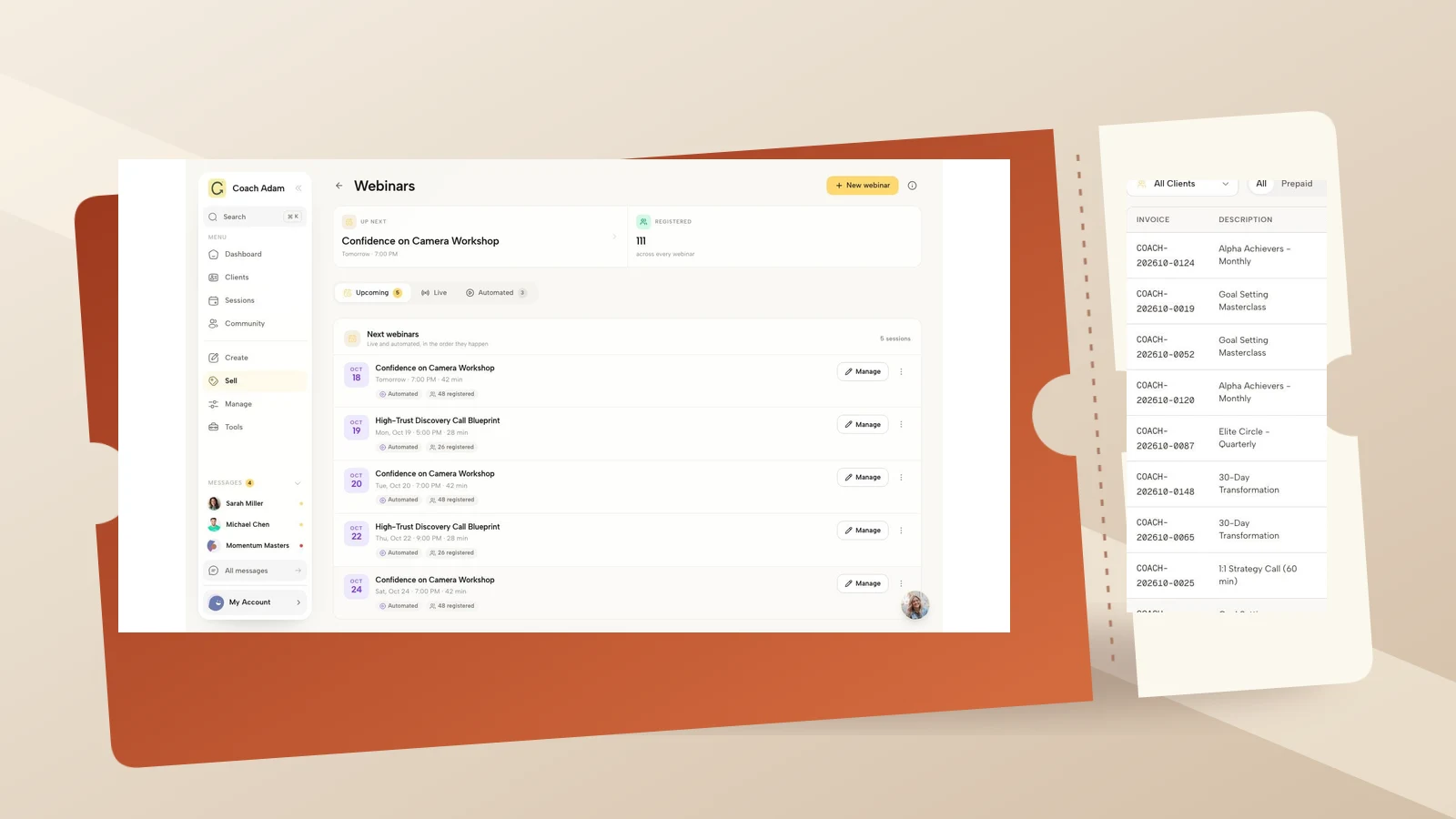
If you are choosing the operational setup, Try the interactive Coachful demo. Inspect the event, website, form, payment and communication surfaces shown here, and check where your policy and decision trail would live. The useful next step is making the promise visible and manageable, not assuming software writes the terms or enforces the law for you.