
14 Best Books for Business Coaches, by Client Problem
The best books for business coaches are the ones your clients' problems are actually about: owners stuck doing the work instead of running the company, cash that never seems to arrive, no rhythm for priorities, hiring mistakes, a message nobody understands and a sales process that depends on the founder's mood. A business coach does not need to be an MBA, but they do need a working toolkit, and these 14 books supply most of it. Each comes with who should read it and a way to use it with a client.
Coachful's team will also build your business coaching website, offer page or program in your account for free, so you can spend the hours reading; we explain how below.
How we chose: books whose frameworks come up in small and growing businesses, from solo founders to teams of a few dozen, checked for title, author and first publication year on Open Library, Wikipedia or the publisher's description in October 2026. We do not rank by sales or link to bookshops. For the coaching craft itself, see our sibling list of the best books for coaches; for senior leadership, the best books for executive coaches.
The best books for business coaches at a glance
| Book | Author | First published | Read this if your client... |
|---|---|---|---|
| 1. The E-Myth Revisited | Michael E. Gerber | 1995 | Owns a job, not a business |
| 2. Traction | Gino Wickman | 2007 | Has no operating rhythm |
| 3. Scaling Up | Verne Harnish | 2014 | Is growing and drowning |
| 4. Profit First | Mike Michalowicz | 2014 | Has revenue and no cash |
| 5. Built to Sell | John Warrillow | 2010 | Can't take a week off |
| 6. Good to Great | Jim Collins | 2001 | Wants to build something that lasts |
| 7. The Goal | Eliyahu M. Goldratt, Jeff Cox | 1984 | Is busy everywhere and stuck somewhere |
| 8. The Lean Startup | Eric Ries | 2011 | Is about to bet big on an untested idea |
| 9. Measure What Matters | John Doerr | 2018 | Sets goals nobody tracks |
| 10. Who | Geoff Smart, Randy Street | 2008 | Keeps making hiring mistakes |
| 11. Building a StoryBrand | Donald Miller | 2017 | Can't explain what they sell |
| 12. SPIN Selling | Neil Rackham | 1988 | Pitches instead of asking |
| 13. Financial Intelligence for Entrepreneurs | Karen Berman, Joe Knight | 2008 | Avoids their own numbers |
| 14. Business Model Generation | Alexander Osterwalder, Yves Pigneur | 2009 | Needs to rethink how the business makes money |
1. The E-Myth Revisited, by Michael E. Gerber (1995)
Published by HarperBusiness in 1995 as a revised edition of Gerber's earlier book The E-Myth, this is about why most small businesses do not work and what to do about it. Its publisher describes how common assumptions get in the way of running a business and walks through the stages of a company from entrepreneurial infancy to maturity.
Why it matters for business coaches: a large share of business coaching clients are skilled practitioners who started a company and now spend every day doing the work themselves. Gerber gives you and the owner a shared way to talk about working on the business, not just in it.
Read this if your client is the best technician in their company and the company falls over when they are sick.
Use it with a client: ask them to list everything they did last week and mark which tasks only they could have done. Then pick one task to document and hand over this month.
2. Traction, by Gino Wickman (2007)
Traction: Get a Grip on Your Business was first published in 2007 by EOS and reissued by BenBella Books in 2011. Its publisher describes the Entrepreneurial Operating System as a practical method for running a company, built around strengthening six key components of the business.
Why it matters for business coaches: many owner-led businesses have no regular rhythm for priorities, numbers and meetings. You will meet its language in client companies, so it is worth knowing even if you coach differently.
Read this if your client's leadership team argues about the same issues every month, or a client says "we run on EOS" on the discovery call.
Use it with a client: agree three priorities for the quarter and a weekly check on each, then review them at the end of the quarter, whatever framework you use.
3. Scaling Up, by Verne Harnish (2014)
Harnish founded the Entrepreneurs' Organization and the Scaling Up company. Scaling Up: How a Few Companies Make It... and Why the Rest Don't, published in 2014, follows his earlier Mastering the Rockefeller Habits (2002). Its publisher describes practical tools for growth company leaders who have reached the point of dreading another customer, employee or location, and whose revenue growth has not turned into profit.
Why it matters for business coaches: it is written for companies past the founder stage, where the habits that built the business stop working and growth starts to feel heavy.
Read this if you coach owners of companies with growing teams, roughly past the point where the founder knows every customer.
Use it with a client: ask what got harder with the last ten customers or the last two hires, and spend the next month only on that one thing.
4. Profit First, by Mike Michalowicz (2014)
First published in 2014 and revised by Portfolio in 2017, Profit First is subtitled, in its revised edition, Transform Any Business from a Cash-Eating Monster to a Money-Making Machine. The title is the method: take profit out first and run the business on what is left, rather than hoping something remains at the end.
Why it matters for business coaches: "we're busy and still broke" is one of the most common things business coaches hear. A simple cash discipline often changes an owner's behavior faster than a spreadsheet does.
Read this if your client's revenue grows every year and their bank balance does not.
Use it with a client: look at last quarter's cash in and cash out together, then agree one small percentage to set aside as profit each time money comes in. Tax and accounting decisions belong with their accountant.

5. Built to Sell, by John Warrillow (2010)
First published in 2010 and expanded by Portfolio in 2011 with the subtitle Creating a Business That Can Thrive Without You, Built to Sell is about making a company that does not depend on its owner, whether or not the owner ever sells.
Why it matters for business coaches: a business that needs its owner for every sale and every decision is fragile, hard to grow and hard to step away from. The book gives owners a concrete reason to systematize: value.
Read this if your client cannot take a week off without revenue dipping, or is starting to think about an exit.
Use it with a client: ask what would happen to sales if they disappeared for a month, then pick the first thing to make repeatable without them.
6. Good to Great, by Jim Collins (2001)
Published on October 16, 2001, Good to Great: Why Some Companies Make the Leap... and Others Don't describes how some companies move from good to great and why most do not. It became a bestseller well beyond the usual business book audience.
Why it matters for business coaches: it is a common reference point for owners who want to build something that outlasts them, and it gives you a way to talk about discipline, focus and the right people without sounding like a motivational poster. Translate its examples carefully for a ten-person firm.
Read this if your client is past survival and asking what kind of company they want to build.
Use it with a client: ask them to name the one thing their business could be better at than anyone in its market, and what they would stop doing to focus on it.
7. The Goal, by Eliyahu M. Goldratt and Jeff Cox (1984)
The Goal is a management novel, first published in 1984, that explains the theory of constraints through a fictional case study in operations management. The theory holds that any system is limited by a very small number of constraints, and that improving anything other than the constraint does little. Time included it in 2011 among the 25 most influential business management books.
Why it matters for business coaches: owners often try to improve everything at once. The Goal gives you a story and a question that cuts through: where is the bottleneck?
Read this if your client's team is busy everywhere and output is still stuck, or a service business has a queue at one step.
Use it with a client: map how work moves from lead to delivered and paid, and find the step where work piles up. Fix only that step this month.
8. The Lean Startup, by Eric Ries (2011)
Ries's 2011 book sets out the lean startup method: build a minimum viable product, gather customer feedback, and iterate, rather than relying on long-term business plans. It draws on lean manufacturing and agile development.
Why it matters for business coaches: it is not only for tech startups. Any owner about to launch a new service, location or product line can test it cheaply first.
Read this if your client is about to spend a lot of money on something no customer has yet paid for.
Use it with a client: ask what the smallest version of the idea is that a real customer could pay for within 30 days, and what result would tell them to stop.
9. Measure What Matters, by John Doerr (2018)
Doerr, a venture capitalist at Kleiner Perkins, wrote Measure What Matters in 2018 about objectives and key results (OKRs), a goal-setting framework generally credited to Andrew Grove at Intel. The book uses examples from Google and other organizations.
Why it matters for business coaches: owners set goals all the time; few turn them into measurable results that someone checks. OKRs are one clean way to do that.
Read this if your client's goals are ambitions ("grow the business") rather than measures.
Use it with a client: turn one quarterly goal into an objective and two or three numbers that would prove it happened, then review them weekly. Our guide to coaching business KPIs shows the same idea for coaches' own businesses.

10. Who, by Geoff Smart and Randy Street (2008)
Who: The A Method for Hiring, published in 2008, presents a practical approach to what its publisher calls one of the biggest problems in business, unsuccessful hiring.
Why it matters for business coaches: owners often hire in a hurry, on gut feel, and then spend months managing the result. A structured method for defining the role and interviewing changes that.
Read this if your client is about to make their first or second key hire, or has just let someone go.
Use it with a client: before they post the job, have them write down what the person must achieve in their first year, then build the interview around evidence of those results.
11. Building a StoryBrand, by Donald Miller (2017)
Building a StoryBrand: Clarify Your Message So Customers Will Listen, published by HarperCollins Leadership in 2017, is about writing marketing messages that customers understand quickly.
Why it matters for business coaches: many small businesses describe themselves in terms that make sense only to the owner. A clear message helps every other marketing effort work harder.
Read this if your client's website talks about them rather than about the customer's problem, or they cannot explain what they sell in one sentence.
Use it with a client: ask them to finish the sentence "We help [customer] who struggle with [problem] get [result]," then test it on three customers.
12. SPIN Selling, by Neil Rackham (1988)
Rackham, an author, consultant and academic, documented the approach he calls consultative selling in SPIN Selling, published by McGraw-Hill in 1988.
Why it matters for business coaches: owner-led sales often lean on pitching. Consultative selling asks questions to understand the buyer's situation first, which also happens to be how good coaches already work, so the skill transfers well.
Read this if your client sells larger contracts and loses deals they thought were certain, or hates selling.
Use it with a client: role-play their next sales call and count questions versus statements. Our guide to the coaching sales script applies the same idea to coaches.
13. Financial Intelligence for Entrepreneurs, by Karen Berman and Joe Knight (2008)
Published by Harvard Business Press in 2008, this book adapts the authors' earlier Financial Intelligence for entrepreneurs, explaining common financial terms and tools so owners can judge how the company is performing and make better decisions.
Why it matters for business coaches: owners who avoid their numbers make decisions on feel. You do not need to be an accountant, but you do need to help a client read their profit and loss, balance sheet and cash flow well enough to ask good questions.
Read this if your client says "my accountant handles that" about every number.
Use it with a client: ask them to bring last month's profit and loss and explain three lines in their own words. Anything about tax, financing or investment goes to their accountant or a licensed adviser.
14. Business Model Generation, by Alexander Osterwalder and Yves Pigneur (2009)
First published by the authors in 2009 and by Wiley in 2010, Business Model Generation introduced the business model canvas, a template with nine building blocks describing a company's value proposition, infrastructure, customers and finances.
Why it matters for business coaches: one page lets an owner see the whole business, and spot the block that is weak, before rewriting a strategy.
Read this if your client is considering a new revenue stream, a pricing change or a new type of customer.
Use it with a client: fill in a canvas for the business as it is today in one session, then a second canvas for the version they want in two years, and compare the two.
Which book for which client problem
| What the owner says | Start with |
|---|---|
| "Nothing happens unless I do it" | The E-Myth Revisited, Built to Sell |
| "We never finish what we plan" | Traction, Measure What Matters |
| "We're growing and it's chaos" | Scaling Up, The Goal |
| "Revenue's up and there's no money" | Profit First, Financial Intelligence for Entrepreneurs |
| "I keep hiring the wrong people" | Who |
| "People don't get what we do" | Building a StoryBrand |
| "I hate selling" | SPIN Selling |
| "Should we launch this?" | The Lean Startup, Business Model Generation |
| "I want to build something that lasts" | Good to Great |
Hand clients a chapter, not a whole book, and tie it to the week's commitment. Our guides on what business coaching is and creating a business coaching program show how to turn frameworks into a structured engagement, and clients often ask about these books in the questions to ask a business coach.
Running the frameworks inside Coachful
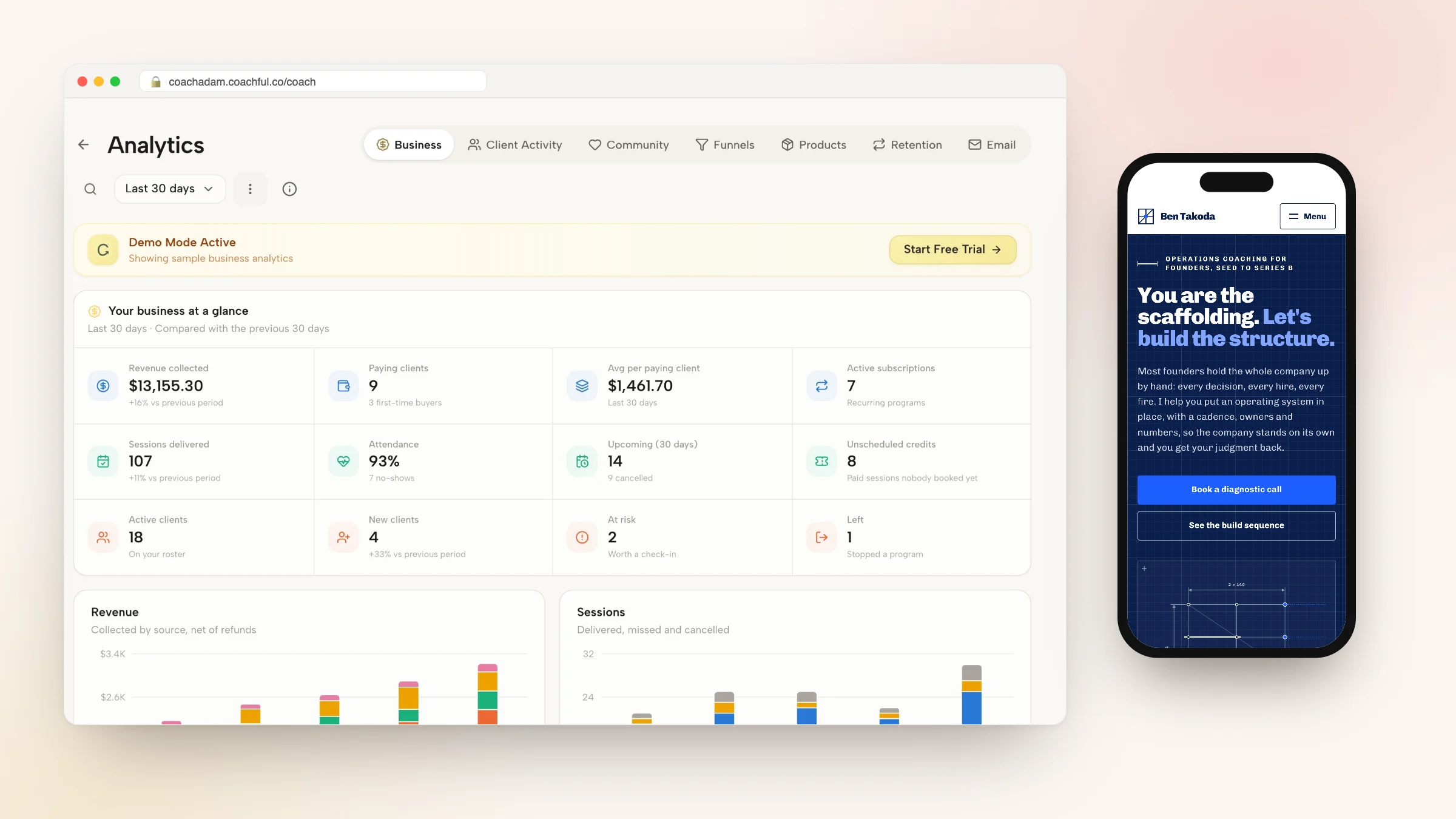
The books give your clients ideas; the weekly rhythm makes them stick. Coachful's business coaching setup adds a weekly scorecard of each client's numbers against targets, a deals tracker with follow-ups, quarterly rocks with weekly commitments and offer versions side by side, with reminders on the scorecard day and for open commitments on Friday. Group programs and masterminds run in a program community, and your own analytics show revenue, sessions and retention for your practice, all included in your membership.


We'll build your business coaching site for free
Coachful's white-glove service is free on every plan. From Create > We'll build it for you · FREE, or the Want us to build it for you? card on your Website or Funnels page, tell the team what you need: a website, a sales page for an accelerator, a funnel that books strategy calls, a program built from your framework or an email sequence. Add up to 8 reference links and 10 files. The team replies by email, usually within about 24 hours, and builds it in your account so you can edit it afterwards. A recent request came from a business mentor for beauty professionals: a sales page and checkout for a 12-week mentorship, a free start-up guide funnel that leads into it, and rewritten follow-up emails. Nothing gets invented: results, testimonials and prices you have not supplied are left for you to fill in. Our guide to a business coach website covers the pages owners look for.


The bottom line
The best books for business coaches map onto the problems owners bring: doing everything themselves (Gerber, Warrillow), no rhythm (Wickman, Doerr), growth pains (Harnish, Goldratt), cash (Michalowicz, Berman and Knight), people (Smart and Street), message and sales (Miller, Rackham), new ideas (Ries, Osterwalder and Pigneur) and building to last (Collins). Know them well enough to recognize when a client needs one, then coach the client to apply it in their own business, one quarter at a time.
Frequently asked questions
What is the best book for a new business coach?
The E-Myth Revisited (1995) is the best single starting point, because the owner who does everything is the most common business coaching client. Add Traction for an operating rhythm and Profit First for cash.
Should business coaches use EOS or Scaling Up?
You do not have to use either, but many client companies already do, so knowing Traction and Scaling Up helps you speak their language. Some coaches specialize in one system; others borrow ideas and coach in their own way.
What books help small business owners with cash flow?
Profit First by Mike Michalowicz gives a simple cash discipline, and Financial Intelligence for Entrepreneurs by Karen Berman and Joe Knight explains how to read the numbers. Tax and financing decisions belong with an accountant.
Are these books useful for coaches running their own practice?
Yes. Building a StoryBrand, SPIN Selling, Profit First and Built to Sell all apply to a coaching business. Our guide to coaching business KPIs shows how to measure your own practice.
What is the business model canvas?
A one-page template introduced in Business Model Generation by Alexander Osterwalder and Yves Pigneur, with nine building blocks covering a company's value proposition, infrastructure, customers and finances.
Do business coaches need business experience as well as books?
Experience helps, and books do not replace it. What matters most is helping the owner apply ideas to their own business. Clients often ask about this on discovery calls, so be honest about what you have run yourself.
Will Coachful build my business coaching website or program for free?
Yes. The white-glove build is free on every Coachful plan. Request it from the Create page, the Website page or the Funnels page, describe what you need and attach your materials; the team usually replies within about 24 hours.












