
13 Best Books for Coaches, and Who Should Read Each
The best books for coaches are the ones that change what you do in your next session: how you listen, the questions you ask, what you do with silence and how you run the business that keeps you coaching. That rules out a lot of popular self-help. The 13 books below cover the craft first (questioning, listening, change conversations), then the evidence, supervision and getting clients, and each one comes with a note on who should read it and a way to use it this week.
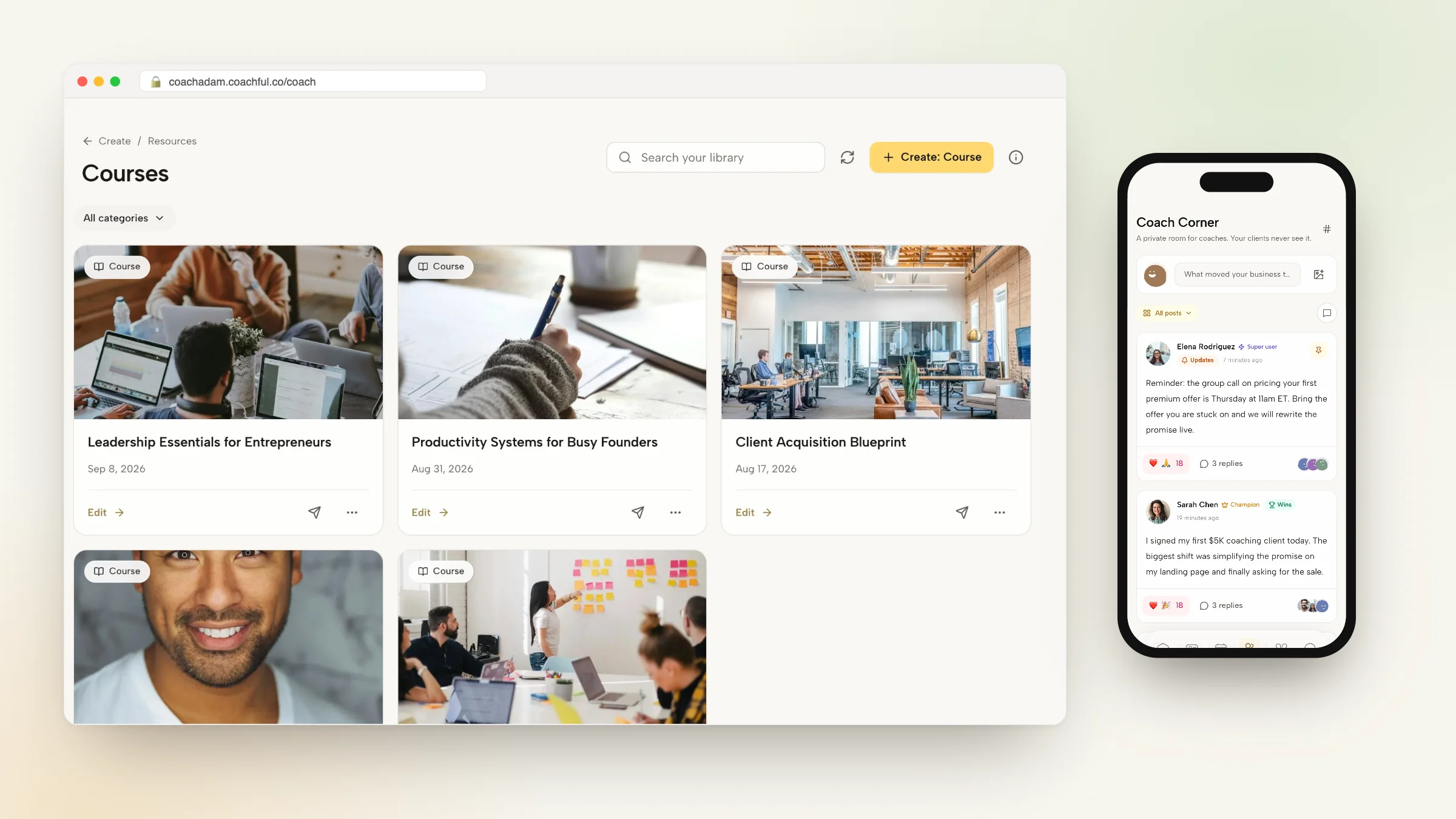
Coachful also turns the frameworks you use into worksheets, check-ins or whole programs inside your account, and our team will build that for you for free if you would rather spend the time reading.
How we chose: every book is about coaching practice or a skill coaches use daily, and has stayed in print or in wide use for years. We checked each title, author and first publication year on Open Library, Wikipedia or the author's or publisher's own pages in October 2026. We do not rank by sales and we do not link to bookshops. If you are brand new, our shorter list of coaching books for beginners is the place to start; this list goes wider.
The best books for coaches at a glance
| Book | Author | First published | Read this if... |
|---|---|---|---|
| 1. Coaching for Performance | John Whitmore | 1992 | You want the GROW model from its source |
| 2. The Inner Game of Tennis | W. Timothy Gallwey | 1974 | You want to know why coaching works at all |
| 3. The Coaching Habit | Michael Bungay Stanier | 2016 | You give advice too fast |
| 4. Time to Think | Nancy Kline | 1999 | You interrupt, even kindly |
| 5. Motivational Interviewing | William R. Miller, Stephen Rollnick | 1991 | Clients say they want change and don't move |
| 6. Clean Language | Wendy Sullivan, Judy Rees | 2008 | Your questions carry your assumptions |
| 7. The Solutions Focus | Paul Z. Jackson, Mark McKergow | 2002 | Sessions get stuck analyzing problems |
| 8. Humble Inquiry | Edgar H. Schein | 2013 | You coach people with less power than you |
| 9. Fierce Conversations | Susan Scott | 2002 | You avoid saying the hard thing |
| 10. Nonviolent Communication | Marshall B. Rosenberg | 1999 | Your clients' conflicts end in blame |
| 11. Evidence Based Coaching Handbook | Dianne R. Stober, Anthony M. Grant (eds) | 2006 | You want to know what the research supports |
| 12. Coaching and Mentoring Supervision | Tatiana Bachkirova and co-editors | 2011 | You coach alone and want better reflection |
| 13. Book Yourself Solid | Michael Port | 2006 | Your calendar has gaps you need to fill |
1. Coaching for Performance, by John Whitmore (1992)
Sir John Whitmore was a racing driver who became, in Wikipedia's words, a pioneer of the executive coaching industry. He trained with Timothy Gallwey, brought the Inner Game approach to Britain and co-created the GROW model: goal, reality, options, will. Coaching for Performance, first published by Nicholas Brealey in 1992 and revised several times since, is where he set the model out, and its publisher calls it the founding text of the coaching profession.
Why it matters for coaches: most coach training still teaches some version of GROW, and reading the source shows you the intent behind each stage, which is raising the client's awareness and responsibility rather than marching through four boxes.
Read this if your sessions wander, or you were taught GROW as a checklist and it feels mechanical.
Try it this week: in one session, spend twice as long as usual in the Reality stage before anyone mentions options. Our list of GROW model coaching questions gives you prompts for each stage.
2. The Inner Game of Tennis, by W. Timothy Gallwey (1974)
A tennis book that changed coaching. Gallwey, a former captain of the Harvard tennis team, argued that performance improves when a person makes accurate, non-judgmental observations, and that the body then adjusts on its own. Wikipedia describes him as one of the first to demonstrate a method of coaching that could be applied to many situations, and notes he ended up lecturing business leaders more than athletes.
Why it matters for coaches: it explains, in about the plainest terms anyone has managed, why asking someone to notice works better than telling them what to do. Much of modern coaching rests on that idea.
Read this if you have trained as a coach but cannot quite explain to a client why your questions are worth paying for.
Try it this week: when a client is stuck on a skill, such as presenting or delegating, swap "here's what to fix" for "what did you notice the last time you did it?" and stay with the answer.
3. The Coaching Habit, by Michael Bungay Stanier (2016)
Published by Page Two in 2016, The Coaching Habit gives managers seven core questions, starting with "What's on your mind?", and the subtitle sums up the method: say less, ask more. It was written for busy managers, which also makes it an easy book to recommend to clients who lead people.
Why it matters for coaches: the questions make a clean session skeleton, and the book's real subject is the habit of advice-giving, which trips up new and experienced coaches alike.
Read this if you notice yourself solving the client's problem in your head while they are still talking.
Try it this week: add "And what else?" two or three times after a client's first answer, then wait. Our guide to The Coaching Habit's seven questions shows a 30-minute session built from them.

4. Time to Think, by Nancy Kline (1999)
Time to Think, subtitled Listening to Ignite the Human Mind and published by Cassell in 1999, introduces what Kline calls a Thinking Environment. Its publisher's description says the book shows how such an environment can change working life, so that hostility and entrenched views give way and new ideas actually get used.
Why it matters for coaches: it is a book about listening as the main event, not a pause before your next question. Most coach training praises that kind of listening; far fewer coaches practice it, and the working-life focus helps if you coach leaders or teams.
Read this if you interrupt with good intentions: finishing sentences, offering a helpful example, asking the next question before the client has finished thinking.
Try it this week: agree with a client at the start of a session that you will not interrupt for the first five minutes, and keep to it. Our guide to the levels of listening pairs well with this book.
5. Motivational Interviewing, by William R. Miller and Stephen Rollnick (1991)
Miller and Rollnick, both clinical psychologists, developed motivational interviewing as a way to help people explore and resolve ambivalence about change. Wikipedia describes it as a client-centered but directive style. The first edition appeared in 1991 and the book has been revised in later editions.
Why it matters for coaches: ambivalence is everywhere in coaching. The client who says they want a new job and never applies, or who wants to lose weight and keeps skipping the plan, is not lazy; they want two things at once. MI gives you a way to work with that instead of arguing.
Read this if you coach health, habits, careers or anything where clients say yes in the session and no in their week.
Try it this week: next time a client gives you a reason not to change, reflect it back without arguing, then ask what the other side of them wants. Our guide to motivational interviewing for coaches covers the OARS skills.
6. Clean Language, by Wendy Sullivan and Judy Rees (2008)
Clean language is a questioning technique, originally used in counseling, psychotherapy and coaching, built around asking questions that carry as little of the questioner's assumptions as possible and that work with the client's own metaphors. Sullivan and Rees's book, subtitled Revealing Metaphors and Opening Minds, was published by Crown House in 2008.
Why it matters for coaches: even open questions smuggle in our ideas. "How can you be more confident?" assumes confidence is the answer. Clean questions use the client's exact words instead.
Read this if clients often answer your question politely and then return to what they were saying, a sign the question was yours, not theirs.
Try it this week: when a client uses a metaphor ("I'm stuck in a fog"), ask "And what kind of fog is that fog?" and follow their image. Our list of clean language coaching questions has eight to practice.
7. The Solutions Focus, by Paul Z. Jackson and Mark McKergow (2002)
Jackson and McKergow's book applies the solution-focused approach, developed in brief therapy by Steve de Shazer and Insoo Kim Berg, to coaching and organizational change. The publisher's summary of its principle is simple: find what works and do more of it. The 2002 first edition was subtitled The Simple Way to Positive Change; the 2007 edition, Making Coaching and Change Simple.
Why it matters for coaches: it gives you a way out of long problem analysis, which can make clients feel worse without moving them. Scaling questions and exceptions ("when is this a little better?") are quick to learn and hard to misuse.
Read this if your sessions spend 40 minutes on why something is hard and 5 on what happens next.
Try it this week: ask a client to rate where they are from 1 to 10, then ask what has got them to that number rather than zero. Our solution-focused coaching questions give you 25 more.
8. Humble Inquiry, by Edgar H. Schein (2013)
Schein, an MIT Sloan professor and one of the founders of organizational behavior research, argues that we live in a "culture of Tell": we tell people what we think they need to know instead of asking. The book, subtitled The Gentle Art of Asking Instead of Telling, came out from Berrett-Koehler in 2013, with a second edition co-written with Peter A. Schein in 2021.
Why it matters for coaches: it is short, and it explains why telling shuts people down, especially across a difference in status. That matters whenever your client sees you as the expert.
Read this if you coach employees, students or anyone who might defer to you, or you are a manager learning to coach.
Try it this week: before your next piece of advice, ask one question you genuinely do not know the answer to, and let it change what you say next.
9. Fierce Conversations, by Susan Scott (2002)
Fierce Conversations, by Susan Scott, founder of Fierce Inc., is a book about how to have a difficult conversation. Its subtitle promises success at work and in life one conversation at a time. It was published in 2002.
Why it matters for coaches: coaching includes saying things clients may not want to hear: that they keep telling the same story, that a goal is not really theirs, that they have not done what they agreed. Scott's book helps you say it directly and stay kind.
Read this if you leave sessions thinking "I should have said something about that."
Try it this week: name one pattern plainly, then ask what the client makes of it. Our guide on how to challenge a coaching client gives seven steps.
10. Nonviolent Communication, by Marshall B. Rosenberg (1999)
Rosenberg, a psychologist and mediator, developed Nonviolent Communication from the 1960s onward. Wikipedia summarizes its four components as observation (distinguishing concrete observation from evaluation), feelings, needs and requests. His book Nonviolent Communication was first published in 1999.
Why it matters for coaches: the four steps are a practical script for clients preparing a difficult conversation with a partner, a manager or a team, and the observation step alone improves most feedback.
Read this if you coach relationships, leadership or conflict, or your clients' plans for hard conversations start with "I'm going to tell them they always...".
Try it this week: have a client rewrite their opening line for a hard conversation in the four parts, then role-play it. Our guide to role-play in coaching shows how to run that.
11. Evidence Based Coaching Handbook, edited by Dianne R. Stober and Anthony M. Grant (2006)
Published by Wiley in 2006, this handbook applies behavioral science research to executive and personal coaching. It presents several different coaching approaches, each with the theory and evidence behind it.
Why it matters for coaches: it helps you choose an approach for a reason and explain it to clients and corporate buyers. Some of the research has moved on since 2006, so read it as a map of approaches, then check newer studies for any claim you plan to quote.
Read this if a sponsor has asked "what's the evidence for this?" and you did not have a good answer, or you want to know what sits under the models you were taught.
Try it this week: write one sentence for your website explaining which approach you use and why. Our guide to coaching models every coach should know lays out the options.
12. Coaching and Mentoring Supervision, edited by Tatiana Bachkirova and colleagues (2011)
Coaching and Mentoring Supervision: Theory and Practice, published by Open University Press and McGraw-Hill in 2011, with a later edition in 2021, collects chapters on how coaches can reflect on their work with a supervisor or peers.
Why it matters for coaches: supervision looks at you as a practitioner, not just your technique: the client who unsettles you, the session that went wrong, the ethical gray area. Many solo coaches have nobody to take those to.
Read this if you have been coaching for a year or more on your own, or you are working toward an ICF credential and want to understand mentor coaching and supervision.
Try it this week: write a ten-minute reflection on one session using a fixed set of prompts. Our guides to what coaching supervision is and reflective practice give you a template.

13. Book Yourself Solid, by Michael Port (2006)
Published by Wiley in 2006, Book Yourself Solid is a guide to starting and growing a service business. Its publisher describes more than 200 marketing strategies for attracting clients, earning referrals and building long-lasting client relationships.
Why it matters for coaches: the craft books on this list will not fill your calendar. This one is about the unglamorous part: who you serve, how you talk about it and how people find you. Some tactics have dated since 2006; the thinking about who you serve has not.
Read this if you are a good coach with a quiet calendar, or you find selling uncomfortable.
Try it this week: write the one sentence that says who you help and with what, and put it at the top of your website. Our guides on getting more clients as a coach and marketing yourself as a coach pick up from there.
How to turn reading into better sessions
Reading changes nothing until it changes what you do in a session. Three habits help:
- One practice per book. Pick one thing from each book and practice it for two weeks before reading the next. The "try it this week" lines above are a starting point.
- Write your own version. Put the idea in your own words and adapt it to your clients. Credit the author when you share their framework, and do not copy their worksheets or text into your materials; build your own.
- Review it with someone. A mentor coach, a supervisor or a peer group will notice whether you are actually using it.
In Coachful, coaches keep this in Brain, a private library of editable pages for methods and notes, with a Build a method shortcut. A question set from your reading can become a prep worksheet under Create, Resources, Forms & Worksheets, or a short check-in in Coaching flows. Coach Corner, the community for coaches on Coachful, is a good place to start a small reading group, and clients never see it.


A reading order for your first year of coaching
| Months | Read | Practice |
|---|---|---|
| 1 to 2 | The Coaching Habit, Time to Think | Fewer answers, longer silences |
| 3 to 4 | Coaching for Performance, The Inner Game of Tennis | A clear session structure, awareness before action |
| 5 to 6 | Motivational Interviewing, The Solutions Focus | Working with ambivalence and progress |
| 7 to 8 | Clean Language, Humble Inquiry | Questions that use the client's words |
| 9 to 10 | Fierce Conversations, Nonviolent Communication | Direct, kind challenge |
| 11 to 12 | Evidence Based Coaching Handbook, Coaching and Mentoring Supervision, Book Yourself Solid | Knowing why it works, reflecting, filling the calendar |
Coaching in a specific niche? Our sibling lists cover the best books for life coaches, health coaches, executive coaches and business coaches, and the best podcasts for coaches fill the commute. For the skills these books build, see our guide to coaching skills.
Spend the time reading: we'll build the rest for free
Coachful's white-glove service is free on every plan. Choose We'll build it for you · FREE on the Create page, pick what you need (a website, a funnel, a program, a course outline, a form or worksheet, a coaching flow, an email sequence and more) and answer a few questions, with up to 8 reference links and 10 files. The team replies by email, usually within about 24 hours, and builds it inside your account so you can edit it afterwards. Nothing gets invented: credentials, testimonials and prices you have not supplied are left for you to fill in. See what Coachful offers life coaches and other niches.

The bottom line
The best books for coaches change your next session, not just your bookshelf. Start with listening and questions (Bungay Stanier, Kline, Whitmore, Gallwey), add the change conversations (Miller and Rollnick, Jackson and McKergow, Sullivan and Rees), then the hard conversations, the evidence and supervision, and one book about getting clients. Read one at a time, practice one thing from each, and take what you learn to someone who can watch you use it.
Frequently asked questions
What is the best book for a new coach?
The Coaching Habit by Michael Bungay Stanier is the easiest place to start, because its seven questions can be used in your next session. Pair it with Coaching for Performance by John Whitmore for the GROW model and Time to Think by Nancy Kline for listening.
What are the classic coaching books?
The Inner Game of Tennis (1974), Coaching for Performance (1992) and Co-Active Coaching (1998) are three of the oldest coaching books still in use, and each has gone through several editions. Motivational Interviewing (1991) is the classic for change conversations.
Are there books on the business side of coaching?
Yes. Book Yourself Solid by Michael Port (2006) is a long-standing guide to getting clients for a service business. Our list of the best books for business coaches covers books about running a company, which also help with your own practice.
Do I need to read these books to become a coach?
No book is required, and reading does not replace training with observed practice and feedback. Books help you understand why techniques work and give you ideas to practice. Combine them with a training program, a mentor coach or a peer group.
Can I use worksheets from coaching books with my clients?
Use the ideas, in your own words, and credit the author. Copying a book's worksheets or text into your paid materials can infringe copyright. Build your own version and adapt it to your clients.
Which coaching book is best for managers?
The Coaching Habit and Humble Inquiry were both written with managers in mind. Fierce Conversations helps with direct feedback. Our sibling list of the best books for executive coaches covers leadership books too.
Will Coachful build a worksheet or program from a framework I use?
Yes. The white-glove build is free on every Coachful plan. Request it from Create > We'll build it for you, describe the framework in your own words, and the team builds a worksheet, coaching flow or program in your account, usually within about 24 hours.












