
12 Best Books for Health Coaches, From Habits to Sleep
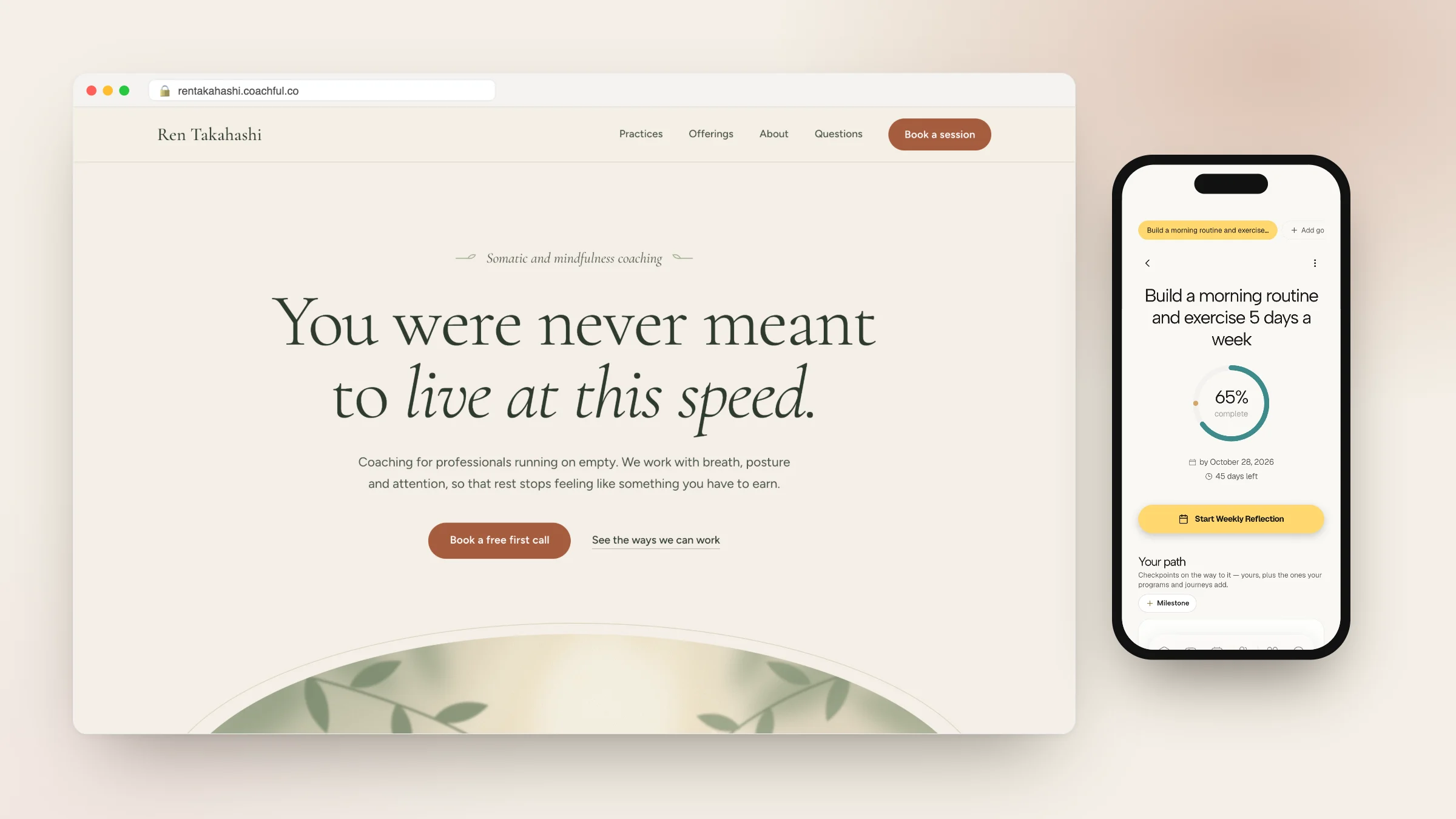
The best books for health coaches fall into two groups: books about how people change, which is the actual job, and books about the health topics clients bring (food, sleep, stress, movement), which give you context without turning you into a dietitian or doctor. A good shelf has more of the first than the second. The 12 books below are chosen that way, each with who should read it, a note on the evidence where it is contested, and a way to use it with a client.
Coachful's team will also build your health coaching website or program in your account for free, so the reading time is yours; more on that below.
How we chose: books that help a health coach work with behavior change or understand the topics clients raise, checked for title, author and first publication year on Open Library, Wikipedia or the publisher's description in October 2026. We do not rank by sales or link to bookshops. For general coaching craft, see our sibling list of the best books for coaches.
The best books for health coaches at a glance
| Book | Author | First published | Read this if... |
|---|---|---|---|
| 1. Motivational Interviewing in Health Care | Stephen Rollnick, William R. Miller, Christopher C. Butler | 2007 | Clients agree, then don't change |
| 2. Changing for Good | James O. Prochaska, John C. Norcross, Carlo C. DiClemente | 1994 | You push clients who aren't ready |
| 3. Tiny Habits | BJ Fogg | 2019 | Plans are too big to start |
| 4. The Willpower Instinct | Kelly McGonigal | 2011 | Clients blame their willpower |
| 5. Why Zebras Don't Get Ulcers | Robert M. Sapolsky | 1994 | Stress is behind most goals |
| 6. Burnout | Emily Nagoski, Amelia Nagoski | 2019 | You coach exhausted women |
| 7. Intuitive Eating | Evelyn Tribole, Elyse Resch | Now in a 4th edition | Clients are worn out by dieting |
| 8. In Defense of Food | Michael Pollan | 2008 | You want a simple frame for eating |
| 9. Salt Sugar Fat | Michael Moss | 2013 | Clients blame themselves for cravings |
| 10. Spark | John J. Ratey, Eric Hagerman | 2008 | Clients need a reason to move |
| 11. Why We Sleep | Matthew Walker | 2017 | Sleep is the habit nobody prioritizes |
| 12. Health Behavior | Karen Glanz, Barbara K. Rimer, K. Viswanath (eds) | 1990 | You want the theory under it all |
1. Motivational Interviewing in Health Care, by Stephen Rollnick, William R. Miller and Christopher C. Butler (2007)
Subtitled Helping Patients Change Behavior and published by Guilford in 2007, this is the health care version of motivational interviewing, the approach Miller and Rollnick developed for helping people explore and resolve ambivalence about change. Rollnick is an honorary professor in Cardiff University's School of Medicine, and the book is aimed at people helping patients change, which is where many health coaches work.
Why it matters for health coaches: most health coaching clients are ambivalent. They want to feel better and they like their evening wine. MI gives you a way to draw out their own reasons for change instead of supplying yours, which is also how the NBHWC frames the coach's role: an accountability partner, not a director.
Read this if clients nod along in the session and nothing happens between sessions.
Use it with a client: ask "on a scale of 0 to 10, how important is this to you?", then "why not a lower number?" and listen to the reasons they give. Our list of motivational interviewing questions has more.
2. Changing for Good, by James O. Prochaska, John C. Norcross and Carlo C. DiClemente (1994)
Prochaska, a University of Rhode Island psychologist, was the lead developer of the transtheoretical model of behavior change, often called the stages of change. Changing for Good, published by William Morrow in 1994, explains the six stages for a general reader. A 2009 article in the British Journal of Health Psychology called the model arguably the dominant model of health behavior change, as Wikipedia records.
Why it matters for health coaches: it stops you giving action plans to people who are still deciding. A client in contemplation needs a different conversation from one already in action.
Read this if you notice yourself pushing, or clients drop out after an enthusiastic first session.
Use it with a client: before setting goals, ask where they are with this change right now: not thinking about it, thinking about it, getting ready or already doing it. Match your next question to the answer.
3. Tiny Habits, by BJ Fogg (2019)
Fogg is a social scientist at Stanford, where he founded and directs the Behavior Design Lab. Tiny Habits: The Small Changes That Change Everything, published in 2019, makes the case for starting with very small behaviors and building from there.
Why it matters for health coaches: health goals are usually too big for a busy week. "Exercise five days a week" fails; "put on my walking shoes after I pour my coffee" often sticks. Fogg's book gives you a method for shrinking a behavior until it is easy.
Read this if your clients' plans are sensible and they still cannot start.
Use it with a client: take the goal, make it so small it feels silly, anchor it to something they already do every day, and track it for two weeks.

4. The Willpower Instinct, by Kelly McGonigal (2011)
McGonigal is a health psychologist and lecturer at Stanford. The Willpower Instinct grew out of her course on the science of willpower, and its publisher describes it as explaining the science of self-control and how it can improve health, happiness and productivity.
Why it matters for health coaches: clients often arrive convinced they lack willpower. Treating self-control as a subject of science, rather than a character trait, helps you move the conversation from "I'm weak" to "when, where and under what stress does this break down?", which leads to better plans than "try harder".
Read this if your clients describe themselves as weak or undisciplined.
Use it with a client: ask when in the day their self-control is strongest and weakest, then move the hardest habit to the strongest time.
5. Why Zebras Don't Get Ulcers, by Robert M. Sapolsky (1994)
Sapolsky is a Stanford neuroscientist whose research focuses on the biology of stress. Why Zebras Don't Get Ulcers, first published in 1994 with a third edition in 2004, is a guide to stress, stress-related disease and coping, written for general readers.
Why it matters for health coaches: stress drives sleep, eating, drinking and motivation. Understanding why chronic stress wears the body down helps you explain to clients why "relax more" is a health goal, not an indulgence.
Read this if stress is behind most of your clients' other goals, or you coach professionals and caregivers.
Use it with a client: map one ordinary week together and mark where stress peaks, then plan one recovery habit for the hardest day. Our guide to stress management coaching goes further.
6. Burnout, by Emily Nagoski and Amelia Nagoski (2019)
Burnout, published in 2019, explains why women can experience burnout differently from men and offers a science-based plan to manage stress and emotions, according to its publisher. Emily Nagoski is a researcher and former director of wellness education at Smith College.
Why it matters for health coaches: the publisher names the gap between what women's lives are really like and what people expect women to be as a primary cause of burnout. That gives you language for clients whose health goals keep losing to everything else they are carrying.
Read this if you coach women in midlife, caregivers, or anyone whose health goals keep losing to exhaustion.
Use it with a client: ask what they do at the end of a hard day that actually helps their body feel safe again, and make one of those a daily habit. Our guide to burnout coaching covers when coaching fits and when to refer.
7. Intuitive Eating, by Evelyn Tribole and Elyse Resch (fourth edition)
Tribole and Resch are registered dietitians who coined the term intuitive eating. Their book, now in its fourth edition, sets out ten principles for eating in response to hunger and satisfaction cues rather than diet rules. Wikipedia describes the approach as fostering a positive relationship with food rather than pursuing weight control.
Why it matters for health coaches: many clients have spent years dieting, and a coach who adds another plan can make things worse. This book gives you language for clients who need to stop fighting food.
Read this if your clients describe a long history of diets, or "good" and "bad" foods dominate your sessions.
Use it inside your scope: coach the habits, such as noticing hunger before eating and planning regular meals. Leave meal plans and medical nutrition to a registered dietitian, and refer anyone with signs of an eating disorder.
8. In Defense of Food, by Michael Pollan (2008)
A 2008 book by the journalist Michael Pollan, which grew out of his essay Unhappy Meals. Its best-known line sums up the advice: "Eat food. Not too much. Mostly plants." Pollan argues that thinking about food as nutrients has overcomplicated how people eat.
Why it matters for health coaches: it gives you and your clients a simple frame that does not require counting anything, which suits coaching better than nutrient-by-nutrient advice that belongs with a dietitian.
Read this if your clients are overwhelmed by conflicting nutrition advice.
Use it with a client: pick one meal a day and ask how it could be a little more like food their grandparents would recognize, then plan the shopping for it.
9. Salt Sugar Fat, by Michael Moss (2013)
Salt Sugar Fat: How the Food Giants Hooked Us, published in 2013, traces how the processed food industry used salt, sugar and fat to shape what people eat over the past half century, according to its publisher's description.
Why it matters for health coaches: clients who blame themselves for cravings often feel relief when they learn how deliberately some foods are designed. That relief can turn shame into planning.
Read this if clients describe themselves as having no self-control around certain foods.
Use it with a client: instead of willpower, plan the environment: what is in the house, what is in the bag at 3 p.m. and what is on the route home.
10. Spark, by John J. Ratey with Eric Hagerman (2008)
Ratey is an associate clinical professor of psychiatry at Harvard Medical School. Spark: The Revolutionary New Science of Exercise and the Brain, published in 2008, describes the benefits of exercise for learning and for people with anxiety, depression and ADHD, according to Wikipedia.
Why it matters for health coaches: clients who will not move for their weight will sometimes move for their mood or focus. Spark gives you that reason, though exercise is not a substitute for treatment when a client needs it.
Read this if your clients see exercise only as a weight-loss tool.
Use it with a client: ask them to rate their mood before and after a short walk for a week, then look at the numbers together. The CDC's guideline of 150 minutes of moderate activity a week plus two days of muscle strengthening is a sensible long-term target (CDC).

11. Why We Sleep, by Matthew Walker (2017)
Walker, a professor of neuroscience and psychology at UC Berkeley and director of its Center for Human Sleep Science, wrote this 2017 popular science book on why sleep matters. It became a bestseller and also drew criticism from academics for broad or unfounded claims; Wikipedia records a detailed critique by the researcher Alexey Guzey and responses Walker posted in 2019.
Why it matters for health coaches: sleep is the habit that makes all the others easier, and many clients rank it last. The book can motivate, as long as you do not repeat its most alarming claims as settled fact.
Read this if sleep keeps coming up and you want to understand why it matters, critically.
Use it with a client: pick one sleep habit (a fixed wake time, screens out of the bedroom) and track it for two weeks. If a client snores heavily or is exhausted despite enough sleep, suggest they see a doctor.
12. Health Behavior: Theory, Research, and Practice, edited by Karen Glanz, Barbara K. Rimer and K. Viswanath (1990)
First published in 1990 as Health Behavior and Health Education, this textbook is now in a fifth edition under its current title. Its publisher describes it as a thorough introduction to the theories, applications and research of health education and health promotion, used in public health courses.
Why it matters for health coaches: it is where the theories behind health behavior change are laid out in depth, with the research and practice that go with them. It is dense, so dip into the chapters you need.
Read this if you want to explain your approach to a clinic, an employer or a health system, or you are preparing for board certification.
Use it in your practice: write one paragraph for your website or a proposal explaining which model your coaching uses and why. Our guide to health coach certification explains the NBHWC route.
Read inside your scope
Several of these books are about food, sleep and the brain. Reading them gives you context, not a license. The NBHWC's scope of practice says coaches on their own do not diagnose, interpret medical data, prescribe, recommend supplements, create meal plans or prescribe exercise (NBHWC). Coaches may share evidence-based information from nationally recognized authorities. In practice:
| From your reading | Inside your scope | Refer it on |
|---|---|---|
| Nutrition books | Planning meals the client chose, shopping, eating out | Meal plans or medical diets: a registered dietitian |
| Sleep books | Wake times, wind-down routines, tracking | Suspected sleep apnea or insomnia: a doctor |
| Exercise books | Building a habit of moving, finding activities they enjoy | Pain, injury or a cardiac condition: a doctor or physical therapist |
| Stress and burnout books | Recovery habits, boundaries, routines | Depression, anxiety or trauma: a therapist |
Our guides to what health and wellness coaching is and health coach skills cover the boundary in more depth, and mistakes new health coaches make covers what happens when it slips.
Turning reading into a program
The behavior-change books are the ones to build into your client experience. A tiny habit becomes a daily habit the client ticks off with a reminder. A readiness question from Changing for Good becomes part of your intake form. A weekly check-in on energy, sleep and stress becomes a short form your client fills in before each session, and a mood-after-walking experiment becomes a goal with a weekly reflection. In Coachful, all of that sits in one program, included in your membership. Our health coaching templates and guide to creating a health coaching program give you a structure.


Want the program built for you? It's free
Coachful's white-glove service is free on every plan. From Create > We'll build it for you · FREE or the build-for-you card on your Website page, describe what you need: a website, a 12-week habit program, an intake form or a weekly check-in. Add up to 8 reference links and 10 files. The team replies by email, usually within about 24 hours, and builds it in your account so you can edit it afterwards. A recent request came from a menopause and midlife health coach starting from nothing: a five-page site in sage and cream where every button leads to a free 20-minute consultation. Nothing gets invented, and the team does not record your videos. See Coachful for health coaches.


The bottom line
The best books for health coaches are mostly about change: Motivational Interviewing in Health Care, Changing for Good, Tiny Habits and The Willpower Instinct. Add stress (Why Zebras Don't Get Ulcers, Burnout), food, movement and sleep for context (Intuitive Eating, In Defense of Food, Salt Sugar Fat, Spark, Why We Sleep, read critically), and one textbook for the theory. Use what you read to coach habits, and send diets, diagnoses and treatment to the professionals who own them.
Frequently asked questions
What is the most important book for a health coach?
Motivational Interviewing in Health Care (2007) is the most useful single book, because ambivalence is behind most stalled health goals and MI is built for exactly that. Pair it with Changing for Good for the stages of change.
Should health coaches read nutrition books?
Yes, for context, as long as you stay in scope. Under the NBHWC's scope, coaches do not create meal plans or medical diets on their own. Use nutrition books to understand clients' questions and coach habits; refer meal plans to a registered dietitian.
Is Why We Sleep accurate?
It is widely read and has been criticized by academics for broad or unfounded claims, including a detailed critique by Alexey Guzey. Use it to motivate better sleep habits, and avoid repeating its most alarming statistics as settled fact.
What books help with the NBHWC exam?
Start with the materials from your NBHWC-approved training program, since completing one is required before you can apply for the exam. Books on motivational interviewing, the stages of change and health behavior theory, such as Health Behavior: Theory, Research, and Practice, are useful background.
What is a good book on habits for health coaches?
Tiny Habits by BJ Fogg (2019) is written around starting with very small behaviors, which suits health coaching well. Atomic Habits by James Clear covers similar ground and appears on our list for life coaches.
Can I use these books' exercises in my health coaching program?
Use the ideas in your own words and credit the author. Copying worksheets or text into paid materials can infringe copyright. Build your own version and fit it to your clients.
Will Coachful build my health coaching program for free?
Yes. The white-glove build is free on every Coachful plan. Request it from the Create page, describe the program and attach your materials; the team usually replies within about 24 hours and builds it in your account.












