The Coaching Habit: All 7 Questions and How to Use Them
The Coaching Habit is Michael Bungay Stanier's 2016 book about coaching in ten minutes or less, built around seven questions: "What's on your mind?", "And what else?", "What's the real challenge here for you?", "What do you want?", "How can I help?", "If you're saying yes to this, what are you saying no to?" and "What was most useful for you?" Written for busy managers, the questions work just as well for professional coaches, who often use them as a session skeleton.
Below are all seven questions from The Coaching Habit with what each one does, how to ask it, follow-ups, mistakes to avoid and an example. Then a 30-minute session that uses them in order, how they map to the GROW model, and how to keep them working between sessions. If you coach on Coachful, our team will turn this structure into a prep worksheet and a post-session check-in in your account for free.
The seven questions at a glance
The wording below matches the list Bungay Stanier presented at a 2019 University of St. Thomas executive coaching conference, as reported by the university. The book's subtitle is Say Less, Ask More & Change the Way You Lead Forever, which is the whole method in eight words.
| # | Name | The question | What it does |
|---|---|---|---|
| 1 | The Kickstart Question | What's on your mind? | Opens the conversation without small talk or an agenda you chose |
| 2 | The AWE Question | And what else? | Gets past the first answer, which is rarely the real one |
| 3 | The Focus Question | What's the real challenge here for you? | Narrows a sprawling issue to the part this person owns |
| 4 | The Foundation Question | What do you want? | Names the outcome, which most people skip |
| 5 | The Lazy Question | How can I help? | Makes the request explicit so you don't rescue by default |
| 6 | The Strategic Question | If you're saying yes to this, what are you saying no to? | Turns a yes into a real commitment with a cost |
| 7 | The Learning Question | What was most useful for you? | Closes the conversation by making the person name what they learned |
1. The Kickstart Question: "What's on your mind?"
It's open enough to let the person pick the topic and focused enough to skip "How's it going?" small talk. You're asking about what is occupying their attention right now, which is usually what the conversation should be about.
The book pairs it with a way to choose the angle: the 3Ps. Once you know the topic, you can ask whether they want to look at the Project (the content, the task itself), the People (a relationship, and their part in it) or the Pattern (a way of working they'd like to change). "Do you want to talk about the launch plan, the tension with your co-founder, or the way you keep taking on everyone's work?" is a 3Ps question in plain clothes.
Mistake to avoid: asking it and then answering for them. If the silence lasts four seconds, let it last eight.
2. The AWE Question: "And what else?"
It may be the most useful of the seven, because it's nearly impossible to get wrong. The first answer to any question is often the rehearsed one. "And what else?" invites the second and third, where the useful material tends to sit. It also slows you down, because you can't give advice while you're asking for more.
In practice two or three rounds is usually enough. When the answers start getting thinner, close it off with "Is there anything else?" so the person knows the list is complete. Asked after a list of options, it widens the choices. Asked after "What's the real challenge?", it often reveals the challenge under the challenge.
Mistake to avoid: saying it like a checklist item. Said warmly and with a pause, it sounds like interest. Said quickly, it sounds like you're waiting for your turn.

3. The Focus Question: "What's the real challenge here for you?"
Most people bring a cloud: the team, the deadline, the client who won't decide. This question asks which part of that cloud is theirs to work on. Each word does a job. "Real" says there are surface challenges and a deeper one. "Here" keeps it to this situation. "For you" moves it from "they" and "it" to the person in front of you, where change is actually possible.
If the answer is still general, ask it again with the client's own words: "So with the launch slipping, what's the real challenge for you?" Pair it with the AWE Question, then ask which of the challenges they want to work on first.
Mistake to avoid: solving the first challenge they name. Wait until they've named the one that makes them pause.
4. The Foundation Question: "What do you want?"
It sounds blunt because it is. People spend a lot of energy describing what's wrong and very little stating what they want instead. Asking it directly often produces a surprised silence, then a clearer answer than anything that came before.
Two follow-ups make it more useful in a coaching session: "What do you want from this conversation?" and "What do you want from the other person?" The second matters in relationship and leadership work, where the client wants something from someone else but has never said it out loud. It is also the bridge to goal setting: once the want is clear, our SMART goals template turns it into something measurable.
5. The Lazy Question: "How can I help?"
It's lazy in the sense that it saves you from guessing. Instead of assuming what the person needs and jumping in, you ask them to make a clear request. Bungay Stanier connects this to Stephen Karpman's Drama Triangle of victim, persecutor and rescuer: managers and coaches who fix things on reflex slip into the rescuer role, and the other person stays stuck in the victim role.
A blunter variation is "What do you want from me?" You don't have to say yes to the request. "No," "Yes, but not this week" and "Let me think about it" are all fine answers. The point is that help becomes an agreement rather than an assumption.
For professional coaches: use it carefully. Asked too often, it trains clients to hand you their problems. In coaching it works best near the end of a session: "What would be most helpful from me between now and next time?"
6. The Strategic Question: "If you're saying yes to this, what are you saying no to?"
Every yes costs something. This question makes the cost visible before the commitment is made. It works on two levels: what will you stop doing to make room for this, and who will you disappoint by saying yes here?
It's the question most clients need and fewest ask themselves. A founder who says yes to a new product line is saying no to something: sleep, the existing customers, the hire she planned. Naming it turns an enthusiastic yes into a plan that might survive contact with the calendar.
Mistake to avoid: asking it only about the big decisions. It's just as useful for "I'll start journaling every morning", which is a no to something else in those twenty minutes.

7. The Learning Question: "What was most useful for you?"
End every conversation with it. It asks the person to recall and name what mattered, which is when the learning sticks, and it tells you what to do more of next time. It also frames the conversation as useful, which most people will happily agree with.
Coaches can stretch it across the week. Asked at the end of a session, it captures the insight. Asked again by message two days later ("What's stayed with you from Tuesday?"), it shows whether the insight survived. Our guide to reflective practice in coaching uses the same answers to improve your own sessions.
Building the habit, not just knowing the questions
The book's real argument is in the title: knowing good questions doesn't change how you behave in a meeting. Advice-giving is a habit with a trigger. The book's approach is to identify the trigger, identify the old habit, and attach one of the seven questions as the new behavior. A practical way to write it:
| When this happens... | Instead of... | I will ask... |
|---|---|---|
| A client starts the session with a long update | Listening for the problem I can solve | "What's the real challenge here for you?" |
| I feel the urge to suggest a solution | Offering my idea | "And what else?" |
| A client asks "What would you do?" | Telling them | "What do you want?" |
| A client commits to something big | Cheering | "What are you saying no to?" |
| The session is ending | Summarizing for them | "What was most useful for you?" |
Pick one row, practise it for a week, then add another. Trying all five at once is how people end up with none.
A 30-minute coaching session using the seven questions
The questions were designed for ten-minute manager conversations, but they make a clean skeleton for a full session. Here's how many coaches run it:
- Minutes 0 to 3, Kickstart. "What's on your mind?" Let them talk. Offer the 3Ps if the topic is broad.
- Minutes 3 to 8, AWE. "And what else?" two or three times, then "Is there anything else?"
- Minutes 8 to 15, Focus. "What's the real challenge here for you?" followed by AWE again. Ask which challenge to work on today.
- Minutes 15 to 22, Foundation. "What do you want?" Explore options with the client's ideas first.
- Minutes 22 to 26, Strategic. "If you're saying yes to this, what are you saying no to?" Agree one action.
- Minutes 26 to 28, Lazy. "How can I help between now and next time?"
- Minutes 28 to 30, Learning. "What was most useful for you today?" Write their answer down in their words.
Listening is the skill under all of it. Our guide to the levels of listening covers what to do with the answers.
The seven questions and the GROW model
If you already coach with GROW (Goal, Reality, Options, Way forward), the seven questions slot in rather than replace it.
| GROW stage | Coaching Habit question |
|---|---|
| Before the goal: choosing a topic | What's on your mind? And what else? |
| Goal | What do you want? |
| Reality | What's the real challenge here for you? And what else? |
| Options | And what else? |
| Way forward | If you're saying yes to this, what are you saying no to? How can I help? |
| Close | What was most useful for you? |
Our GROW model coaching questions give you 32 more prompts for each stage, and the motivational interviewing questions are the better choice when the client is unsure whether they want to change at all.
Where The Coaching Habit falls short for professional coaches
- It's written for managers. The examples are workplace conversations, and a manager also holds authority over the person. Coaches don't, so the Lazy Question needs the adjustment above.
- It's a set of questions, not a full model. There's little on contracting, goals across sessions, or measuring progress.
- Silence carries much of the weight. The questions only work if you wait for the answers, which is harder than it sounds on a video call.
- It isn't a credential. If you want accredited training, the ICF lists the core competencies its programs teach.

Keeping the seven questions going between sessions in Coachful
The questions are short enough to live in your client's week, not just in your calls. This is how coaches set that up in Coachful, all of it included in your membership.
A prep worksheet built from questions 1 to 4
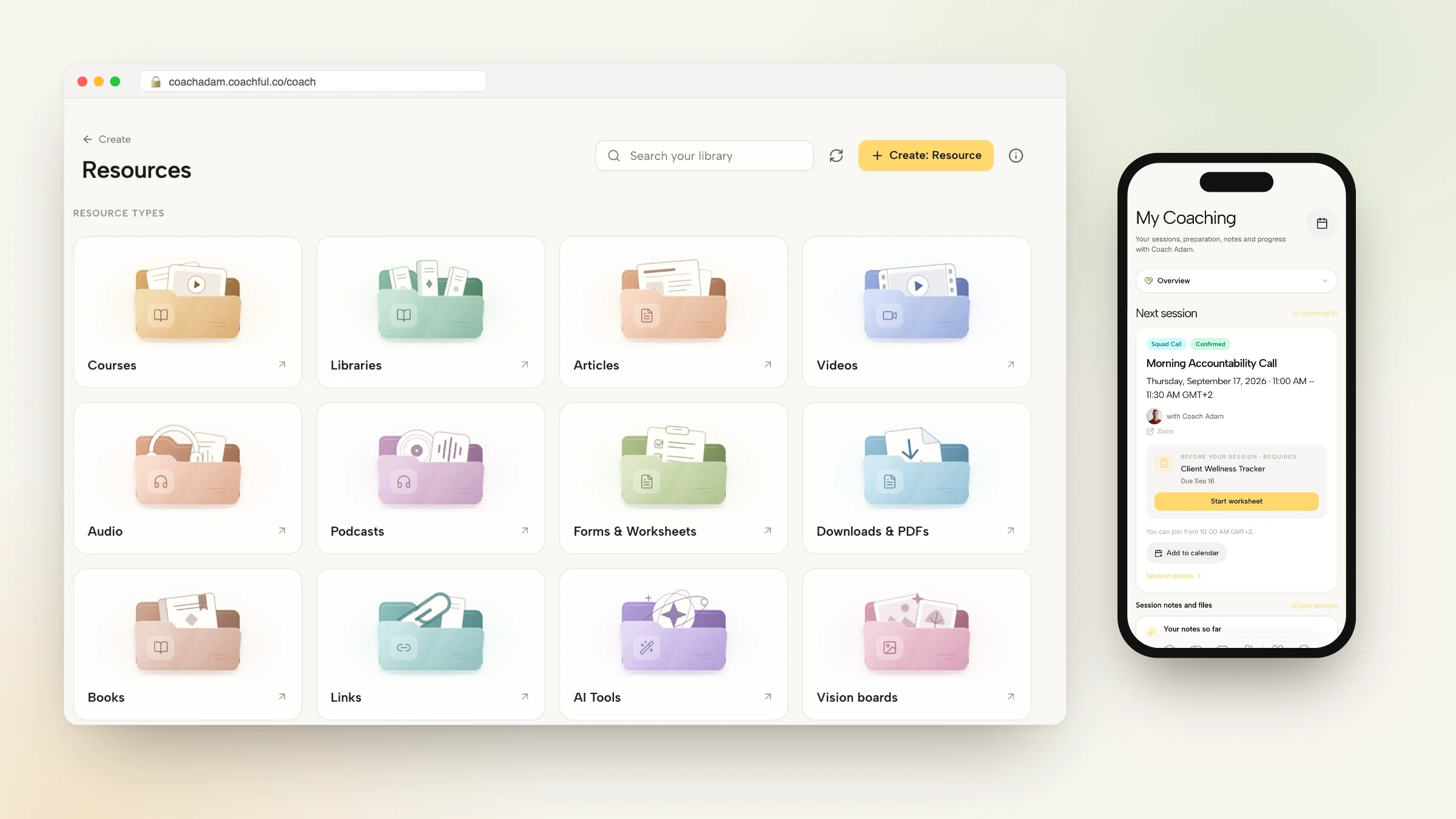
Build a worksheet (Create > Resources > Forms & Worksheets) with four text questions: What's on your mind? What else? What's the real challenge here for you? What do you want from our next session? Attach it to your session type as prep. Clients see it on their session card under Before your session, and you start the call already past the small talk.

A post-session check-in for question 7
Create a short coaching flow with one question, "What was most useful for you from our session?", and a second, "What are you saying no to this week to make room for it?" Send it after each session. The answers land on the client's record, so you can see which insights lasted.

Notes that keep the thread
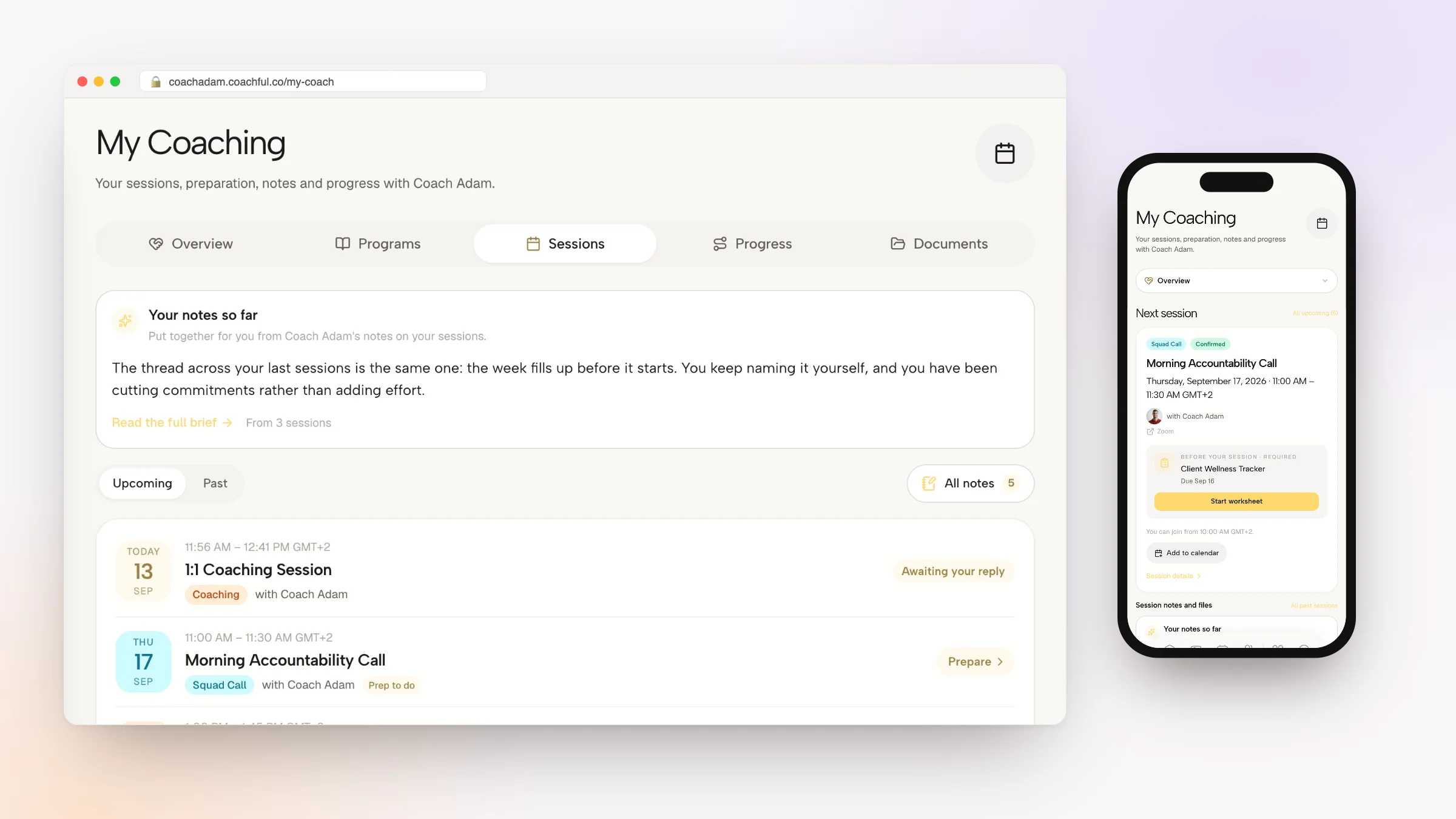
Your session notes build into a running summary the client can read on their My Coaching page under Your notes so far. Writing the client's answer to the Learning Question in their own words there gives them the thread across sessions.
Prepare in Brain before the call
Brain's Prepare for a client shortcut brings together a client's context, progress and what to discuss next, which is a fast way to decide which of the seven questions to lead with.

Or have our team build it
Coachful's team will build the prep worksheet, the post-session flow or a whole program around these questions in your account for free, on every plan. Use Create > We'll build it for you, describe what you want, and the team usually replies within about 24 hours. Read what the free white-glove service builds. Our pages for executive coaches and business coaches show the rest of the setup, and the free coaching questions bank has 200 more questions sorted by moment.

Frequently asked questions
What are the 7 questions in The Coaching Habit?
What's on your mind? And what else? What's the real challenge here for you? What do you want? How can I help? If you're saying yes to this, what are you saying no to? What was most useful for you? Bungay Stanier names them the Kickstart, AWE, Focus, Foundation, Lazy, Strategic and Learning questions.
Who wrote The Coaching Habit and when was it published?
Michael Bungay Stanier wrote it. It was published by Page Two in February 2016 with the subtitle Say Less, Ask More & Change the Way You Lead Forever. It's aimed at managers and team leaders who want to coach as part of everyday conversations.
What is the AWE question in coaching?
AWE stands for "And what else?" It's the second of the seven questions. You ask it after the first answer to draw out more options, concerns or ideas, usually two or three times, then close with "Is there anything else?" It also stops you from jumping in with advice too early.
What is the best coaching question from The Coaching Habit?
"And what else?" is the most versatile, because it works almost anywhere and is hard to misuse. For many coaches the most useful in practice is the Focus Question, "What's the real challenge here for you?", because it turns a general complaint into something the client can act on.
Can professional coaches use The Coaching Habit questions, or only managers?
Coaches use them widely. They make a clean session structure: Kickstart and AWE to open, Focus and Foundation for the middle, Strategic and Lazy to agree actions, and Learning to close. Adjust the Lazy Question so it doesn't invite clients to hand you their problems.
How long does a Coaching Habit conversation take?
The book is built around coaching in ten minutes or less, so a manager can use the questions in an ordinary one-to-one. A professional coaching session using all seven usually runs 30 to 60 minutes, because the Focus and Foundation questions take longer when you let the client think.
Will Coachful build a session worksheet from the seven questions for me?
Yes. The white-glove service is free on every Coachful plan. Ask from Create > We'll build it for you and the team will build a prep worksheet, a post-session check-in or a full program in your account, usually within about 24 hours, so you can edit it afterwards.