Coachful
Coachful
ToolsBlogContact
Best of
September 4, 202646 min

Best Coaching Apps and Software for Online Coaches (2026)

Best Coaching Apps and Software for Online Coaches (2026)

Search for a coaching app and you get two completely different products wearing the same word. One is software you log into on a laptop to run a business: booking, invoices, contracts, client notes. The other is the thing your client taps on their phone on a Tuesday morning to log a habit and read the message you left them. Most roundups quietly merge the two, which is how coaches end up paying for a beautiful admin tool their clients never open, or a slick client app that cannot take a payment.

So this piece separates them, because the best coaching apps are honest about which of the two they are. We looked at 14 tools coaches actually shortlist, checked every price on the vendor's own pricing page on 2 September 2026, and pulled review scores with their counts from G2, Capterra and Trustpilot instead of repeating marketing claims. Where a vendor does not publish something, we say we could not verify it rather than guessing.

The finding that surprised us most: of these 14 tools, four have no client mobile app at all. Not a limited one. None. Clients get a mobile web page and an "add to home screen" shortcut, and two of those four are among the highest-rated coaching tools in the category. That is a trade-off worth understanding, not a flaw.

Prices move. Kajabi raised most tiers between 25% and 61% in January 2026 and cut Basic contacts from 10,000 to 2,500. TrueCoach's live prices are higher than the ones Capterra still shows. Treat every number here as correct on 2 September 2026 and check the vendor page before you put a card in.

The two questions hiding inside "coaching app"

Write down which of these sounds more like your problem. The answer changes the shortlist completely.

Question one: "I need software to run my coaching business." Discovery calls booked over email, invoices chased in a spreadsheet, contracts sent as PDFs, notes in Notion, a Calendly link and a separate email tool. You want fewer logins and one client list. This is a practice-management problem, and the strongest answers are Coachful, Paperbell, CoachAccountable, Simply.Coach, Delenta, Satori and CoachVantage. Our coaching CRM roundup goes deeper on that side.

Question two: "I need an app my clients open every day." Your delivery lives between sessions: habits, check-ins, workouts, homework, a nudge on day four when someone goes quiet. Here the answer set changes to Coachful, upcoach, Trainerize, TrueCoach, HubFit, Quenza, Delenta and Simply.Coach. Paperbell, CoachAccountable, Satori and CoachVantage cannot serve this need with a native app today, however good they are at the first question.

A minority of coaches genuinely need both at full strength, and that group has the hardest decision, because most tools here are honest specialists. The all-in-one category exists for exactly that reader, and we covered it in the all-in-one software roundup.

Pick your lane in 60 seconds

Read these six statements. Stop at the first one that describes you. That is your shortlist.

  1. "I sell 1:1 packages and I need booking, contracts and payment to stop leaking." Paperbell at $57/mo or CoachVantage at $39/mo. Both do enrollment-to-payment well and neither has a client app. Satori at $33/mo is the calmest option under 10 paying clients.
  2. "My clients need daily accountability and I want them on their phone." Coachful from $29/mo, upcoach from $49/mo billed annually, or HubFit at $39/mo in fitness. All three ship habits, check-ins and a native client app.
  3. "I run cohorts and the community is the product." upcoach and Skool are the two poles. upcoach at $99/mo annually gives 100 participants with real progress dashboards. Skool at $9/mo gives a community and a course vault for almost nothing, and takes 10% of every sale on that tier.
  4. "I write training programs and my clients log workouts." Trainerize, TrueCoach and HubFit. Entry prices are $10, $29.98 and $39 a month, and the client caps matter more than the headline.
  5. "I coach executives with a corporate sponsor who wants reports." Simply.Coach claims SOC2, HIPAA and GDPR and does stakeholder reporting. CoachAccountable gives unlimited coach seats and the deepest accountability toolset here.
  6. "I sell courses and memberships, and coaching is one product line." Kajabi, from $179/mo. It is the only tool here with a full website, email marketing, funnels and a course platform sharing one contact record.

If two statements fit, pick the one that describes where your revenue comes from, not where your time goes. Time follows revenue eventually.

Two lanes separating business software from a client-facing app
Practical tip. Before comparing a single feature, count your active clients and write the number down. Six of these 14 tools price by client count and the ladders are steep. CoachAccountable goes from $40 at 5 clients to $250 at 50. TrueCoach goes from $29.98 at 5 clients to $164.98 at 50. Your client number is the biggest single input into what you actually pay.

How we checked the numbers

Everything below comes from a competitor registry we maintain and re-verify, not from memory or other listicles. Three rules govern it.

  • Prices come from the vendor's own pricing page, checked on 2 September 2026, with the annual equivalent where one is published. Where a third-party directory disagrees with the live page we flag it, because stale directory prices are the most common error in this category.
  • Ratings come with their counts. A 5.0 from 6 reviews and a 4.6 from 694 are not the same claim. Coachful's own score is 4.5 on Trustpilot from 21 reviews, which is a small sample and we say so.
  • Unknown is a valid answer. Where a vendor does not publish a data-export process or a compliance posture, we write that we could not verify it. You will see that phrase several times.

The order below runs from coaching-delivery tools, through admin-first tools, into fitness, then into course and community platforms, because that is the order in which the decision actually splits.

A coach working on a laptop between client sessions

Which of these actually ship a client mobile app

This is the question the phrase "coaching app" is really asking, and it is the one most articles skip. Here is the honest split as of 2 September 2026.

Native client app on iOS and Android: Coachful, Simply.Coach, Delenta (Premium and above only), Quenza, upcoach, Trainerize, TrueCoach, HubFit, Kajabi (Growth and Pro) and Skool.

No client app, browser only: Paperbell, CoachAccountable, Satori and CoachVantage. CoachAccountable documents an add-to-home-screen shortcut instead. CoachVantage's own FAQ states it is not an iOS or Android app. Paperbell is mobile browser only. Satori is mobile-responsive and nothing more.

That is not a knockout blow. CoachAccountable holds 5.0 on Capterra from 67 reviews and 4.8 on Trustpilot from 46 while shipping no app, because its buyers are coaches whose clients do reflective written work on a laptop. Paperbell holds 4.7 on Capterra from 150 reviews for the same reason. If your delivery does not depend on a phone in a pocket, the absence costs you nothing.

If you are selling daily habits and check-ins, a browser tab is not a delivery mechanism. Nobody bookmarks their accountability.

The 14 best coaching apps and software for online coaches

1. Coachful: for coaches who deliver programs and want clients on their phone

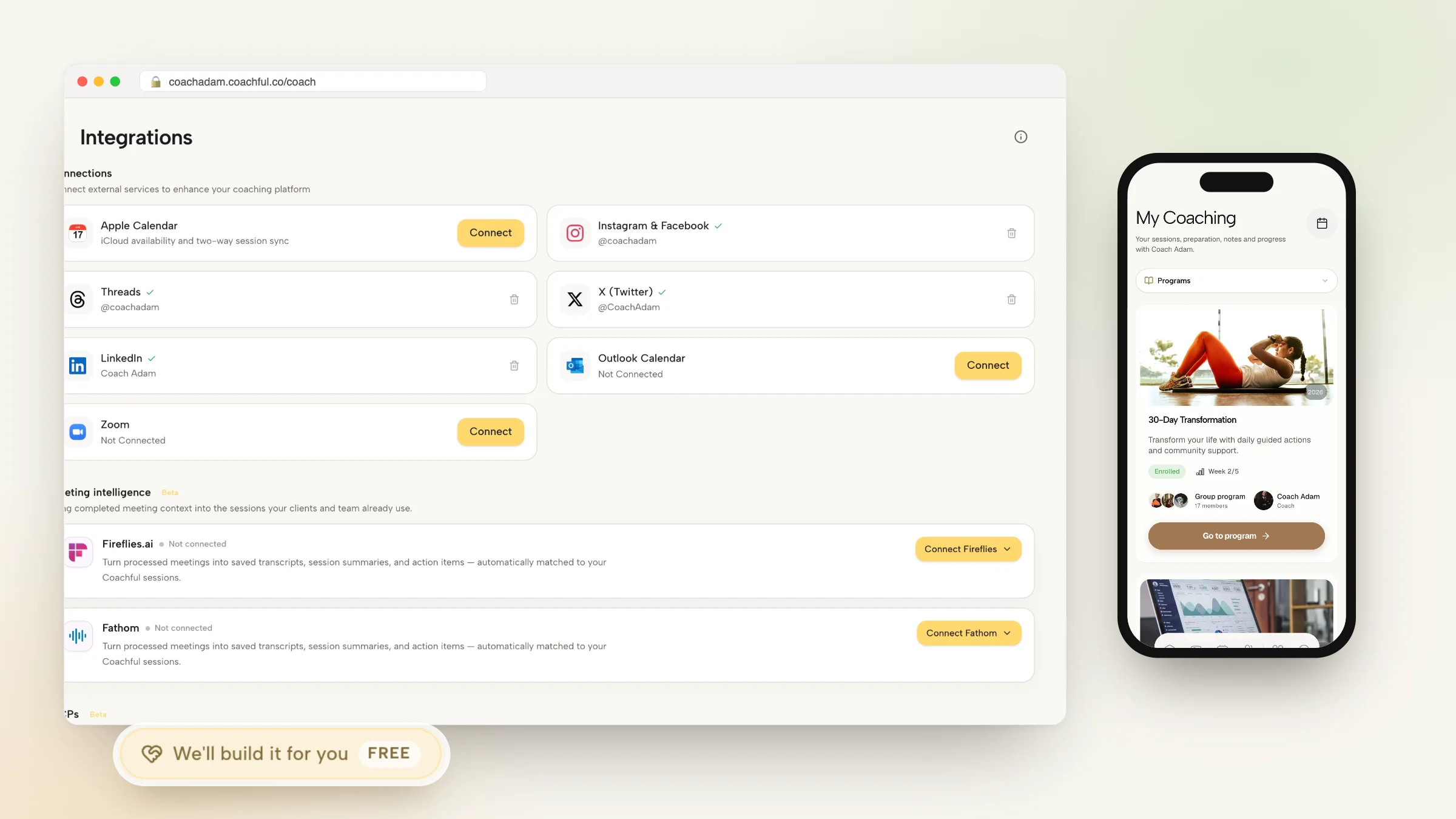
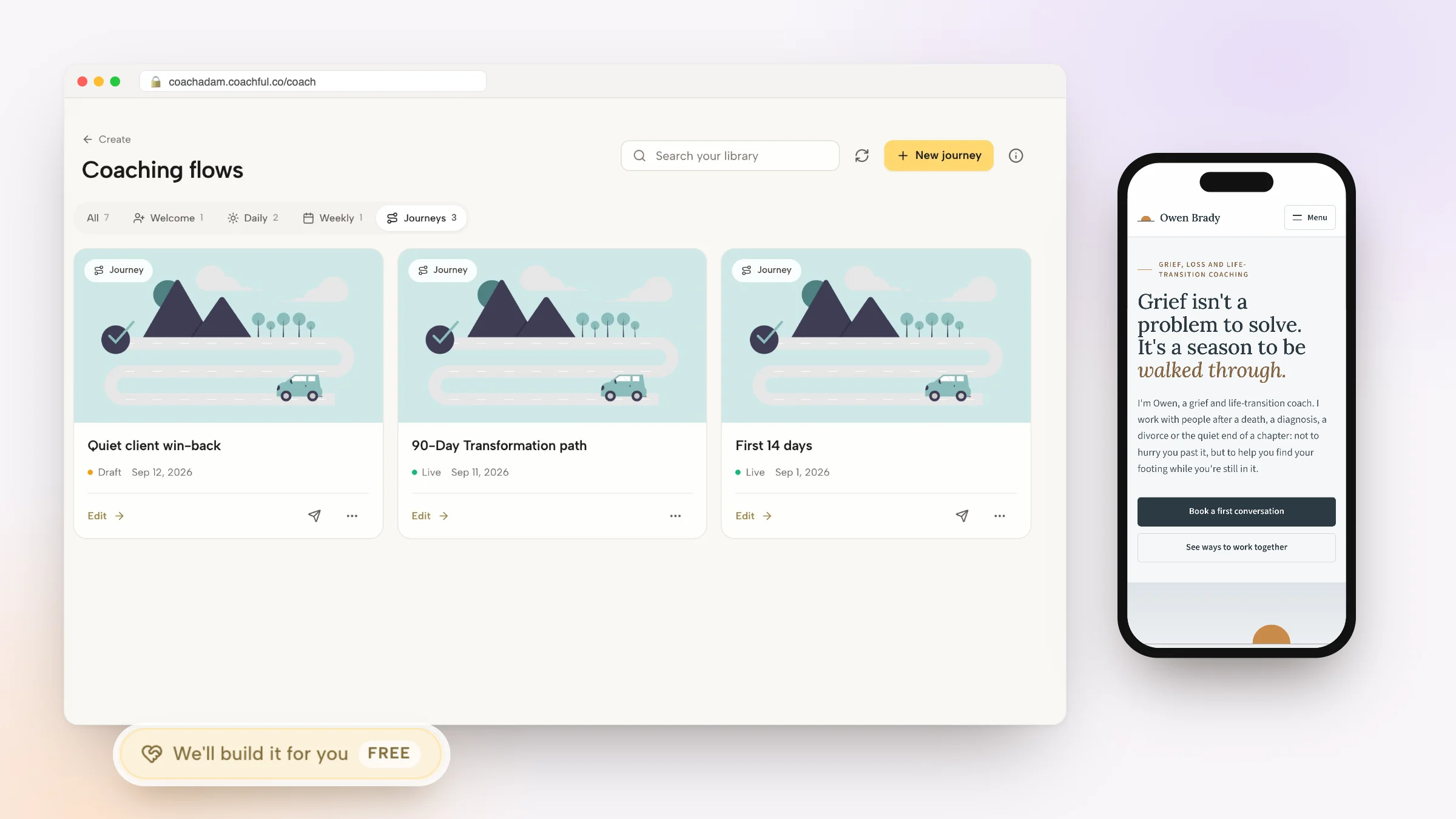
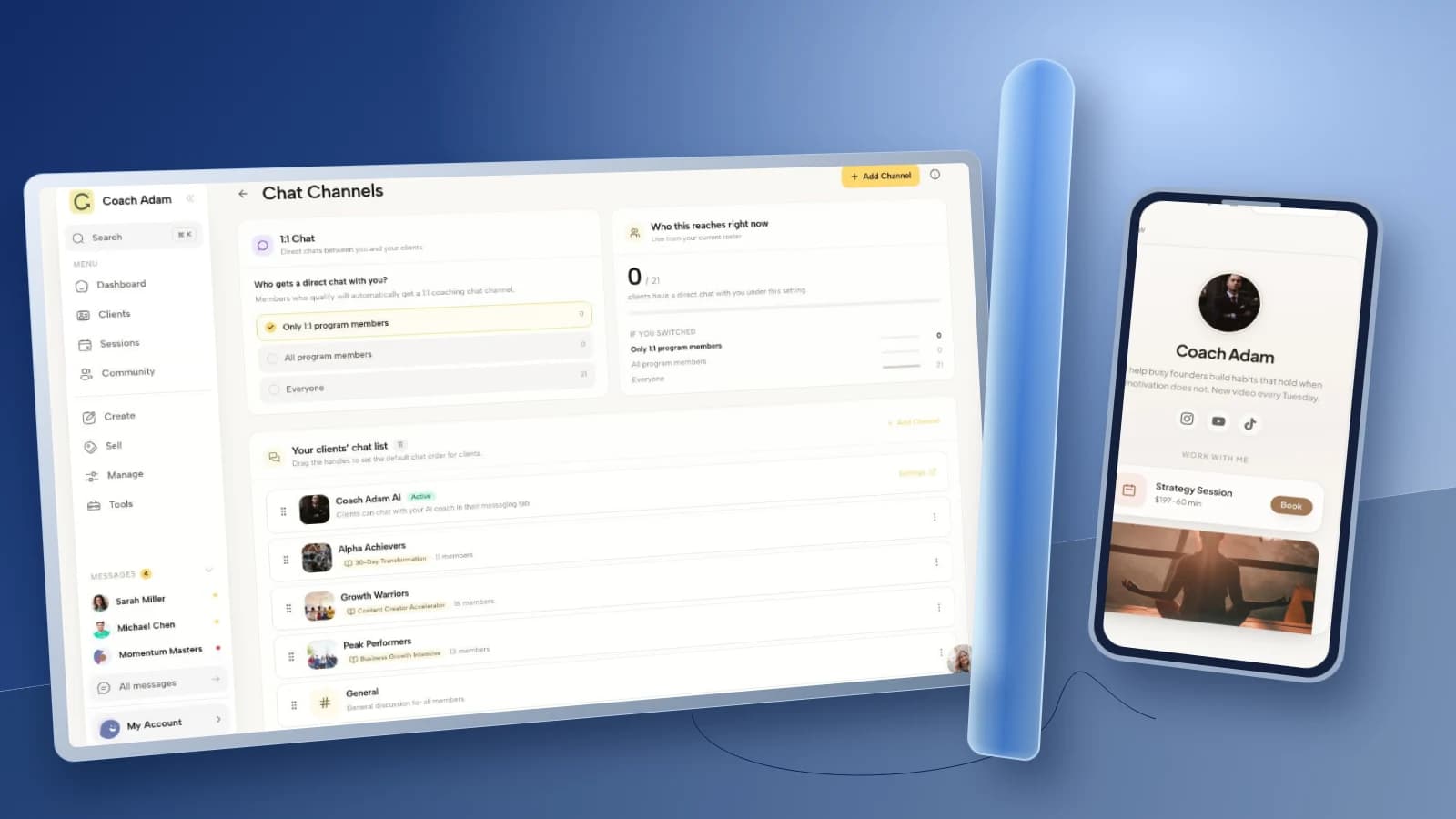
Coachful is the tool we build, so read this with the scepticism it deserves and check the limitations, which are not decorative. Programs run as multi-week structures with weekly goals and daily tasks. Habits, morning and evening check-ins and streaks are native. Booking, payments, contracts, a website, a community feed, courses and email sequences sit in the same subscription, and clients see all of it under your logo, colors and domain. Michelle, the assistant, works from live practice context across clients, programs, sessions, calendar and payments, and takes actions behind a confirmation step rather than writing to client records unasked.

Price, checked 2 September 2026: Lite from $29/mo for up to 5 clients with every feature, $19 billed annually. Solo $49/mo unlimited clients, $39 annually. Pro $99/mo unlimited clients plus Coachful Intelligence, $79 annually. Studio $199/mo for 3 coach seats, Agency $299/mo for 6. A 7-day free trial, card required at signup, no charge during the trial, cancel in one click. Platform fee is 0%, so after Stripe or Razorpay processing you keep the rest.

Ratings: 4.5 on Trustpilot from 21 reviews, a small sample next to CoachAccountable's 46 or Trainerize's 96. Client app: yes, iOS and Android, showing your branding.

Why it is a top pick

  • Delivery is native rather than bolted on. Programs with weekly goals and daily tasks, habits, check-ins and streaks are first-class objects, not workarounds built from packages or calendar events.
  • One subscription covers what most coaches assemble from four to six tools. The stack it replaces most often is Calendly plus Zoom plus Kajabi plus Circle plus HoneyBook plus Mailchimp.
  • Flat pricing with unlimited clients from $49/mo. Six of the 14 tools here charge by client count, and at 50 clients that gap is the size of a car payment.
  • Reminders by email, plus SMS at 24 hours and WhatsApp at one hour once messaging is enabled. Only four tools in this set do SMS at all.
  • Full export: a client data ZIP with roster, notes, check-ins, goals, habits, sessions and form responses, plus course export and org backup JSON.

Potential limitations

  • Younger product, smaller public review footprint than tools shipping since 2011. If you buy on review volume, CoachAccountable, Trainerize and TrueCoach all have more.
  • The mobile app is branded, not fully white-labelled. Your logo and colors sit inside the Coachful app rather than on a separate App Store listing under your own developer account. Delenta on Premium and Trainerize for a one-time $169 both go further.
  • No HIPAA certification. We are GDPR-ready with full data export and that is where the claim stops. Simply.Coach and Delenta both claim HIPAA.
  • Direct iCloud calendar setup uses an Apple app-specific password rather than one-click OAuth, which costs a few minutes the first time.
  • Affiliate support is partial. You can create affiliate links and track clicks, conversions and attributed revenue, but payouts are recorded manually rather than sent by Coachful.

See Coachful vs Paperbell and Coachful vs CoachAccountable for the closest head-to-heads, or the reviews page for what customers say.

2. Paperbell: the cleanest way to sell 1:1 coaching packages

Founded in 2020 by Laura Roeder, who also built MeetEdgar, Paperbell shows its restraint in the product. One checkout carries the contract, the payment, the intake questionnaire and the booking, in that order, so a client goes from "yes" to booked without you touching anything. Reviewers describe it as an admin assistant rather than a platform, which is exactly the pitch.

Price, checked 2 September 2026: a genuinely free plan with no time limit for your first client, though the public coaching site only stays live for the first 7 days. One paid tier at $57/mo, or $47.50/mo billed annually, which is $570 a year against a regular $684, with unlimited clients, sessions, packages and files. Zero platform fee: Stripe and PayPal processing is all you pay.

Ratings: 4.7 on G2 from 63 reviews, 4.7 on Capterra from 150 reviews, 3.9 on Trustpilot from 13. Client app: none, mobile browser only.

Why it is a top pick

  • One price, no tiers, no upsell path. At $57/mo you have the whole product, and Capterra gave it a Best Value badge in 2025.
  • The free plan is real. No 14-day clock, no card. You upgrade when you sign your second client, the fairest trial structure in this roundup.
  • The packaged checkout is the best-executed version of that flow anywhere here: contract, payment, intake and booking in one link.
  • Support scores 4.8 on Capterra and reviewers report shipped feature requests, which is rare at this price. Group coaching, workshops and live classes are supported, so it is not purely 1:1.

Potential limitations

  • No habit tracking, no daily check-ins, no goal tracking. Reviewers name the missing client goal-tracking specifically. If your value is what happens between sessions, this is the wrong shape of tool.
  • No mobile app. Nothing to install, nothing to push a notification from.
  • One service provider per account. A two-coach practice buys two accounts; there is no team tier.
  • No courses beyond video inside packages, and no community. Reviewers say plainly they had to add a second platform. It is also explicitly not HIPAA compliant per its own FAQ.
  • A documented CSV client export was not verifiable in the help center. Client history is visible in the Clients area, but we could not confirm a formal export path.

More at Paperbell alternatives and the Paperbell alternative page, or Paperbell's pricing page.

3. CoachAccountable: the deepest accountability toolset, and no app

Founded in 2012 by John Larson, who still answers support personally often enough that reviewers name him, CoachAccountable is what coaches graduate into when homework, metrics and follow-through become the actual work. Action items, custom metrics with charts, fillable worksheets, drip courses, routine tracking and follow-through reports. Nothing here is decorative.

Price, checked 2 September 2026: the ladder is per active client. Starter $20/mo for 2 clients, Level 1 $40 for 5, Level 2 $70 for 10, Level 3 $120 for 20, Level 3.5 $200 for 35, Level 4 $250 for 50, continuing to $4,000/mo at 1,000 clients. Unlimited coach and admin accounts on every tier. A 30-day free trial with no card, and no setup or cancellation fees.

Ratings: 5.0 on Capterra from 67 reviews, 4.8 on Trustpilot from 46, 4.7 on G2 from 11. Client app: none, web only with a documented add-to-home-screen shortcut.

Why it is a top pick

  • The accountability layer has no equal here: action items, metrics, worksheets, drip courses and routine tracking, all reportable, all tied to a client record.
  • Unlimited coaches and admins on every plan, with only active clients counting toward billing. A five-coach firm with 20 shared clients pays $120/mo total, which nothing else here matches.
  • Full feature set on every tier. No gating, no add-ons, no "upgrade to enable".
  • A 30-day trial without a card, month-to-month billing with no cancellation fee, and a company stable enough to ship an automated Practice.do importer within days of that shutdown.

Potential limitations

  • Per-client pricing punishes group programs. This is the most-cited con on Capterra. A 40-person cohort costs far more here than an unlimited plan elsewhere.
  • Steep learning curve. Reviewers describe the interface as outdated or overwhelming. It is a power tool with power-tool ergonomics.
  • No native mobile app, and reviewers ask for one repeatedly. No website, landing pages, funnels or marketing automation either; it embeds into a site you already have.
  • No AI at all, deliberately. The company states it does no AI or ML processing of coaching content as a privacy stance. That is a feature for some buyers and a dealbreaker for others.
  • Not HIPAA compliant by its own statement, even though it says the server environment is. Only 2 Trustpilot reviews landed in the last 12 months, so the 4.8 is real but not fresh.
Practical tip. If you are choosing between CoachAccountable and anything flat-priced, do the arithmetic at the client count you expect in 12 months, not today. At 10 clients it is $70/mo and excellent value. At 50 clients it is $250/mo, more than Coachful Studio with 3 coach seats and unlimited clients at $199.

More at CoachAccountable alternatives and the CoachAccountable alternative page.

4. Simply.Coach: the compliance answer for corporate and executive work

Launched in 2020 out of Pune, India, Simply.Coach aims at coaching where a third party pays the bill. Development plans, 360 assessments, stakeholder reports, sponsor and HR-partner roles, coach matching. It claims SOC2, HIPAA and GDPR compliance together, which is unusual at this price and is often the whole reason it wins a deal.

Price, checked 2 September 2026: Starter $9/mo for 3 clients, 1 contract and 1 program. Essentials $29 for 7 clients and 3 programs. Growth $49 for 30 clients, multiple calendars, recurring sessions and your logo. Leap $69 for unlimited clients, a white-labelled platform, your own domain and 100GB. Business plans price per active coach: CoCreate $79 per coach with 10 clients each, Surge $159 per coach with 25 clients each plus white-label and custom domain. Annual savings are advertised as up to 52% but the figures sit behind an on-page toggle, so we could not verify exact annual prices. The 14-day trial needs no card and reviewers report it is capped at 3 clients and 10 sessions.

Ratings: 4.8 on G2 from 146 reviews, the highest G2 score with real volume here, and 4.6 on Capterra from 41 with support at 4.9. No Trustpilot presence. Client app: yes, iOS and Android, in English, Spanish and French.

Why it is a top pick

  • SOC2, HIPAA and GDPR claimed together. Pitching an enterprise L&D team, that paperwork is the difference between a shortlist and a no.
  • Stakeholder reporting, 360s and sponsor roles are built for sponsored engagements rather than retrofitted.
  • Cheapest serious entry point here at $9/mo, with a native app on iOS and Android at every tier.
  • Embedded video conferencing plus Zoom, Teams and Google Meet, so you are not forced onto one vendor. A 4.8 from 146 G2 reviews is a well-sampled signal.

Potential limitations

  • Client caps on every solo tier below Leap: three clients at $9, seven at $29, thirty at $49. You will hit a ceiling and move up.
  • Feature overwhelm. The most consistent review criticism is the setup and navigation curve. Small practices call it more tool than they needed.
  • The trial is capped at 3 clients and 10 sessions, and reviewers say that is not messaged clearly.
  • No community, no funnels, no marketing automation, and the website capability is a showcase page rather than a site builder. Xero, Wave and MailerLite integrations are missing, which reviewers name.
  • The AI capability is marketed rather than specified. It is described as AI-enabled and we could not verify what that includes. Payment processors are not named on the site either.

See Coachful vs Simply.Coach and the Simply.Coach alternative page, or Simply.Coach's solo pricing.

5. Delenta: a white-label client app without an enterprise contract

Delenta is the shortest route to a coaching app with your own name on it at a price a solo coach can actually pay. The iOS and Android client app is white-labelled, and it sits on top of a stack that also includes landing pages, a booking funnel, courses, a community feed and AI session summaries. In March 2026 the company announced HIPAA compliance alongside a public trust centre, which moved it from "GDPR and hope" into the small group of tools a therapist-adjacent coach can consider.

Price, checked 2 September 2026: Starter $29/mo, Pro $49/mo, Premium $79/mo, or $19.08, $39.08 and $58.25 respectively when billed annually, which is a 25% discount. Teams and Enterprise are quote-only. No platform transaction fee, so Stripe and PayPal processing is the whole cost of getting paid. The white-label app is Premium and above, which is the number that matters if the app is why you are here.

Ratings: 4.8 on Capterra from 60 reviews, with a 4.9 for customer service, and 4.1 on Trustpilot from 5. Client app: yes, iOS and Android, white-labelled on Premium.

Why it is a top pick

  • The only tool under $80/mo here that puts your brand on a client app instead of somebody else's. Everyone else charges a one-time build fee, gates it behind a $249 tier, or does not offer it.
  • Genuinely broad for the money: programs with drip content, quizzes and tasks, digital contracts, goals, notes, a community feed and group chat for cohorts, plus a landing page and booking funnel.
  • HIPAA and GDPR with a public trust centre, and an ICF partnership. Almost nothing at this price can say that.
  • Support is the single most praised thing in the reviews, described as impeccable more than once. A 4.9 service score across 60 reviews is a real signal, not a launch-week spike.

Potential limitations

  • The mobile experience is the most common complaint, and specifically scheduling on a phone, which reviewers call clunky. The app exists; it is not the smoothest app here.
  • The calendar is thin next to a dedicated scheduler. If booking is the centre of your business, you will notice.
  • Depth costs you a learning curve. This is the most-cited con on Capterra, and it is the tax on a stack this wide.
  • Few email marketing integrations, so your list probably lives somewhere else and stays there.
  • A client-data export was not verifiable in the help centre. CSV and XLS contact import is documented, but we could not confirm the way out. Ask before you commit a year of client history to it.

See Coachful vs Delenta and the Delenta alternative page.

6. upcoach: the best between-session tracking in this roundup

If your programs live or die on what clients do on a Tuesday, upcoach is built for exactly that. Its habit tracker and daily check-ins are the strongest in this set, and the reviews say so in language you rarely see: one Capterra reviewer calls the progress tracking something they had never seen in another product. The whole product is organised around programs rather than around bookings, so cohorts, masterminds and bootcamps get first-class treatment: tasks, lessons, live events, channels, group chat and a who-is-on-track dashboard.

Price, checked 2 September 2026: Starter $49/mo, Pro $99/mo, Business+ $199/mo, Scale $399/mo, billed annually, plus Enterprise on request. Extra team seats are $39/mo on Business+ and Scale. The number to read carefully is the platform fee on top of Stripe: 2% on Starter, 1% on Pro, 0.5% on Business+, and 0% only once you reach Scale at $399/mo.

Ratings: 4.9 on Capterra from 8 reviews, with a 4.8 for support. No Trustpilot profile, and its AppSumo score is 4.08 across 78 reviews, which is the larger and less flattering sample. Client app: yes, iOS and Android; white-label status unverified.

Why it is a top pick

  • Habits, check-ins and progress dashboards that were designed first rather than bolted on. For accountability-led coaching this is the closest competitor to Coachful in the whole roundup.
  • Unlimited programs on every tier, and multi-role access for admins, facilitators and sponsors from the cheapest plan. Corporate work often needs a sponsor seat, and most tools charge for it.
  • The first product in the category to ship an MCP integration, so an AI assistant can read your program data directly. Whether you need that today or not, it says something about the engineering.
  • Programs, courses, tasks, events, community and dashboards in one place, which is a genuinely short list of tools that do all six.

Potential limitations

  • A percentage of your revenue until $399/mo. On $8,000/mo of client payments, Pro's 1% is $80/mo on top of the $99 subscription and on top of Stripe. Do that arithmetic before you compare sticker prices.
  • No contracts, no invoicing, no Outlook sync, and the landing pages are limited. You are pairing this with something.
  • Privacy is a live complaint. AppSumo reviewers cite a missing data processing agreement and an inability to delete client accounts. The terms of service also require you to establish your own legal basis for health data, and HIPAA is not offered.
  • The interface has, in its own reviewers' words, scope for improvement, and setup involves jumps of logic.
  • Very thin public review base: 8 Capterra reviews, no Trustpilot, no verified G2. Treat the 4.9 as promising rather than proven.

Closest comparison points are Coachful vs CoachAccountable and the CoachAccountable alternatives roundup, since all three compete on accountability rather than on checkout.

7. Quenza: the exercise library, if you already own the rest

Quenza is not trying to run your business, and understanding that is the whole review. It came out of PositivePsychology.com and it does one job at a very high standard: designing and sending science-based exercises, reflections, assessments and journals between sessions, then collecting the responses in the client's profile. Pathways let you sequence those activities into a program that drips on a schedule. There are hundreds of pre-made exercises to start from, which is the part nobody else in this roundup offers at all.

Price, checked 2 September 2026: Spark $25/mo, Growth $50/mo, Impact $125/mo, Collective $160/mo, and Beyond on request. Annual billing takes those to $20, $40, $100 and $128. The 30-day trial needs no card, which is the most generous trial here. Spark caps you at 10 clients, so most working coaches are really looking at Growth.

Ratings: 4.9 on G2 from 20 reviews, 4.8 on Capterra from 33, 4.3 on Trustpilot from 8. Consistently high across three independent sites, which is rarer than it sounds. Client app: yes, iOS and Android, not white-label.

Why it is a top pick

  • The activity and assessment builder is the best in the category, and the pre-built library means you can send something excellent on day one instead of writing it yourself.
  • High ratings on three separate platforms, with reviewers specifically praising developers who ship requested features.
  • EU-hosted and GDPR-aligned, at a $25 entry price with a month to evaluate it properly and no card up front.
  • If you are a therapist, a positive-psychology practitioner or a coach whose value is the depth of the reflective work, nothing else here comes close on that one axis.

Potential limitations

  • No payments, no invoicing, no scheduling, no video. This is a companion tool by design. Budget for a second subscription and a second login for your clients.
  • The client app is not white-label, so your clients install Quenza.
  • No habit tracker as such. Recurring activities and journaling can approximate daily check-ins, but it is not a streak-and-completion engine.
  • No community. Group work has to happen elsewhere.
  • Your content is locked in its own format. Exports were not documented on the pages we checked, and API access starts at Collective. Expect to rebuild your activities by hand if you ever leave.

If you want the exercise depth without the second subscription, compare against the coaching CRM roundup, which covers the tools that combine client records with delivery.

8. Satori: the most elegant enrollment flow, and no app at all

Satori has the nicest single link in this roundup. A prospect clicks once and moves through a questionnaire, your coaching agreement, payment and booking without stopping, and the client-facing screens are the calmest of anything here. Reviewers keep using the word easy about the client side specifically, which is the compliment that matters most in a tool your clients have to use. It also has the fairest pricing model in the set: you pay for active clients, so a quiet month costs less.

Price, checked 2 September 2026: a free Scholar plan for pro-bono work, then Essentials $33/mo, Pro $49/mo, Leader $124/mo, or $27.50, $40.83 and $103.33 billed annually. No fee on client payments beyond Stripe and PayPal. A 15-day trial with no card, plus a 30-day money-back guarantee. Client caps top out at 150, with per-tier limits on programs and booking pages below that.

Ratings: 4.5 on Capterra from 13 reviews, and 4.1 on G2. Client app: none. Mobile browser only.

Why it is a top pick

  • The one-link enrollment flow is beautifully executed: questionnaire, agreement, payment, booking, in one uninterrupted move.
  • You pay for active clients rather than for a seat, which is the right shape for a practice with seasonal gaps.
  • Coaching agreement templates are signed inside enrollment, so contracts are not a separate product you bolt on.
  • A free tier for pro-bono coaching, and founder-level support that reviewers call out by name.
  • Coaching log exports for ICF credentialing, which matters if you are accumulating hours toward ACC, PCC or MCC.

Potential limitations

  • No mobile app and no native Zoom integration. These are the two loudest complaints in the reviews, and the second one is surprising in 2026.
  • Calendar sync is one-directional and described as cumbersome.
  • No goal tracking, no habits, no courses, no community, no landing pages. This is a booking-and-enrollment tool with excellent manners, not a delivery platform.
  • Small review base, 13 on Capterra, and one reviewer calls the interface not that appealing on the coach side.
  • Compliance posture is not stated. Neither GDPR nor HIPAA appears on the site, so ask directly if that governs your work.

See the Satori alternative page, or the scheduling software roundup if booking is the job you are actually hiring for.

9. CoachVantage: contracts, goals and e-signature at the lowest price

CoachVantage is the value pick for a solo coach who needs the paperwork to be real. E-signature contracts, goal and progress tracking, 1:1 and group programs with their own sales pages, and unlimited contacts and engagements all start on the cheaper of its two tiers. GetApp rates its value for money and its customer service both at 5.0, and the founder answers support email personally, which is either charming or concerning depending on how big you plan to get.

Price, checked 2 September 2026: two plans only. Clarity $39/mo and Aha! $59/mo, or $35 and $53 billed annually with a 10% discount. No commission on your revenue, so Stripe and PayPal fees are all you pay. Clarity's caps are the thing to check: 2 booking pages, 4 e-signatures a month and 500MB of storage.

Ratings: 4.8 on Capterra from 26 reviews, 4.5 on G2 from a single review, and nothing on Trustpilot. Client app: none. The FAQ says so plainly: it is a responsive web app, not an iOS or Android download.

Why it is a top pick

  • Unlimited contacts and engagements on a $39 plan, which nothing else here matches.
  • Built-in e-signature contracts and goal tracking at that price, plus an AI assistant, and a stated no-commission policy.
  • 5.0 for both customer service and value for money on GetApp, with reviewers calling setup intuitive.
  • Coaching log exports to CSV and a one-click export of your whole contact list, so you can leave. That is worth more than it sounds and most of this list cannot claim it.

Potential limitations

  • The built-in video is not good enough and users say they bought Zoom anyway. Treat CVMeet as a bonus, not a line item.
  • No client app, so between-session engagement depends on email and browser tabs.
  • No team or multi-coach features at all. The moment you hire an associate, you are shopping again.
  • Email-only support with a 24 to 48 hour response and no chat.
  • Clarity's caps bite early. Four e-signatures a month is two new clients and a renewal.
  • Almost no third-party review footprint, one G2 review and zero on Trustpilot, so the 4.8 rests on Capterra alone.

See the CoachVantage alternative page.

The fitness and body-composition lane

The next three are not coaching platforms that happen to have workouts. They are training platforms, built around sets, reps, load, macros and a scale reading, and they are better at that than anything above. If you coach bodies, start here and accept that the business side will be thinner. If you coach careers, relationships, founders or habits, these will feel like the wrong building entirely, because the whole data model assumes an exercise.

One warning that applies to all three: this is where add-on pricing lives. The sticker price is rarely the bill.

A client checking in on their phone

10. ABC Trainerize: the market leader, and the add-on trap

Trainerize is the default in online fitness coaching and the review base proves it: 694 Capterra reviews and 169 on G2, an order of magnitude more than most tools here. You get phased programs, the deepest exercise template library in the category, an AI workout builder, bulk assignment, habits with streaks and badges, group challenges with leaderboards, and wearable integrations across Apple Watch, Garmin, Fitbit, Withings, Polar and Whoop. Clients self-book appointments and classes. It scales from a free tier to thousand-client studio plans with multi-location controls.

Price, checked 2 September 2026: a free Basic tier, then Grow $10/mo, Pro 5 $25/mo, Pro 15 $50/mo, Pro 30 $79/mo and Pro 50 $135/mo, with roughly 10% off annually. A 30-day trial with no card and unlimited clients. Then the add-ons: nutrition $20 to $45, in-app payments $10, video $10, business tools $25, and a custom-branded app at $169 one-time on Pro 30 and above. A coach who wants payments, nutrition and branding is not on a $79 plan, they are near $150 a month plus a build fee.

Ratings: 4.6 on Capterra from 694 reviews, 4.8 on G2 from 169, and 3.2 on Trustpilot from 96. That gap is the story. Client app: yes, plus a coach app, with custom branding available.

Why it is a top pick

  • The largest and best-sampled review base in this entire roundup. Whatever its flaws, they are known flaws.
  • Programming depth, habit coaching, challenges and wearables in one product, which no general coaching platform matches on the fitness axis.
  • Real headroom. Team permissions, multi-location and thousand-client tiers mean a studio can grow inside it.
  • A 30-day no-card trial with unlimited clients is enough runway to migrate a real book of business and see what breaks.

Potential limitations

  • The add-on stack is the single biggest complaint, and it is structural rather than a pricing accident. Budget the total, not the tier.
  • Trustpilot 3.2 from 96 reviews cites app bugs, workouts not saving, slow loading, difficult cancellation and billing disputes. On Capterra, 96% of negative mentions are about performance and speed.
  • The data export is incomplete. It excludes message archives, photos and PDFs, and fully extracting one client takes minutes of manual work. Multiply that by your roster before you assume you can leave.
  • Onboarding is four to eight hours per coach. That is the honest cost of the depth.
  • Leaving with a branded app means re-approval with Apple and Google, because the app was never yours.

See Coachway vs HubFit for the head-to-head in this lane, or Coachful for fitness coaches.

11. TrueCoach: the best client app in fitness, on a steep ladder

TrueCoach, now part of Xplor, has the highest-rated client app in this roundup by a wide margin: 4.9 from roughly 35,000 App Store ratings. That is not a vendor claim, that is a very large public sample. Coaches praise the programming workflow as fast and intuitive, and the entry tier is unusually complete, with payments, habits, nutrition tracking and a 3,500-video exercise library all included rather than sold separately. Capterra sits at 4.8 across 838 reviews.

Price, checked 2 September 2026: Starter $29.98/mo, Standard $69.98/mo, Pro $164.98/mo, plus Custom. Annually those become $26.34, $57.99 and $136.99. A 14-day no-card trial and a 90-day money-back guarantee on your first annual plan. Note the per-client arithmetic: Pro is $165/mo for 50 clients, about $3.30 each, against HubFit's $69/mo for 100. In-app payments only work if your bank account is in the US, UK, Canada or Australia.

Ratings: 4.8 on Capterra from 838 reviews, 4.6 on G2 from 278, and 2.4 on Trustpilot from 19. Client app: yes, 4.9 from about 35,000 ratings. The coach app is a different story at roughly 1.8.

Why it is a top pick

  • The client experience is the best in fitness, and client adoption is the whole ballgame for online coaching.
  • Very complete at $26 a month: payments, habits, nutrition and the full video library, with nothing important behind an add-on.
  • Nearly 1,100 reviews across Capterra and G2 averaging above 4.6, so the coach-side workflow praise is well established.
  • Wearables on Standard and above cover Apple Health, Garmin, WHOOP and OURA.

Potential limitations

  • Trustpilot 2.4 cites outages and maintenance windows, template support replies, and one review summarising five years as price increases only.
  • The price ladder is the steepest here per client, and Capterra still lists the old $25.99, $63.99 and $128.99 tiers against live prices of $29.98, $69.98 and $164.98. Those increases are recent and real.
  • The coach mobile app is rated about 1.8 for limited functionality, so you are working from a laptop.
  • No coach-side export is documented, and clients report being unable to export or delete their own workout data. Reviewers also say clients get locked out if the coach's payment lapses.
  • No video, contracts, community, courses or website, and the product is English-only.

Compare in Coachful for fitness coaches.

12. HubFit: the most included in a $39 fitness tier

HubFit is the aggressive-value option. Workouts, nutrition, check-ins, habits and wearable syncing all ship in the $39 entry plan, where competitors put half of that behind add-ons. The workout builder handles supersets, circuits and AMRAP, there is a follow-along video studio on Ultimate, and the wearable list is unusually long for the price: Apple Health, Garmin, Fitbit, Whoop, Oura, Ultrahuman and Eight Sleep. Per-tier pricing runs cleanly up to 500 clients.

Price, checked 2 September 2026: Standard $39/mo, Premium $69/mo, then Ultimate by roster size at $119 for 100 clients, $209 for 200, $289 for 300 and $359 for 400. Annual billing works out to roughly two months free. Branding and Stripe payments both require Premium, and teams plus Zapier require Ultimate.

Ratings: 5.0 on Capterra from 6 reviews, and 5.0 on GetApp. That is six reviews, which is the caveat. Client app: yes, native iOS and Android, with a custom-branded option whose price is not published.

Why it is a top pick

  • The best price-to-included-features ratio in the fitness lane, and by a clear margin at the entry tier.
  • Transparent roster-based pricing all the way to 500 clients, so scaling holds no surprises.
  • Habits with a pre-built library, and check-in cadences from daily to monthly, which is proper accountability rather than a workout log.
  • A wearable integration list that beats tools costing three times as much.

Potential limitations

  • Six public reviews against marketing claims of 50,000 coaches and 2,500 five-star reviews. The product may well be good; the third-party evidence is thin, and that asymmetry is itself worth noting.
  • Payments and your own branding are both gated at Premium, so the real entry price for a working coach is $69.
  • No scheduling, no video, no contracts, no website. What the site calls scheduling is check-in cadence, not appointment booking.
  • Nutrition is the weakest section by reviewers' own accounts, though improving.
  • Company details are not published: no HQ, no founding date, no compliance posture, and no documented data export. The domain also moved from hubfit.app to hubfit.com, with the old one now unreachable.

See the HubFit alternative page and Coachway vs HubFit.

The course and community lane

The last two are here because coaches keep buying them for coaching, and then discovering they bought a publishing tool or a forum. Both are excellent at their real job. Neither tracks whether a client did the thing.

13. Kajabi: the publishing platform coaches outgrow into, or out of

Kajabi is the most capable content business in a box on this list. Courses, funnels, email marketing, a website, communities with challenges and live rooms, a Coaching product with structured programs and milestones, its own scheduler, and a branded mobile app on the higher tiers. If your revenue comes mostly from a course and a community with coaching attached, this is a serious answer and always has been.

Price, checked 2 September 2026: Kickstarter $89/mo, Basic $179/mo, Growth $249/mo, Pro $499/mo, or $71, $143, $199 and $399 billed annually. Payment processing runs 2.9% + 30c on Basic, 2.8% on Growth and 2.7% on Pro with Kajabi Payments, and Kajabi adds a surcharge if you use your own Stripe or PayPal.

The January 2026 restructure is the thing to know. Prices rose 25% to 61%, Basic's contact limit fell from 10,000 to 2,500, Kickstarter came off public pricing, and the third-party processor surcharge appeared. Existing customers were not protected. If you are evaluating Kajabi on a two-year-old recommendation, you are evaluating a product that no longer exists at that price.

Ratings: 4.1 on G2 from 93 reviews, 4.4 on Capterra from 226, and 3.5 on Trustpilot from 2,337. That last sample is the largest of any tool here by far, and value for money is its weakest Capterra sub-score at 3.7. Client app: yes, with white-label branding on Growth and Pro.

Why it is a top pick

  • Nothing else here sells content as well. Funnels, email, a real website and checkout in one place, with a mature ecosystem around it.
  • Communities are strong: challenges, live rooms and leaderboards, with one community on Basic and Growth and three on Pro.
  • A branded mobile app from Growth upward, plus a built-in scheduler in the Coaching product, or connect Calendly or Acuity instead.
  • 0% platform fee on your sales when you use Kajabi Payments, which is genuinely competitive at volume.

Potential limitations

  • It is the most expensive option here, and the 2026 repricing was not grandfathered. Trustpilot complaints centre on unexpected charges, failed cancellations, data-retrieval fees and AI-first support that cannot escalate to a human.
  • No habit tracking and no daily check-ins. The Coaching product handles timelines, session outlines, milestones and shared notes, but there is no engine for what a client does between sessions.
  • No client goal dashboards. Progress means course completion.
  • A surcharge for using your own payment processor is unusual and worth pricing before you sign.
  • 2026 reviews report email deliverability and domain connection problems, which is serious when email is a core reason to be there.

See Coachful vs Kajabi, the Kajabi alternative page, or Kajabi vs Podia.

14. Skool: the cheapest way to run a community, with the worst reviews here

Skool is one screen and it is very good at it: a feed, categories, a classroom, a calendar, direct messages, a leaderboard and gamification levels that make people post. Classroom modules drip by days since joining, or unlock by level or purchase. The Discovery marketplace brings genuine inbound. Group coaching businesses use it because members actually show up, and that is not a small thing.

Price, checked 2 September 2026: Hobby $9/mo and Pro $99/mo, or $7.50 and $82.50 billed annually. Read the fees rather than the price: Hobby takes 10% plus processing. Pro is 2.9% + 30c up to $899 per transaction, then 3.9% + 30c above that, so a $2,000 program pays roughly a 1% Skool cut on top. For a coach selling high-ticket, that is the highest take rate in this roundup.

Ratings: 1.7 on Trustpilot from 51 reviews, 78% of them one star, on an unclaimed profile. Skool is not listed on G2 or Capterra at all. The complaints are unauthorised charges, a hidden cancellation flow, unresponsive support and scam communities on Discovery. That is the lowest rating on this page and it deserves to be stated plainly. Client app: yes, the Skool Communities app, not white-label.

Why it is a top pick

  • The engagement mechanics work. Points, levels and leaderboards drive posting better than any community product here, and the interface is a single uncluttered screen.
  • $9/mo to start is the lowest real entry price on this list.
  • Discovery is a distribution channel, not just a directory, which almost no other tool here offers.
  • Classroom drip by days-since-join or by gamification level is a clever fit for cohort-style content.

Potential limitations

  • 1.7 on Trustpilot. Fifty-one reviews is a modest sample, but 78% one-star with an unclaimed profile is a pattern rather than noise.
  • Hobby's 10% fee and Pro's extra 1% above $899 make it the most expensive option here for anyone selling volume or high-ticket.
  • No custom domain, no white-label, no website, no funnels, no email automation, no public API. Very little control and even less portability.
  • No 1:1 booking. Group calendar events only, so private sessions live elsewhere.
  • No habits and no real progress tracking. Points reward posting and commenting, not completing what you asked for.
  • Member export is name, email and join date only. Posts and progress cannot be exported, so the community you built is not yours to move.

See Coachful vs Skool, the Skool and Circle alternative page, or Skool vs Circle.

All 14 compared on one screen

Prices are the cheapest paid entry point, checked 2 September 2026. Read the fee column as carefully as the price column, because that is where two of these become the most expensive options on the page.

ToolFromFee on your revenueClient appHabits and check-ins1:1 bookingBest for
Coachful$29/mo (5 clients)0%Yes, your brandingYesYesPrograms with daily accountability
Paperbell$57/mo0%NoNoYesSelling 1:1 packages cleanly
CoachAccountable$20/mo (2 clients)0%NoYes, deepestYesAccountability without an app
Simply.Coach$9/mo (3 clients)0%PartialYesYesCorporate and executive work
Delenta$29/mo0%Yes, white-label on PremiumPartialYesA branded app on a solo budget
upcoach$49/mo2% to 0%YesYes, excellentYesCohorts and masterminds
Quenza$25/mo (10 clients)No paymentsYes, not brandedPartialNoScience-based exercises
SatoriFree, then $33/mo0%NoNoYesThe smoothest enrollment link
CoachVantage$39/mo0%NoNoYes, 2 pages on ClarityContracts and goals, cheapest
ABC TrainerizeFree, then $10/mo0%, many add-onsYes, branded from $169YesYesFitness at scale
TrueCoach$29.98/mo0%Yes, best ratedYesNoFitness programming
HubFit$39/mo0%YesYesNoMost included per dollar in fitness
Kajabi$89/mo0% on Kajabi PaymentsYes, branded on GrowthNoYesCourses, funnels and email
Skool$9/mo10%, or 2.9% plus 1% high-ticketYes, not brandedNoNoCommunity engagement

Two rows deserve a second look. upcoach's percentage runs until the $399 tier, so on $8,000/mo of payments its $99 plan really costs $179. Skool's 10% on Hobby means a coach billing $3,000/mo pays $300 to a $9 plan.

Three coaching apps that shut down in the last 18 months

This is the part of the category nobody puts in a roundup, and it is the reason the export column matters more than the feature list.

  • Nudge Coach shut down on 30 April 2025. It was one of the better-known white-label client apps for habit-based coaching, recommended in exactly this kind of article for years.
  • Practice.do went offline on 3 November 2025. It had strong reviews and an active user base, and coaches had weeks rather than months to move.
  • Profi ended access on 31 December 2025. Coaches who had not exported lost session notes.

Three products in eighteen months, all of them credible at the time. The lesson is not to avoid small vendors, because the small vendors on this list include some of the best-rated products on it. The lesson is to check, before you commit, whether you can get your clients, your notes and your content out in a format you can read. On this page, CoachVantage documents a one-click CSV export of everything, Coachful and upcoach both export clients with custom fields, Trainerize exports without messages, photos or attachments, TrueCoach documents no coach-side export at all, and Skool exports a name, an email and a join date.

If you are moving off something that closed, the CoachAccountable alternatives roundup covers the accountability-first options and the Paperbell alternatives roundup covers the admin-first ones.

What actually makes a client open the app

Buying an app does not create engagement. Almost every coach who has churned off one of these tools tells a version of the same story: the app was fine, the clients installed it, and after week three nobody opened it. The tools that hold attention share four mechanics, and you can check for all four in a trial.

A daily loop of check-in, streak and nudge
  1. Something is waiting when they open it. A task due today, a check-in question, a lesson unlocked. An app that only holds a booking history has nothing to open for.
  2. A notification that is about them, not about you. Push that says a habit is due lands. Push that announces a new post does not, after the second week.
  3. Visible progress that is theirs. A streak, a completion percentage, a goal moving. This is why the accountability tools retain and the publishing tools do not.
  4. A reply loop. The client submits something and a human responds. Reviewers across every tool here name the coach's response as the reason they kept going, which is worth remembering before you buy engagement mechanics instead of building the habit of replying.

Judged on those four, the strongest here are Coachful, upcoach, CoachAccountable, Trainerize and TrueCoach. Kajabi, Skool, Paperbell, Satori and CoachVantage are all good products that will not do this job, because they were built for a different one.

Where Coachful is the wrong choice

We build Coachful, so treat this section as the one worth reading twice. There are coaches who should buy something else on this page, and pretending otherwise would make the other thirteen reviews worthless.

  • You sell a course and a community, and coaching is the add-on. Kajabi is a better business for you. Funnels, email marketing and a real website in one place is not something we are trying to beat, and its Communities product is strong.
  • You coach bodies. Trainerize, TrueCoach and HubFit understand sets, reps, load, macros and wearable data at a depth we do not. If your program is a training block, buy a training platform.
  • You need HIPAA. Coachful is GDPR-aligned and not HIPAA compliant. Delenta announced HIPAA in March 2026 with a public trust centre, and Simply.Coach is built for that world. If a covered entity is signing your contract, this decides it.
  • Your value is the depth of the reflective exercise. Quenza's activity builder and its pre-made science-based library are better than what we offer, and if that is your craft, the trade is worth it.
  • You only sell 1:1 sessions and want the smallest possible tool. Paperbell at $57 flat, or Satori's pay-for-active-clients model, will feel lighter than a platform with a programs engine you never open.
  • You want gamified community engagement above everything. Skool's points and levels drive posting better than we do, and if you accept the fee and the portability limits, it works.
  • You want the most-reviewed product in the room. Our Trustpilot sample is 21 reviews at 4.5. Trainerize has 694 Capterra reviews, TrueCoach 838. If a large public sample is how you buy software, we are not it yet, and that is a fair thing to weigh.

Frequently asked questions

What is the difference between a coaching app and coaching software?

Coaching software is what you work in: a client list, a calendar, notes, payments, program builders. A coaching app is what your client installs on their phone. Most products in this category are software with a client web login and no app, which is fine if your value is delivered in the session and a problem if it is delivered between sessions. Of the fourteen here, nine ship a real client app and only three let you put your own name on it.

Which coaching apps are white-label?

Coachful shows your branding on iOS and Android on every paid plan. Delenta white-labels its app on Premium at $79/mo. Trainerize sells a custom-branded app for $169 one-time on Pro 30 and above. Kajabi offers a branded app on Growth and Pro. HubFit offers one without publishing the price. Everyone else either has no app or puts their own name on it, which means your client's home screen advertises your vendor.

Is there a free coaching app for coaches?

Three real free tiers exist here. Trainerize Basic is free with limits. Satori's Scholar plan is free and intended for pro-bono coaching. Paperbell has a free plan with no time limit for your first client, though the public coaching page only stays live for the first 7 days. Quenza's 30-day trial needs no card, and Trainerize's is 30 days with no card and unlimited clients, which is the most generous way to evaluate a platform properly before paying.

What does a coaching app actually cost per month?

A working solo coach with unlimited clients, payments and their own branding lands between $39 and $99/mo on most tools here. Below that you are on a client cap, an add-on, or somebody else's branding. Above it you are buying courses, funnels and email. The two numbers that break this range are percentage fees and add-ons: upcoach takes 2% down to 0% depending on tier, Skool takes 10% on Hobby, and Trainerize sells nutrition, payments, video and business tools separately.

Can I switch coaching apps without losing my client history?

Sometimes, and you have to check before you commit rather than after. CoachVantage documents a one-click CSV export of your full contact list plus coaching logs. upcoach exports clients with custom fields, and offers an API on Business+. Trainerize exports client data but excludes messages, photos and PDFs. TrueCoach documents no coach-side export, and its own clients report being unable to export their workout data. Skool exports names, emails and join dates only. Given that three products in this category shut down between April 2025 and December 2025, treat the export path as a feature you are buying, not a detail.

Do coaching apps work for group coaching?

Yes, and the mechanism differs enough to matter. upcoach and Coachful both run cohorts with shared program timelines, group check-ins and channels. Skool and Kajabi run communities, meaning a feed and a classroom, which suits a membership better than a cohort with a start date. Trainerize and HubFit run challenges with leaderboards, which is the fitness version of the same idea. Paperbell, Satori, CoachVantage and Quenza are essentially 1:1 tools, and Paperbell supports group sessions and workshops without a group delivery layer.

Which coaching app is best for ICF credentialing hours?

Satori and CoachVantage both export coaching logs in a format built for ICF submissions, which saves real hours when you are accumulating toward ACC, PCC or MCC. Delenta is an ICF partner. If credential tracking is a deciding factor, ask any vendor to show you the export before you sign, because a session list is not the same thing as a compliant log.

Do I need a coaching app at all?

If your clients pay for the hour and the work happens in the hour, no. Buy the smallest tool that handles booking, contracts and payment, and spend the difference on marketing. If your clients pay for a result that depends on what they do on the days you do not meet, then the app is not a nice-to-have, it is the delivery mechanism, and the tools without one will quietly cap how good your outcomes can get.

How to choose in the next twenty minutes

Answer one question honestly: does your result depend on what your client does between sessions?

If it does not, buy Paperbell or Satori today, spend twenty minutes setting up one package, and stop researching. Both are excellent and neither will make you regret the simplicity.

If it does, you need habits, check-ins and a phone your client already looks at. Shortlist Coachful, upcoach and CoachAccountable, and add Delenta if a branded app is non-negotiable at a solo price. Then do the thing that actually settles it: put one real client through one real week inside a trial. Send the check-in. Watch whether they answer. That single week tells you more than any comparison table, including this one.

If you coach bodies, start with TrueCoach for the client experience or HubFit for the price, and only move to Trainerize when you need team and multi-location controls, with the add-on total budgeted from the start.

Next, compare the two closest options side by side in the full comparison hub, or read the 12 best online coaching platforms for the wider platform view.

Share
Loading article engagement

More in Best of

Best of

Best Practice Management Software for Coaches (2026)

For the coach with forty clients, six years of notes and a contract template in Google Docs. Ten tools compared on the admin half nobody writes about.

Sep 4, 202648 min
Best Practice Management Software for Coaches (2026)
Best of

Best All-in-One Software for Coaches in 2026

Most coaches pay for four to six tools and still juggle logins. Here is what all-in-one really means, which platforms genuinely are, and what consolidating costs you.

Sep 4, 202644 min
Best All-in-One Software for Coaches in 2026
Best of

Best Client Acquisition Frameworks for Coaches Building Systems

Why Most Coaches Are Building Client Acquisition Backwards You know the feeling. You create content. You show up on social media. You maybe even send a few ema...

Jul 1, 202611 min
Best Client Acquisition Frameworks for Coaches Building Systems

Start Your Coaching
Journey Today

You didn't become a coach to manage 6 apps. Try Coachful free — takes 5 minutes — and watch your coaching business take off.

Built for coaches who take their clients seriously

Coachful
Coachful
BlogPrivacyTermsRefundsContact

© 2026 Coachful. All rights reserved.