Coach Collective: What It Is and How to Start One
A coach collective is a group of independent coaches who work under a shared banner. They might share a brand and website, pass referrals to each other, pool marketing, or share a back office for booking, billing and client onboarding, while each coach usually keeps their own clients and income. A coach collective sits between a loose referral network and a coaching firm: more structure than the first, far less overhead than the second.
This guide explains the main kinds of coach collective, the honest pros and cons, how to start one, what to put in the agreement, and how to run the shared back office on Coachful's team features. A collective's first visible asset is usually a shared website, and Coachful's team will build that for you, free on every Coachful plan.
Coach collective, firm, network or associate model?
The labels blur, so here is how they usually differ in practice.
| Model | Who owns the clients | Shared brand | Money | Commitment |
|---|---|---|---|---|
| Referral network | Each coach | No | Optional referral thank-yous | Low |
| Coach collective | Usually each coach, by agreement | Often | Shared costs, sometimes referral fees | Medium |
| Associate model | The practice owner | The owner's brand | Revenue share with associates | Medium to high |
| Coaching firm | The firm | Yes | Salaries or fees from the firm | High |
If you want to bring coaches in to deliver your own programs under your brand, that is the associate model, and our guide to structuring an associate coach revenue share covers it in detail. This article is about peers joining forces as equals.
Three kinds of coach collective
1. The referral collective
Coaches in complementary niches agree to refer to each other first. A career coach, a leadership coach, a wellbeing coach and a money coach can cover most of what a mid-career professional needs. There may be a shared page listing everyone, but each coach runs their own business. This is the easiest to start and the easiest to leave.
2. The shared-brand collective
Members trade under one name, often with a single website, shared discovery calls and joint offers such as a leadership program delivered by three coaches. Clients see one team. Each coach still invoices their own clients or receives an agreed share. This is where collectives win corporate work that a solo coach would struggle to bid for, because a buyer can see capacity and breadth.
3. The back-office collective
Coaches keep separate brands but share the expensive, boring parts: a booking system, a client portal, templates, a virtual assistant, a bookkeeper, a marketing calendar. The benefit is lower cost and less admin per coach. The risk is that the shared tools become a single point of failure if the group splits.
The pros and cons, honestly
Why coaches start collectives:
- Bigger bids. A team of five can propose a company-wide program; one coach usually cannot.
- Warmer referrals. Clients trust a recommendation from a coach they already work with.
- Shared costs. One website, one set of tools, one assistant spread across several coaches.
- Company. Solo coaching can be lonely, and a collective gives you colleagues. We wrote about that in feeling lonely as a coach.
- Coverage. When one coach is ill or on holiday, another can step in.
Where collectives go wrong:
- Uneven effort. One member brings most of the work and starts to resent the split.
- Brand drift. Clients get different experiences from different coaches under the same name.
- Unclear client ownership. Nobody agreed who keeps the client if a coach leaves.
- Decision paralysis. Five equal partners can take months to agree a logo.
- Messy exits. Shared tools, shared domains and shared clients make leaving painful without a written plan.
Almost every item on the second list is solved by a written agreement made before the first client arrives.
How to start a coach collective in eight steps
- Find two to five coaches you already trust. Collectives built on a few months of working together, in a coach community or a peer group, last longer than ones assembled from strangers. A coaching network is the natural recruiting ground.
- Agree the kind of collective. Referral, shared brand or back office. Write it in one sentence.
- Define the client you serve together. "Mid-career professionals navigating a promotion or a career change" gives everyone a role. "Anyone who needs coaching" does not.
- Map the members to the client's journey. Who handles the first call, who delivers which offer, who covers which gaps.
- Write the agreement (see the checklist below) and have every member sign it.
- Build one shared presence. A page or site with each coach, the joint offers and a single booking route.
- Set up the shared operations: booking, client records, payments, a shared community or chat, and a monthly members' meeting.
- Run a 90-day pilot. Agree what success looks like (joint clients, referrals, one corporate proposal), then review honestly and adjust.
The collective agreement: what to put in writing
| Topic | What to decide |
|---|---|
| Client ownership | Who the client belongs to when they come through the collective, and when a coach leaves |
| Referral terms | Whether referral fees apply, how much, for how long, and how they are tracked |
| Money | How shared costs are split, who collects payment for joint offers, and how and when shares are paid |
| Brand standards | What every client gets regardless of coach: onboarding, response times, agreement, session format |
| Decision-making | Which decisions need everyone, which need a majority, and who decides day-to-day |
| Confidentiality and data | Who can see which client records, and how notes are handled |
| Joining and leaving | How a new member is admitted, notice periods, and what happens to the domain, tools and clients on exit |
| Disputes | A simple escalation path before anyone calls a lawyer |
Have a lawyer review it if money or clients change hands between members. A two-page agreement that everyone understands beats a twenty-page contract nobody has read.
Running a coach collective's back office in Coachful
For a shared-brand or back-office collective, the simplest setup is one Coachful workspace with a seat for each coach. Coachful's team plans, Studio and Agency, include three and six coach seats, with per-coach availability and staff permissions.
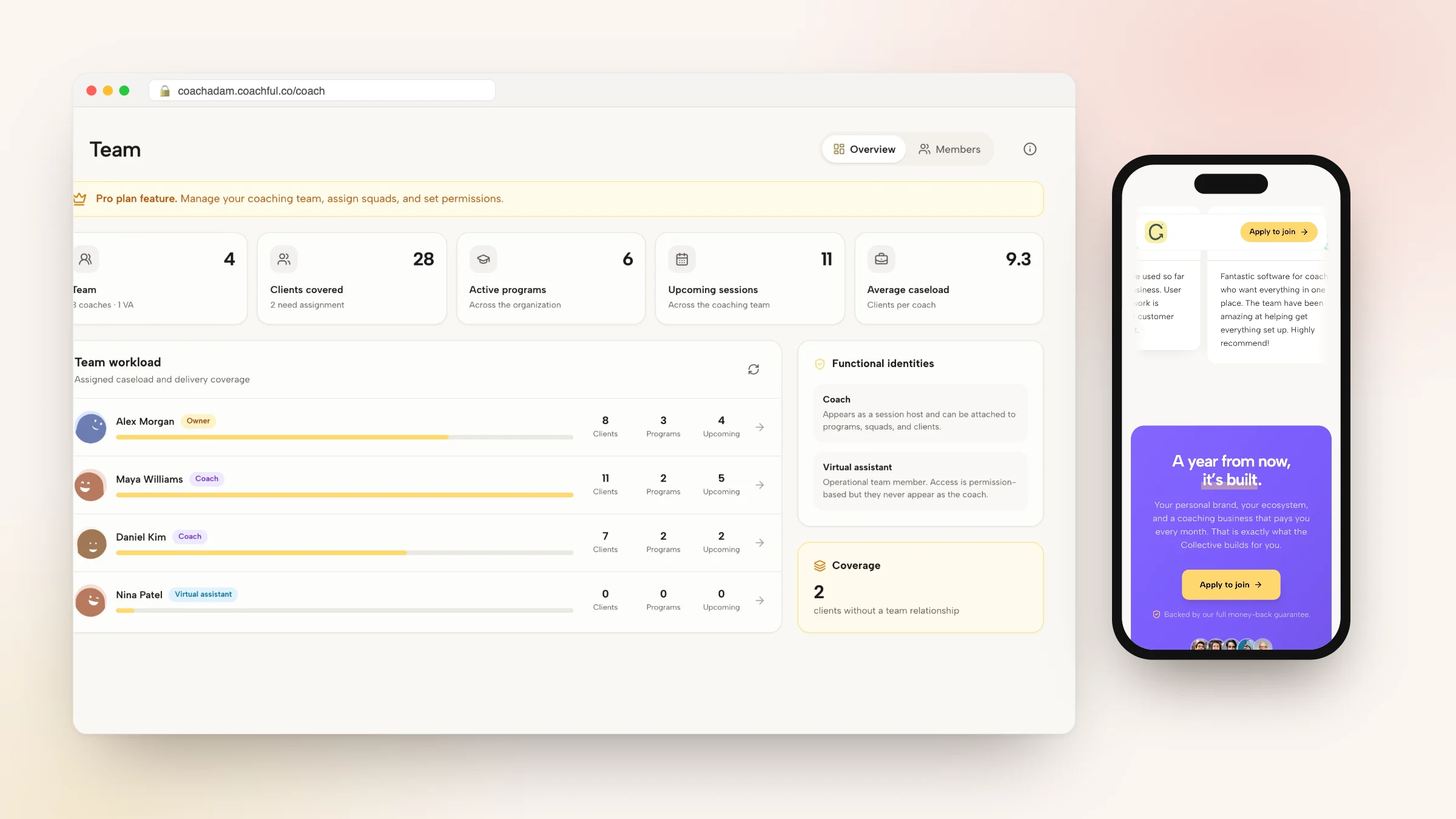
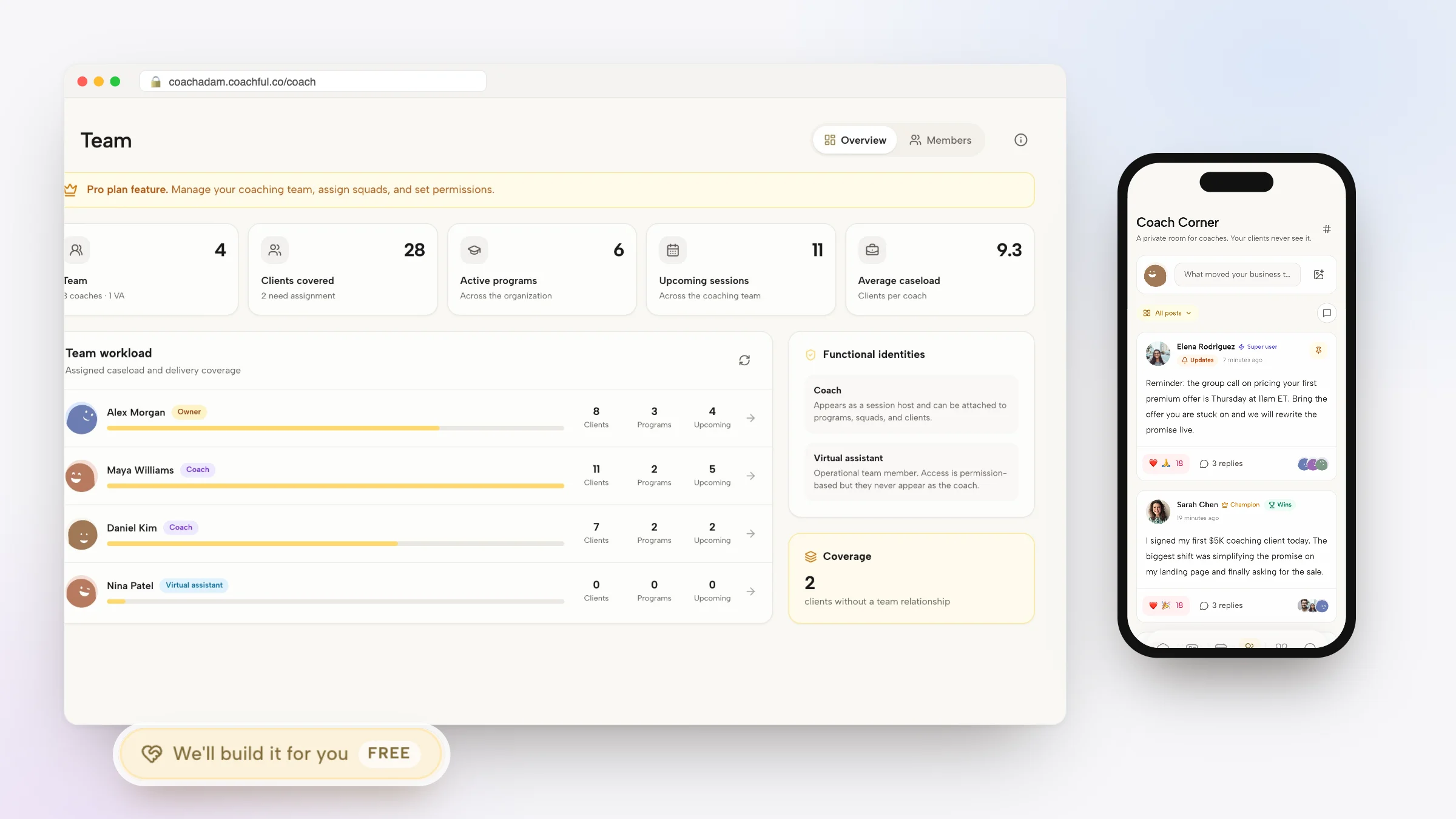
The Team page shows each member with a role (owner, coach or virtual assistant) and their workload: clients, programs and upcoming sessions. A coach appears as a session host and can be attached to programs, groups and clients. A virtual assistant is an operational team member with permission-based access who never appears as the coach, which suits a shared admin. The page also flags clients who don't yet have a team relationship.

Scheduling is where shared operations save the most time. Multi-coach session types assign a booking to a coach who is free at the chosen time, by round-robin or least busy, or let the client choose. That means one "book a discovery call with the collective" link on the website, and every booking lands on the right coach's calendar, synced two ways with Google, Apple or Outlook. Read more on the scheduling features page.

Leads from the shared site and funnels arrive in one Prospects view, each tagged with its source, so the collective can see whether referrals, LinkedIn or a joint webinar produced the most conversations.

Clients get one branded home and app with your logo and colors, and the community can carry a channel per program or group, so clients of the collective's joint leadership program share a space while one-to-one clients keep their direct chats.

Be clear-eyed about what this setup doesn't do. Payments go to the workspace's own Stripe account, with a 0% Coachful platform fee, so payment for joint offers lands in one place. Coachful does not split payouts between coaches automatically; the collective pays members their agreed shares itself. If members want fully separate finances, they each keep their own Coachful account and collaborate through referrals and a shared page instead.
The coaching platform overview lists everything else included, and the community features page covers the client-facing space. If the collective wants a members-only community for its clients, our guide on how to create an online coaching community walks through the launch.
Where collective members meet other coaches
Every coach on an active Coachful plan, including the free trial, also gets Coach Corner, Coachful's private community for coaches. It's where many collectives start: coaches who have been answering each other's questions for months already know whose work they would put their name next to. The coaches directory lists each coach's business name, and a profile has a Message button. The screenshot is from Coachful's demo community, with sample coaches.

For more on choosing a peer community, see our coaching community guide.
Get the collective's website built, free
A shared website is the moment a collective becomes real to clients. It needs a team page, the joint offers, each coach's profile and one booking route. Coachful's team will build it inside your workspace, free on every Coachful plan.
Open Create > We'll build it for you · FREE, or the Want us to build it for you? card on the Website page, and click Fill in a form. Tell the team which pages to create, what they should do (book calls, collect leads, sell an offer), what visitors should do after they land and which sites you like. Add up to 8 reference links and 10 files: each coach's photo and bio, your logo, a draft of the joint offer.

The team replies by email, usually within about 24 hours, and builds the pages in your account so any member with access can edit them later. It doesn't invent testimonials, credentials or prices; anything missing is left for you to fill in. It doesn't design logos or run ads either. Recent builds have ranged from a five-page site for a coach starting from nothing to an eight-page site on a coach's own domain. See the white-glove service guide for the full scope.

A naming note: if you searched for the Coachful Collective specifically, that is something else. The Coachful Collective is a 12-month implementation program for coaches and other experts building an information business, with weekly live group sessions, personal daily feedback from the Coachful team in the private community, a private channel in Coach Corner, the CLIMB curriculum and the Coachful platform included.
Frequently asked questions
What is a coach collective?
A coach collective is a group of independent coaches who work together under a shared banner, through referrals, a shared brand and website, joint offers or a shared back office. Each coach usually keeps their own clients and income, and a written agreement sets out how clients, costs and referrals are handled.
How is a coach collective different from a coaching firm?
In a firm, the business owns the clients and pays the coaches. In a collective, the coaches are independent peers who choose what to share: a brand, costs, referrals or operations. Collectives are cheaper to start and easier to leave, but they need clear agreements on ownership and money.
How many coaches should be in a collective?
Three to six is a practical range. Fewer than three adds little breadth for clients or buyers. More than six makes decisions slow unless one person has authority for day-to-day choices. Start small, run a 90-day pilot and add members once the agreement has been tested.
Who owns the clients in a coach collective?
Whoever your agreement says. Common options are that each coach owns the clients they bring, that the collective owns clients who come through shared marketing, or a mix with a handover rule when a coach leaves. Write it down before the first joint client.
Can several coaches share one Coachful account?
Yes. Coachful's Studio and Agency plans include three and six coach seats, with per-coach availability, staff permissions and roles such as coach and virtual assistant. Multi-coach session types assign bookings by round-robin, least busy or client choice. Payments go to the workspace's Stripe account, so you handle revenue shares yourselves.
Is the Coachful Collective the same as a coach collective?
No. A coach collective is a group of coaches working together. The Coachful Collective is a 12-month implementation program run by Coachful, with weekly live group sessions, personal daily feedback from the Coachful team in the private community, a curriculum and the platform included. Members get a private Collective channel inside Coach Corner.
Will Coachful build our collective's website for free?
Yes. Fill in the website form from Create or the Want us to build it for you? card, attach each coach's photo and bio, your logo and the joint offers, and Coachful's team replies by email, usually within about 24 hours. It builds the site inside your workspace at no extra cost on any plan.
The collectives that last are the ones where every member would refer to every other member even without an agreement. Start there, then write it down anyway.