Coaching Network: How to Build One in 90 Days
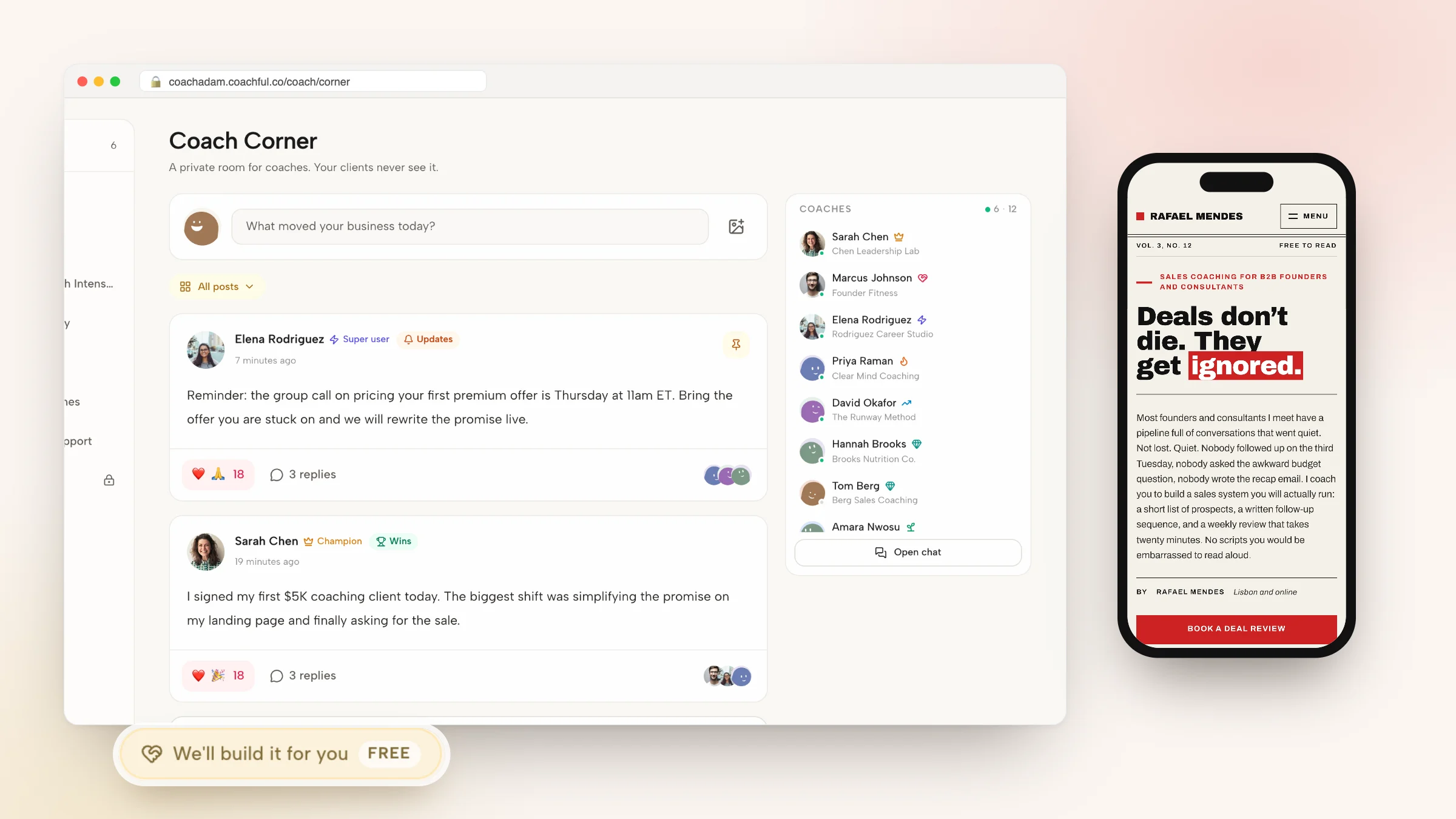
A coaching network is the group of people who know your work well enough to send you clients, answer your questions and collaborate with you. For most coaches it has five parts: peer coaches, referral partners in neighboring professions, communities, events and an audience on LinkedIn. You build it on purpose, a few relationships at a time, and you keep it alive with a simple follow-up habit rather than a burst of activity before a launch.
This guide shows how to build each part, what to say, and how to fit it all into a 90-day plan that takes a few hours a week. Most of the network-building happens in conversations, but a fair amount of it ends with someone visiting your website or booking page. If those pages are not ready for visitors, Coachful's team will build them for you, free on every Coachful plan. More on that later.
What a coaching network is made of
People often picture networking as a room full of name badges. In practice, a coaching network is five overlapping rings. Each gives you something different and asks something different of you.
| Ring | Who is in it | What it gives you | What it asks of you |
|---|---|---|---|
| Peers | Other coaches, in your niche and outside it | Answers, feedback, referrals for clients who aren't a fit for them | Helping first, being specific about who you serve |
| Referral partners | Professionals who meet your clients before you do | Warm introductions from people your clients already trust | A clear description of who you help, and sending people back |
| Communities | Coach communities, professional bodies, alumni groups | A steady stream of new contacts and a place to be seen helping | Regular, generous participation |
| Events | Chapter meetings, conferences, workshops, local business groups | Face time that turns names into relationships | Preparation and follow-up |
| Former colleagues, clients, people who read your posts | Visibility that keeps you in mind between conversations | Consistent posting and real comments |
You do not need all five at full strength. A career coach might live mostly on LinkedIn and with recruiter partners. A health coach might rely on referral partners in clinics and a local wellness community. Pick the two rings that suit your clients and keep the others ticking over.
Start with peers: the coaches who will send you clients
Counterintuitive but true: other coaches are some of your best sources of clients. A coach who works with executives gets asked about career changes. A relationship coach meets people whose real issue is money. Coaches refer to coaches all the time, but only to people whose work they have seen.
That last part matters. Nobody refers to a name on a list. They refer to the person whose answers they have been reading, whose thinking they trust, who was kind to them when they were stuck. Which means the way to build a peer network is to be visibly useful in places coaches gather.
Inside Coachful, that place is Coach Corner, the private community every coach on an active plan can use. The coaches list on the right shows each person's business name, and a profile opens to a Message button, so the step from "I liked your answer" to a direct conversation is one click. In the demo community, introductions sit in their own channel, which makes it easy to spot a new coach in a niche next to yours and say hello.

Three habits build a peer network faster than any event:
- Answer two questions a week where you have real experience. Say what you did, not what people should do.
- Introduce yourself with a niche, not a title. "I coach first-time managers in tech through their first year" is referable. "Leadership coach" is not.
- Keep a short list of peers you would refer to, with one line on who each one serves best. When you send someone a client, tell them. Reciprocity takes care of itself.
Our guide to finding a coaching community covers the kinds of room worth joining, and the tour of Coach Corner shows what that room looks like inside Coachful.
Referral partners: who meets your clients before you do
A referral partner is a professional whose clients often need what you offer. The question to ask is simple: who sees my ideal client in the month before they would hire me?
- Career coaches: recruiters, HR consultants, outplacement firms, CV writers, university alumni offices.
- Health and wellness coaches: physiotherapists, personal trainers, dietitians, yoga studios, functional medicine clinics.
- Business coaches: accountants, bookkeepers, business lawyers, web designers, small business banks.
- Life and relationship coaches: therapists (for clients who are ready for forward-focused work), mediators, divorce lawyers, wedding planners.
- Executive coaches: HR directors, leadership development leads, executive recruiters, board advisors.
The first conversation is not a pitch. Ask what their clients struggle with after working with them, explain the one kind of person you help best, and agree on what an introduction looks like (an email copying both of you is usually enough). Our piece on referral partners for life coaches goes deeper on who to approach first, and these referral email templates help with the asking.
Give partners something they can forward without thinking: a single page that explains who you help, a free resource, and a booking link. If a partner has to explain you in their own words, the referral usually stalls.
Communities and professional bodies
Communities widen the network beyond the people you already know. They come in a few flavors, and most coaches end up in two or three:
- Professional bodies. The International Coaching Federation says it has over 140 chapters in more than 90 countries and territories, and members choose a chapter when they join. The Association for Coaching runs co-coaching forums where members practice together. Our comparison of coaching associations covers the main bodies.
- Coach training alumni groups. The people you trained with are already a network. Most coaches underuse it.
- Platform communities like Coach Corner, where you can ask a question between sessions and get a reply from someone in the same software as you.
- Open online groups on LinkedIn, Facebook and Reddit, which are broad and noisy but useful for visibility. See our guide to coaching forums for how to use them well.
For a ranked list, our roundup of online coaching communities compares the main options.

Events: the network you meet in person
Events are where a name in a thread turns into someone you would happily recommend. They are also where coaches waste the most time. A few rules keep the time well spent.
- Choose small over big. A chapter meeting of twenty people where you speak to six beats a conference hall where you speak to forty and remember none.
- Go with one question. "I'm looking for two referral partners who work with new managers" gives every conversation a direction.
- Follow up within 48 hours, with something specific from the conversation and one useful link. Our list of networking email subject lines helps with the opener.
- Host one. A small online workshop with a partner, where each of you invites your audience, introduces you to a whole list at once.
Hosting is the underrated move. A joint webinar with a referral partner, a free workshop for a local professional group or a panel with two peer coaches all put you at the front of the room. In Coachful, the Webinars page shows upcoming live and automated sessions with their registration counts, and our guide to networking events worth your time covers which ones to attend.

LinkedIn: the network people can see
LinkedIn is the one ring where your network watches you work. That makes it the best place to stay in mind between conversations. A simple routine works better than a content strategy:
- Update your headline to the niche sentence you use in introductions.
- Post once or twice a week about a pattern you see in your clients, written for the client, not for other coaches.
- Comment properly on three posts a day from people in your rings: partners, peers, past clients.
- Send connection requests with one line of context after every event or community conversation.
- End the occasional post with a soft offer: a free resource or a call link.
Our step-by-step guide to getting coaching clients on LinkedIn covers profile and outreach in more detail.
A 90-day plan to build your coaching network
Most networks fail from irregularity rather than lack of effort. This plan asks for about three hours a week and gives every week one clear job.
| Weeks | Focus | Actions | Done when |
|---|---|---|---|
| 1 to 2 | Foundations | Write your one-sentence niche. Update LinkedIn headline and About. Make sure your booking page and one free resource work. | A stranger could explain who you help after reading your profile |
| 3 to 4 | Peers | Join one coach community. Introduce yourself. Answer two questions a week. Message three coaches in neighboring niches. | Three peer conversations held |
| 5 to 6 | Partner list | List 20 possible referral partners. Pick the five most likely. Research what their clients struggle with. | Five named partners with a reason to talk |
| 7 to 8 | Partner conversations | Ask the five for a 20-minute call. Learn first, describe your niche second. Agree how introductions work. | At least two partners who know how to refer you |
| 9 to 10 | Events | Attend one small event. Follow up within 48 hours. Connect on LinkedIn with context. | Three new relationships with a next step |
| 11 to 12 | Host | Run one joint session with a partner or peer, each inviting your audience. | One event hosted and a list of attendees to follow up |
| 13 | Review | Look at where calls and clients came from. Thank everyone who referred. Drop what produced nothing. | A short list of what to keep doing next quarter |
Two rules make the plan work. First, every relationship gets a next step written down, even if the step is "check in after their launch in May". Second, say thank you to every referrer, every time, whether or not the person became a client.
Keep track of who sends you clients
A network is only useful if you know which parts of it work. You do not need a sales CRM for that, just a habit of recording where each person came from.
In Coachful, the Prospects view lists leads with their source (the demo shows tags such as Referral, Funnel, Quiz, Link in bio and Newsletter) and their stage, so after three months you can see whether partners, LinkedIn or events actually produced conversations. If a partner sends people regularly, you can give them an affiliate link: Coachful tracks clicks, conversions and attributed revenue, and you record any payouts yourself. Discovery calls book through your own booking page, so a partner only ever needs one link.

If you also run a community for your clients, it becomes part of the network too. Clients who feel part of something refer friends into it. Our guide on how to create an online coaching community covers that side, and the community features page shows what is included.
Make the link you share worth clicking
Every ring of your network eventually ends with someone clicking a link. A partner forwards your page. A peer recommends you in a thread. A LinkedIn post points to a free guide. If that link leads to a half-finished site, the network does its job and the page undoes it.
That is the part Coachful's team will build for you, free on every Coachful plan. In the app, go to Create > We'll build it for you · FREE or use the Want us to build it for you? card on the Website and Funnels pages. The funnel form asks what the funnel should do (book discovery calls, grow your email list, sell a program, deliver a free resource, fill an event or webinar), who it is for and what they get, the journey people should follow and where traffic comes from, with LinkedIn, referrals, your email list and others to tick. You can add up to 8 reference links and 10 files.

The team replies by email, usually within about 24 hours, and builds inside your own account, so you can edit everything afterwards. Recent builds include a free start-up guide funnel for a business mentor that now leads into her sales page, and a one-page site with a repeated "talk with me" button for a leadership coach. The team does not invent testimonials or credentials, and it does not run ads or record videos. Our guide to the free white-glove service has the full list of what it covers.

Frequently asked questions
What is a coaching network?
A coaching network is the set of people who know your work well enough to refer clients, answer questions or collaborate: peer coaches, referral partners in related professions, communities and professional bodies, event contacts and your LinkedIn audience. It grows through regular, generous contact rather than one-off networking pushes.
How do I build a coaching network from scratch?
Write a one-sentence niche, join one coach community and help there weekly, list 20 possible referral partners and talk to the best five, attend one small event a month and follow up within 48 hours. The 90-day plan above breaks this into two-week blocks of about three hours a week.
Who are the best referral partners for coaches?
People who meet your ideal client shortly before they would hire you. For career coaches, recruiters and HR consultants. For health coaches, physiotherapists, trainers and dietitians. For business coaches, accountants and lawyers. For life coaches, therapists, mediators and divorce lawyers, with clear boundaries about clinical work.
Is networking with other coaches worth it if they are my competitors?
Usually yes. Coaches in neighboring niches refer clients who are not a fit for them, and coaches in your own niche become sources of advice, collaboration and overflow work. The people who refer most are the ones whose work you have seen, so be visible and helpful in a coach community.
Can I join a coaching network for free?
Many open groups on LinkedIn, Facebook and Reddit cost nothing. Professional bodies such as the ICF charge membership, and their chapters run local events. Coach Corner, Coachful's private community for coaches, is included in your Coachful membership on every plan, including the free trial.
How do I track referrals from my network?
Record the source of every lead. In Coachful, the Prospects view shows each lead's source and stage, and affiliate links track clicks, conversions and attributed revenue for partners who refer often. Review the sources every quarter and spend more time with the rings that produce conversations.
Will Coachful build my referral funnel or booking page for free?
Yes. Fill in the funnel or website form from Create or from the Want us to build it for you? card, say what it should do and where traffic comes from, and attach links and files. The team replies by email, usually within about 24 hours, and builds it inside your account, free on every plan.
Pick one ring this week and give it one hour. In thirteen weeks you will know which relationships send you clients, and you can stop guessing where to spend your time.