
11 Coaching Exercises for Confidence, Built on Research
The coaching exercises for confidence that work best give a client evidence, not encouragement. Confidence in a specific situation grows mainly from doing a slightly harder version of the thing and surviving it, then from watching people like you do it, from credible feedback, and from learning to read nerves differently. The eleven exercises below are built on those four sources, and each comes with its purpose, time, steps, debrief questions and a version for online and group coaching.
Use them alongside a good conversation, not instead of one. Our 35 confidence coaching questions cover what to ask; this list covers what to do with the answers. And if your own coaching website is the thing you've been putting off, Coachful's team will build it for free in your account, which we come back to near the end.
Why these exercises: the four sources of confidence
Psychologist Albert Bandura's 1977 paper in Psychological Review introduced self-efficacy: a person's belief that they can carry out a specific task. He described four sources of it, and mastery experiences, actually doing the thing, are the strongest. The idea has held up at work: a meta-analysis of 114 studies by Stajkovic and Luthans (1998) found a correlation of .38 between self-efficacy and work performance.
That gives a coach a practical map. When a client says "I need more confidence," the question is which source is missing.
| # | Exercise | Source of confidence | Time | Best for |
|---|---|---|---|---|
| 1 | Situational confidence map | Diagnosis | 20 min | First session on the topic |
| 2 | The confidence ladder | Mastery | 30 min to plan | Avoided situations |
| 3 | The daily brave rep | Mastery | 5 min a day | Building a habit of small risks |
| 4 | Rehearse and replay | Mastery (practice) | 30 min | A specific upcoming moment |
| 5 | The model study | Seeing others | Homework plus 20 min | "I don't know how people do it" |
| 6 | Peer proof round | Seeing others | 20 min | Group coaching |
| 7 | Feedback harvest | Credible feedback | One week plus 30 min | Clients who discount praise |
| 8 | Past-success debrief | Credible feedback (from yourself) | 25 min | Imposter feelings |
| 9 | Values affirmation | State | 10 min | Before a high-stakes moment |
| 10 | Reappraise nerves as excitement | State | 5 min | Speaking, interviews, pitches |
| 11 | Third-person self-talk | State | 5 min | Spiralling before or after an event |
1. Situational confidence map
Purpose: turn "I'm not confident" into a list of specific situations, because confidence is rarely general. Time: 20 minutes. Format: 1:1 or group.
- Ask the client to list ten situations from the last month where confidence mattered: a meeting, a phone call, a date, a gym, a price conversation.
- Rate each from 0 to 10 for how confident they felt.
- Mark the situations they avoided altogether.
- Pick one situation rated 4 to 6, not the hardest, as the first focus.
Debrief questions: What do your 8s have in common? What is different about the situations you rated low? Which avoided one costs you most?
Online variation: send it as a worksheet before the session so the client has time to remember real examples. Our guide to scaling questions has follow-ups for each rating.
2. The confidence ladder
Purpose: build mastery in steps small enough to take. Time: 30 minutes to plan, then several weeks of practice. Format: 1:1.
- Take the situation from exercise 1 and write the "top rung": the full version the client wants to be able to do.
- Write six to eight rungs below it, each a little easier. For speaking up in meetings: ask one question, add to someone else's point, share an idea in a small meeting, present one slide, lead an agenda item.
- Rate each rung 0 to 10 for difficulty and reorder.
- Agree the first rung and when it will happen this week.
- Climb one rung at a time, repeating a rung until it feels easy before moving up.
Debrief questions: What did you expect before the rung, and what actually happened? Is the next rung too big a step?
Online variation: set each rung as a milestone on a goal in the client's app, so they tick it off when it's done and you see progress before the call.
This is graded practice for everyday confidence. If the fear is severe, persistent or stops someone functioning, it's a matter for a licensed therapist, not a coaching ladder (more on that below).
3. The daily brave rep
Purpose: make small risks a habit rather than an event. Time: 5 minutes a day. Format: 1:1 or group.
- Define a "brave rep": one small action a day that is slightly uncomfortable. Ask a question, send the email, say no, wear the thing.
- Agree a minimum: one rep a day for two weeks.
- The client logs each rep in one line: what they did and what happened.
- In session, read the log together and look for the outcomes that were better than predicted.
Debrief questions: How many reps turned out the way you feared? Which one would you have avoided a month ago?
Online variation: track it as a daily habit with a reminder, so the streak does some of the motivating.

4. Rehearse and replay
Purpose: practice a specific upcoming moment until it feels familiar. Time: 30 minutes. Format: 1:1, or trios in a group.
- Name the moment: the first two minutes of the pitch, the boundary conversation, the interview answer they dread.
- Run it once as it would happen, with you playing the other person.
- Replay: the client says what they'd keep and change.
- Run it again with the change, then a harder version (an interruption, a tough question).
- Finish on the version that went best.
Debrief questions: What changed between the first and last run? What will you say in your first ten seconds?
Online variation: record the run with permission so the client can watch the improvement. Role play in coaching covers safety and setup.
5. The model study
Purpose: learn from someone a step or two ahead, not a celebrity. Seeing a similar person succeed is Bandura's second source of confidence. Time: homework plus 20 minutes. Format: 1:1.
- Choose someone who does the target thing well and is reasonably similar to the client: same field, similar seniority, similar style.
- Observe them three times (a meeting, a talk, a recorded video) and note three specific behaviors each time. "Pauses before answering" counts; "is confident" doesn't.
- In session, choose one behavior to borrow this week.
- If possible, ask the person one question about how they learned it.
Debrief questions: What did they do that you assumed they didn't need to? What did you see them get wrong and recover from?
Online variation: recorded talks and podcasts work well when the model is out of reach.
6. Peer proof round
Purpose: use the group as evidence that people like you can do hard things. Time: 20 minutes. Format: groups of 4 to 12.
- Each person shares one brave thing they did since the last session, in 60 seconds: what they did, what they feared, what happened.
- Listeners write down any action they could borrow.
- Close with each person naming one borrowed action for the coming week.
Debrief questions: Whose story was closest to your situation? What did their result change about your prediction?
Online variation: a standing "brave things" thread in the group community, where members post as they happen and you read highlights at the call.
7. Feedback harvest
Purpose: gather credible evidence of strengths from people who have seen the client at work. Time: one week, plus 30 minutes. Format: 1:1.
- The client chooses five people from different parts of their life who will be honest.
- They ask each one: "Can you tell me about a specific time you saw me at my best, and what I did?"
- They collect the stories in writing, word for word.
- In session, look for patterns: the strengths that appear in more than one story.
- Write a short "best self" description using only words from the stories.
Debrief questions: Which story were you tempted to dismiss? Where could you use the pattern you see this month?
Online variation: the requests can go by email or message; the client pastes replies into a shared worksheet.
8. Past-success debrief
Purpose: help clients who discount their own wins see the skill behind them. Time: 25 minutes. Format: 1:1 or pairs in a group.
- Pick one past success the client tends to explain away ("I got lucky", "anyone could have").
- Walk through it in detail: what was the situation, what exactly did they do, what did they decide along the way?
- List every decision and action that was theirs.
- Ask what someone without those skills would have done differently.
Debrief questions: How much of the result came from what you did? Where else do you use the same skill?
Online variation: works as is on video. For clients with imposter feelings, pair it with our imposter syndrome coaching questions.
9. Values affirmation
Purpose: steady a client before a moment that feels like a threat to who they are. Time: 10 minutes. Format: 1:1 or group.
Self-affirmation interventions usually ask people to write about a core personal value. A review by Cohen and Sherman found that timely affirmations have improved education, health and relationship outcomes, with benefits that sometimes last months (Cohen and Sherman, 2014).
- From a short list of values, the client picks the one that matters most to them right now (it shouldn't be about the upcoming event).
- They write for 8 to 10 minutes about why it matters and a time it shaped what they did.
- Schedule it for the day before, or the morning of, the high-stakes moment.
Debrief questions: How did writing it change how the event felt? What does that value ask of you in the event itself?
Online variation: send it as a short private worksheet the client completes on the day. Our values clarification exercise helps if they don't yet know their values.
10. Reappraise nerves as excitement
Purpose: stop fighting the racing heart and use it. Time: 5 minutes. Format: 1:1 or group.
In experiments with karaoke singing, public speaking and maths tests, people who told themselves "I am excited" felt more excited and performed better than people who tried to calm down (Brooks, 2014). Calming down fights a high-arousal state; excitement matches it.
- Explain that nervousness and excitement feel physically similar.
- Agree a short phrase the client will say out loud before the event: "I'm excited."
- Practice it in session before a rehearsal (exercise 4).
- Afterwards, ask how it compared with their usual approach.
Debrief questions: What did you notice in your body after saying it? Did your first minute go differently?
Online variation: clients can say it on mute before unmuting in a meeting; it works anywhere.
11. Third-person self-talk
Purpose: create distance from anxious thoughts before or after a stressful event. Time: 5 minutes. Format: 1:1.
Across seven studies, people who reflected on a stressful task using their own name or "you" instead of "I" showed less distress, performed better in first impressions and public speaking according to independent raters, and ruminated less afterwards (Kross and colleagues, 2014).
- Before the event, the client asks themselves in writing or out loud: "Why is [name] feeling nervous? What does [name] need to do in the first minute?"
- They answer in the same third-person voice.
- After the event, they review it the same way: "What did [name] do well? What will [name] try next time?"
Debrief questions: What did you see from the outside that you miss from the inside? Was the review kinder than usual?
Online variation: an evening check-in with the third-person prompts built in.

When a confidence exercise is the wrong tool
Coaching suits everyday confidence: speaking up, selling, starting something new, recovering from a setback. It isn't treatment. If a client describes fear that is intense, frequent and stops them doing ordinary things, panic attacks, or low mood that lasts most days, refer them to a licensed mental health professional, and say so plainly. In the US, someone in crisis can call or text 988, the Suicide and Crisis Lifeline. Our guides to life coach vs therapist and whether a life coach can help with anxiety set out where the line sits.
Running confidence exercises in Coachful
Confidence is built between sessions, which is where most coaching tools are thinnest. In Coachful, each exercise has a natural home:
- Goals with milestones for the confidence ladder, so each rung is a checkpoint the client ticks off on their phone.
- Habits with reminders and streaks for the daily brave rep.
- Worksheets for the confidence map, values affirmation and feedback harvest, built in Forms & worksheets and attached to a session so the client completes them first.
- Check-in flows you design yourself, such as an evening check-in with the third-person review prompts.
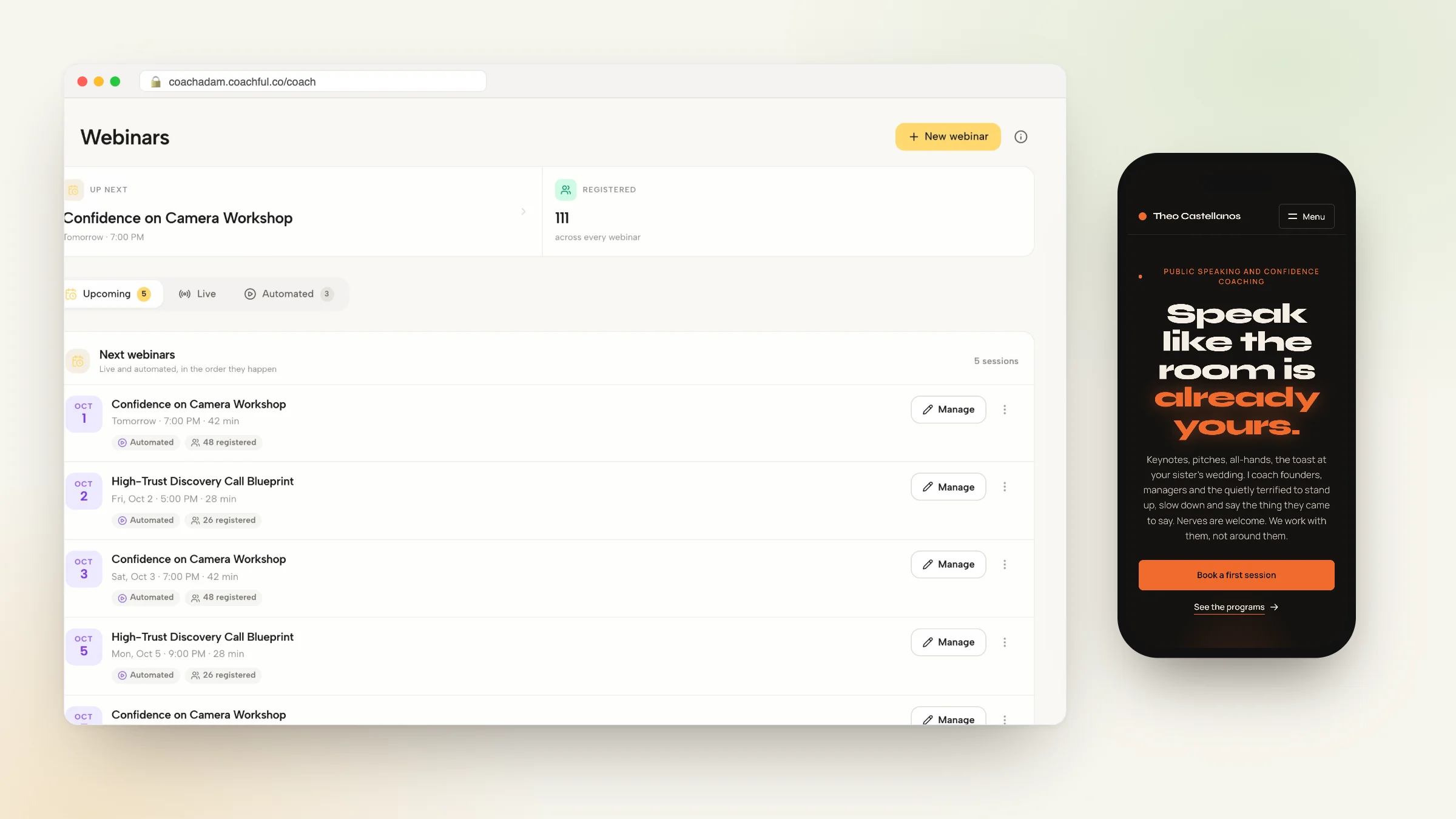
- Group programs and webinars for confidence cohorts and workshops, with a community feed for peer proof rounds.


The Coachful page for confidence coaches shows how it fits together, and our roundup of software for confidence coaches compares the options.
Get your confidence coaching site built for free
Coachful's team builds coaching websites, offer pages and funnels for free on every plan, inside your own account. Coachful itself is a paid subscription, with a free trial. Choose We'll build it for you · FREE under Create, or click Fill in a form on the Website page, and describe the pages you want and what visitors should do next. You can add up to 8 links and 10 files. The team replies by email, usually within about 24 hours, and won't invent credentials, testimonials or prices. Read what the free build covers.

The bottom line
Most confidence work fails when it tries to make someone feel confident first and act second. These exercises reverse the order. Map the specific situations, climb a ladder of small rungs, rehearse the moments that matter, borrow from people a step ahead, collect credible feedback, and give clients two or three quick state tools (an affirmation, "I'm excited", third-person self-talk) for the day itself. Track the evidence so the client can see it. For the craft behind these, see our guides to coaching techniques and life coaching exercises.
Frequently asked questions
What are the best coaching exercises for confidence?
Exercises that create evidence work best: a confidence ladder of small graded steps, a daily brave rep, rehearsal of specific moments, and a feedback harvest from people who know the client. Quick state tools such as values affirmation, reappraising nerves as excitement and third-person self-talk help on the day.
How do you build confidence in a coaching client?
Start by mapping the specific situations where confidence drops, then work on one of moderate difficulty with small, repeated actions. Mastery experiences are the strongest source of self-efficacy, so plan actions the client can complete this week and review what actually happened.
How long does it take to build confidence with coaching?
Clients often notice a difference in a targeted situation within a few weeks of regular practice, such as a daily brave rep or one ladder rung a week. Broader change takes longer. Track the evidence so progress is visible, because clients tend to forget their wins.
Can I use these confidence exercises in group coaching?
Yes. The confidence map, peer proof round, rehearsal in trios, values affirmation and the excitement reappraisal all work in groups. Seeing similar people succeed is one of the four sources of confidence, which makes groups especially useful for this topic.
Is confidence coaching the same as therapy for anxiety?
No. Confidence coaching helps with everyday situations such as speaking up, selling or starting something new. Intense, persistent fear, panic attacks or low mood need a licensed mental health professional. A good coach refers clients when that's what they need.
Which confidence exercise should I start with?
Start with the situational confidence map. It turns a vague goal into specific situations and shows which one to work on first, which makes every other exercise more targeted.
Will Coachful build my coaching website for free?
Yes. Coachful's team builds coaching websites, offer pages and funnels for free on every plan, inside your account. Request it from Create or the Website page, and the team replies with next steps, usually within about 24 hours. Coachful is a paid subscription; the build costs nothing extra.












