Financial Coach Website: How to Earn Trust Before the Call
People land on a financial coach website carrying something they don't say out loud: a bit of embarrassment. They earn reasonably well and don't know where it goes, or they've avoided opening a credit card statement for three months, or they and their partner keep having the same argument about money. Before they book anything, your site has to show three things: you won't judge them, you know exactly what you are (and aren't) as a coach, and there's a clear, small first step.
This guide covers how to describe your role so visitors trust it, the pages a money coach website needs, a worked homepage with an illustrative "typical month" table, how to book first calls without asking for sensitive information too early, and pages for workshops and couples. If you'd prefer not to build it, Coachful's team builds financial coaching websites for free on any plan, from a short form.
Coach, advisor or planner? Say it on the homepage
Visitors often can't tell a financial coach from a financial advisor, and the difference matters to them and to regulators. Generally, a financial coach works on behavior, budgeting, debt plans and money habits, while investment advice and selling financial products are regulated activities that need the appropriate license. Rules vary by country and state, so check where you practice, and then say clearly on your site what you do.
A line that works on the homepage or just below it:
- "Fee-only money coaching: no products, no commissions, no investment advice."
- "I help you build a plan you can run. For investments or tax, I'll point you to a licensed professional."
Visitors read that as honesty, and it quietly answers the "are you going to sell me something?" worry that stops many people from booking. If you're new to the field, this guide to becoming a financial life coach covers training and scope.
The pages a money coach website needs
- Home: who you help, the change, your role, the first step.
- Method: how the work runs, from the first look at the numbers to a monthly plan to the habits that keep it going.
- Engagements: your packages (for example a single money map session, a three-month program, monthly accountability) with length, format and price.
- About: your background and credentials. Former banking, accounting or financial counseling experience counts for a lot here.
- Workshops or employers: if you run financial wellbeing sessions for companies.
- Questions: "Do you see my accounts?", "Will you tell me what to invest in?", "We're a couple; do we both need to come?", "What if I'm in a lot of debt?"
- Book a free call, plus privacy and terms pages.

Worked example: a money coach's homepage
Here's a homepage for a fictional coach who works with people on good incomes who feel their money disappears. Each block has a copy line and the trust job it does.
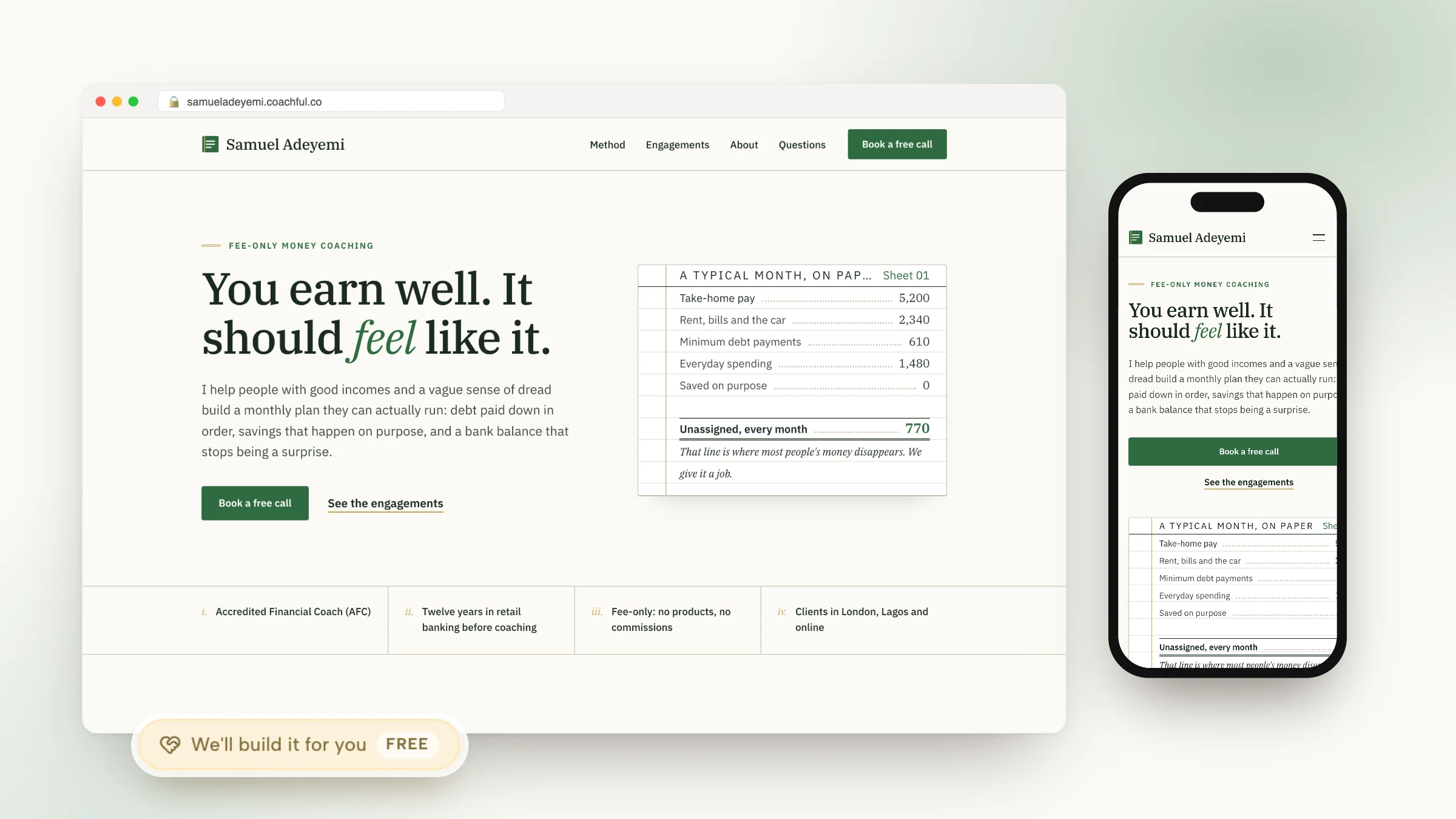
- Hero. "You earn well. It should feel like it." Sub-line: "I help people with good incomes and a vague sense of dread build a monthly plan they can actually run: debt paid down in order, savings that happen on purpose and a bank balance that stops being a surprise." Trust job: names the feeling without shaming it.
- Role line. "Fee-only money coaching. No products, no commissions." Trust job: answers "what are you selling me?"
- Credentials strip. Four short, true facts: certification, past career, fee-only status, where you work. Trust job: competence, at a glance.
- A typical month, on paper. A small illustrative table (below). Trust job: shows the method instead of describing it.
- How it works. "A free 20-minute call. A first session where we put one month on paper. Then six fortnightly sessions to give every line a job." Trust job: makes it finite.
- Engagements. Two or three cards with length and price. Trust job: no surprises on cost from a money coach, of all people.
- Stories. Real client words with permission, about feelings and behaviors as much as numbers. Trust job: someone like me did this.
- Free resource. "Get the one-page money map: the sheet we fill in on the first session." Trust job: a no-risk first step.
- Questions and close. Four answers, then "Book a free call." Trust job: removes the last objections.
The "typical month" table is the most persuasive block on the page, as long as it's clearly an illustration rather than a promise. Something like this, in the visitor's own currency:
| A typical month, on paper (illustration) | Amount |
|---|---|
| Take-home pay | 5,200 |
| Rent, bills and the car | 2,340 |
| Minimum debt payments | 610 |
| Everyday spending | 1,480 |
| Saved on purpose | 0 |
| Unassigned, every month | 770 |
Then one sentence: "That last line is where most people's money disappears. We give it a job." Those sample figures are the ones used on Coachful's Ledger template, pictured above, which was drawn for money and financial coaches with ruled paper, tabular numbers and offers set out as line items. The coach shown is fictional.

The first call: booking with less shame and less risk
Money is a hard thing to talk about with a stranger. The booking step should feel small and private.
- Keep the first call free and short, 20 to 30 minutes, with a plain description: "We'll talk about what's going on and whether coaching would help. You don't need to bring any numbers."
- Ask two gentle intake questions, such as "What made you look for help now?" and "Are you coming on your own or with a partner?"
- Don't ask for sensitive details up front. No account numbers, no passwords, ever. Ask for statements or figures only after someone becomes a client, and only what you need.
- Use a form, not email, for anything personal. On Coachful, forms and questionnaires attach answers and uploaded files to the client record, so nothing sits in your inbox (here's how forms work).
- Send a reminder by email, text or WhatsApp. Money calls are the ones people are most tempted to quietly skip.
When someone says yes, send the agreement for e-signature and take payment. Coachful supports one-time payments, subscriptions for monthly accountability and payment plans, paid into your own Stripe account with a 0% Coachful platform fee. If you offer reduced rates, this guide to sliding scale coaching rates shows how to present them without awkwardness.

Pages for couples, workshops and employers
Couples
Money is a frequent source of friction for couples, and many financial coaches work with both partners. A couples page should say that both partners are welcome on the first call, how sessions handle different money histories, and that you don't take sides. A sample line: "Two people, two money stories, one plan you both agreed to."
Workshops
Short live sessions on a single topic (a debt plan in an evening, the first-home savings plan, money basics for freelancers) are a good way in for new clients. Give each workshop a page with date, length, what people leave with and a sign-up. Here's how to run an online coaching workshop that leads to clients.
Employers
Some financial coaches sell financial wellbeing programs to companies. That buyer wants a separate page: topics covered, formats (talks, group sessions, confidential 1:1s), how employee privacy is handled, and how billing works. This piece on billing company-funded coaching covers the invoicing side.

If you coach business owners on their company finances, a more structured design can suit better than a personal one. Scaffold, shown above, was drawn for startup and operations coaches, with offers laid out as phases; our business coach website guide covers that audience in detail.
Let our team build your financial coach website for free
Coachful's team builds coaching websites for free on every plan. Coachful is a paid subscription, which you can start with a free trial; the build costs nothing extra on any plan.
Request it from the Website page with Fill in a form on the "Want us to build it for you?" card, or from Create > We'll build it for you · FREE.

The form asks which pages to create or improve; what they should do (book calls, collect leads, sell an offer, deliver a resource); what visitors should do after landing; up to 8 links to sites you like or your current one; up to 10 files of branding, copy, images or offers, such as your logo, headshot, money map worksheet or a copy document (no video files); and anything confusing or unfinished. For a money coach, also tell the team the exact wording you use to describe your role and what you don't do.

The team replies by email with next steps, usually within about 24 hours. That's a usual turnaround, not a guaranteed deadline. Everything is built in your own account, so you can change any figure or word yourself afterwards.
A recent example from this exact niche: a real-estate and money coach got a year-long cohort program with an application form, an eight-page website on the coach's own domain, a free nine-day bootcamp course with its own signup funnel and emails, and legal pages. Not every coach needs that much, but it shows the range of one request.
As in every build, nothing gets invented: no fake credentials, client results, testimonials or prices. Anything missing is left for you to fill. The team doesn't design logos, record videos, run ads or manage marketing over time. Here's the full scope of the free build service.
Frequently asked questions
What should a financial coach website include?
A homepage that names who you help and states your role, a Method page, an Engagements page with prices, an About page with credentials, an FAQ, a free call booking page and privacy and terms pages. Add couples, workshop or employer pages if you serve those groups.
What's the difference between a money coach website and a financial advisor website?
A money coach website focuses on behavior, budgeting, debt and habits, and should say clearly that you don't sell financial products or give investment advice, unless you're licensed to. An advisor's site covers regulated services and usually carries required disclosures.
Should a financial coach show prices on the website?
Yes, in most cases. People looking for a money coach are often anxious about money, and an unclear price feels like a risk. Show package prices or a starting price, and mention payment plans or a sliding scale if you offer them.
Will Coachful build my financial coach website for free?
Yes. The build service is free on every Coachful plan; Coachful itself is a paid subscription. Send the website request form with your pages, role wording and materials, and the team replies by email with next steps, usually within about 24 hours.
How do I collect client financial information safely?
Ask only for what you need, only after someone becomes a client, and never for passwords or full account numbers. Use a form inside your coaching platform rather than email, so answers and files are attached to the client record instead of sitting in an inbox.
Which website template suits a financial coach?
Coachful's Ledger template was drawn for money and financial coaches, with ruled paper, tabular numbers and offers as line items. Coaches who work with business owners on company finances may prefer Scaffold. See how Coachful works for financial coaches for everything beyond the website.