
How to Become a Nurse Coach: NC-BC, Training and Clients
To become a nurse coach, you need an active registered nurse license, a few years of nursing practice, coach training and supervised coaching experience. The main US credential is Nurse Coach Board Certified (NC-BC) from the American Holistic Nurses Credentialing Corporation (AHNCC), which asks for an unrestricted RN license, two to four years of RN practice depending on your degree, 60 contact hours of nurse coaching education in the last three years and 60 hours of coaching mentored by a certified nurse coach supervisor, followed by a board exam.
That's how to become a nurse coach in one paragraph. The rest of this guide covers what the role involves, how nurse coaching differs from health coaching, the scope questions that come with putting "nurse" in your title, the other credentials worth knowing (NBHWC and ICF among them), the cost and time, and how to get paying clients once you're trained.
When you're ready to launch a private practice, Coachful's team will build your nurse coaching website and first program page for free on every plan.
What a nurse coach does, and who hires one
A nurse coach is a registered nurse who uses a coaching approach: helping a person set their own health goals, find what gets in the way and make changes they can keep, rather than only telling them what to do. The clinical knowledge stays; the conversation changes. Instead of "you need to cut your salt," a nurse coach asks what the person already knows about their blood pressure, what they've tried and what they'd be willing to change this week.
Nurse coaches work in two broad settings:
- Inside healthcare. For example in hospitals, clinics, health plans or employer health programs, supporting people with chronic conditions, transitions home or prevention. Here you're employed and paid as a nurse.
- In private practice. Self-employed nurse coaches work with individuals or small groups, often on a focus they know from their nursing career: burnout among clinicians, life after a diagnosis, perimenopause, heart health or caregiving. Here you set the price and find the clients.
Some start in the first setting and move into the second, or do both. If you want the numbers for each route, our guide to nurse coach salary compares RN pay with independent coaching income.

Nurse coach, health coach or both?
Four credentials come up when nurses research coaching. They're awarded by different bodies, for different purposes, and only the first two are specific to nurses or clinicians.
| Credential | Awarded by | Who can apply | Key requirements |
|---|---|---|---|
| NC-BC (Nurse Coach Board Certified) | American Holistic Nurses Credentialing Corporation | RNs with an unrestricted US license | RN practice experience, 60 contact hours of nurse coaching education, 60 hours of mentored coaching, board exam |
| HWNC-BC (Health and Wellness Nurse Coach Board Certified) | American Holistic Nurses Credentialing Corporation | RNs who also hold AHNCC holistic nurse certification | The same exam as NC-BC |
| NBC-HWC (National Board Certified Health & Wellness Coach) | National Board for Health & Wellness Coaching | Anyone who meets the education or experience rule, nurses included | An approved training program, 50 logged sessions, an associate degree or 4,000 work hours, board exam; $100 application and $400 exam fee |
| ACC (Associate Certified Coach) | International Coaching Federation | Anyone | 60 hours of coach education, 100 coaching hours, 10 hours of mentor coaching, an exam; $175 to $625 to apply |
Requirements and fees as listed on each body's site in October 2026. The AHNCC's NC-BC fee is published only through its testing partner's application page, so we haven't quoted it.
The AHNCC says its exams are accredited by the Accreditation Board for Specialty Nursing Certification. The NBHWC's board certification page sets out its requirements, and the ICF's ACC page its own. Some nurses hold more than one: NC-BC because it's built for nursing, and NBC-HWC or an ICF credential because employers and coaching clients outside nursing recognize them. Our guides to health coach certification and ICF certification compare those routes in full.
A fifth option is aimed at licensed clinicians specifically: the National Society of Health Coaches offers a Certified Health Coach credential only to licensed health practitioners, with program materials at $875 and about 85 hours of self-study, as listed in October 2026. It's a separate credential from both NC-BC and NBC-HWC.
Scope of practice: where coaching ends and nursing care begins
This is the part most coaching courses skip, and it matters more for a nurse than for anyone else. A health coach without a license works under the NBHWC's scope statement, which says coaches on their own "do not diagnose, interpret medical data, prescribe or de-prescribe" and describes the coach's role as an "accountability partner, not director." A registered nurse has a license with a wider scope, set by the state.
That cuts both ways:
- Your license is an asset. You can explain what a lab result means in general terms, recognize warning signs and tell a client when to call their doctor today rather than next week. Clients pay for that judgment.
- Your license also comes with you. The BLS notes that registered nurses must be licensed by the state they work in. If you call yourself a nurse coach, clients will reasonably assume you're acting as a nurse, and your state board of nursing decides what that obliges you to do. Ask your board how it views independent coaching practice before you open one, and write your scope into your coaching agreement.
- Some things stay with the treating team. Diagnosis, prescribing (unless you're an advanced practice nurse working within that license), changing medication plans and treating mental health conditions belong with the client's physician, nurse practitioner or therapist.
Refer or hand back to the treating clinician when: a client describes new or worsening symptoms; wants to stop or change a medication; shows signs of depression, an eating disorder, self-harm or substance dependence; or asks you to interpret their own test results as a diagnosis. Coaching can continue alongside, on the habits and goals the clinician supports. Our guide to keeping therapy and coaching separate covers the paperwork side of that line.

The route to NC-BC, step by step
- Hold an unrestricted, current US RN license. International nurses must pass the NCLEX or have their license verified as equivalent.
- Build your nursing practice hours. With a BSN, the AHNCC asks for two years full time or 4,000 hours part time in the last five years. With an ADN or diploma, four years full time or 8,000 hours part time in the last seven.
- Complete 60 contact hours of nurse coaching education within the last three years, with content consistent with the Nurse Coach Core Values and Competencies. Academic credit counts at set conversion rates.
- Log 60 hours of coaching experience mentored or supervised by a Certified Nurse Coach Supervisor, and get a validation letter from a certified nurse coach. The AHNCC also recommends, but doesn't require, at least 10 hours of being coached yourself.
- Apply and sit the exam. Testing runs through the AHNCC's testing partner, year-round, as a computer-based test, with a three-month window once you're approved and results straight away. A practice test costs $65.
Keep a careful log of those 60 coaching hours from the start: dates, durations and who mentored you. Our guide to tracking coaching hours was written for the ICF, but the logging habits are the same.

What it costs and how long it takes
The biggest time cost is the nursing practice requirement, which most nurses reading this already meet. After that, the timeline depends on how fast you complete training and log supervised hours.
| Step | Realistic time | Cost as listed |
|---|---|---|
| RN practice requirement | 2 years full time (BSN) or 4 years (ADN or diploma) | Already part of your career |
| 60 contact hours of nurse coaching education | A few months part time, depending on the program | Set by each provider |
| 60 hours of mentored coaching | About 7 to 14 months at 1 to 2 hours a week | Supervision fees vary |
| NC-BC exam | A three-month testing window after approval | Fee on the testing partner's application page; practice test $65 |
| Optional: NBC-HWC | An approved program (about 12 weeks to 12 months), then 50 sessions | $100 application, $400 exam; approved programs we checked from $2,848 to $9,999 |
Time estimates are our arithmetic from the stated requirements, not body-published timelines. Prices as listed in October 2026.
For most working nurses, a year from starting training to sitting the NC-BC exam is a reasonable plan. Coaching clients privately during that year also counts toward your practice, so the mentored hours and your first paying clients can overlap.
Choose who you'll coach
The easiest niche for a nurse coach is usually the one your nursing career already gave you. A cardiac nurse knows what the weeks after a heart attack feel like. An oncology nurse knows the fatigue and fear of survivorship. A labor and delivery nurse knows the postpartum months. Clients will pay more for that recognition than for "wellness."
Coachful's 2026 Coaching Business Report flags women's health as underserved and growing, with low saturation, against health and wellness coaching overall, which it calls "the most crowded end of the profession." Another strong focus is your own colleagues: nurses and other clinicians dealing with burnout often trust a coach who has worked the same shifts.

Package and price your nurse coaching
There's no published rate for nurse coaches specifically, so the closest data is health and wellness coaching. Coachful's 2026 Coaching Business Report puts it at $75 to $200 a session (PayScale and practitioner reports), with these common formats:
- A four-week reset: four sessions plus a habit tracker and a simple plan, $400 to $800.
- A three-month program: eight to ten sessions with weekly check-ins, $900 to $2,000.
- Ongoing monthly coaching: two to four sessions a month plus messaging, $300 to $700 a month.
A nurse's clinical background can support pricing toward the top of those ranges, especially in a specific focus. The ranges and more examples are in our breakdown of what health coaches charge, and the health and wellness rates page shows the sources.

Get your first nurse coaching clients
- Start with the people who already know your work. Former colleagues, physicians you've worked with, discharge planners and practice managers are your first referral sources. Tell them exactly who you help and what you don't do.
- Offer a free consultation with a clear next step. Twenty minutes to hear the person's situation, then a specific program offer, not an open-ended "let's see."
- Write about one problem, repeatedly. Three short posts a week on the same focus beat a general health blog.
- Run a small group. A six-week group for one audience, such as night-shift nurses rebuilding sleep, fills faster than one-to-one places and creates testimonials you can use with permission.
- Talk to employers. Workplace health programs pay from a budget, and a nursing license is a credential an HR team can check.
Our guide on how to become a health coach has more on finding clients in the wider health coaching market, and how to become a holistic health coach covers the holistic side.
The tools a nurse coaching practice runs on
A Coachful membership includes what an independent nurse coaching practice needs in one account:
- Intake forms attached to a booking, so health history and goals arrive before the first session and sit on the client record.
- Coaching agreements sent for e-signature, with your scope as a coach written in.
- Programs with weekly goals, daily habits with reminders and morning, evening or weekly check-ins, in a client app on iPhone and Android.
- Recurring check-in forms, such as an energy and symptoms tracker, with answers saved for you to review.
- Payments to your own Stripe or Razorpay account with a 0% Coachful platform fee.
One limit nurses should weigh carefully: Coachful is not HIPAA-certified. It is GDPR-ready with full data export. If you'll handle protected health information, receive patient records or coach under a clinic's license, confirm what's required before choosing any tool. See the Coachful page for health coaches for the full setup.

Have your website built for free
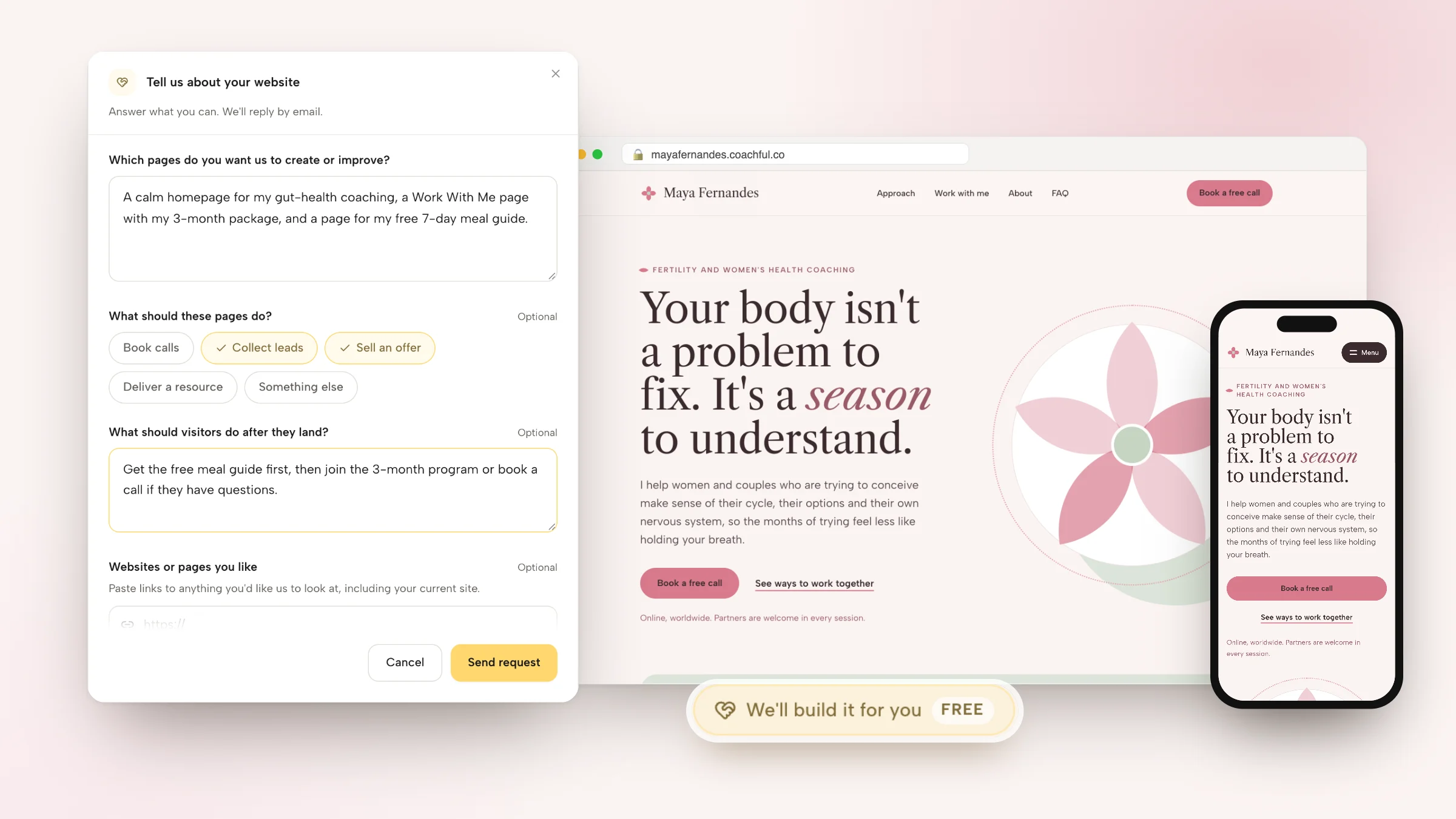
Coachful's team builds your website, program page and first offer for free on every plan, inside your own account. Coachful itself is a paid membership with a free trial to start. Choose We'll build it for you · FREE under Create, or Fill in a form on the Website page, describe the pages you need and what visitors should do next, and attach up to 10 files and 8 links.

The team replies by email with next steps, usually within about 24 hours, which is typical rather than guaranteed. Nothing gets invented: your RN license and NC-BC appear only if you hold them, and there are no made-up testimonials or prices. See everything the free build covers.
Frequently asked questions
Do you need to be a nurse to be a nurse coach?
Yes. The title assumes a registered nurse, and the AHNCC's NC-BC requires an unrestricted, current US RN license. People without a nursing license can become health coaches instead, through NBHWC board certification or a coaching credential such as the ICF's ACC.
How long does it take to become a nurse coach?
If you already meet the AHNCC's nursing practice requirement, about a year is realistic: 60 contact hours of nurse coaching education, 60 mentored coaching hours and the exam. Without the practice hours, add two years full time with a BSN or four with an ADN or diploma.
What is the difference between a nurse coach and a health coach?
A nurse coach is a licensed RN using a coaching approach, so their state nursing license and board apply. A health coach doesn't need a license and works under a narrower scope; the NBHWC says coaches on their own don't diagnose, interpret medical data or prescribe.
Is NC-BC or NBC-HWC better for a nurse?
NC-BC is built for nurses, around the Nurse Coach Core Values and Competencies. NBC-HWC is the national board credential for health coaching in general, open to nurses and non-nurses alike. Some nurses hold both; choose the first based on where your clients will come from.
Can a nurse coach work independently?
Yes. Check with your state board of nursing how it views independent coaching under the nurse title, carry appropriate insurance and put your scope in a signed agreement. Refer diagnosis, prescribing and mental health treatment to the client's clinicians.
How much do nurse coaches charge?
There's no nurse-specific rate data. Health and wellness coaching runs $75 to $200 a session, $900 to $2,000 for a three-month program and $300 to $700 a month for ongoing coaching, according to Coachful's 2026 Coaching Business Report. A clinical specialty supports the upper end.
Will Coachful build my nurse coaching website for free?
Yes. Coachful's team builds nurse coaching websites, program pages and first offers for free on every plan, inside your account, usually within about 24 hours. Coachful is a paid membership; the build costs nothing extra.












