
How to Become a Recovery Coach: Certification and Practice
There are two ways to work as a recovery coach, and knowing how to become a recovery coach starts with choosing between them. Both usually begin in the same place: lived experience of recovery from addiction and 30 to 60 hours of recovery coach or peer support training. Peer recovery coaches then earn their state's certification and work in treatment programs, hospitals and recovery community organizations. Private recovery coaches set up their own practice for individuals and families. Neither provides addiction treatment, which in the US is the work of licensed counselors and medical providers.
Below are both routes side by side, the certifications and training that matter, what the research shows, how long it all takes, and how a private practice runs day to day, including the confidentiality and crisis planning this work demands. If you go independent, Coachful's team will build your recovery coaching website for free on every plan.
Two different jobs share the name recovery coach
| Peer recovery coach or specialist | Private recovery coach | |
|---|---|---|
| Where you work | Treatment programs, hospitals and emergency departments, recovery community organizations, courts, crisis services | Your own practice, online or in person |
| Who pays | An employer or a grant; some states also let programs bill public insurance for peer services | The client or their family |
| Credential | Usually your state's peer certification, sometimes IC&RC's Peer Recovery credential | None required; training and a credential still build trust |
| Supervision | Built in, through the employer | You arrange your own |
| Typical client | People early in recovery, often in crisis or just out of treatment | People and families who want structured support around and after treatment |
Many coaches do both: a few years of peer work for supervised experience and referrals, then private clients. If you're deciding, the employed route teaches you faster, because the situations come to you. Our sibling guide to sobriety coaching covers the same work from the client's side.
What recovery coaches do, and what they leave to clinicians
A recovery coach helps someone build a life in which recovery holds: daily structure, connection to mutual-help groups or other supports, practical goals like work, housing and family repair, and a plan for high-risk moments. SAMHSA's materials describe recovery coaches as one form of peer support: people who bring their lived experience of recovery, combined with training and supervision, to support others.
What they don't do: diagnose, detox anyone, adjust medication or provide counseling for substance use disorder. The Bureau of Labor Statistics notes that substance abuse and behavioral disorder counselors in private practice must be licensed, which in every state means a master's degree, supervised clinical hours and an exam. A recovery coach works next to that care, not in place of it.
One more line matters in this field: pathways. SAMHSA's National Model Standards for Peer Support Certification recommend that certification requirements tied to a particular recovery pathway, including abstinence-only rules, be excluded, and SAMHSA recognizes the value of medications for substance use disorder. A good recovery coach supports the client's chosen path, including medication, rather than their own.

Peer recovery certification: what states and SAMHSA set
Each state runs its own peer certification, with its own competencies, ethics code, training hours, exam and fees, and there's no automatic reciprocity between states. SAMHSA's National Model Standards for Peer Support Certification (released 2023, updated 2026) give a sense of the common ground:
- Lived experience is treated as an essential part of the role, usually confirmed by a written self-attestation.
- Training: SAMHSA recommends 40 to 60 hours. Most state certifications currently require between 40 and 46.
- Supervised work experience: 22 of 55 state peer certifications required it when SAMHSA reviewed them, ranging from under 200 hours to 2,000. SAMHSA recommends that states which require it ask for no more than 120 hours, and accept paid, volunteer, virtual and out-of-state hours.
- Three types of peer certification exist: mental health, substance use and family peer.
Start with your state's certification board. It will tell you which training courses it accepts, how many supervised hours it wants and whether it uses the IC&RC exam.
Recovery coach training and credentials compared
| Option | What it involves | What it's for |
|---|---|---|
| Your state's peer recovery certification | Approved training, lived-experience attestation, any required supervised hours, often an exam | Employed peer work and, in some states, billable peer services |
| IC&RC Peer Recovery (PR) | A high school diploma or equivalent; 46 hours of training (10 each in advocacy, mentoring and education, and recovery and wellness support, plus 16 in ethical responsibility); 500 hours of supervised paid or volunteer work; 25 hours of supervision; the IC&RC PR exam | A credential issued through member boards in many states and countries |
| CCAR Recovery Coach Academy | A live five-day course from the Connecticut Community for Addiction Recovery, online or in person; CCAR says its trainings cover active listening, motivational interviewing, recovery wellness planning and ethical practice | The foundational training many programs use; CCAR also offers a separate ethics course and its Recovery Coach Professional designation |
| ICF-accredited coach training | General coaching skills, with ICF credentials from 60 hours of education and 100 coaching hours | Private practice with clients who expect coaching credentials |
Motivational interviewing is worth learning properly whatever route you take; our guide to motivational interviewing for coaches covers the OARS skills, and the sibling article on motivational interviewing questions gives you the wording.
What the research says about recovery coaching
The evidence is encouraging and honest about its limits. A 2019 systematic review from the Recovery Research Institute at Massachusetts General Hospital, published in Frontiers in Psychology, looked at peer recovery support services and recovery coaching. It found tentative support across a range of settings: reduced substance use and relapse rates, better relationships with providers and social supports, higher treatment retention and satisfaction. It also found many null results and real weaknesses in the studies, including the difficulty of separating peer support from everything else a person receives. That's a fair summary to give clients and employers.
How long it takes and what it costs
| Stage | Typical time |
|---|---|
| Foundational recovery coach training | About a week of live training, such as CCAR's five-day academy |
| State-required training hours | 40 to 60 hours in most states |
| Supervised work experience, where required | From a few weeks to more than a year, depending on the state |
| IC&RC Peer Recovery | 500 supervised hours, so several months of part-time work at least |
Course fees vary by sponsor, and some states and community organizations subsidize peer training for residents, so ask your state's recovery community organization before you pay full price. Budget separately for the exam, your state's application fee and, if you go private, liability insurance; our insurance checklist lists what to ask an insurer.
Building a private recovery coaching practice
Private clients usually find a recovery coach at a transition: leaving residential treatment, returning to work, a family that wants to help without policing. Families are often the buyer, which means three-way contracting: what the client shares, what the family hears, and what stays private.
Coachful's rates data has no figure for recovery coaching, so set prices from the structure of the work, not from a borrowed hourly number. For context only, the BLS reports a median of $59,350 a year in May 2025 for substance abuse, behavioral disorder and mental health counselors, an adjacent licensed occupation, not a coach salary. Package shapes that suit the work:
- First 30 days: daily check-ins, two sessions a week and an agreed plan for weekends and evenings.
- 90-day support: weekly sessions, daily check-ins and a monthly family session.
- Ongoing monthly: two sessions and message support, for the second half of the first year.
Our guide to minimum commitments and the three-month dip explains why 90 days is a sensible first engagement.

Confidentiality, crisis plans and the tools you'll need
Recovery coaching handles some of the most sensitive information a person has. Before your first client, put three things in writing: a confidentiality agreement that says exactly what you share with family and when; a crisis plan with emergency numbers and what you'll do if someone is at risk (in the US, the 988 Suicide & Crisis Lifeline is reachable by call or text); and a referral list of treatment providers, detox services and mutual-help meetings near your clients. Our emergency escalation protocol is a starting point.
If you work with or inside a treatment program, ask whether federal confidentiality rules for substance use records apply to your arrangement, and choose your tools accordingly. Coachful is not HIPAA-certified. It is GDPR-ready with full data export, and it has an owner-only Sensitive Data Mode that blocks AI processing of client records, notes, check-ins, questionnaires and call recordings.
What a private practice runs on, included in your Coachful membership:
- Daily check-ins the client answers in the app, morning and evening, with a weekly review.
- Habits such as a meeting, a call to a sponsor or a walk, with reminders.
- Direct messages and group chat, plus a community feed for a peer group you run.
- A client overview that shows who has gone quiet, so a missed week turns into a phone call.
- Agreements for e-signature and payments through your own Stripe account, including payment plans.


See the Coachful page for health coaches for the wider feature set.

Get your recovery coaching website built for free
A recovery coach's website needs to feel safe and say plainly what you do and don't do. Coachful's team builds it for free on every plan, inside your account: a calm homepage, an About page with as much of your story as you want to share, a ways-to-work page, a page for families and a booking page. Coachful itself is a paid subscription, and you can start with a free trial.

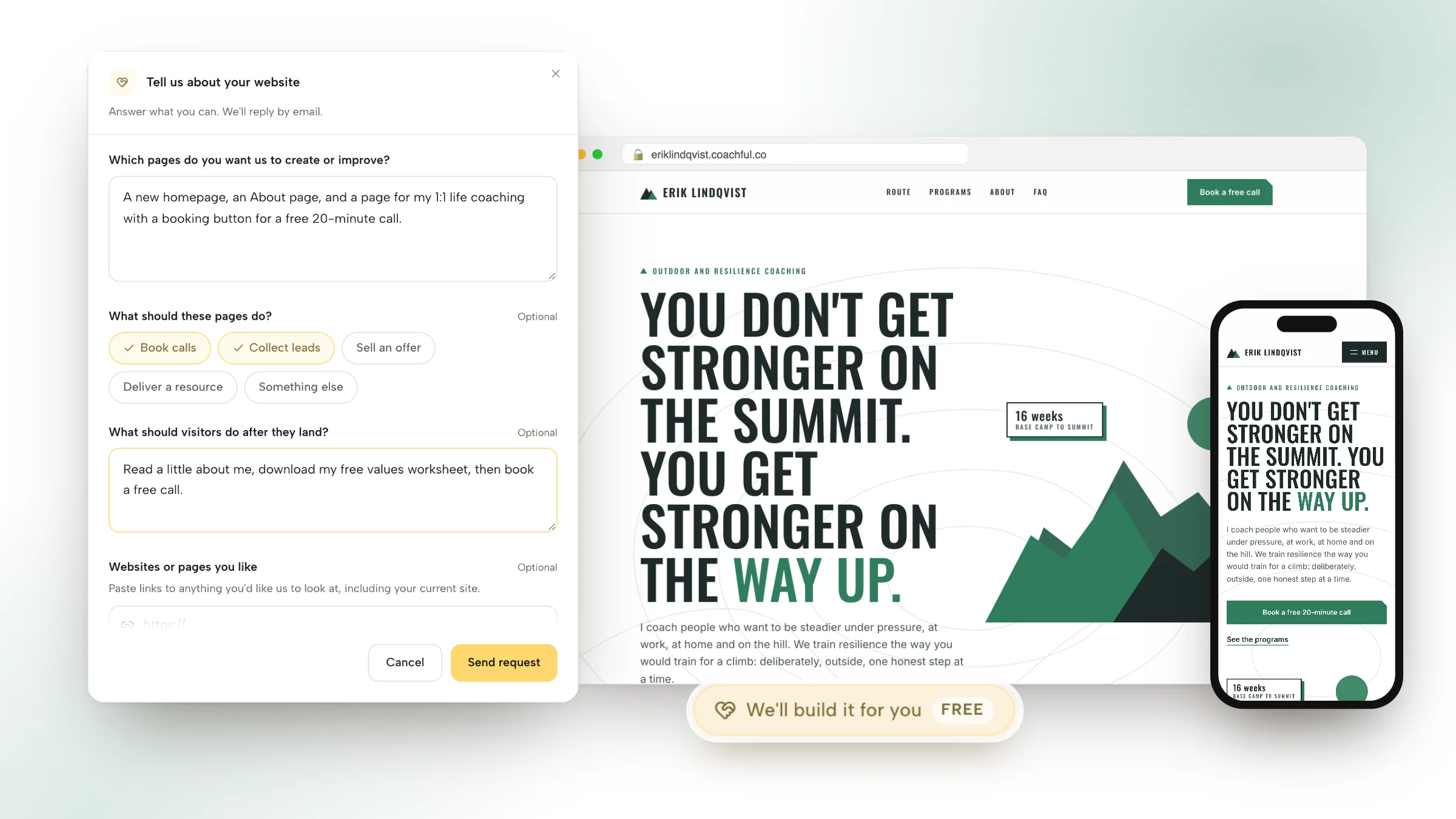
Choose We'll build it for you · FREE under Create, or click Fill in a form on the Website page. Describe the pages, what they should do and what a visitor should do next, and add up to 8 links and up to 10 files. The team replies by email with next steps, usually within about 24 hours, typical rather than guaranteed. A recent build for a coach starting from nothing, with no site, logo or prices, produced five pages (home, about, coaching, consultation and contact) with every button leading to a 20-minute consultation booking. Prices were left for the coach to decide, and nothing about credentials or outcomes was invented. Logos, video and ads aren't part of it. Here's everything the free build covers.
Frequently asked questions
Do you need to be in recovery to be a recovery coach?
For peer recovery certification, lived experience is generally required and confirmed by self-attestation. Private recovery coaches aren't legally required to be in recovery, but many are, and clients often choose them for it. Family-peer certifications cover people who were the main caregiver of someone with a mental health or substance use condition.
How do I get certified as a recovery coach?
Contact your state's peer certification board. Most ask for around 40 to 60 hours of approved training and a lived-experience attestation; many add an exam, and some require supervised work hours. The IC&RC Peer Recovery credential asks for 46 training hours, 500 supervised hours and an exam.
What is the difference between a recovery coach and an addiction counselor?
An addiction counselor provides treatment and, in private practice, must be licensed, which requires a master's degree and supervised clinical hours. A recovery coach offers peer support, practical planning and connection to resources, and refers clinical needs to counselors and medical providers.
How long does recovery coach training take?
Foundational training such as CCAR's Recovery Coach Academy takes five days. State certification usually needs 40 to 60 training hours plus any supervised experience, which can add weeks to more than a year.
Can a recovery coach work online?
Yes. Private recovery coaching is often online, with sessions by video and daily check-ins in an app. Have a local crisis plan for every client, because you may not be in the same city when something goes wrong.
Can recovery coaches support medication for addiction treatment?
They should. SAMHSA recognizes the value of medications for substance use disorder and recommends against pathway-specific certification rules. A recovery coach supports the path the client and their clinicians choose.
Will Coachful build my recovery coaching website for free?
Yes. Coachful's team builds coaching websites and booking pages for free on every plan. Fill in the form from Create or the Website page and the team replies with next steps, usually within about 24 hours. Coachful is a paid subscription; the build costs nothing extra.












