
Are Relationship Coaches Worth It? A Guide for Couples
Are relationship coaches worth it? Often yes, for couples who are basically safe and committed but stuck in the same arguments, drifting apart or facing a big decision together, and for individuals who want to get better at relationships. Studies of structured relationship programs, including online ones with a coach checking in, show real gains in relationship satisfaction for many couples. Relationship coaching typically costs $100 to $200 a session. It is the wrong choice when there is violence or fear in the relationship, or when one partner's mental health or addiction is driving the problems.
This page is for deciding. It sets out who relationship coaching tends to help, what the trials found, including a surprising result about how much coaching couples actually need, what it costs, how to tell if it is working, and the warning signs in a coach.
A decision checklist for couples
If most of these are true, a relationship coach is a reasonable place to start. If any statement in the second table is true, start somewhere else.
| Coaching is a good fit when | Why it matters |
|---|---|
| Both of you want to work on the relationship | Coaching runs on joint effort between sessions. |
| The problems are about how you talk, decide, share the load or spend time | These are skills and habits, which coaching is built for. |
| You can disagree without anyone feeling afraid | Coaching assumes basic safety. |
| You want a plan as much as an understanding of why | Coaching focuses on the present and the next few months. |
| You have a decision to make together, such as moving, marriage or children | A neutral third person helps both voices count. |
| Start somewhere else when | Where to start |
|---|---|
| There is violence, threats, or control over money, movement or contact | A domestic violence service. In the US, the National Domestic Violence Hotline is 800-799-7233, or text START to 88788 (listed by the US Office for Victims of Crime). |
| Depression, anxiety, trauma or addiction is driving the conflict | A licensed therapist, for the individual and possibly the couple |
| You are in acute crisis after an affair or a sudden separation | A licensed couples therapist first. Coaching can help later. |
| One partner has already decided to leave | Discernment counseling with a therapist, or, if separating, a divorce coach or mediator |
For a fuller comparison of the professions, see our guide to what relationship coaching is, which sets coaches, couples therapists and marriage counselors side by side.
What the research says
Relationship coaching sold one-to-one has not been studied much under that name. Structured relationship programs, many of them delivered with coaches, have been studied a lot.
- Light-touch coaching works about as well as heavy coaching, at least online. In a trial with 740 low-income US couples, the online OurRelationship program improved relationship satisfaction compared with a waitlist whether couples got full coach calls, coaching only if they fell behind, or automated emails only. Effect sizes ranged from d = 0.40 to 0.47 with no reliable differences between the three versions (Le and colleagues, 2023). The senior author co-invented the program and holds equity in it, which the paper discloses.
- The gains can last. Among 151 distressed couples randomized to the same program, improvements in relationship satisfaction and confidence held for 12 months, and depressive and anxious symptoms stayed lower too. The program takes about eight hours and is mostly self-guided (Doss and colleagues, 2019).
- Online relationship education helps couples and individuals. A meta-analysis of 12 publications found online programs raised relationship satisfaction, communication skills and confidence, and also reduced anxiety and depressive symptoms (Spencer and Anderson, 2021).
- The relationship with the coach matters. Across 27 samples and 3,563 coaching processes, a strong working alliance was consistently linked to better coaching outcomes (Graßmann, Schölmerich and Schermuly, Human Relations). In couples work, both partners need to trust the coach.
The practical takeaway: a structured approach, a clear set of skills and steady practice do most of the work. You may not need the most expensive coach or the longest package. You do need both partners doing the exercises.

What a relationship coach costs in 2026
These ranges come from Coachful's 2026 Coaching Business Report for the second quarter of 2026, in US dollars.
| What you buy | Typical price | Source behind the range |
|---|---|---|
| An hour of relationship coaching | $100 to $200 | PayScale and practitioner reports |
| Newer relationship coach, per hour | $75 to $125 | Practitioner estimates |
| Experienced relationship coach, per hour | $125 to $250 | Practitioner estimates |
| Top of the niche, per hour | $250 to $500 | Practitioner estimates |
Compiled in Coachful's 2026 Coaching Business Report. Practitioner estimates are not measured study results. More on coachingrates.com.
The report adds a useful caution: couples sessions are often longer and emotionally heavier than individual ones, so an hourly rate can understate what a session costs. Ask whether a session is 60, 75 or 90 minutes, and how many the coach usually recommends. Coaching is usually paid out of pocket; our guide to whether life coaching is covered by insurance explains why.
How to tell whether it is working
Relationship coaching has no lab result, so agree with your partner and the coach what you will watch. Simple measures work:
- A weekly score. Each of you rates the relationship from 1 to 10 every Sunday, privately, then compares at the end of the month.
- The recurring fight. Name it. Is it happening less often, ending sooner, or ending with a repair rather than a silence?
- The shared plan. Has the decision you came in with, such as the move, the money or the division of chores, been made or at least narrowed?
- Effort on both sides. Are both of you doing the between-session exercises, or is one person carrying the coaching?
- A review at session six. If nothing has shifted, change the approach, consider a therapist, or stop.
A worked example. Jordan and Sam have been together eight years and have the same fight about the weekend calendar every Thursday. They book six sessions at $150 each, $900 in total, and agree to track the Thursday fight. By week four it happens half as often, and they have a shared calendar and a rule for saying no to plans. That is a good return. If by week six one partner has stopped coming, the issue is no longer the calendar, and a couples therapist is the better next step.

How to choose a relationship coach, and the red flags
| Good sign | Red flag |
|---|---|
| Explains how they stay neutral with both partners | Quickly takes one partner's side |
| Has a clear policy on secrets told in individual sessions | Has no policy, or shares what one partner says in private |
| Screens for violence and safety before starting couples work | Never asks about safety |
| Teaches named, practical skills and gives you exercises | Sessions are venting with no structure |
| Refers to a therapist when an issue is clinical | Claims to treat trauma, depression or addiction |
| Puts sessions, length, price and cancellation in writing | Promises to save your relationship |
The International Coaching Federation's Code of Ethics asks coaches to agree roles, responsibilities, confidentiality and fees before coaching begins, and to have a clear agreement about what information is shared with each party (ICF Code of Ethics). In couples work that agreement is especially important, and the wider characteristics of a good coach still apply. For a ready-made list, see questions to ask a relationship coach, and if you are not sure coaching is what you need, signs you need a relationship coach.

Is relationship coaching worth it if you are single?
It can be. Individual relationship coaching helps people understand their patterns, get clearer about what they want and practice the conversations that are hard for them, such as raising a need or setting a boundary. Research on relationship education for individuals found medium short-term gains in relationship knowledge, attitudes and skills, though long-term follow-up is thin. If dating is the main focus, our guide on whether dating coaches are worth it goes deeper.
What good relationship coaching looks like between sessions
The skill-building happens at home, on an ordinary Thursday. Expect a few exercises each week, a way to note what happened, and the coach picking up exactly where you left off next time.

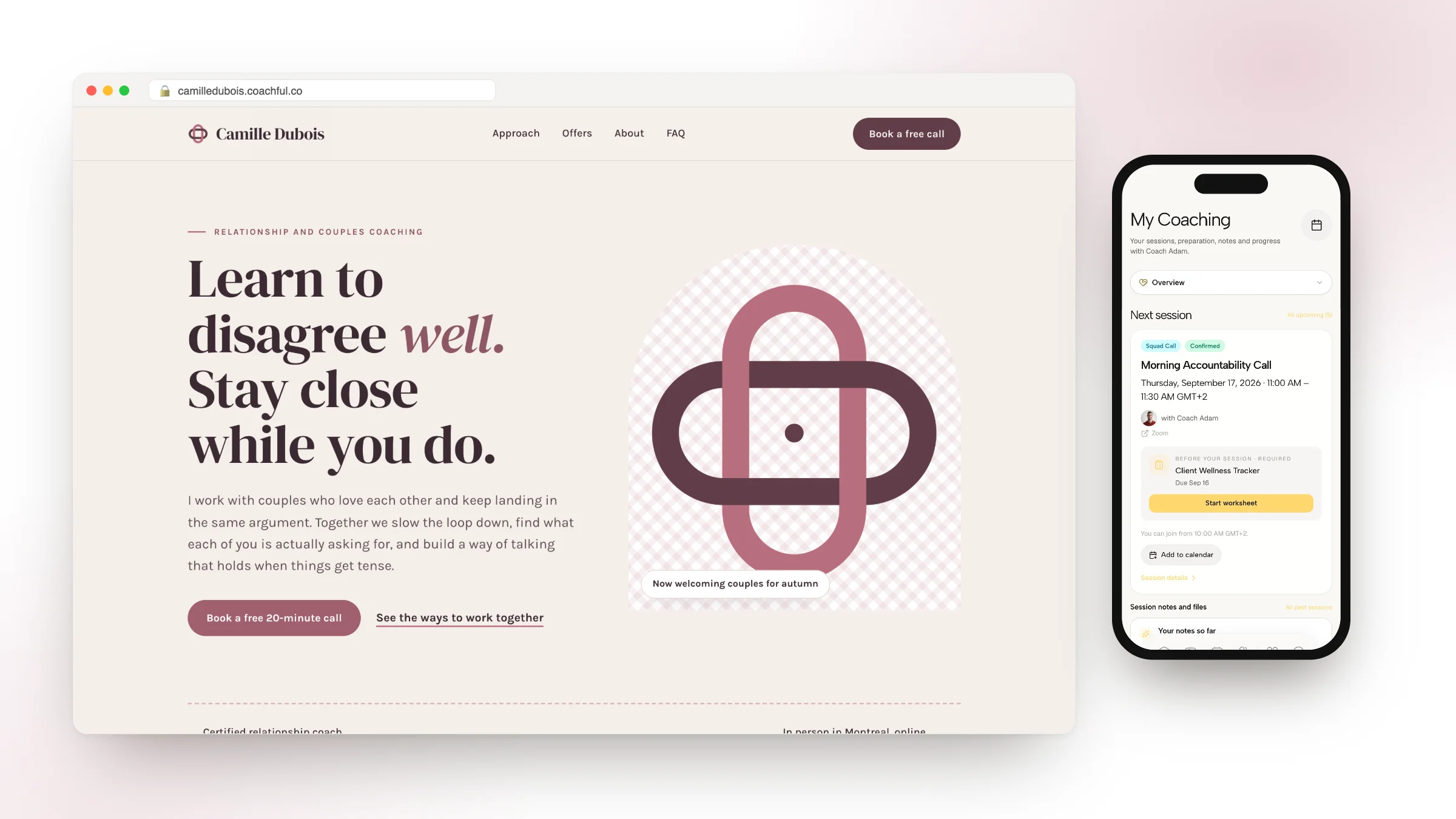
In Coachful's client app, each partner can see upcoming sessions, notes from past ones, goals and any program the coach has set up, so the plan does not live in one person's memory.

Find a relationship coach on Coachful
Coachful's Find a Coach directory is open to anyone. Browse the Relationships category, search for "couples", "communication" or "marriage", or switch to browsing programs. The Find My Coach quiz asks what you want to improve, where you are now, the coaching style you prefer and your monthly budget before suggesting coaches. Each profile shows the coach's background and programs, with a calendar to book a discovery call or a form to send a message. Book the call together if you are a couple.

Are you a relationship coach?
Couples want to know you are safe, neutral and practical before they book. Your website should say so plainly, with your method, your policy on individual sessions and where you refer; our guide to a relationship coach website lists the pages. Coachful's team will build that website for you for free on every plan, usually within about 24 hours: see how the free build works. There is more in what Coachful offers relationship coaches and our guide to becoming a relationship coach.

Frequently asked questions
Is relationship coaching worth the money?
For couples who are safe, committed and stuck on communication or decisions, often yes. Trials of structured online relationship programs found gains in relationship satisfaction that held for a year. At $100 to $200 a session, six sessions is a modest test. Start with therapy instead if there is violence, addiction or a mental health crisis.
Is a relationship coach better than couples therapy?
Neither is better in general. A couples therapist is licensed to assess and treat relationship distress and mental health problems. A relationship coach is unlicensed and focuses on skills, habits and plans. Choose therapy for crisis, trauma or clinical issues, and coaching for practical problems between two people who are basically doing okay.
How much does a relationship coach cost?
Most relationship coaches charge $100 to $200 an hour, according to PayScale data and practitioner reports compiled in Coachful's 2026 Coaching Business Report. Newer coaches charge $75 to $125 and those at the top $250 to $500. Couples sessions often run longer than an hour, so ask about length.
Can relationship coaching save a marriage?
It can help a marriage where both partners want to stay and are willing to change how they work together. It cannot save one where a partner has decided to leave, and no ethical coach should promise it will. If one of you is unsure, ask a therapist about discernment counseling first.
How many relationship coaching sessions do we need?
Many couples start with about six sessions and review progress then. Research on online programs found that a structured, mostly self-guided program of around eight hours produced lasting gains, so a short, well-structured engagement can be enough. More sessions help when you are practicing new habits under real stress.
Can I see a relationship coach without my partner?
Yes. Many people work with a relationship coach alone, to understand their own patterns, prepare for a hard conversation or decide what they want. If you are both seeing the same coach, ask how they handle individual sessions and anything you share privately.












