Best Coaching Websites: 11 Real Examples and What to Steal
The best coaching websites are rarely the most expensive ones. They are the ones where the right visitor can tell within a few seconds who the coach helps and what to do next. Judge any site by that test and a surprising pattern appears: several of the most famous coach websites are built for a different business from yours, and copying them can cost a solo coach calls.
Below are 11 real coaching websites we looked at in October 2026, from life and career coaches to executive advisors, with what each does well, what to borrow and what to leave alone. Because we don't reproduce other people's sites, each pattern is illustrated with one of Coachful's own designed templates. And if you want a site built on these patterns without doing it yourself, our team builds coaching websites for free on every Coachful plan.
How we chose these coaching websites
We picked well-known coaches and coaching firms across niches and judged every homepage on the same four questions:
- First screen. Can a stranger tell who it's for before scrolling?
- Offer. Is it clear what you can buy or join?
- Proof. Is there specific evidence, from named people, near the decision?
- Next step. Is there one obvious action, and does it lead to a conversation or a purchase?
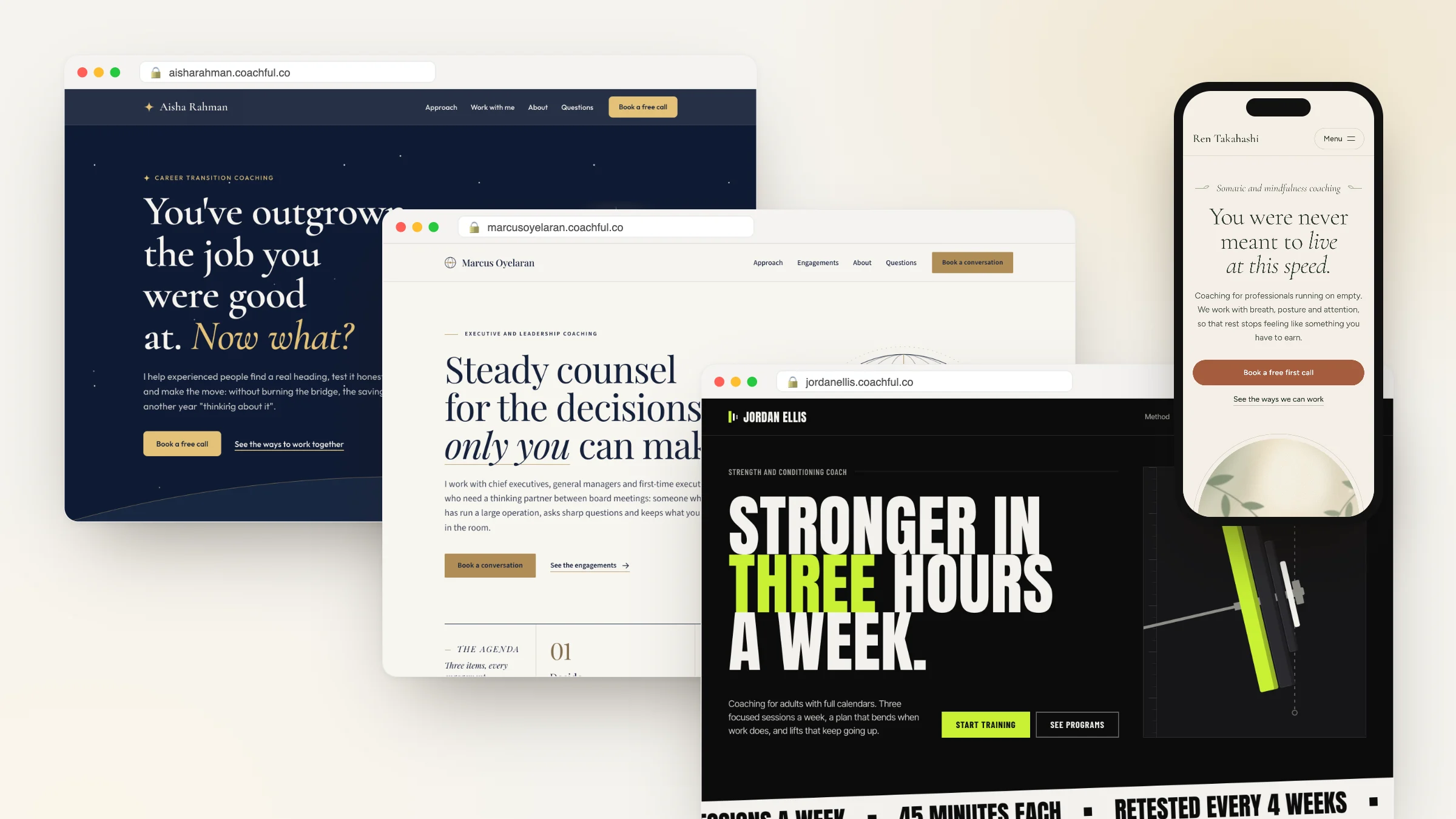
Two notes on method. Sites change often, so we describe what each homepage showed when we looked, and we quote headlines rather than paraphrase them. Numbers such as student counts are the sites' own claims, which we haven't verified. We don't link to or screenshot these sites; the pictures in this article are Coachful templates with fictional sample coaches, chosen to show the same pattern.
| Website | Coaching type | First-screen promise | Main next step | Book a call from the homepage? |
|---|---|---|---|---|
| Rich Litvin | Coach for coaches | "$100K clients. Word-of-mouth only. No marketing required." | Learn more, or take a short quiz | No |
| Cultivated Culture (Austin Belcak) | Career coaching | "Sick Of Applying For Jobs Online And Getting Nowhere?" | A free 1:1 clarity call | Yes |
| Marshall Goldsmith | Executive coaching | A one-line mission about measurable behavior change | Contact, newsletter, free resources | No |
| Reboot | CEO coaching firm | "CEO Coaching Services and Leadership Development" | An inquiry | Inquiry only |
| Marie Forleo | Business coaching and courses | "Create a Business and Life You Love" | A button per offer, plus a free training | No |
| Brendon Burchard | High performance | "High performance, made repeatable." | Newsletter and a free assessment | No |
| Martha Beck | Life coaching and coach training | Her coach training program | Several: training, free masterclass, toolkit | No |
| Jody Moore | Life coaching | "Are you ready to reinvent yourself?" | Pick one of two paths | Through a separate coaching-call page |
| Tony Robbins | Life and business strategy | A new event experience | Events, coaching, shop | No |
| The Life Coach School | Coach training | "A private school for your mind." | Learn the Model | No |
| Amy Porterfield | Online business coaching | A banner naming six-figure female founders | Register for a free training | No |
Look at the last column. Only one of the 11 lets you book a call straight from the homepage. That's not a flaw in those sites: most of them sell books, events, courses and certifications to large audiences. It does mean the homepage you admire may be solving a problem you don't have yet.
The 11 best coaching websites, and what each does well
1. Rich Litvin: say who you're not for
The headline does an unusual amount of work: "$100K clients. Word-of-mouth only. No marketing required." In eight words it names the reader (coaches who want high-fee clients), the method (referrals) and the objection it removes (marketing). Further down, a section titled "Why Most Coaches Shouldn't Work With Me" turns away the wrong reader on purpose.
Borrow: one sentence on your homepage that tells the wrong person to keep looking. It makes the right person lean in. Leave: the multiple quizzes and learn-more paths, unless you have several programs to route people into. A newer practice usually has one.

The Atelier template does the same quietly: "I take on eight clients a year, and every engagement begins with a conversation." Scarcity stated as a fact, not a countdown.
2. Cultivated Culture: lead with the problem, then repeat one call
Austin Belcak's career coaching site opens with the reader's frustration in their own words: "Sick Of Applying For Jobs Online And Getting Nowhere?" Free tools such as a resume scanner bring people in, and the same offer, "Book a free 1:1 clarity call", appears more than once down the page. It's the only homepage on this list where booking a call is the main action.
Borrow: a problem-first headline and one free useful thing that leads to the call. Leave: the sheer number of tools and courses on one page, which suits a large audience but would bury a solo coach's single offer.

3. Marshall Goldsmith: named proof for senior buyers
The page title reads "Executive Coaching & Leadership Resources", and the mission line is plain: "My mission is simple: I help successful leaders achieve positive, measurable, long-term change in behavior." Then comes proof most coaches will never match, 15 written testimonials from named executives and public figures and a text list of organizations he has worked with, followed by free courses, books and a contact link rather than a booking calendar.
Borrow: named, specific testimonials with job titles, and a mission written as one sentence. Leave: the absence of a next step. Without a famous name doing the selling, a contact link alone is too quiet.
4. Reboot: an inquiry for a considered purchase
Reboot, the CEO coaching firm, says exactly what it sells in its main heading, "CEO Coaching Services and Leadership Development", and backs it with "Since 2014". The buttons read "Work with us" and "Inquire here", and lead to an inquiry rather than a calendar. Services such as coaching, team experiences, bootcamps and 360 reviews sit side by side, with short testimonials from named founders and investors.
Borrow: for engagements a company pays for, an inquiry or "request a conversation" button feels more appropriate than a free 20-minute slot. Leave: a long services menu, if you sell one engagement.

The Velvet template, drawn for coaches of senior women leaders, uses the same move: "Request a conversation" in the top bar and the hero, and "Fewer clients, deeper work" in the first paragraph.
5. Marie Forleo: buttons that say what happens
The headline is broad ("Create a Business and Life You Love"), but the buttons are specific. Each offer has its own label: "Take Back My Time", "Show Me the Profit System", "Write Words That Sell". You know what each click gives you before you make it. A free audio training sits beside the paid programs for people who aren't ready.
Borrow: button labels written as the outcome, not "Learn more". Leave: the wall of press logos, unless you genuinely have them; an empty "as seen in" strip with one podcast looks worse than none.

6. Brendon Burchard: a quiz with a time promise
"High performance, made repeatable." The first screen sells a weekly newsletter rather than coaching, and the strongest secondary offer is a free assessment described as "Ten questions. Two minutes. Your six-habit profile, free." Saying how long something takes is the cheapest conversion trick on the internet.
Borrow: a short quiz or scorecard as your free resource, with its length in the button or right next to it. Leave: leading with a newsletter if your business runs on one-to-one clients; put the call first and the newsletter second.
7. Martha Beck: many doors, and the cost of them
Martha Beck's site is warm and credible: a quote from Oprah Winfrey ("She's one of the smartest women I know"), her coach training program, podcasts, a retreat, a free masterclass and a free anxiety toolkit. What it doesn't have is one front door. There are about a dozen calls to action on the homepage and no way to book a conversation.
Borrow: a free resource that matches a real problem your clients have, like her toolkit. Leave: the number of doors. A solo coach's homepage works better with one main action repeated three times.

8. Jody Moore: let visitors sort themselves
The headline asks "Are you ready to reinvent yourself?" and then, instead of a button, two plain options: "I want coaching to help me be happier and have a better life" and "I am a coach who wants to be more successful helping others." Each goes somewhere different. It's a clean fix for a coach who serves two audiences that need different pages.
Borrow: a two-path choice if you really have two audiences, such as individuals and companies. Leave: it if you have one audience; a choice nobody needs is a speed bump.
9. Tony Robbins: what not to copy for a solo practice
The homepage leads with a new event experience, lists events with dates and cities, and offers one-to-one "Results coaching" and "Business coaching" further down, with celebrity testimonials and press logos. It is built for a media business with an audience in the millions, which the site itself claims.
Borrow: one thing, the specific event details: dates, places, what you get. If you run workshops, show them that clearly. Leave: nearly everything else. A coach with twenty clients doesn't need an events calendar, a shop and a podcast on the first screen.
10. The Life Coach School: a named method as the front door
"A private school for your mind." The first call to action isn't a program or a call. It's "Learn the Model", Brooke Castillo's named framework, which then leads to the podcast, recorded coaching sessions and certification. A name gives a method weight and makes it easy to talk about.
Borrow: if you have a real, repeatable method, name it and show it in three or four steps on your homepage. Leave: inventing a trademark-style name for an ordinary process; people can tell.

The Scaffold template shows a method without a slogan: "Sheet 01, The founder operating system", with cadence, owners and roles, runway and metrics drawn as a blueprint.
11. Amy Porterfield: name the audience in the banner
Before the headline, a banner speaks to one reader: "SIX-FIGURE FEMALE FOUNDERS: Tired of working harder for the same inconsistent results?" It's followed by a free training, a weekly podcast and named testimonials, several of them with specific revenue results.
Borrow: an eyebrow line that names the exact person you help, above the headline. It costs nothing and filters instantly. Leave: testimonials built only on revenue figures, unless money is genuinely the outcome you sell.

What the best coaching websites have in common
Strip away the budgets and celebrity and the same five habits show up again and again:
- The reader is named early. In the eyebrow, the headline or the banner: "six-figure female founders", "coaches who'd rather go deep", "job seekers getting nowhere".
- The buttons describe the result of the click. "Book a free 1:1 clarity call" beats "Get started" every time.
- Proof is specific and attributed. Named people, real roles, concrete changes. Vague praise is absent from the strongest sites.
- There's a door for people who aren't ready. A quiz, a toolkit, a free training or a newsletter, usually right after the main offer.
- The next step matches the price. Free calls for individual clients, inquiries or "request a conversation" for executive and company work.
The fifth one is where most coaches go wrong when they copy a famous site. If your clients pay you one at a time, the most useful thing your homepage can do is put your calendar one click away, which, as the table shows, is exactly what the famous sites tend not to do.
What not to copy from famous coaches' websites
- A dozen calls to action. They have a team routing traffic into many products. You have one offer and a calendar.
- Press logos you don't have. Leave the strip out until it's real.
- Celebrity testimonials. One honest quote from a client like your reader persuades more than a borrowed famous name.
- Newsletter-first homepages. A list is valuable, but for a practice that runs on one-to-one work, the call comes first.
- Events and shops on the first screen. Show them on their own pages when you have them.
For the full page-by-page plan, our coaching website guide covers every page with copy you can adapt. The older piece on what the best coaching sites do boils it down to four jobs.
Build a coaching website on these patterns
Coachful's 30 designed homepage templates are built around the habits above: a named reader in the eyebrow, a headline about the client's situation, one main button repeated down the page and a proof strip of true facts. Each template was written for a sample coach in a real niche, from Hearth for life transitions to Atelier for executive advisory, and when you apply one, Coachful fills it with your own business name, offers, prices and booking links.
- Every Book a call button points at your real booking flow, with live availability in the visitor's time zone and your intake questions attached.
- Each offer gets its own page with checkout: one-time, subscription or payment plan, paid to your own Stripe account with a 0% Coachful platform fee.
- The result opens as a private draft. Your current site stays live until you switch.
- Already have a site? Import up to 10 pages and your blog posts as drafts.
More on how the Coachful coaching website works, and on the look itself in our coaching website design guide. Life coaches will find more inspiration in our life coach website examples.
Have our team build it for you, free
Coachful's team builds coaching websites for free on every plan, and it's often the fastest way to end up with a site that follows these patterns. Open Website and click Fill in a form on the "Want us to build it for you?" card, or choose We'll build it for you · FREE under Create.

Tell us which pages you want, what they should do (book calls, collect leads, sell an offer, deliver a resource) and what visitors should do after they land. Paste up to 8 links to sites you like, including any from this list, and attach up to 10 files such as a logo, photos or a copy document. The team replies by email with next steps, usually within about 24 hours, and builds the pages inside your account so you can edit every word later.
Recent builds include a leadership coach whose Squarespace renewal was days away (one clean homepage with a repeated "talk with me" button) and a psychologist-turned-coach working on emotional eating, whose new homepage offers three clear paths: book a call, join the free community or enroll in the program. Nothing is invented: no made-up testimonials, credentials or prices. The service doesn't include logo design, videos, ads or ongoing marketing. Here's everything the free build covers.
Frequently asked questions
What makes a coaching website one of the best?
The best coaching websites name the reader in the first screen, describe the offer plainly, put specific, attributed proof near the decision and give one obvious next step that matches the price: a free call for individuals, an inquiry for company-funded work. Design quality matters less than those four things.
Should my coaching website look like a famous coach's website?
Usually not. Most famous coach websites sell books, events, courses and certifications to large audiences, so their homepages carry many calls to action and rarely offer a booking calendar. Of the 11 we looked at, only one put a free call front and center. A solo coach's homepage works better with one main action.
What is the best coach website for a new coach to model?
Model the structure, not the brand. A strong new-coach homepage has an eyebrow naming the niche, a headline about the client's situation, one sentence on how you help, one main button, three or four true facts and one free resource for people who aren't ready. Coachful's templates follow that structure.
Do the best coaching websites show prices?
Many of the large ones list course or membership prices on their offer pages and keep coaching prices off the homepage. For a coach selling to individuals, a starting price on the Work with me page helps filter calls. Executive coaches more often describe engagements and share prices in a proposal.
How many pages do the best coaching websites have?
Famous coaches' sites run to dozens of pages, but a practice can launch with five: Home, About, Work with me, Book a call and a privacy page. Add offer pages, a results page and a blog as you grow. Our guide to websites for coaches covers the SEO side.
Can Coachful build a coaching website like these for me?
Yes. Coachful's team builds coaching websites for free on every plan. Fill in the website form, paste links to sites you admire and attach your logo and photos, and the team replies with next steps, usually within about 24 hours. Coachful is a paid subscription; the build costs nothing extra.
Where can I find coaching website templates?
Inside Coachful, on the Website page, there are 30 designed homepage templates on five shelves: Business, Wellness, Performance, Creative and Life. Fifteen of them come with matching About, Services, Pricing, FAQ, Contact, Book a call and Newsletter pages. Website builders such as Squarespace and Wix have general templates you adapt yourself.