
12 Career Coaching Activities for Sessions and Workshops
The career coaching activities that earn their place do one of three jobs: they help a client see what they want next, they turn that into a search they can actually run, or they prepare them for the moments that decide the outcome, such as interviews, negotiations and the first months in a new role. The twelve below cover all three, in roughly the order a career engagement uses them, and each one has its purpose, time, format, steps, debrief questions and an online version.
They work one to one and in group programs. Where an activity needs a tool, it's a free one. If your coaching website or booking page is the part holding you back, Coachful's team will build it for you for free, inside your account, which we cover near the end.
The 12 career coaching activities at a glance
| # | Activity | Stage | Time | Format |
|---|---|---|---|---|
| 1 | Job-by-job energy map | Clarity | 45 min | 1:1 or group |
| 2 | Transferable skills inventory | Clarity | 60 min plus homework | 1:1 or group |
| 3 | Interest profiler debrief | Clarity | 30 min after homework | 1:1 |
| 4 | Three futures | Clarity | 60 min | 1:1 or group |
| 5 | Job crafting map | Stay and improve | 45 min | 1:1 |
| 6 | Next-job scorecard | Decision | 40 min | 1:1 |
| 7 | Weak-ties network map | Search | 45 min | 1:1 or group |
| 8 | Informational interview sprint | Search | Two weeks | 1:1 or group |
| 9 | STAR story bank | Interviews | 60 min | 1:1 or group |
| 10 | Mock interview with a rubric | Interviews | 45 min | 1:1 or trios |
| 11 | Salary negotiation rehearsal | Offer | 40 min | 1:1 or trios |
| 12 | 30-60-90 day plan | New role | 60 min | 1:1 |
One finding worth keeping in mind as you choose: a meta-analysis of 47 job search interventions found participants' odds of finding work were 2.67 times higher than controls', and the programs worked only when they combined skill-building with motivation, such as self-efficacy and goal setting (Liu, Huang and Wang, 2014). A good engagement needs both kinds of activity, not just CV edits.
1. Job-by-job energy map
Purpose: find the work that energizes a client, using evidence from their own history rather than guesses. Time: 45 minutes. Format: 1:1, or groups of up to 12 working individually then in pairs.
- List every role the client has held, including side projects and volunteer work.
- For each, write two columns: tasks that gave energy and tasks that drained it. Aim for concrete tasks ("rewriting the onboarding guide"), not job titles.
- Circle any task that appears in the energy column more than once.
- Ask what those tasks have in common: the people, the problem, the pace or the outcome.
Debrief questions: Which energizing task do you do least in your current job? What would a role built around the circled tasks be called?
Online variation: send it as a worksheet a week before the session so the client can fill it in over several days, when memories come back.
2. Transferable skills inventory
Purpose: translate experience into the language employers in a new field use. Career changers usually undersell themselves here. Time: 60 minutes plus homework. Format: 1:1 or group.
- Pick three achievements the client is proud of.
- For each, list the skills it took, as verbs: negotiated, forecast, trained, redesigned.
- Look up two target occupations in O*NET OnLine, the U.S. Department of Labor's free occupation database, and copy the skills and tasks it lists.
- Match the client's verbs to the occupation's language, and mark the gaps.
- For each gap, decide: learn it, show it differently or accept it.
Debrief questions: Which skill did you not realize was transferable? Which gap matters most to an employer, and which only to you?
Online variation: works fully online; share screens on the occupation pages and build the match table together.
3. Interest profiler debrief
Purpose: give a client who "has no idea" a structured starting point. Time: 30 minutes after homework. Format: 1:1.
- As homework, the client completes the O*NET Interest Profiler, a free Department of Labor tool whose short form has 60 questions and scores six interest areas (Realistic, Investigative, Artistic, Social, Enterprising and Conventional).
- In session, look at their top two or three areas and the occupations suggested.
- Ask them to sort the suggestions into "yes", "no" and "curious", and say why for each "no".
- Pick two "curious" occupations to research before the next session.
Debrief questions: What did your "no" reasons have in common? What surprised you in your profile?
Online variation: the profiler is online already; ask the client to screenshot their results into your shared notes.
Treat the results as a conversation starter, not a verdict. Interest inventories describe preferences, not ability or fit with a specific employer.
4. Three futures
Purpose: loosen "one right answer" thinking. Time: 60 minutes. Format: 1:1 or group.
This is adapted from the Odyssey Plans in Designing Your Life by Bill Burnett and Dave Evans (2016), which grew out of their Stanford course.
- Ask the client to sketch three different five-year futures: the path they're on, the path if that disappeared, and the path if money and status didn't matter.
- For each, write a six-word title and two questions it would need answered.
- Rate each from 1 to 5 on resources, liking, confidence and coherence with their values.
- Choose the cheapest way to test the most appealing one in the next month.
Debrief questions: Which future had the most energy as you described it? What's the smallest real-world test you can run?
Online variation: in a group, members post their three titles in the cohort feed and others ask one question about each.
5. Job crafting map
Purpose: help a client who doesn't want to leave make their current job better. Time: 45 minutes. Format: 1:1.
Job crafting comes from Amy Wrzesniewski and Jane Dutton's 2001 paper in the Academy of Management Review, which describes people reshaping their work by changing its task, relational and cognitive boundaries.
- List the client's main tasks and estimate the share of time each takes.
- Task crafting: what could they do more, less or differently?
- Relational crafting: who could they work with more, or less?
- Cognitive crafting: how could they describe the purpose of the job to themselves differently?
- Pick one change from each column and the conversation with their manager it needs.
Debrief questions: Which change needs nobody's permission? What would make staying feel like a choice?
Online variation: works on any video call with a shared document.
6. Next-job scorecard
Purpose: decide what the next role must have before an offer arrives, so the decision isn't driven by relief. Time: 40 minutes. Format: 1:1.
- List must-haves, nice-to-haves and deal-breakers (pay floor, commute or remote, manager style, growth, hours).
- Weight the must-haves from 1 to 5.
- Score the current job on the same card as a baseline.
- Use the scorecard on every interview and every offer.
Debrief questions: Which item did you hesitate to write down? Does your current job score better than you expected?
Online variation: keep it as a worksheet the client can update after each interview.
7. Weak-ties network map
Purpose: find the people most likely to lead to a job. Time: 45 minutes. Format: 1:1 or group.
A causal test of the "strength of weak ties" idea, using randomized experiments on LinkedIn's connection suggestions across more than 20 million people, found an inverted U: weaker ties helped more than close ones, but only up to a point, and moderately weak ties (measured by mutual connections) created the most job mobility (Rajkumar and colleagues, 2022). The same study found strong ties mattered more in less digital industries.
- Draw three circles: close (talk monthly), middle (worked with, studied with, met a few times) and outer (met once, followed online).
- Fill the middle circle with 25 names. Use old colleagues, former managers, classmates, clients and suppliers.
- Mark anyone in or near the target field.
- Choose five to contact this week, with a specific, small ask.
Debrief questions: Who did you forget you knew? What's stopping you from messaging the first one?
Online variation: in a group, members share their asks in pairs and help word the first message.

8. Informational interview sprint
Purpose: learn what a target role is really like, and get known, before applying. Time: two weeks, with a 20-minute prep and 30-minute review. Format: 1:1 or group.
- Set a target: five conversations in two weeks with people in the role or company.
- Write a two-line request: who you are, why them, and "20 minutes to hear how you got into it".
- Prepare five questions, such as "What does a good week look like?" and "What would you look for in someone moving in from my field?"
- Log each conversation: what you learned, who they suggested next, and a thank-you sent.
- Review the pattern in session.
Debrief questions: What did three people say that matched? Did anything make you less interested?
Online variation: run it as a two-week group challenge with a shared count of conversations held.
9. STAR story bank
Purpose: give a client six to eight stories they can adapt to almost any behavioral question. Time: 60 minutes. Format: 1:1 or group.
- List the competencies the target roles ask for: leadership, conflict, failure, influence, delivering under pressure, learning fast.
- For each, pick one true story and write it as Situation, Task, Action, Result in under 150 words.
- Make the Action section about "I", and give the Result a number or a visible outcome where honest.
- Tell each story out loud in under two minutes and trim.
Debrief questions: Which story covers the most competencies? Which result needs a clearer number?
Online variation: clients record each story on their phone and you review the recordings.
10. Mock interview with a rubric
Purpose: practice under realistic pressure and get specific feedback. Time: 45 minutes. Format: 1:1, or trios in a group (interviewer, candidate, scorer).
- Use five questions from a real job ad's requirements, plus one curveball.
- Agree a simple rubric: answers the question, uses a specific example, shows the result, under two minutes.
- Run the interview straight through without stopping.
- Score together, then rerun the weakest answer.
Debrief questions: Which answer felt strongest and why? What will you say differently in the first ten seconds?
Online variation: run it on video, since most first interviews are online now, and record it with consent so the client can watch back. Our guide to interview coaching goes deeper.
11. Salary negotiation rehearsal
Purpose: make asking for more feel familiar before it matters. Time: 40 minutes. Format: 1:1, or trios.
- Research the range for the role together, using salary data sources the client trusts.
- Write the ask in one sentence, with a number and a reason.
- Role-play three responses: an easy yes, "that's above our budget" and silence.
- After each, the client writes their next line.
- Run it once more without notes.
Debrief questions: Which response was hardest? What will you do if they say no to the number but yes to something else?
Online variation: works well on video; ask the client to stand while they practice the ask. For more structure, see role play in coaching.
12. 30-60-90 day plan
Purpose: help a client start a new role well, and give them something strong to share in final interviews. Time: 60 minutes. Format: 1:1.
Michael Watkins's The First 90 Days (2003) is the best-known book on leadership transitions; this is a simpler version for any new job.
- Days 1 to 30, learn: who to meet, what to read, what to ask.
- Days 31 to 60, contribute: one early win that matters to the manager.
- Days 61 to 90, lead: one improvement the client owns.
- Add the three conversations to have with the new manager: expectations, how they like updates, and what success looks like at 90 days.
Debrief questions: What could derail the first month? Who do you need on your side by day 30?
Online variation: keep the plan as a goal with milestones the client ticks off, and schedule a check-in at day 30.

Running career coaching activities in Coachful
Career coaching creates a lot of moving parts: contacts, applications, interview dates, CV versions. Most coaches end up with clients' spreadsheets, documents and emails scattered everywhere. Coachful's Career Coaching power-up pulls them into one place. Each client gets a private tracker for networking connections, job applications and interviews, LinkedIn content and their CV, and you can open and edit every record. Clients are reminded when a follow-up falls due and the day before an interview, and your overview shows what's due across all clients. Install it from Power-ups in your account.
- Worksheets for the energy map, skills inventory, scorecard and STAR stories, built in Forms & worksheets and saved as reviewable documents.
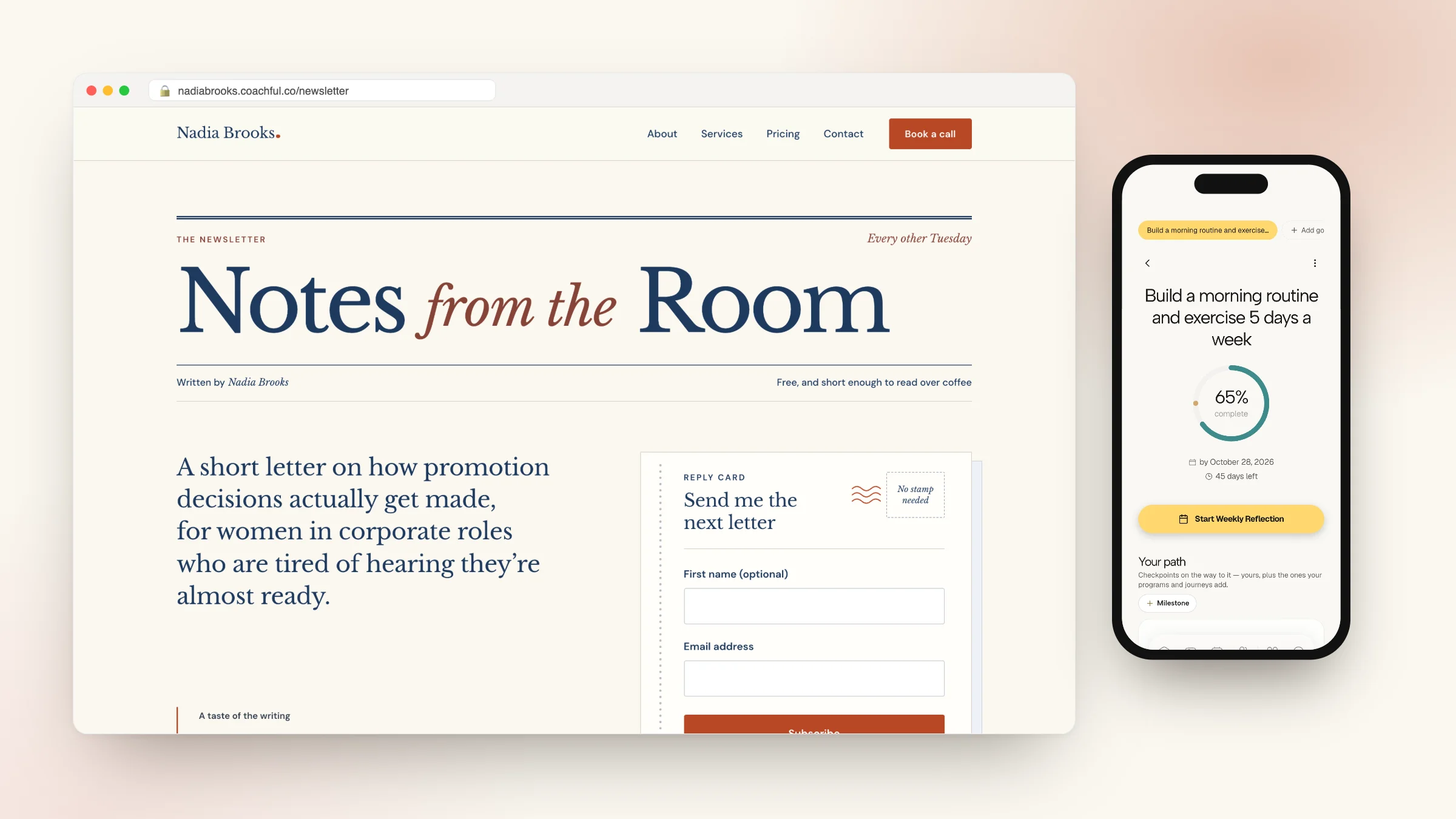
- Goals with milestones for the informational interview sprint and the 30-60-90 day plan, on the client's phone.
- Session types for mock interviews and negotiation rehearsals, with a worksheet required before the session so the client arrives prepared.
- Group programs for career-change cohorts, with a cohort feed and chat for sprint counts and story feedback.
- Session notes and a running summary the client can read, so the plan survives between calls.


The Coachful page for career coaches shows the full setup. For a longer engagement plan, see how to create a career coaching program, and for the questions behind these activities, 24 career coaching questions to ask clients.
Get your career coaching website built for free
Coachful's team builds coaching websites, offer pages and funnels for free on every plan, inside your account. Coachful itself is a paid subscription, and you can start with a free trial. On the Website page, click Fill in a form on the "Want us to build it for you?" card, or choose We'll build it for you · FREE under Create. Say which pages you want (a CV review page, an interview prep package, a booking page) and what visitors should do next, and add up to 8 links and 10 files. The team replies by email, usually within about 24 hours, and nothing gets invented. See everything the free build covers.


The bottom line
Run career coaching activities in the order the client's decision needs them. Start with evidence from their own history (the energy map and skills inventory), widen the options (interest profiler, three futures), decide what matters (the scorecard), then build the search through people (weak ties and informational interviews) and prepare for the moments that decide it (STAR stories, mock interviews, negotiation). Close with a 30-60-90 day plan, so the coaching carries into the new job. Our guide to what career coaching is covers the engagement around these, and the benefits of a career coach explains what clients can expect.
Frequently asked questions
What activities do career coaches use with clients?
Common career coaching activities include an energy or career history map, a transferable skills inventory, an interest assessment debrief, a next-job scorecard, network mapping, informational interviews, a STAR story bank, mock interviews, negotiation rehearsal and a 30-60-90 day plan for the new role.
What is a good first career coaching activity?
The job-by-job energy map works well first, because it uses the client's own history rather than a test result. It shows which tasks energize and drain them, which gives every later activity something concrete to build on.
Can I run career coaching activities in a group?
Yes. The energy map, skills inventory, three futures, network map and STAR story bank all work in groups, with individual work followed by pairs. Mock interviews and negotiation rehearsals work well in trios, with one person scoring.
Are free career assessments good enough for coaching?
For starting a conversation, often yes. The O*NET Interest Profiler from the U.S. Department of Labor is free and well documented. Treat any assessment as a prompt for discussion, not a verdict, and be trained in any paid psychometric tool before you interpret it.
How many sessions does a career change take?
It varies widely. A focused job search might use six to eight sessions over a few months; a full career change often takes longer because it includes research, testing and skill-building. Plan the activities in stages and review progress at the midpoint.
How do I track a client's job applications between sessions?
A shared tracker beats a spreadsheet the client forgets to send. In Coachful, the Career Coaching power-up gives each client a private tracker for connections, applications, interviews, LinkedIn content and CV, with reminders before interviews and when follow-ups are due.
Will Coachful build my career coaching website for free?
Yes. Coachful's team builds coaching websites, offer pages and funnels for free on every plan, inside your account. Fill in the request form from the Website page or Create, and the team replies with next steps, usually within about 24 hours. Coachful is a paid subscription; the build costs nothing extra.












