
9 Benefits of a Career Coach, According to the Research
The biggest benefits of a career coach are a clearer decision about what you want next, less stress while you make it, and a job search with real structure: targeted applications, rehearsed interviews, a network you actually use and a plan for the offer. Research on career coaching and job search programs supports the decision and search benefits best, and shows they work when skill-building is combined with confidence and motivation. A coach won't find you a job, but can make every part of finding one work better.
Below are nine benefits, what each looks like in practice and how to make sure you get it. If you're still deciding whether to hire one, our guides to whether a career coach is worth it and the signs you need a career coach cover the decision itself.
The benefits of a career coach at a glance
| # | Benefit | Evidence |
|---|---|---|
| 1 | A clearer answer to "what next?" | Randomized trial: more career choice certainty |
| 2 | Less stress while you decide | Same trial: lower career decision-making stress |
| 3 | A search with structure | Meta-analysis of 47 job search programs: 2.67 times the odds of employment |
| 4 | Belief that you can do it | Job search self-efficacy explained part of programs' effect |
| 5 | Applications that get read | Self-presentation was an effective program ingredient |
| 6 | Interviews you've already rehearsed | Practice-based; part of self-presentation training |
| 7 | A network you actually use | Large randomized study: moderately weak ties drive job moves |
| 8 | A better-prepared negotiation | Practice-based |
| 9 | A skill for every future move | Context: people change jobs many times over a career |
1. A clearer answer to "what next?"
The hardest part of a career change is often the decision, not the search. In a randomized waitlist-controlled trial, medical master's students who received five individual career coaching sessions over eight months became more certain of their career choice, and more of them changed their choice compared with the waiting group (Fris and colleagues, 2025). Some of that is a coach helping you test assumptions you'd never questioned.
What it looks like: an operations manager who "might want to do product" runs three informational interviews and a small side project, and either commits or rules it out within six weeks, rather than wondering for another year.
How to get it: ask a prospective coach how they help clients decide, not only how they help them apply. Good answers involve your history, your values and small real-world tests.
2. Less stress while you decide
The same trial found coaching reduced career decision-making stress, a small to moderate effect, partly by increasing students' confidence in their ability to make career decisions. That's worth a lot if you're lying awake over whether to leave.
What it looks like: the decision moves from a loop in your head to a list on paper, with a date to decide by and the information you still need.
How to get it: tell your coach what's at stake for you (money, identity, family) so the plan accounts for it. If the stress has become anxiety or low mood that affects daily life, talk to a doctor or a licensed therapist alongside or before coaching.
3. A search with structure
Job searching alone tends to drift into sending applications into the void. Structured help changes the odds. A meta-analysis of 47 job search interventions found the odds of finding work were 2.67 times higher for participants than for controls, and the programs that worked combined skill-building (job search skills, self-presentation) with motivation (self-efficacy, proactivity, goal setting and social support) (Liu, Huang and Wang, 2014). Those programs weren't all called coaching, but a good career coach uses the same ingredients.
A separate study of 205 transitioning US veterans with service-connected disabilities found that being assigned to a career coaching program was the single best predictor of getting a job over two years (Bond and colleagues, 2025).
What it looks like: a weekly target (for example, five tailored applications and three conversations), a tracker, and a session every week or two to review what's working.
How to get it: agree weekly activity goals with your coach, and report honestly, including the weeks you did nothing.
4. Belief that you can do it
In the same meta-analysis, part of why job search programs worked was that they raised participants' job search self-efficacy, their confidence that they could carry out the search. After months of rejections, that confidence is often the first thing to go.
What it looks like: you stop hesitating before applying to roles that are a stretch, because you've seen evidence that your experience translates.
How to get it: keep a record of small wins (replies, interviews, good conversations) and review it in sessions. Confidence grows faster from evidence than from reassurance.

5. Applications that get read
Self-presentation was one of the ingredients that made job search programs more effective. In practice, that means a CV that leads with results, a LinkedIn profile that says what you want next, and cover letters written for the role rather than recycled.
What it looks like: a teacher moving into instructional design rewrites her CV around three projects with outcomes, instead of a list of duties, and starts getting replies.
How to get it: bring two or three real job ads to your coach and tailor your materials to them, rather than polishing a generic CV.
6. Interviews you've already rehearsed
Most people walk into interviews having thought about their answers but never said them out loud. A coach runs mock interviews, gives specific feedback and helps you build a small bank of true stories you can adapt to most behavioral questions.
What it looks like: the "tell me about a time you failed" question stops being a freeze and becomes a two-minute story with a clear lesson.
How to get it: ask for at least one full mock interview before your first real one, ideally on video, since many first interviews are online. Our guide to interview coaching explains what a good session includes.
7. A network you actually use
A large set of randomized experiments on LinkedIn's connection suggestions, covering more than 20 million people over five years, found that weaker ties helped people move jobs more than close ones, up to a point: moderately weak ties created the most job mobility (Rajkumar and colleagues, 2022). In other words, former colleagues and acquaintances often matter more than your best friends.
What it looks like: your coach helps you list 25 people you've worked with or met, choose five to contact, and write a short, specific ask for each.
How to get it: expect your coach to ask who you've talked to this week, not only what you've applied for.
8. A better-prepared negotiation
Many people accept the first number because negotiating feels risky. A coach can help you research the range for the role, decide your number and your walk-away point, and rehearse what you'll say if they push back or go quiet.
What it looks like: you answer "what are your salary expectations?" with a researched range and a reason, and ask about the whole package, not just base pay.
How to get it: bring the offer to your coach before you reply, and rehearse the conversation at least once.
9. A skill for every future move
You'll probably do this again. US Bureau of Labor Statistics data on people born between 1957 and 1964 found they held an average of 12.9 jobs from age 18 to 58 (BLS, 2025). A good coach teaches you how to decide, search and negotiate, so the next move is faster, and the coaching often continues into the first months of the new role, when early habits get set.
What it looks like: you leave coaching with a 30-60-90 day plan for the new job and a method you can reuse in three years.
How to get it: ask your coach to close the engagement with a plan for the new role, not just a celebration of the offer.
What a career coach won't do
- Get you hired. A coach can't place you in a job or guarantee an offer. Recruiters fill roles for employers; career coaches work for you.
- Replace counseling or therapy. If career stress has turned into anxiety or depression, see a licensed professional.
- Do the search for you. The benefits above depend on what you do between sessions.
If cost is a barrier, the US has about 2,300 public American Job Centers offering job search assistance; services and eligibility vary by state. Our comparison of career coaches, counselors and recruiters explains who does what.
What a career coach costs
Coachful's 2026 Coaching Business Report puts career coaching at $100 to $250 an hour in US dollars (PayScale and practitioner reports), with newer coaches at $75 to $150 and experienced ones at $150 to $300. A verified sample of published career coach rates runs from $99 to $280 a session. Many coaches sell packages, such as a CV and LinkedIn review or six sessions over three months. More detail is on coachingrates.com and in our guide to what career coaches charge.
Find a career coach on Coachful
Coachful's Find a Coach directory is public, so you can browse it without signing up. Search for "career change", "interview" or your field, or start in the Business or Tech & Skills categories. The Find My Coach quiz asks what you want to improve, where you are now, your preferred style and your monthly budget, then suggests coaches. Profiles show each coach's background and programs, with a way to book a discovery call or send a message. Our guide on how to find a career coach lists the questions to ask.


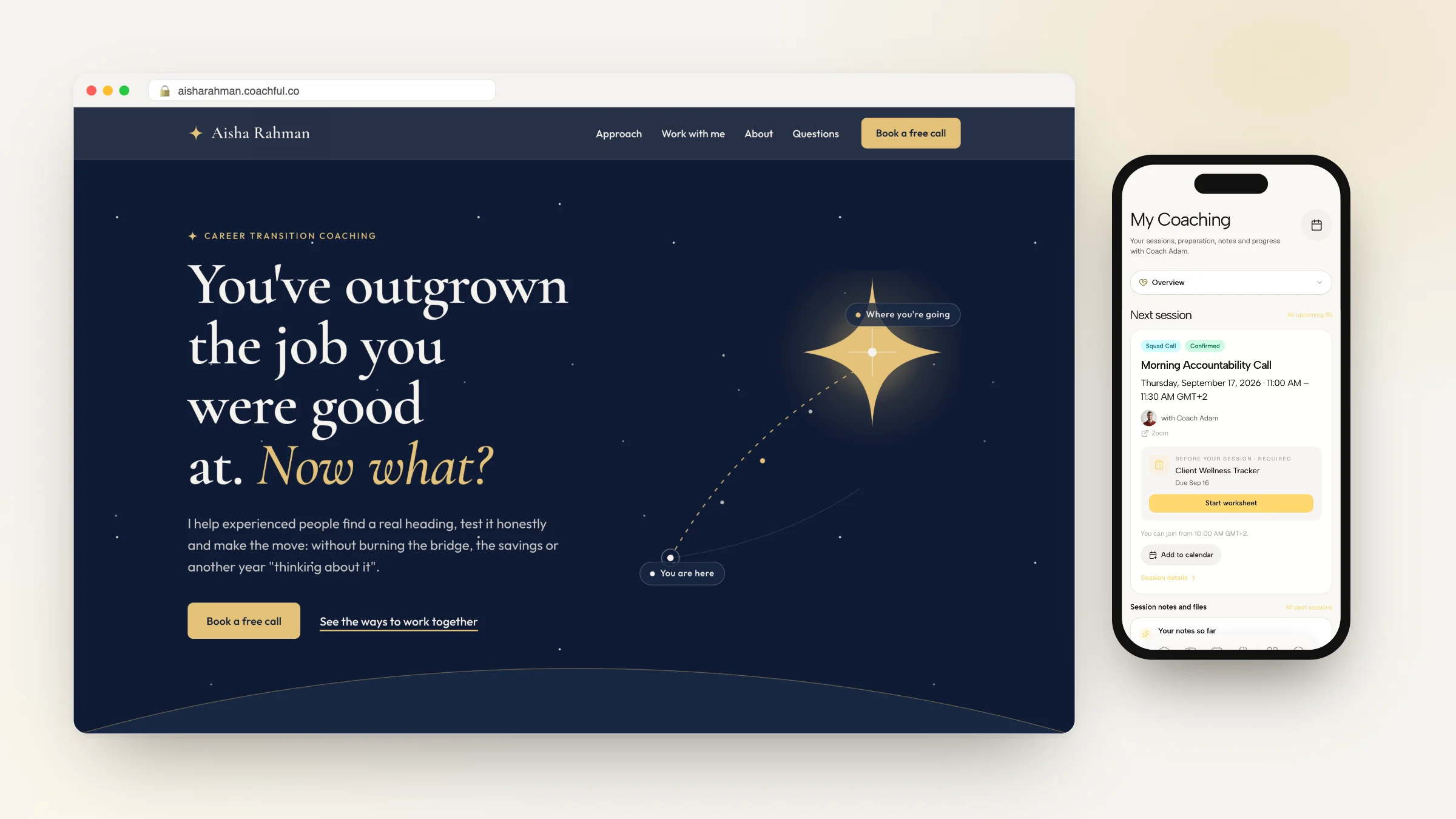
When your coach runs their practice on Coachful, your sessions, notes, preparation and next steps sit in one place, and career coaches can give each client a private tracker for applications, interviews, networking and CV versions.


Are you a career coach?
Our guide to becoming a career coach covers training and first clients, and our list of career coaching activities has twelve you can run this week. The Coachful page for career coaches shows the platform, and Coachful's team will build your coaching website for free through the white-glove service.

The bottom line
A career coach is most useful at two moments: when you can't decide what you want, and when your search isn't working. The research supports both, with clearer, less stressful decisions in a randomized trial and much better odds of employment in structured job search programs that combine skills with confidence and motivation. You get those benefits by choosing a coach who works on the decision and the search together, setting weekly goals, practicing interviews and negotiations out loud, and using your network rather than just the job boards.
Frequently asked questions
What are the benefits of a career coach?
A clearer career decision with less stress, a structured job search, more confidence, stronger applications, rehearsed interviews, better use of your network and a prepared negotiation. Research on career coaching and job search programs supports the decision and search benefits most strongly.
Is a career coach worth the money?
Often, if you're stuck on a decision or your search isn't producing interviews or offers, and you'll do the work between sessions. Compare the cost with a few weeks of the salary difference you're aiming for. Our guide to whether a career coach is worth it goes through the math.
Can a career coach help me find a job?
A career coach helps you find a job yourself: they improve your decision, applications, interviews, networking and negotiation. They don't place you in roles. Recruiters do that, and they work for the employer.
How many sessions with a career coach do I need?
A focused job search often takes six to eight sessions over two or three months. A full career change usually takes longer because it includes research and testing. In one randomized trial, five sessions over eight months improved students' career decisions.
What is the difference between a career coach and a career counselor?
Career counselors often hold a counseling degree, some are licensed, and many work in schools and public services, sometimes using formal assessments. Career coaches are usually unlicensed and focus on decisions, search strategy and performance. Both can help; check training and approach.
When should I hire a career coach?
When you've been stuck on a decision for months, when applications aren't producing interviews, when interviews aren't producing offers, or when you have an offer to negotiate. Hiring earlier in a search usually helps more than hiring after months of rejection.
Can I get free career coaching?
Some options are free or low cost: university career services for students and alumni, and about 2,300 public American Job Centers in the US offering job search assistance. Services vary, so check what your local center offers.












